Scientists find genetic link between Attila’s Huns and Xiongnu empire that fought Han China

Modern Turks are just a bunch of Turkified Greeks who have little to nothing to do with the real Turks. Of course, such modern Turks refuse to admit this and will use cultural heritage as an excuse. In fact, our history records that the Turkic people were a people who valued blood, especially male lineage, and they were not a cultural heritage, because it is impossible for a culture to be born on the steppe.
Better to say the clash site of two major civilizations, Iranian and Greeks.
 
100%. They have no connection to the Asian steppe.
The soldiers and elites married/raped the local women and were assimilated, that's why in Russia, Central Asia and Eastern Europe, you can see Mongol admixture. The modern Turks are simply Greeks/Italians who submitted to Turko-Mongol culture and claimed it as their own. Turco-mongols eventhough genetically related to us are our sworn enemies for millenias, and the Han People managed to destroy them multiple times to ensure the survival of the Chinese Civilization. Their culture is very different from ours, we treasure literature, they treasure violence.
 
Modern Turks are just a bunch of Turkified Greeks who have little to nothing to do with the real Turks.

And before that, 'Greekified' (Hellenized) Anatolians. I guess they were even Celtic at some point.
 
Hahahah, that's funny as shit, the East Asian genetic admixture is pretty dilluted in Turkey, they are mostly Mid Eastern and Greeks.

The Central Asian Turkic admixture in Turks is 10% to 50% depending on the region. "Turkic" itself isn't pure East Asian, but a mix of ancient Iranic and proto-Turkic ancestry.

1741229207925.png
 
Last edited:
Why are you so obsessed with genetics and lineage ?

You don't like facts that are backed by scientific evidence and experimental data as proof? Or do you prefer to trust the results of divination by temple monks?
 
Why are you so obsessed with genetics and lineage ?

Anything wrong with being interested in genetics? It's a fascinating topic, especially now that scientists are able to dig up old human remains and analyze ancient DNA with technology/techniques that didn't exist a decade ago. I have noticed many Pakistanis are kind of 'touchy' about genetics related discussion, don't understand why.
 
Last edited:
You don't like facts that are backed by scientific evidence and experimental data as proof? Or do you prefer to trust the results of divination by temple monks?
Anything wrong with being interested in genetics? It's a fascinating topic, especially now that scientists are able to dig up old human remains and analyze ancient DNA with technology/techniques that didn't exist a decade ago. I have noticed many Pakistanis are kind of 'touchy' about genetics related discussion, don't understand why.
Nothing wrong with scholarly interest in genetics but putting down the entire nation is not a desirable trait
 
putting down the entire nation is not a desirable trait

I had no intention to put anyone down, just a personal observation. Regardless, this thread is all about genetics, I suppose anyone visiting this thread or posting here has some interest in population genetics, and I hope my post helps dispel some wrong ideas.
 
The Central Asian Turkic admixture in Turks is 10% to 50% depending on the region. "Turkic" itself isn't pure East Asian, but a mix of ancient Iranic and proto-Turkic ancestry.

View attachment 105808
Turkic peoples are not East Asians, but Huns are East Asians.

According to the <Sui-shu>, the ancestral Ashina tribe of the Turkic peoples was a branch of the Miscellaneous Hu Frustration Clan, which was located to the north of the Huns people(Located in what is now Mongolia).

The Frustrated Qu Clan was once a subordinate hu tribe under the rule of the King of Xiongnu, but was not of Xiongnu ethnicity. During the Northern Wei Dynasty, the Frustrated Qu Clan established a small state called the “Northern Liang State”. In 439 AD, the Northern Wei Emperor Tuoba To personally led an army to destroy the Northern Liang State. The Ashina family and about 500 other Frustrated Qu families fled to the Altai Mountains.

In 552 A.D., the Ashkenazi family annihilated the Zoran Khanate and established the Turkic Khanate, which is the origin of the Turkic people.


As for the Huns, the royal ancestor of the Huns was Chun Wei, a descendant of a Chinese minister of the Xia Dynasty. After the Shang Dynasty destroyed the Xia Dynasty, Chun Wei led his family to flee to the steppe, forming the earliest Xiongnu community and royal family. After that, the nomadic tribes that were defeated and destroyed by the successive Chinese imperial dynasties, such as the Shanrong, the long-snouted tribes, the Meat Porridge, the Gifang, the Mianyi, the Cunning and so on, were successively annexed by the Xiongnu royal family to form the final Xiongnu community. It is true that the Xiongnu royal family had Han Chinese blood, but that was thousands of years ago. So the Huns were a large collection of East Asian steppe peoples. It was East Asian, but not representative of East Asian Confucian culture.
 
Nothing wrong with scholarly interest in genetics but putting down the entire nation is not a desirable trait
We are not demeaning anyone, we just resent you calling our thousand year old mortal enemy our brother. Ask the Irish if they would consider the English to be brothers. Ask the Koreans if they think the Japanese are brothers. We are not demeaning other peoples, rather it is your comments that offend us.
 
Turkic peoples are not East Asians, but Huns are East Asians.

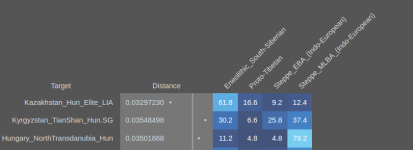
It appears the Huns had a very diverse genetic profile, varying with geography and time. They weren't one monolithic group genetically. I guess the same would hold for Xiongnu, though to a lesser extent perhaps.

1741234710556.png
 
It appears the Huns had a very diverse genetic profile, varying with geography and time. They weren't one monolithic group genetically. I guess the same would hold for Xiongnu, though to a lesser extent perhaps.

View attachment 105822

The Han Chinese controlled the Great Wall and blocked trade and intelligence from the steppe peoples. That caused the steppe peoples of East Asia to lack salt, tea (to supplement vitamin C and avoid sepsis), metalwork, and almost all other necessities of life. Also, the Han Chinese often used the Great Wall to cover up army movements and frequently attacked the unsuspecting steppe peoples. This led to the extremely poor living conditions of the steppe peoples. 1949 China's first census, the life expectancy of the nomadic herders on the Mongolian steppe at that time was only 19.8 years old. It can be seen that the life expectancy of nomads in ancient times was only shorter.
It was difficult enough to keep the tribe alive in such a harsh environment. Apart from the Hun royal family, it was impossible for other Hun nomads to maintain the integrity and purity of their bloodline.

In general, the royal court of the Huns was in the Loop region of China. In the third century B.C., the first complete and unified Han empire (the Qin dynasty) was about to emerge and made no secret of its hostility to the steppes. And at that time almost all of the East Asian steppe tribes chose to join the king of the Xiongnu in order to cope with the Han people that was about to enter the age of empire. This is the original story of the Han people and his thousand year old mortal enemy.

Whereas the royal Ashina family of the Turkic people came from the Outer Mongolian steppe, the Turkic tribes were a collection of nomadic people from the Altai Mountains. So it was a Central and North Asian nation, not an East Asian nation.
 
Last edited:
The Central Asian Turkic admixture in Turks is 10% to 50% depending on the region. "Turkic" itself isn't pure East Asian, but a mix of ancient Iranic and proto-Turkic ancestry.

View attachment 105808
Exactly, Turkmen would be most East Asian genetics. Turkmenistan is the homeland of the Turks, and they look like Mongols mixed with Iranians.
 
The Han Chinese controlled the Great Wall and blocked trade and intelligence from the steppe peoples. That caused the steppe peoples of East Asia to lack salt, tea (to supplement vitamin C and avoid sepsis), metalwork, and almost all other necessities of life. Also, the Han Chinese often used the Great Wall to cover up army movements and frequently attacked the unsuspecting steppe peoples. This led to the extremely poor living conditions of the steppe peoples. 1949 China's first census, the life expectancy of the nomadic herders on the Mongolian steppe at that time was only 19.8 years old. It can be seen that the life expectancy of nomads in ancient times was only shorter.
It was difficult enough to keep the tribe alive in such a harsh environment. Apart from the Hun royal family, it was impossible for other Hun nomads to maintain the integrity and purity of their bloodline.

In general, the royal court of the Huns was in the Loop region of China. In the third century B.C., the first complete and unified Han empire (the Qin dynasty) was about to emerge and made no secret of its hostility to the steppes. And at that time almost all of the East Asian steppe tribes chose to join the king of the Xiongnu in order to cope with the Han people that was about to enter the age of empire. This is the original story of the Han people and his thousand year old mortal enemy.

Whereas the royal Ashina family of the Turkic people came from the Outer Mongolian steppe, the Turkic tribes were a collection of nomadic people from the Altai Mountains. So it was a Central and North Asian nation, not an East Asian nation.
The Huns and Mongolians do share a genetic ancestry with us. Culturally they aren't East Asian but genetically speaking Mongolians and Chinese are North Asiatic from the Siberian region who moved to the Yellow River region and began to have civilization.
 

Users who are viewing this thread

Pakistan Defence Latest

Back
Top