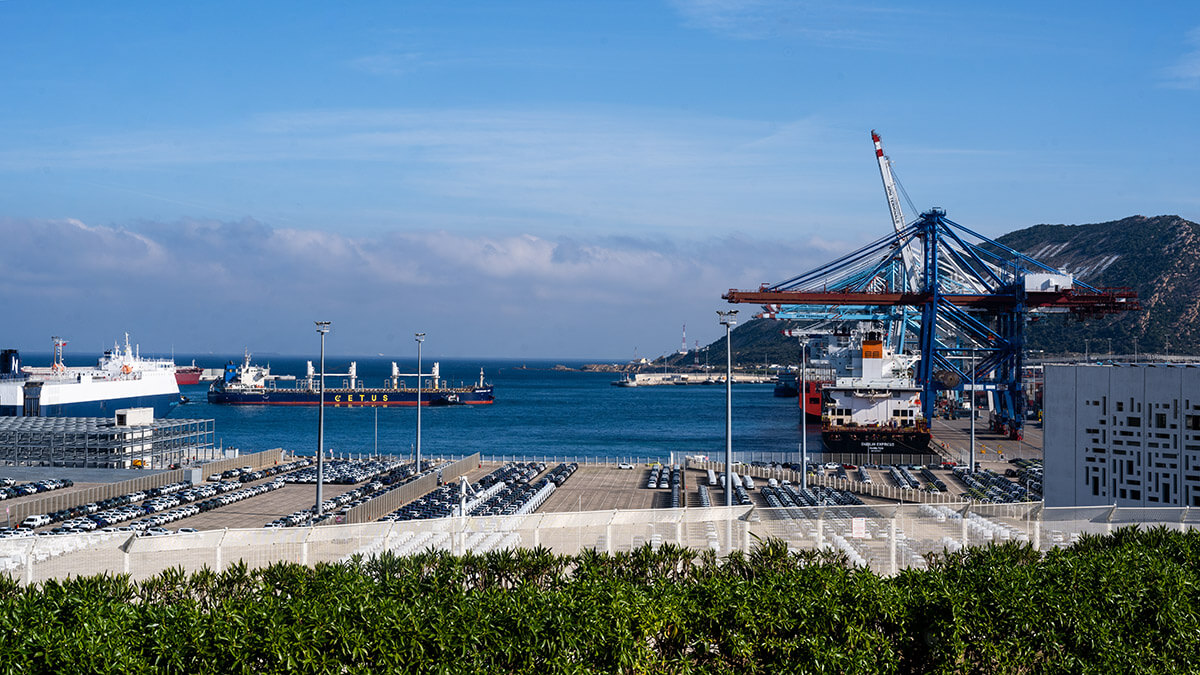
Trade flows between the two nations reached 59.81 billion dollars in the first seven months of this year

www.atalayar.com
Morocco and China break trade records in 2025
Trade flows between the two nations reached 59.81 billion dollars in the first seven months of this year
Trade between Morocco and China reached a record 59.81 billion dollars in the first seven months of 2025, a record figure in terms of economic cooperation between the North African and Asian countries.
This level of trade represents a 19.1% increase over the same period last year. It is an exponential increase that reflects the boom in economic cooperation between the two nations, which are considered allies.
These data come from the latest report presented by the General Administration of Customs of China (GACC).
China is establishing itself as a very important trading partner for Morocco at a crucial moment on the international stage, which is being rapidly reconfigured with the rise in power of nations such as China itself. This situation is redrawing the international map, which in previous years was marked by the political and economic dominance of the United States.
The increase in trade between China and Morocco was mainly driven by Chinese exports to the Moroccan market, reaching 52.9 billion dollars in the first seven months of 2025, 20.4% more than in the same period in 2024.
The main products that have reached the Moroccan market from China are those related to high technology, such as mobile phones and vehicles, which highlights Morocco's dependence on Chinese production in this area. It is worth noting that the supply of spare parts from China for the automotive sector alone reached 1.16 billion dollars.
Moroccan exports to China are significantly lower, but they also grew. They reached 6.91 billion dollars in the first seven months of 2025, which is 10.1% more than in the same period in 2024. These figures show a trade balance in favour of China in relation to Morocco of 45.99 billion dollars.
Morocco is making history with a massive $5.6 billion investment from China to build Africa’s first-ever battery gigafactory. This project isn't just

www.leravi.org
China invests $5.6 billion in Morocco to build Africa’s first of its kind
By
Greta Taubert
September 14, 2025
Morocco is making history with a massive
$5.6 billion investment from
China to build Africa’s first-ever
battery gigafactory. This project isn’t just about construction; it’s a symbol of a new era where Africa and China are joining forces to transform the continent’s role in the global energy and automotive sectors.
This huge step forward signals
Morocco’s strategic rise as a key player in the worldwide clean energy race. With the gigafactory set to deliver cutting-edge technology, it’s a win for both innovation and economic development. What does this partnership mean for Morocco, China, and Africa’s future?
How Morocco positions itself in the global energy revolution
After previously partnering with
France, Morocco is now deepening its ties with China through an ambitious project to build the continent’s first
battery gigafactory. Located in Kenitra, in northwest Morocco, this facility marks a major milestone for Africa’s role in the energy transition.
The Chinese company Gotion High-Tech will lead the effort, with production starting as early as the third quarter of 2026. The first phase aims for a capacity of 20 gigawatt-hours (GWh) per year, enough to supply thousands of electric vehicles, and the final goal is to ramp up to an astonishing 100 GWh.
With a total projected investment of around
$6.5 billion (equivalent to $5.6 billion in euros), this is one of the largest industrial projects ever seen on the continent. The initial phase alone involves a $1.3 billion investment and is expected to generate approximately 17,000 jobs, both direct and indirect. This huge economic boost can hardly be overstated in a country eager to diversify its industry.
What makes the project unique beyond battery assembly
The gigafactory isn’t just about putting cells together. It will also produce critical
electrode materials such as cathodes and anodes, which adds a powerful layer of security over the supply chain. This integration means Morocco won’t have to rely entirely on imports, giving it a leg up in
cost competitiveness and regional autonomy.
Approximately 85% of the batteries made here will be exported to the European Union, helping cut down the reliance on Asian markets and shortening supply lines for the auto industry. Morocco’s role is evolving from a simple assembly hub to a major
manufacturing powerhouse, servicing one of the world’s largest markets.
The project’s roadmap lays out a modular growth plan, starting with the first stage in 2026 and expanding as new contracts are secured and financing is finalized. This flexibility is important in the fast-changing
energy sector, allowing for adaptation while maintaining ambitious long-term goals.
The economic and geopolitical significance for Morocco
For Morocco, this is more than an industrial project; it’s a statement of geopolitical strategy. Sitting at the crossroads of Africa and Europe, Morocco is leveraging its strategic location and existing trade agreements to position itself as a foothold for innovation and manufacturing.
This gigafactory aligns perfectly with Morocco’s goal to retain skilled talent and enhance its expertise in a high-tech industry that already leads its export market. By developing this facility, the nation reduces its economic dependence on agriculture and textiles, diversifying into more sustainable, future-proof industries.
This move also strengthens Morocco’s commercial ties with the EU and opens doors for closer economic interactions with the U.S., promoting the country as a reliable partner in the green transition.
How China is deepening its presence in Moroccan industry
China isn’t new to Morocco’s industrial landscape, but this $5.6 billion project represents a big leap. Several other Chinese companies, including BTR, CNGR, Hailiang, and Shinzoom, are also investing heavily in battery production in Morocco.
The timing couldn’t be better, with Europe preparing to shift to zero-emission vehicles by 2035. Morocco’s ambitions to attract more large-scale projects are clear, especially as the battery market booms globally. This partnership highlights how African countries can become pivotal players in the new clean energy economy with the right international cooperation.
From a personal perspective, I find it exciting how this gigafactory symbolizes a real global partnership rooted in tangible benefits like jobs, technology transfer, and industrial diversification. It’s a reminder that progress is often built on collaboration, vision, and seizing historic opportunities.
What do you think about this growing relationship between Africa and China? Could Morocco become a model for other African countries aiming to harness their resources for sustainable development? Share your thoughts and let’s get the conversation started!