See, the Iranians have national and Russian OTH radars. OTH radars are not beeps on the screen, but waves of anomalies, which require interpretation and further investigation. An airplane, or other means, causes anomalies in the waves, which require investigation. A civilian aircraft causes the same anomalies, so you will know that there is something causing oscillations in the waves, but you don't know what? To investigate more deeply, you have to move something around the wave anomaly.
Here in Brazil, that's how we caught the German research ship in the south and put an end to the games of the English Typhoons, based in the Falklands. – For those who don't know the event, the English Typhoons did aerial refueling exercises and reached the southern coast of Brazil and the Cindacta II system (Curitiba) detected the incursion and activated Canoas for the F-5s to investigate. Because the range of the English “normal” radars was deeper, when they noticed the F-5s, they turned around and disappeared from our screens, until the IACIT (Brazilian Strategic Defense Company, leader in Air and Maritime Traffic Control, Defense and Public Security technologies) personnel in Albardão, mentioned the wave anomalies to the Brazilian Navy (MB) personnel and how they occurred – location, area, speed and degree of interference.
The MB personnel, when cross-referencing information with the FAB (Brazilian Air Force) personnel, noticed the dates of the occurrences, which coincided between the Cindacta radar interference and the wave anomalies. They set up an “ambush” – not detailed how – for the Typhoons and after the “scare” for the English, they never happened again. This was commented on in an interview on the Fox 3 Kill podcast channel by a FAB Colonel.
So the Iranians could have detected it, but what? Just getting closer to check the anomaly. This entire system appears to have been destroyed by Israel, both in the attacks in October 2024 as retaliation for the Iranian attacks on October 1, 2024, and since June 13, 2025.
This is the early warning system.
Then comes the IADS layer, composed of command posts, radar stations, communications centers and support structures (mainly energy) spread throughout Iran. All of these assets are related to the enemy's ability to gain air superiority. Without these systems, they are compromised and ineffective, and the chances of friendly aircraft returning from missions increase.
IADS is not just SAM missiles and anti-aircraft artillery. C2 centers and sensors must be attacked first. Destroying a long-range surveillance radar can force the SAMs to turn on their radars for search, making them vulnerable to an anti-radar missile. This is what the USAF did on the first day of Kosovo with B-52s firing cruise missiles (CALCM) and F-117s equipped with laser-guided bombs against early warning radars, communications towers and command and control centers. The same was done on the first day of the Gulf War. They used the same formula of stealth and long-range attack.
After this phase, attacks on other enemy targets begin. This is the phase in which the suppression of enemy air defenses (SEAD) begins, with the destruction or neutralization of enemy SAM missiles and anti-aircraft artillery. The objective of SEAD is to reduce aircraft and pilot losses by reducing attrition among forces.
A modern air defense system is made up of a closely interconnected network of sensors and control units. It can be subdivided into four major categories: passive detection, active detection, weapons system, and control system. A survey of the enemy's positions, characteristics, and modes of operation is the first step in considering the possibility of a SEAD mission. From there, the available equipment must be verified and, finally, the tactics to be employed must be defined.
One of the first tasks of SEAD is to assemble a general picture of these enemy defenses. The general characteristics of ground-based air defenses are:
- They are finite and have flanks.
- They are oriented towards the enemy's possible attack routes. - They are rarely strong in depth and width at the same time.
- They are generally not very mobile or fixed.
- This formation suggests the possibility of flanking attacks, penetration and exploitation, or systematic attacks with destruction from front to back.
According to Western doctrine, enemy air defenses can be studied using the following parameters:
- Depth. Defenses are layered to provide early warning to gain time and enable multiple engagements.
- Density. If the enemy defends everything, he ends up spreading the defenses, which favors the attacker. The attacker has an advantage in concentrating forces.
- Technology. It makes it possible to increase depth and density qualitatively. The countermeasure is to use electronic warfare, stealth, and long-range weapons to reduce enemy technology.
Long-range SAMs generally defend strategic, fixed or slow-moving targets such as command posts, radar stations, power plants, refineries, air bases, land or ports. Tactical missiles have less range and sophistication and defend bridges, troops, and tactical command posts. They are highly mobile weapons but have a shorter range. They are also located in high locations and are the first place to look.
The primary objective of SEAD is to ensure the survival of friendly forces, with engagement time being the determining factor of the mission, while DEAD is to locate and destroy enemy air defenses, with target mobility being the determining factor.
SEAD focuses on suppressing the enemy's ability to engage and defend against "strike package" aircraft during ingress and egress against enemy SAM missiles and anti-aircraft artillery. The emphasis is on suppression because the objective is to inhibit the IADS from operating effectively, thus maintaining the operational and tactical integrity of friendly forces. DEAD may be a byproduct of SEAD, but it is not the final definition.
Note that the aircraft that performs SEAD (EA-18G Growler) flies in front of the "strike package" and therefore it is ideal that it has a significant air-to-air capability or an escort with this capability (F-22A Raptor or F-35A). It opens a safe path to the target and around the target. The difficult part is knowing that it is in the right area, using sensors correctly, and providing protection against threats on the ground and in the air. The aircraft flies in orbits at medium altitude with military power and high subsonic speed.
SEAD and CAP aircraft are the first to arrive and last to leave, and they protect each other. The wingman stays 1-3 miles away and not at the same altitude to avoid collision. If the enemy sees one, he can easily see the other in a horizontal sweep. The wingman also protects the other's rear, where 80% of victories in surprise attacks occur. The interceptors orbit 10 miles and monitor the "kill box" for BVR missiles.
The SEAD aircraft must also have good range (Growler has the ability to be re-targeted, as do the Raptor and the F-35A) because it is the first to enter the combat area and the last to leave.
Mission planning includes data on possible threats collected from other means, such as ELINT/SIGINT aircraft (RC-135 Rivet Joint), sniffing out any emissions in the rear, and including debriefing of attack aircraft.
In the Kosovo conflict, the USAF used 48 F-16CJ Block 50 and 30 EA-6B aircraft for suppression of defenses. The fighters were in the front of the attack package. Four aircraft covered 360 degrees, with one pair advancing and the other retreating. Each pair monitored 180 degrees. The fighters formed hunter-killer pairs with one aircraft detecting (EA-6B) and the other attacking targets with data being passed through the IDM datalink.
The Serbs dispersed their SAMs and controlled their emissions. They were difficult to find and attack, forcing allies to remain alert. This increased the size of the attack package, prevented certain targets from being attacked for some time and increased the need for SEAD support. It was estimated that there were 16 SA-3 Low Blow and 25 SA-6 Straight Flush fire control radars. The Serbs would emit for 20 seconds and then turn off the radars.
In Kosovo, pilots also flew at least 5 km away from roads or only crossed at 90 degrees to reduce exposure to anti-aircraft artillery, which preferred to stay close to the roads to increase mobility.
In Kosovo, DEAD was also carried out with F-16CG (Block 40) or F-15E armed with laser-guided bombs. The aircraft were located close to the REVO aircraft and were called in when the radars began to emit. They also used AGM-130 guided bombs fired by the F-15E and the JSOW launched by the F/A-18.
In the Kosovo conflict, 800 SAM missiles were fired in 78 days, 477 of which were SA-6s and 124 MANPADS (shoulder-fired missiles). These missiles shot down two aircraft (one F-117 and one F-16CJ). Another F-117 was damaged and another 2 A-10s were damaged by anti-aircraft artillery. Another two A-10s were hit by MANPADS, one of which was damaged and the other did not explode.
NATO fighters fired 743 HARM missiles, 200 of which were preemptive strikes that were not detected by enemy radar. Only three of the 25 SA-6 missile batteries were destroyed. The Serbs knew how the Americans operated and were prepared, unlike the Iraqis who had no control over the use of their radars. The Serbian tactics led to the use of three times as much EA-6B protection as in the Gulf.
The F-16CJs of the Fighting Hawks squadron alone flew 1,071 sorties and fired 191 HARM missiles in 4,600 flight hours. The SEAD aircraft were used for escort or for geographical coverage in search of enemy radars.
The attack on Iran and what we know:
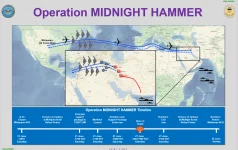
We know from the briefing and news reports that 7 B-2A Spirits were used, 125 aircraft were used, and over 75 precision guided munitions (MOP, TLAM, MALD, HARM) were used.
The operation included more than 125 US aircraft, "dozens" of aerial refueling tankers, a guided missile submarine and approximately 75 precision guided weapons.

breakingdefense.com
View attachment 131167
What must have happened?
Axios reported that the IAF conducted an initial DEAD campaign in the air corridor that the B-2A would fly over, which ensures coordination at the tactical-operational level between Israel and CENTCOM.
The operation marked the culmination of months of intense U.S.-Israeli coordination.

www.axios.com
With the Iranian IADS in the air corridor (it was reported that the selected route was through southern Iran) compromised, the Americans were left to carry out the rest of the attack, including the SEAD, first the SEAD (Growler) aircraft to suppress any air defense and sensors via electronic interference and CAP (F-22A/F-35A) with HARM missiles to fire preventive HARM missiles and escort the SEAD aircraft because they are stealthy and have superior air-to-air capability with BVR missiles. After clearing the air corridor and initiating the attack, the B-2A followed the SEAD/CAP aircraft until it reached Fordow and Natanz, with the attack package split into two different locations. I believe that each attack package was split to form this large formation of over a hundred aircraft supporting the attack against the Iranian nuclear facilities, so think about:
ELINT/SIGINT: RC-135U/V/W
AWACS: E-3B/G
SEAD: EA-18G
CAP: F-22A or F-35A
There was no way for the Iranian IADS to overpower this attack package. Iran would need to have interceptor and air superiority aircraft to have carried out missions against the SEAD/CAP aircraft, so even if Iran suffered losses in this aerial combat, the attack would be stopped, because the planners would not risk the B-2A flying over non-permissive territory.
Note that in any scenario, you need an aircraft capable of both checking the OTH radar anomaly that I mentioned at the beginning and carrying out the country's air defense against the attack package. In this way, there was no way for Iran to do anything other than absorb the blow or try to activate some (decently mobile) sensor to intercept some aircraft with the risk of having been attacked immediately because the HARM missiles were fired and they sniff out radar emissions, in addition to the constant jamming and electronic attack of the Growler, its air defenses could not even have successfully engaged the aircraft, because the jamming is precisely to suppress the IADS, so there was no way for Iran to respond adequately even if it still had some surviving OTH radar.
Without air force, Iran was on the receiving end of the attack and could do nothing. This is a huge learning experience for countries. Air defense is built with IADS (SAMs) and Air Force.
Impregnable defense systems being breached in this war were seen on all sides, including in other wars, Russia-Ukraine. Defensive systems were overwhelmed with a huge diversity of techniques including: speed, stealth, opportunism, surprise factor, overload, electronic warfare.