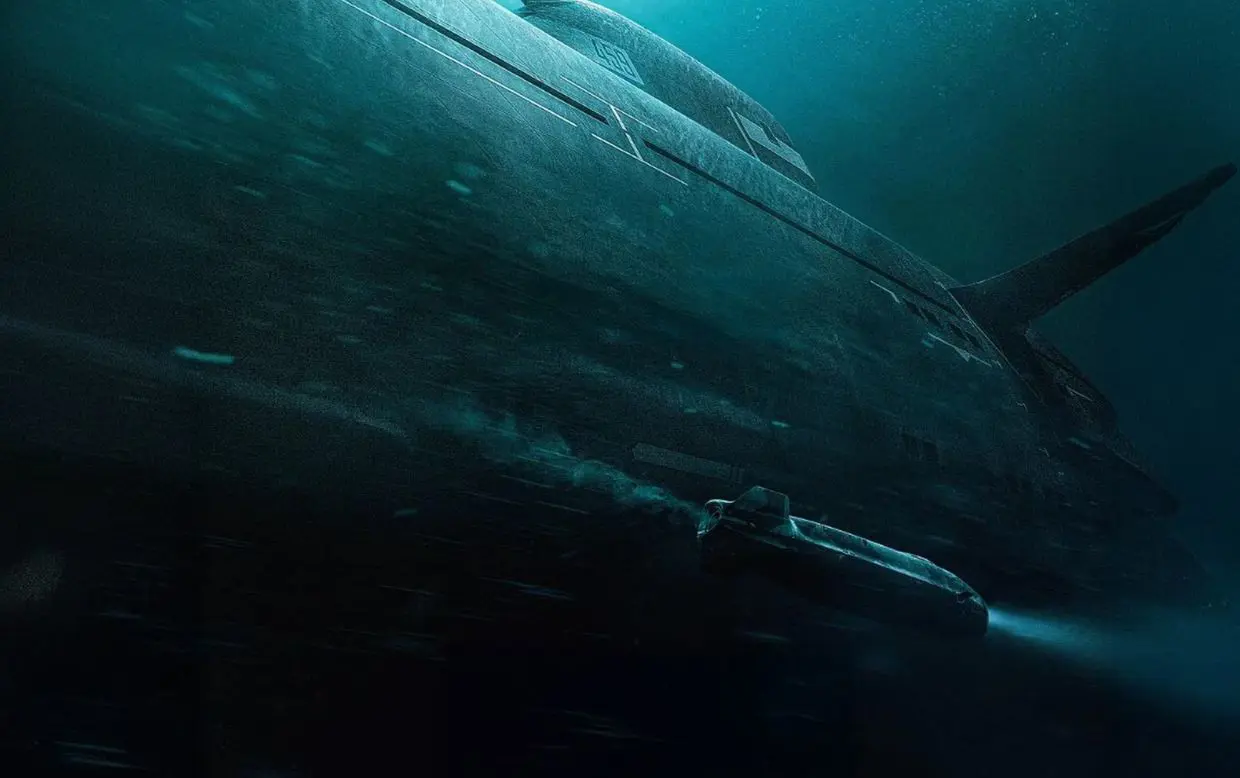
Chinese Naval Platform & PLAN discussions

Can they use some of these to try to find MH370 in the Indian Ocean ??

That would be a great achievement if these have cameras and finders
Considering Malaysia opened the search back up a few months ago, it opens up China to send these long endurance unmanned drones to search the Indian Ocean with nearly free reign.

If China can use this tech to actually find the wreckage it will be a huge boost for the PLAN in the eyes of the public; no matter where you go in the world, China will come, sparing no expense, and bring you back to your family, in one way or another, aka closure.

To view this content we will need your consent to set third party cookies.
For more detailed information, see our cookies page.


As the following video points out depths of 6000 meters means searching down there could push China to build ever more capable vehicles to be able to adequately search every nook and cranny.

To view this content we will need your consent to set third party cookies.
For more detailed information, see our cookies page.
 
Last edited:

BBC: China's huge navy is expanding at breakneck speed - will it rule the waves?​

Laura BickerChina correspondent
August 31 2025

Chinese shipyards, among the world's most productive, are giving the country a critcial edge in the oceans

"Socialism is good…" a pensioner warbles into a portable karaoke mic, slightly off-key and drowned out by her friends' chatter.

But they join her for the chorus: "The Communist Party guides China on the path to power and wealth!"

It is not the catchiest karaoke number. But it is an apt one to belt out as they look towards a horizon framed by cranes towering over ships of all sizes.

Suoyuwan park in Dalian, which juts out of north-eastern China into the Yellow Sea, has stunning views of one of China's largest shipyards, and is a place to gather and be merry.

But to White House analysts thousands of miles away in Washington, this cradle of Chinese shipbuilding is part of a growing threat.

In the last two decades, China has ramped up investment in shipbuilding. And that has paid off: more than 60% of the world's orders this year have gone to Chinese shipyards. Put simply, China is building more ships than any other country because it can do it faster than anyone else.

"The scale is extraordinary… in many ways eye-watering," says Nick Childs, a maritime expert with the London-based International Institute for Strategic Studies. "The Chinese shipbuilding capacity is something like 200 times overall that of the United States."

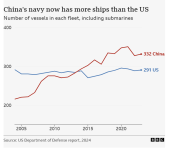
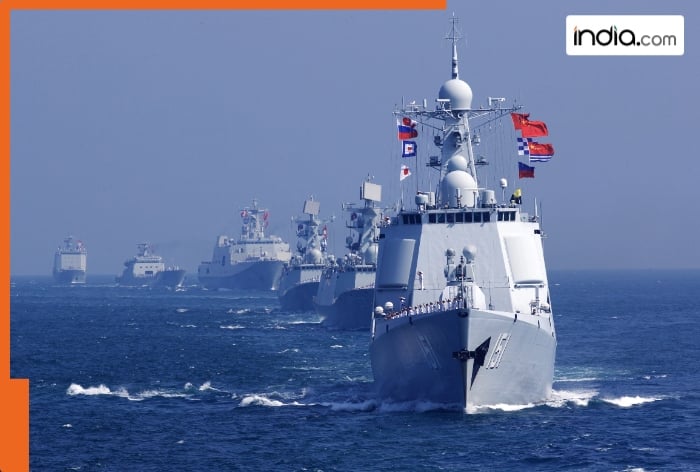
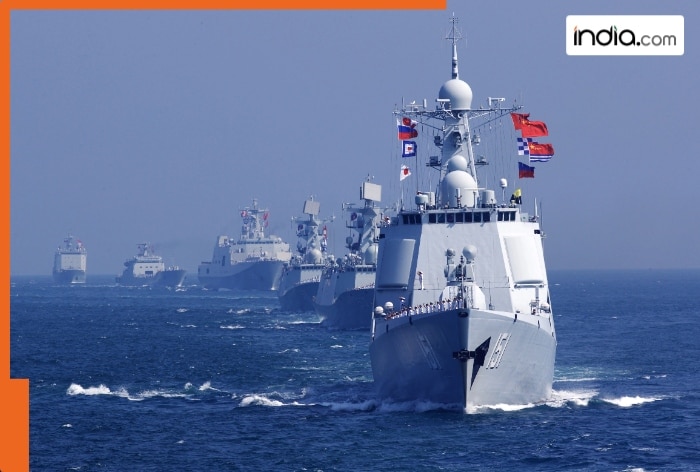
That commanding lead also applies to its navy. The Chinese Communist Party now has the world's largest, operating 234 warships compared to the US Navy's 219.

微信图片_20250901123857.png
China's explosive rise has been fuelled by the sea. The world's second-largest economy is home to seven of the world's 10 busiest ports, which are critical to global supply routes. And its coastal cities are thriving because of trade.

As Beijing's ambitions have grown, so has its arsenal of ships - and its confidence to stake a louder claim in the South China Sea and beyond.

President Xi Jinping's China certainly wants to rule the waves. Whether it will is the question.

A grand military parade in the coming days may reveal just how close it is to that goal. Xi will host Russian President Vladimir Putin and North Korea's leader Kim Jong Un for the event in a defiant message to the Western nations that have shunned them.

The US and its allies will be closely watching the photo-op and the display of military might, which is expected to include anti-ship missiles, hypersonic weapons and underwater drones.

"The US Navy, while it still has significant advantages, is seeing the gap in its capabilities with China narrow and is struggling to find a way of answering that," Mr Childs says, "because its shipbuilding capacity has dwindled significantly over the past decades."

US President Donald Trump has said he wants to fix this, and has signed an executive order to revitalise US shipbuilding and retake America's maritime advantage.

That, Mr Childs adds, will be a "very tall order".

A navy to end the 'bitter memories'​

Between 2019 and 2023, China's four largest shipyards - Dalian, Guangzhou, Jiangnan and Hudong-Zhonghua - produced 39 warships with a combined displacement of 550,000 tonnes, according to a study by the Center for Strategic and International Studies (CSIS).

That is the volume of water they displace, which is the most common way of measuring the size of a vessel or fleet. In comparison, the UK's Royal Navy currently has an estimated total displacement of around 399,000 tonnes.

While China has the world's largest navy by number of vessels, the US fleet has a greater overall tonnage and is more powerful - with far more large aircraft carriers.

But Beijing is catching up.

"There's no sign that the Chinese are slowing down," says Alexander Palmer from the CSIS and author of the report, Unpacking China's Naval Buildup.

"Hull count [number of ships] is not the only measure of a navy's effectiveness of course, but the ability to produce and churn out warships has been extremely impressive and could make a strategic difference."

e8011dd0-8623-11f0-9cf6-cbf3e73ce2b9.png.webp

There are still limits on China's naval rise. Beijing may have more ships, but it only has two operational aircraft carriers, and its navy has far fewer submarines than the US.

Some analysts argue they are also not as sophisticated as the American ones, which have a technological head start going back to the the Cold War.

The Chinese subs are also largely built for the shallower South China Sea, where a game of cat-and-mouse with the US is already under way. For now, China's ability to travel far from its own coastline is limited.

But there are signs this is changing, and fast.

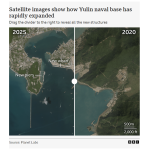
Satellite imagery obtained by BBC Verify from Hainan, a Chinese island province in the South China Sea, suggests Beijing is pouring significant funding into expanding its naval bases.

The base at Yulin has five new piers which appear to have been constructed in the last five years. It is thought China plans to base all of its largest submarines, the Jin-class (or Type 094), in this port. These new subs can carry 12 nuclear missiles each.

微信图片_20250901124211.png

Photographs and footage of rehearsals, shared on Chinese social media, suggest that at least two new types of unmanned underwater drones, which look like large torpedoes, will be among the new systems on show at next week's parade.

These could allow China to carry out surveillance deep underwater and detect other submarines or even undersea cables without risking its own naval forces.

Much of the technology is still "unproven and the timeline of its capabilities is still unclear", cautions Matthew Funaiole from CSIS's China Power Project. "The big question is how long will it take for the technology to mature."

And that's why the US cannot overlook the threat China's shipbuilding represents, he adds.

The country's vast naval buildup is being propelled by a party that is still reeling from the pains of the past - and is more than willing to channel them to buttress its message of loyalty, power and patriotism.

Holding a massive military parade to commemorate the victory over Japan, and the end of its brutal occupation, is testament to that.

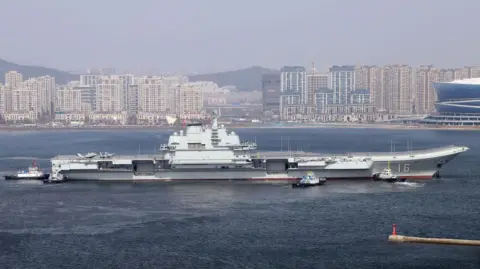
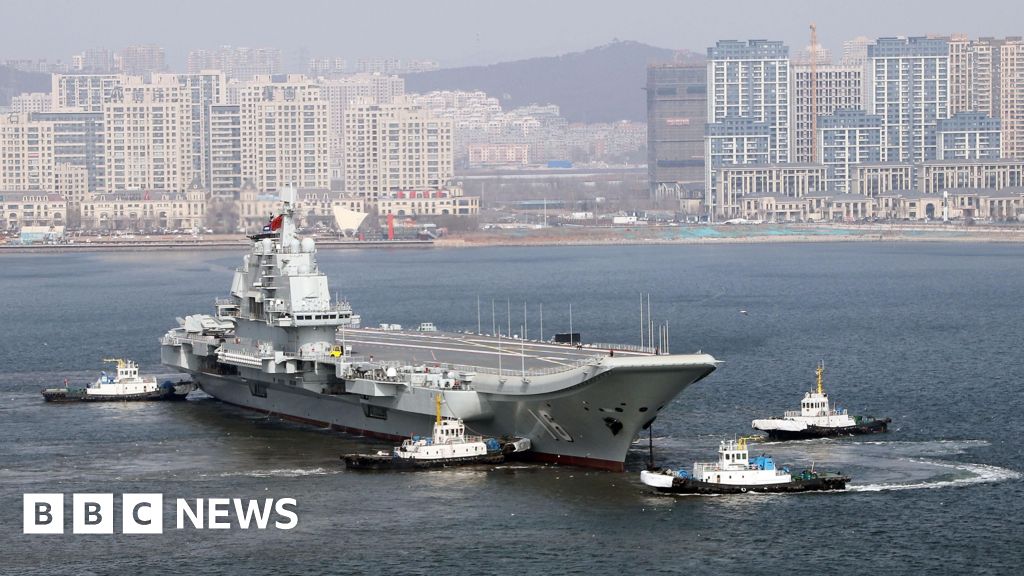
Getty Images Aircraft carrier Liaoning sets for sea trial at Dalian shipyard with the help of towboats after on February 29, 2024 in Dalian, Liaoning Province of China.


Getty Images
China's aircraft carrier Liaoning set for sea trial at Dalian shipyard in February 2024
 
What the rest of the world sees as China's rise, Xi sees as its resurgence.

He has touted the value of a "strong navy to safeguard national security". He cites 470 invasions between 1840 and 1949 that brought "untold suffering" - as the once-powerful Qing empire cracked, China plunged into turmoil, revolution and civil war.

And he has vowed that his country will never again be "humiliated" or relive those "bitter memories of foreign assaults".

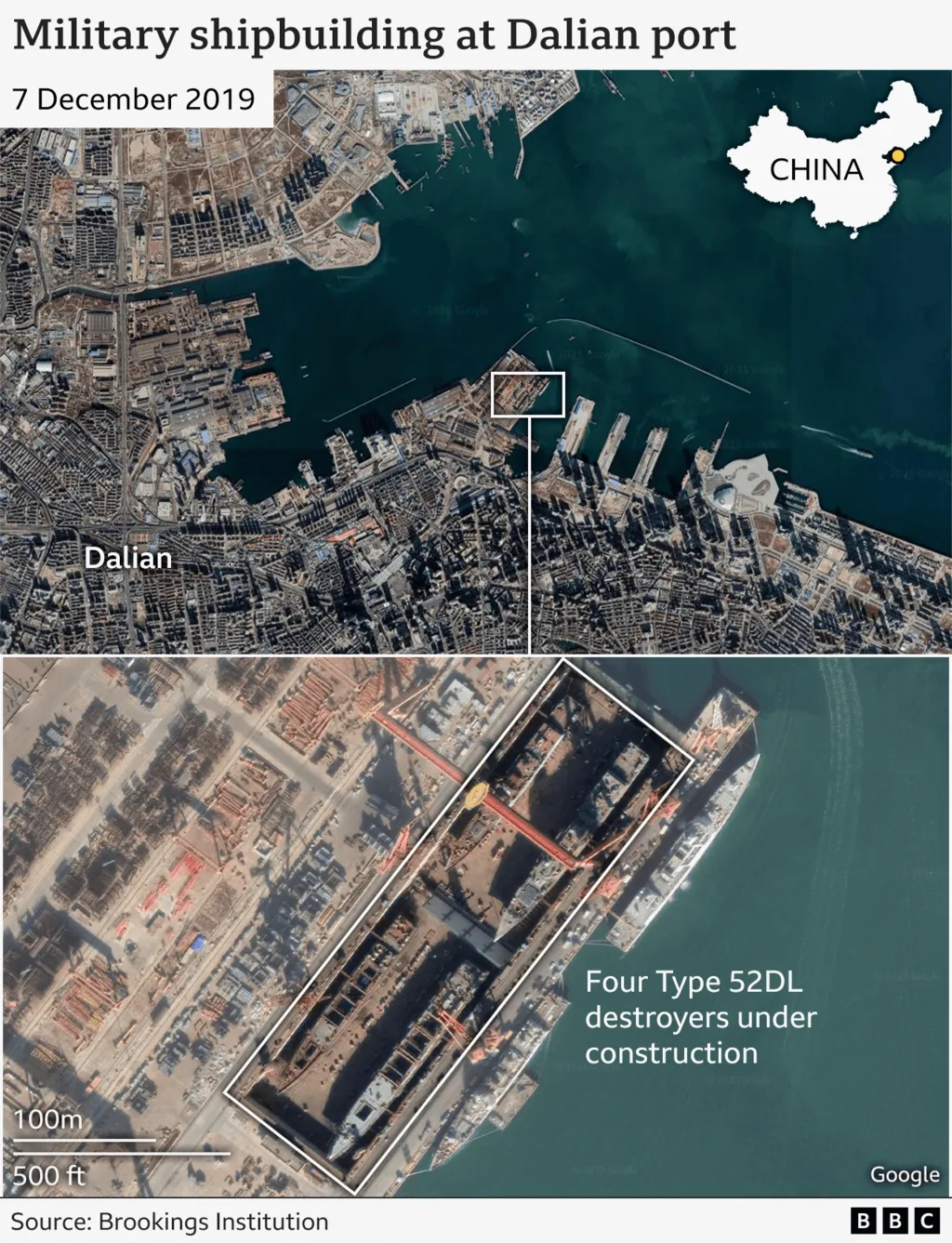
Where China has an undeniable edge is the dual use of shipyards. Many of those that support commercial production can also help produce warships for the navy.

Military and civilian shipyards work hand in hand in some places, which state media describes as "military-civilian fusion", a concept Xi has pushed hard.

Dalian, which Beijing calls a "flagship shipyard", plays a big part in this.
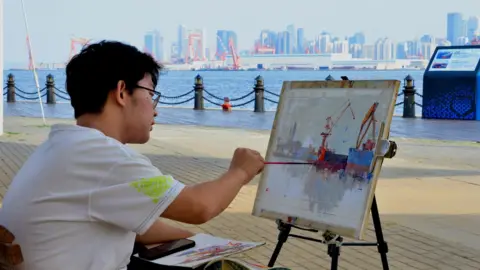
A young man is painting a view of the Dalian shipyard in watercolours. He is sitting across the harbour from it, in a white shirt and black shorts, with an easel in front of him.

The shipyard and the areas in Dalian with clear views of it are popular with locals

In full view of the picnicking pensioners waving karaoke mics are huge commercial ships, some as long as three football fields.

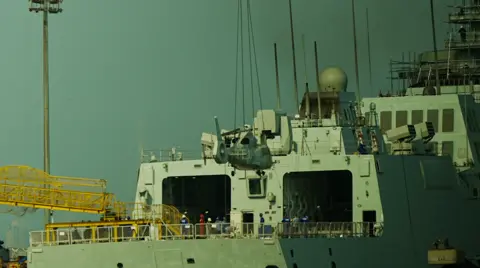
But just around the corner, berthed where no-one can take pictures, is a group of military vessels. There, a crane is lowering a helicopter onto the huge deck of a ship, as a marching band bellows in Suoyuwan park.

"This is a politically motivated agenda to merge both the commercial and military entities together," Mr Funaiole says. "There are efforts to bring the technology needed to build both into a centralised location – Dalian is one of them."

That is why even without powerful aircraft carriers or submarines, China's commercial fleet and its expertise in building ships quickly can be key during a crisis, he adds.
A helicopter is being lowered onto the deck of a military vessel by a crane, while the crew watch.

A helicopter is lowered onto a military vessel docked in Dalian

"In any protracted conflict, if you have shipyards that quickly produce new ships, this is a huge strategic advantage," Mr Funaiole says. "Commercial ships can transport food etc into any conflict zone. Without this, the US is in a position where it might not be able to sustain a prolonged war effort."

It boils down to a straight question, he says: "Who can put more assets into the water more quickly and readily?"

The answer, at the moment, is China.

'Hide your strength, bide your time'​

But the world should not worry, says Prof Hu Bo, director of the Center for Maritime Strategy Studies at Peking University.

"We have no interest in interfering in the business of other countries, especially militarily," he adds. His message is that China is building big ships because it can, not because it wants to take over the world.

There is one island which China does not see as another country: Taiwan.

Beijing has long vowed to "reunify" with the democratic island and has not ruled out the use of force. In recent years, high-ranking US officials have declared that China will invade Taiwan by 2027, but Beijing denies there is a deadline.

"China already has the capacity to take Taiwan back," Prof Hu Bo says, "but China doesn't do that because we have patience. China has never given up on the prospect of peaceful unification. We can wait."

The bigger concern is that any attack on Taiwan could trigger a wider war, and involve the US. Washington is bound by law to provide arms to help Taiwan defend itself - support which is unacceptable to Beijing for what is considers a breakaway province that will eventually be part of China.

Earlier this year US Defence Secretary Pete Hegseth warned that China posed an "imminent" threat to Taiwan, and urged Asian countries to boost defence spending and work with the US to deter war.

So despite Prof Hu Bo's assurances, it is hard to ignore the fact that China's warships are beginning to sail further from the country's shores.

In February, they were seen circumnavigating Australia's coastline for more than three weeks where they staged unprecedented live-fire drills.

More recently Chinese aircraft carriers conducted naval drills near Japan, sparking concern - although it was in international waters, the move was unprecedented.

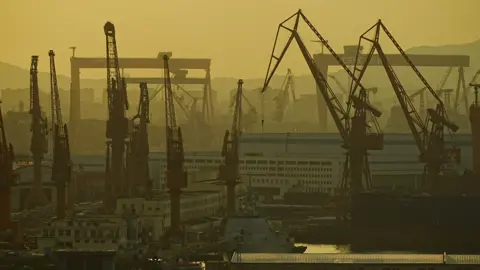
A dockyard in China is photographed in a hazy, yellow light.

China's shipbuilding expertise should not worry the world, Prof Hu Bo says
As Beijing grows bolder in its attempts to project power in the Pacific, China's neighbours, from Taiwan to Australia, are worried that its famous mantra is paying off: "hide your strength and bide your time".

But Prof Hu Bo believes that fears of a conflict between the US, whose allies in the region - Japan, South Korea and Australia - are often at odds with China, are overblown, because they all know it could be catastrophic.

"In the last three years, I think the signal is very clear that both sides don't want to fight," he says. "We are prepared for that, but we don't want to fight with each other."

'We defend our ocean dream'​

Back in Dalian, around an hour's drive from the vibrant city, tourists are arriving by the coach load in the naval fortress town of Lushunkou, which also has a military theme park in the shape of an aircraft carrier.

Guides on loud microphones lead their groups into the park, pointing to the official notices warning visitors not to photograph the military vessels moored in the crescent-shaped harbour and to report any behaviour that might be construed as spying "to help defend the Motherland".

More military notices on bridges and walls declare, "united as one, we defend our ocean dream".

China has fostered pride in its shipbuilding prowess, especially here in Dalian.
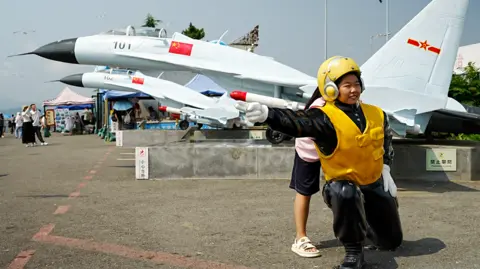
A girl in demin shorts and a pink shirt stand behind the statue of an airman. which is kneeling on the ground and pointing an arm in one direction- she puts her face above the statue's shoulders and smiles at the camera.

The military theme park near Dalian is a huge tourist draw
At the theme park, which also overlooks the shipyard, a 50-year-old blogger dressed in the local fashion - a floral pattern shirt - is giving his followers their daily rundown of the latest ships being built in the port.

"I am very proud – really, look at what this city gives us," he announces to his followers. A mother and her seven-year-old daughter, on holiday from the neighbouring province, marvel at the ships. "I was amazed. It's huge. How does it sail, I wonder?"

The key question for the US and its allies is how far can China's war fleet sail, and how far from its shores is Beijing prepared to venture.

"At what point will they will break out and be able to really show influence further afield, for example, in the Indian Ocean and beyond, will be a key thing to look at," Nick Childs says.

"They still have a significant way to go, but they are certainly pushing the boundaries."


Chinese threat looms large as Beijing leaves US far behind in naval capabilities; should India be worried?​

Chinese shipbuilding capacity is about 200 times more than the total capacity of the United States.

Published: September 1, 2025 6:15 PM IST
By Tahir Qureshi

Beijing, India, China, warship, United States, Dalian, Jiangnan, South China Sea, Xi Jinping, Taiwan, Donald Trump, Japan, Philippines, Brahmos missiles

New Delhi: China’s navy has expanded rapidly in the last 20 years. In the year 2025, China received orders to build 60 per cent of the world’s warships. According to a BBC report, China is building more ships than any other country because it can do it at a faster rate than any other country. Nick Childs, a maritime expert at the London-based International Institute for Strategic Studies, said in a BBC report that “the scale is extraordinary. In many ways eye-popping. Chinese shipbuilding capacity is about 200 times more than the total capacity of the United States.”

China has more warships than the US

From huge shipyards like Dalian and Jiangnan to military bases in the South China Sea, Beijing has rapidly accelerated the construction of warships and aircraft carriers. Its effort is to build the world’s most powerful navy, and it is almost succeeding in this. According to a BBC report, China now has 234 warships, while the US Navy has only 219 warships.

Why does China want to increase its naval capacity?

China currently has the world’s seven busiest ports and has established its dominance over global shipping routes. Under President Xi Jinping, China certainly wants to rule the seas. China is going to hold a military parade on September 3, and it is believed that during this, it will demonstrate its power.

Xi Jinping aims to establish China’s complete dominance over the South China Sea as well as capture Taiwan. That is why Beijing is trying to give a clear message by showing new weapons, hypersonic missiles, underwater drones and Jin-class nuclear submarines in its military parades that it no longer wants to be just a regional power, but a global maritime power.

China’s progress worries the US

Although comparison shows that the US Navy is much more advanced than China in terms of technology, and it has 11 huge aircraft carriers, this gap is decreasing rapidly. While the US shipbuilding capacity is quite sluggish, China has increased its production capacity manifold. Experts believe that these capabilities can put China in a decisive position in a long war. US President Donald Trump has said that he wants a solution to this problem and has signed an executive order to revive US shipbuilding and regain America’s maritime advantage.

China becomes a big threat to America

A study by the Center for Strategic and International Studies (CSIS) found that between 2019 and 2023, China’s four largest shipyards, Dalian, Guangzhou, Jiangnan and Hudong-Zhonghua, have built 39 warships with a combined displacement of 550,000 tons. China has the world’s largest navy in terms of the number of ships, while the US fleet has a greater total tonnage and is far more powerful. The US has advanced large aircraft carriers. BBC verified satellite images from the Chinese island province of Hainan in the South China Sea show that Beijing is spending huge amounts of money to expand its naval bases.

According to the BBC report, the biggest threat is to countries like Taiwan, the Philippines and Japan. The Philippines has bought Brahmos missiles from India to stop China, but will it be able to stop China alone? Experts consider it impossible.

HIGHLIGHTS

  • In the year 2025, China received orders to build 60 per cent of the world’s warships.
  • China is building more ships than any other country because it can do it at a faster rate than any other country.
  • Chinese shipbuilding capacity is about 200 times more than the total capacity of the United States.”
  • Beijing has rapidly accelerated the construction of warships and aircraft carriers.
China currently has the world’s seven busiest ports and has established its dominance over global shipping routes. Under President Xi Jinping, China certainly wants to rule the seas. China is going to hold a military parade on September 3, and it is believed that during this, it will demonstrate its power.


Chinese threat looms large as Beijing leaves US far behind in naval capabilities; should India be worried?​

Chinese shipbuilding capacity is about 200 times more than the total capacity of the United States.

Published: September 1, 2025 6:15 PM IST
By Tahir Qureshi

Beijing, India, China, warship, United States, Dalian, Jiangnan, South China Sea, Xi Jinping, Taiwan, Donald Trump, Japan, Philippines, Brahmos missiles

New Delhi: China’s navy has expanded rapidly in the last 20 years. In the year 2025, China received orders to build 60 per cent of the world’s warships. According to a BBC report, China is building more ships than any other country because it can do it at a faster rate than any other country. Nick Childs, a maritime expert at the London-based International Institute for Strategic Studies, said in a BBC report that “the scale is extraordinary. In many ways eye-popping. Chinese shipbuilding capacity is about 200 times more than the total capacity of the United States.”

China has more warships than the US

From huge shipyards like Dalian and Jiangnan to military bases in the South China Sea, Beijing has rapidly accelerated the construction of warships and aircraft carriers. Its effort is to build the world’s most powerful navy, and it is almost succeeding in this. According to a BBC report, China now has 234 warships, while the US Navy has only 219 warships.

Why does China want to increase its naval capacity?

China currently has the world’s seven busiest ports and has established its dominance over global shipping routes. Under President Xi Jinping, China certainly wants to rule the seas. China is going to hold a military parade on September 3, and it is believed that during this, it will demonstrate its power.

Xi Jinping aims to establish China’s complete dominance over the South China Sea as well as capture Taiwan. That is why Beijing is trying to give a clear message by showing new weapons, hypersonic missiles, underwater drones and Jin-class nuclear submarines in its military parades that it no longer wants to be just a regional power, but a global maritime power.

China’s progress worries the US

Although comparison shows that the US Navy is much more advanced than China in terms of technology, and it has 11 huge aircraft carriers, this gap is decreasing rapidly. While the US shipbuilding capacity is quite sluggish, China has increased its production capacity manifold. Experts believe that these capabilities can put China in a decisive position in a long war. US President Donald Trump has said that he wants a solution to this problem and has signed an executive order to revive US shipbuilding and regain America’s maritime advantage.

China becomes a big threat to America

A study by the Center for Strategic and International Studies (CSIS) found that between 2019 and 2023, China’s four largest shipyards, Dalian, Guangzhou, Jiangnan and Hudong-Zhonghua, have built 39 warships with a combined displacement of 550,000 tons. China has the world’s largest navy in terms of the number of ships, while the US fleet has a greater total tonnage and is far more powerful. The US has advanced large aircraft carriers. BBC verified satellite images from the Chinese island province of Hainan in the South China Sea show that Beijing is spending huge amounts of money to expand its naval bases.

According to the BBC report, the biggest threat is to countries like Taiwan, the Philippines and Japan. The Philippines has bought Brahmos missiles from India to stop China, but will it be able to stop China alone? Experts consider it impossible.

HIGHLIGHTS

  • In the year 2025, China received orders to build 60 per cent of the world’s warships.
  • China is building more ships than any other country because it can do it at a faster rate than any other country.
  • Chinese shipbuilding capacity is about 200 times more than the total capacity of the United States.”
  • Beijing has rapidly accelerated the construction of warships and aircraft carriers.
China currently has the world’s seven busiest ports and has established its dominance over global shipping routes. Under President Xi Jinping, China certainly wants to rule the seas. China is going to hold a military parade on September 3, and it is believed that during this, it will demonstrate its power.

Would the ECM on the Type 054A and Type 052D be considered “3 rd generation ECM” as defined in the following video; continuously changing their jamming frequencies and measuring it’s effectiveness, and then doubling down on those frequencies, to deal with missiles with frequency hopping seekers?

To view this content we will need your consent to set third party cookies.
For more detailed information, see our cookies page.
 
Would the ECM on the Type 054A and Type 052D be considered “3 rd generation ECM” as defined in the following video; continuously changing their jamming frequencies and measuring it’s effectiveness, and then doubling down on those frequencies, to deal with missiles with frequency hopping seekers?

To view this content we will need your consent to set third party cookies.
For more detailed information, see our cookies page.


China's upcoming Destroyers, type 55 or a new name may be like type 56, will have 3.5 generation ECM capability plus directed energy weapons like the Microware (HPM) and Lasers.
 
China's upcoming Destroyers, type 55 or a new name may be like type 56, will have 3.5 generation ECM capability plus directed energy weapons like the Microware (HPM) and Lasers.
Semantics aside, does it have a known system that has this capability presently or one in development?
 
Would the ECM on the Type 054A and Type 052D be considered “3 rd generation ECM” as defined in the following video; continuously changing their jamming frequencies and measuring it’s effectiveness, and then doubling down on those frequencies, to deal with missiles with frequency hopping seekers?

To view this content we will need your consent to set third party cookies.
For more detailed information, see our cookies page.


I haven't watched the video, but frequency hopping is already considered old tech. AESA radar with LPI mode was already introduced in the end of last century.

Current state of the art is probably represented by spread spectrum, pseudo-random signal type of deal. Case in the point, it is very likely Rafael's rwr system failed to recognize PL-15 seeker in LPI mode which lead to the one side slaughter we've witnessed.

I guess so called “3 rd generation ECM” is simply defined by the video maker or their country's MIC (Canada I presume) which has no much of a relevance in whatever level PLAN is working at
 

Chinese threat looms large as Beijing leaves US far behind in naval capabilities; should India be worried?​

Chinese shipbuilding capacity is about 200 times more than the total capacity of the United States.

Published: September 1, 2025 6:15 PM IST
By Tahir Qureshi

Beijing, India, China, warship, United States, Dalian, Jiangnan, South China Sea, Xi Jinping, Taiwan, Donald Trump, Japan, Philippines, Brahmos missiles

New Delhi: China’s navy has expanded rapidly in the last 20 years. In the year 2025, China received orders to build 60 per cent of the world’s warships. According to a BBC report, China is building more ships than any other country because it can do it at a faster rate than any other country. Nick Childs, a maritime expert at the London-based International Institute for Strategic Studies, said in a BBC report that “the scale is extraordinary. In many ways eye-popping. Chinese shipbuilding capacity is about 200 times more than the total capacity of the United States.”

China has more warships than the US

From huge shipyards like Dalian and Jiangnan to military bases in the South China Sea, Beijing has rapidly accelerated the construction of warships and aircraft carriers. Its effort is to build the world’s most powerful navy, and it is almost succeeding in this. According to a BBC report, China now has 234 warships, while the US Navy has only 219 warships.

Why does China want to increase its naval capacity?

China currently has the world’s seven busiest ports and has established its dominance over global shipping routes. Under President Xi Jinping, China certainly wants to rule the seas. China is going to hold a military parade on September 3, and it is believed that during this, it will demonstrate its power.

Xi Jinping aims to establish China’s complete dominance over the South China Sea as well as capture Taiwan. That is why Beijing is trying to give a clear message by showing new weapons, hypersonic missiles, underwater drones and Jin-class nuclear submarines in its military parades that it no longer wants to be just a regional power, but a global maritime power.

China’s progress worries the US

Although comparison shows that the US Navy is much more advanced than China in terms of technology, and it has 11 huge aircraft carriers, this gap is decreasing rapidly. While the US shipbuilding capacity is quite sluggish, China has increased its production capacity manifold. Experts believe that these capabilities can put China in a decisive position in a long war. US President Donald Trump has said that he wants a solution to this problem and has signed an executive order to revive US shipbuilding and regain America’s maritime advantage.

China becomes a big threat to America

A study by the Center for Strategic and International Studies (CSIS) found that between 2019 and 2023, China’s four largest shipyards, Dalian, Guangzhou, Jiangnan and Hudong-Zhonghua, have built 39 warships with a combined displacement of 550,000 tons. China has the world’s largest navy in terms of the number of ships, while the US fleet has a greater total tonnage and is far more powerful. The US has advanced large aircraft carriers. BBC verified satellite images from the Chinese island province of Hainan in the South China Sea show that Beijing is spending huge amounts of money to expand its naval bases.

According to the BBC report, the biggest threat is to countries like Taiwan, the Philippines and Japan. The Philippines has bought Brahmos missiles from India to stop China, but will it be able to stop China alone? Experts consider it impossible.

HIGHLIGHTS

  • In the year 2025, China received orders to build 60 per cent of the world’s warships.
  • China is building more ships than any other country because it can do it at a faster rate than any other country.
  • Chinese shipbuilding capacity is about 200 times more than the total capacity of the United States.”
  • Beijing has rapidly accelerated the construction of warships and aircraft carriers.
China currently has the world’s seven busiest ports and has established its dominance over global shipping routes. Under President Xi Jinping, China certainly wants to rule the seas. China is going to hold a military parade on September 3, and it is believed that during this, it will demonstrate its power.

Gee, how old is this picture?
 

China’s submarine surge and the US struggle to keep pace

China's military is rapidly increasing its submarine force, prompting an arms race in the Pacific region as the US and its allies face pressure to match technology as much as numbers.

September 09, 2025 / 12:55 IS

After decades of incremental growth, China is on track to be a world-class submarine fleet. Its new nuclear-powered models, like the Type 095 in development, should be quieter and faster and feature vertical launch tubes for cruise missiles. Non-nuclear Yuan-class boats, using air-independent propulsion, can stay underwater longer and be more covert. That is a revolutionary shift from Beijing's earlier, noisy designs, the Wall Street Journal reported.

The Pacific chessboard

China's submarine bases now reach as far as Liaoning to Hainan, stretching its navy's influence into the South China Sea and beyond. Blockade and invasion drills off Taiwan highlight the strategic value subs would play in any conflict, from cutting US supply lines to encircling the island. The US has deployed about 60% of its submarine fleet in the Indo-Pacific, forward-deployed based on Guam, and shifted Virginia-class attack subs into the theatre to keep deterrence intact.

Washington's production woes

The US Navy is still leading in stealth and technology, but manufacturing shortfalls erode that edge. Maintenance backlogs have kept nearly a third of attack subs offline, and only 1.2 are currently being built a year—half the pace needed to grow the force and meet Aukus commitments to Australia. The Columbia-class ballistic missile submarine program already is two years behind, and the next-generation SSN(X) attack sub won't exist until the 2040s.


Allies and the submarine arms race

Local navies are developing their own fleets. Japan, South Korea, Singapore and Australia are developing submarine fleets, with Vietnam and Taiwan holding minor deterrent assets. Singapore just bought German-built subs, and the Philippines has been eyeing membership in the club. With France and the UK, these countries might form a wartime coalition to safeguard sea routes and block China's naval expansion.

Industrial advantage and strategic risks

China has a strategic strength in shipbuilding capacity. Its gargantuan commercial shipyards allow it to mass-produce diesel subs, making up for US quality with numbers. Experts warn that those dynamics would skew the odds beneath the waves, preventing the US from projecting power. Trump officials have cited the challenge, underscoring that barring production increases, Washington's strategy of deterrence is "a very difficult problem."

What a conflict could be

In a Taiwanese conflict, Chinese diesel-electric subs would stalk the coastal seas, while nuclear ships tried to interdict US reinforcements. US attack subs, with Tomahawk missiles and advanced sensors, would try to sink Chinese warships, strike land targets, and sever southern supply lines. The stealth and range of these vessels are the backbone of any Pacific war strategy, contributing to what is already the world's most important undersea arms race.
 
Same issue like we debated before on the other thread of Chinese naval growth beyond the US.

China may be building more submarines, but their tonnage and missile capacity are much less than the US. For an apples to apples comparison, China needs to produce similar capability submarines with both torpedo and missile launch capability.

Additionally, range is an issue. Chinese submarines are "local area" focused, limiting nearly 75% of the Chinese submarines to South & East China Sea. For submarine comparison, China still needs to:

1) Miniaturize nuclear reactors to create effective nuclear attack submarines carrying a larger load of weapons, longer range and longer sub-merge time like the US nuclear attack submarines do.

2) Enhance existing submarines capacity to hold more missiles. Build new submarines with larger power units, for larger range and larger payload.
 
China needs to produce similar capability submarines with both torpedo and missile launch capability.
Like this?

China to arm submarines with new hypersonic missile

By Dylan Malyasov

Sep 8, 2025
Modified date: Sep 8, 2025

Captures via WeiboCaptures via Weibo

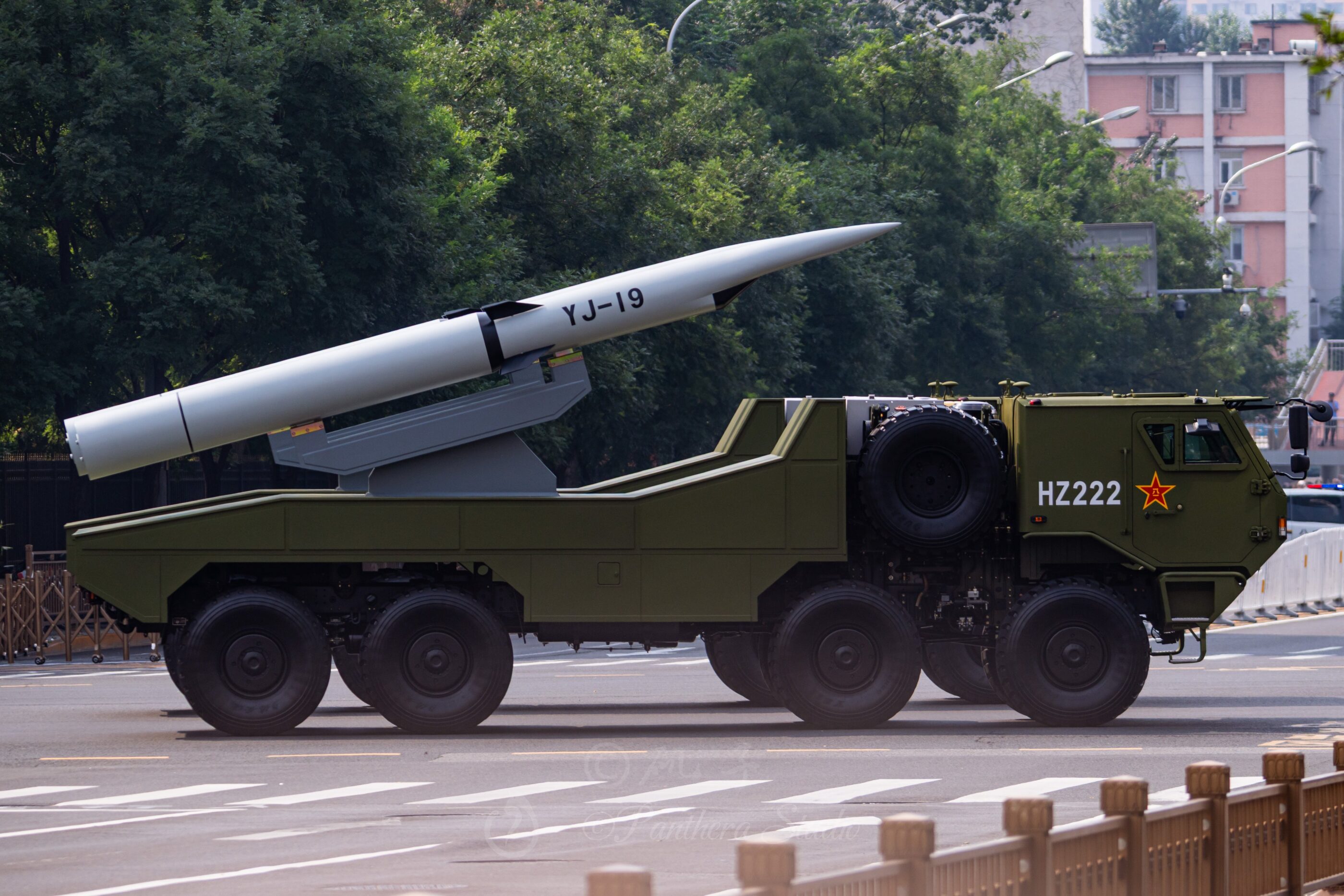
China is preparing to equip its navy’s submarines with a new scramjet-powered hypersonic cruise missile, known as the YJ-19.

Mockups of the YJ-19 hypersonic missile, publicly displayed for the first time during the parade in Beijing attended by Chinese President Xi Jinping, Russian President Vladimir Putin, and North Korean leader Kim Jong Un, point to a system designed for underwater launch from the People’s Liberation Army Navy’s (PLAN) submarines, including both conventional and nuclear-powered platforms.

The missile is expected to be launched from standard 533 mm torpedo tubes, a configuration common across China’s expanding submarine fleet.

Military analysts describe the YJ-19 as a scramjet-powered, high-altitude cruise missile with boosted launch capability, offering the PLAN a new standoff strike weapon that combines submerged survivability with hypersonic speed. Its compact dimensions—noticeably smaller than China’s YJ-17 and YJ-20 systems—suggest compatibility with existing torpedo launch infrastructure, eliminating the need for vertical launch systems.

Footage aired by Chinese state media showed the YJ-19 mockup displayed in a distinct white paint scheme, contrasting with the blue typically used for PLAN anti-ship weapons. The absence of visible suspension lugs further supports the assessment that the missile is not intended for aircraft or deck-mounted launch, but rather for encapsulated storage and deployment from underwater platforms.

Captures via WeiboCaptures via Weibo

Defense analyst Shahryar Pasandideh noted that, “Given how the YJ-19 has a much smaller diameter (including its booster) than the YJ-17 and YJ-20, there has been speculation that the YJ-19 is designed to be launched from a standard 533 mm diameter torpedo tube of PLAN submarines.”

China’s emphasis on unveiling submarine-launched weapons—alongside surface-launched anti-ship missiles and advanced torpedoes—during a parade attended by key geopolitical allies highlights its drive to modernize undersea strike capabilities. The YJ-19, if fielded, would mark a new phase in PLAN submarine warfare by introducing hypersonic weapons to its underwater arsenal, allowing for faster, longer-range engagement of naval targets.

While the Chinese government has not officially confirmed the operational status of the YJ-19, its appearance at a nationally televised military event strongly suggests the system is progressing toward deployment. China’s broader investment in hypersonic and long-range maritime strike systems aligns with its strategic focus on deterring adversary naval forces and denying access to key regional waters.

The inclusion of the YJ-19 in the Beijing parade, set against the backdrop of tightening ties between China, Russia, and North Korea, signals an intent to publicly display strategic deterrent capabilities and emerging naval technologies. Observers note that China’s submarine fleet continues to expand not just in numbers but in technological sophistication—now poised to carry one of the most advanced submarine-launched hypersonic weapons yet unveiled.

If fielded successfully, the YJ-19 would expand the PLAN’s ability to strike from below the surface with near-immediate impact, presenting a new operational challenge to Western and regional navies operating in the Indo-Pacific.

 
China missed out on 4 years of easy military expansion with Sleepy Joe Biden. China should have went into a war economy and said it was doing so because it learned from the Trump years and was preparing for a conflict with a returned Trump. This would have given China the military it needs and had US voters link Trump with a war in East Asia.
 

China is working on an ultra-fast torpedo powered by AI for submarine warfare​

Thursday, 05 Jun 2025

3351887.webp

Technology could help supercavitating torpedoes achieve a 92% success rate in distinguishing real submarines from decoys. — SCMP

In the recent Chinese blockbuster Operation Leviathan, an American nuclear submarine uses hi-tech acoustic holograms to bamboozle Chinese torpedoes and their human operators.

Months after the film hit cinema screens, military researchers in China revealed they were working on an artificial intelligence system designed to cut through exactly this type of underwater deception.

In a peer-reviewed paper published in Chinese-language journal Command Control & Simulation in April, the team from the PLA Navy Armament Department and China State Shipbuilding Corporation said their system had unprecedented accuracy for torpedoes travelling at high speeds.

Tested against data from classified high-speed torpedo ranges, the technology achieved an average 92.2 per cent success rate in distinguishing real submarines from decoys even during tense exchanges, according to the paper.

That is a leap from the legacy systems that often miss the target.

Future submarine warfare hinges on deceiving torpedoes using illusions. Hi-tech decoys – as dramatised in Operation Leviathan – are used to replicate a vessel’s acoustic signature, generate a false bubble trail to make it look like it is making an emergency turn, or deploy in coordinated swarms to project ghost targets across sonar screens.

These tactics are particularly effective against what is known as ultra-fast supercavitating torpedoes – weapons that generate cavitation, or vapour bubbles, around their hulls to reduce drag. The resulting roar drowns out genuine target echoes while distorting acoustic fingerprints, according to the Chinese researchers.

“Current target recognition methods for China’s underwater high-speed vehicles prove inadequate in environments saturated with advanced countermeasures, necessitating urgent development of novel approaches for feature extraction and target identification,” said the team led by senior engineers Wu Yajun and Liu Liwen.

“Only those underwater high-speed systems equipped with long-range detection capabilities and high target recognition rates can deliver sufficient operational effectiveness,” they added.

The solution they proposed came from an unorthodox combination of physics and machine learning. Facing scarce real-world combat data, the team began by simulating decoy profiles using hydrodynamic models of bubble collapse patterns and turbulence. To do that they used raw data collected from the PLA Navy’s high-speed torpedo test range.

These simulations were then added to a “generative adversarial network” – a duelling pair of AI systems. One of them, the generator, refined decoy signatures by studying submarine physics and acoustic principles. Its opponent, the discriminator, trained to detect flaws in these forgeries using seven layers of sonic pattern analysis.

After many rounds of training, the system had created a huge collection of artificial decoy profiles.

The AI uses a specialised neural network architecture inspired by image recognition, according to the paper. Sonar signals go through a process where they are normalised for amplitude, filtered through correlation receivers to suppress noise, and finally rendered as spectral “thumbnails” using a mathematical tool known as a Fourier transform.

These sonic snapshots then pass through convolutional layers in the neural network that are tuned to detect anomalies in frequency modulation. Pooling operations then average out distortions like bubble interference.

The team said that when confronted with the most sophisticated type of decoys, detection rates went from 61.3 per cent to more than 80 per cent.

It comes amid a global race to develop “smart” torpedoes. Russia’s VA-111 Shkval torpedo and its US counterparts under development all rely on supercavitation at present, and they struggle with target discrimination at extreme speeds.

“With continuous advancements in modern underwater acoustics, electronic technologies and artificial intelligence, today’s underwater battlespace often contains multiple simultaneous threats within a single operational area – including decoys, electro-acoustic countermeasure systems, electronic jammers and diverse weapon systems,” the paper said.

In such intense underwater environments where multiple targets or decoys can appear simultaneously, these systems must be able to instantly distinguish authentic targets from false ones to avoid mission failure or a wasted trajectory and to prioritise the highest-threat targets, according to the team.

“Critically, given the autonomous nature of underwater high-speed vehicles, all decisions must be made without real-time external communication support, substantially increasing algorithmic complexity and computational demands,” the team said.

“The deep-learning recognition model proposed in this study, combined with the generative adversarial networks’ small-sample identification solution, enables effective underwater target discrimination. This lays the technical groundwork for field deployment,” they added.

 
@Beijingwalker

If the PLAN had a sub base on the Tumen river as stated in the other thread (with a canal linking it to the Bohai bay for secure movement only through Chinese waters) it could operate subs in the “safe bastion” of the Northern Sea of Japan with the 10,000 km JL-3.
 

Users who are viewing this thread

Pakistan Defence Latest

Back
Top