How China Powers Its Electric Cars and High-Speed Trains
By
Keith Bradsher
Photographs by Gilles Sabrié
Reporting from Guquan, China
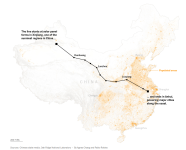
In China, the longest ultrahigh-voltage power line stretches more than 2,000 miles from the far northwest to the populous southeast — the equivalent of transmitting electricity from Idaho to New York City.
Sources: Chinese state media, Oak Ridge National Laboratory
The power line starts in a remote desert in northwest China, where vast arrays of solar panels and wind turbines generate electricity on a monumental scale. It snakes southeast, following an ancient river between mountain ranges before reaching Anhui Province near Shanghai, home to 61 million people and some of China’s most successful electric car and robot manufacturers.
That’s a single power line. China has 41 others. Each is capable of carrying more electricity than any utility transmission line in the United States. That’s partly because China is using technology that makes its lines far more efficient than almost anywhere else in the world. The feat is owed to China’s ambitious national energy policies and the fact that few residents along the path of these lines dare object — even though the lines cause small electric shocks that local people said they could feel when holding a metal fishing pole.
“As long as you don’t fish directly underneath the wires and keep the fishing line from getting tangled in the wires, it’s basically fine,” Shu Jie, an air-conditioning repairman, said matter-of-factly, showing off a six-inch fish he had just caught.
China’s
aggressive embrace of clean energy technologies, at a faster pace than even its own government expected or planned, has left it with an unquenchable thirst for electricity. Half the country’s new cars are battery-powered, and the 30,000 miles of high-speed rail lines run on electricity. Wind and solar energy provided over a quarter of China’s power in April, a milestone that few other countries can brag about.
But much of that clean energy
is produced in the country’s sunny, windy western and northern regions, far from most of its people and factories. More than 90 percent of China’s 1.4 billion people live in the east, where cloudy days, windless nights and sluggish rivers limit the potential for clean energy. So to move the electricity to where it is needed most, China is urgently upgrading its power grid.
Beijing’s central planners, having underestimated the country’s swift adoption of solar and wind energy, are building the world’s first nationwide grid of ultrahigh-voltage power transmission lines.
Beijing’s expansion of its power grid
contrasts sharply with President Trump’s “
Drill, baby, drill” approach of doubling down on fossil fuels and rolling back federal programs to spur greater use of clean energy.
In July, the Energy Department
terminated its commitment to provide a $4.9 billion loan guarantee for construction of the Grain Belt Express power line to take wind power from Kansas to cities in Illinois and Indiana. That 800-mile ultrahigh-voltage line, which would have covered a shorter distance than dozens of lines already built in China, ran into criticism from rural landowners and Republican lawmakers.
Even before Mr. Trump took office, other renewable energy projects in the United States had to wait as long as 17 years for permits to be approved for transmission lines running a few hundred miles.
Many of China’s ultrahigh-voltage lines use direct current technology, which allows them to carry electricity for long distances with barely any of the transmission losses that affect most high-power lines in other countries.
China’s more efficient power lines have broad consequences for the global race against climate change. They will help determine how quickly China can reduce its world-leading use of coal, a stain on the country’s clean energy track record. China uses as much coal as the entire rest of the world, and emits
more greenhouse gases than the United States and the European Union combined.
The more advanced power grid is starting to address a central problem facing China’s energy planners. In its western regions, where the weather is favorable for solar, wind and hydroelectric power, China produces more renewable energy than it can use.
Xi Jinping, China’s top leader, set a goal in 2020 of tripling the country’s capacity to generate wind and solar energy by 2030. The country reached that mark last year — six years ahead of schedule.
The country’s government-owned electricity transmission giant, State Grid, was caught unprepared.
“State Grid is good at building things, but not six years ahead,” said David Fishman, an electricity consultant in Shanghai.
In some recent months, a tenth of China’s wind and solar capacity has gone unused partly because the grid was unable to move all the power generated.
“To improve the power system’s ability to absorb new energy, we must accelerate the construction of power grid projects supporting new energy,” Du Zhongming, electricity director of the National Energy Administration in China, said at a news conference last year.
China already consumes twice as much electricity as the United States. By 2050, China plans to triple its count of ultrahigh-voltage routes.
The most recent public Chinese data, from the end of 2024, showed 19 lines transmitting power at 800 kilovolts. Another 22 lines operated at 1,000 kilovolts. One of them, the behemoth terminating in Guquan, transmits enough electricity at 1,100 kilovolts to power more than seven million American households or 40 million to 50 million Chinese households.
A tea plantation below the world’s longest and most powerful ultrahigh-voltage power line near its terminus in Guquan in south-central China.
To put the scale of China’s power grid build out in perspective, consider that the United States has a handful of 765-kilovolt lines and a few running at 500 kilovolts or less, according to the Electric Power Research Institute, a nonprofit research group. The 765-kilovolt lines together total about 2,000 miles — the length of a single line across China.
The Soviet Union built a power line in Central Asia that was designed to operate at 1,150 kilovolts. But it used less powerful equipment and has not run at full tilt for decades.
The development of China’s ultrahigh-voltage lines was given a push in 2009, during the global financial crisis. The central government approved enormous investments in their construction to create jobs and head off an economic slowdown. China’s leaders staked ambitious plans for electric vehicles and high-speed rail lines around the same time.
In March 2011, the construction of ultrahigh-voltage lines gained further momentum from the partial meltdown of three nuclear reactors after an earthquake and tsunami in Fukushima, Japan. Beijing delayed many prospective nuclear reactors, which had been planned near cities, and doubled down on transmission lines from remote areas.
Construction of the power lines has helped China reduce its emissions of toxic air pollution and greenhouse gases. A University of Chicago analysis of satellite data, released in August, found that air pollution in China had plunged 41 percent since 2014. That added almost two years to the country’s average life expectancy.
Beijing, once notorious for smog, mostly stopped burning coal for electricity in 2020 and now relies partly on wind power delivered from hundreds of miles away.
China’s ultrahigh-voltage network has helped the country limit its dependence on imported oil and natural gas, but it has also created new vulnerabilities. Much of northwestern China, where many of the lines are being built, is mountainous. As a result, lines had to be closely bunched as they hug a single, flood-prone tributary of the Yellow River that passes between earthquake-prone mountain ranges from Dunhuang to Lanzhou in Gansu Province.
For decades, countries have talked about building power lines similar to China’s. They have found it difficult to persuade people living along the routes to accept any high-power lines, much less ultrahigh-voltage lines.
China can build faster because of its top-down industrial planning, government control of information and intolerance for public dissent.
Some villagers in Anhui Province living near China’s longest ultrahigh-voltage line said they had reservations about the line, although they did not try to stop its construction.
The line carries mostly solar and wind energy, as well as some coal-fired power, from the Gurbantünggüt Desert in Xinjiang. It helps supply electricity to big eastern Chinese cities like Shanghai, Hangzhou and Nanjing.
Xu Shicai, a farm manager in Xuchong, a village next to lines that pass within 30 yards of homes, expressed concern.
“When you hold an umbrella in the rain, sparks will fly from it, and you’ll feel numb,” he said. “When fishing, it’s hard to hold the pole under the wires, as your hands feel very numb.”
The village’s small fish pond lies directly under the power lines. A “no fishing” sign has a cartoon of a skeleton being electrocuted and a graphic photo of a badly burned man who was apparently electrocuted. But Mr. Xu and other residents said that did not stop many villagers from fishing because the pond was so close by.
Mr. Xu said he accepted the power line because it was an important national project, but he worried it might scare off visitors. “I’m used to it now,” he said. “But honestly, we don’t want more lines built here.”


 in many places.
 www.google.com

 onto a street on this Beijing map.
 www.google.com


