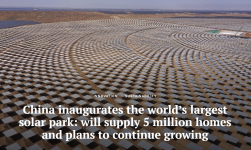
China inaugurates the world’s largest solar park: will supply 5 million homes and plans to continue growing
13 October, 2025
In a new milestone for the
global energy transition, China is advancing with the construction of the
world’s largest solar park.
This is the
Talatan Solar Park, in Gonghe County, Qinghai Province.
This is part of a broad system of
renewable energies that China is expanding day by day.
In this way, the Asian nation is getting to work to achieve a
constant 3% annual reduction in emissions and meet its goal of
carbon neutrality by 2060.
What the world’s largest solar park is like
Currently, the Talatan Solar Park has a
capacity of 16,930 megawatts.
However, the facility continues to expand, aiming to grow up to
10 times the area of Manhattan in three years.
Thus, although it is already the
largest park in the world with 420 km2 (seven times the area of Manhattan),
610 km2 are projected for the future.
Additionally, near the park, China also operates
wind energy (4,700 megawatts) and
hydroelectric dams (7,380 megawatts).
The project, equipped with
7,000,000 solar panels, will generate
electricity for five million Chinese homes.
This will arrive through
high-voltage lines that transport electricity over more than
1,600 kilometers.
Parque solar Talatan en China.
China advances in clean energy with massive investments
The magnitude of the project is part of a
massive investment by China in
clean energy.
Between January and June 2025,
212 GW of solar capacity were installed, a figure that alone surpasses the total accumulated in the United States.
This expansion had an immediate effect: the country’s
carbon emissions decreased by 1% in the first half of 2025.
According to Li Shuo of the Asia Society Policy Institute, it is a “moment of global significance” that demonstrates that
emission reduction can coexist with
economic evolution.
As of today,
photovoltaic energy already surpasses hydro as the
main source of clean generation in China, and is approaching wind energy.
Thus, by 2030, China is expected to reach
1,200 GW of combined energy between
solar and wind.
More than energy: the ecological restoration
Additionally, the
Tibetan solar park will not only produce electricity.
This is because the panels also function as
wind barriers, reduce
soil evaporation, and allow for
vegetation regeneration.
On the other hand, the installation enables thousands of sheep to graze in the shade of the panels,
benefiting their habitat.
Thus, this
ecological combination transforms the territory in the following ways:
- reduces erosion;
- decreases evapotranspiration;
- favors vegetation and local fauna, and;
- creates a productive ecosystem that integrates energy generation and environmental restoration.
Cleaner energy to boost electric mobility
On the other hand, the expansion of
clean energy is essential in a key business where China aims to be a pioneer:
electric mobility.
This is because, for the advancement of
electric vehicles without dependence on
fossil sources, the expansion of
clean generation and the strengthening of the
electrical grid are essential.
A
reliable renewable grid would boost the deployment of
fast charging stations and a
more sustainable automotive fleet.
The Tibetan plateau: China’s large-scale clean energy laboratory
The Talatan Solar Park is just part of the extensive network of
clean energy industries that China is building on the
Tibetan plateau, the highest in the world.
The goal is to harness the region’s
intense sun,
low temperatures, and
extreme altitude to produce
low-cost renewable energy.
To supply the plateau with almost all the electricity it needs, including artificial intelligence data centers, China even had an original idea.
They managed to have the
wind turbines -also present in the park- capture the
night breezes that balance the
daytime energy of the
solar panels.
No other country takes advantage of
great altitudes to generate
solar,
wind, and
hydroelectric energy on a comparable scale.
This effort exemplifies how China has come to dominate the
clean energy sector.
This was achieved through investment and government planning, allowing it to reduce its
dependence on fossil fuel imports.
China’s climate commitment
Although China still
burns as much coal as the rest of the world combined, President Xi Jinping made a remarkable promise before the
United Nations.
He stated for the first time that
the country will reduce its greenhouse gas emissions across its entire economy and
sextuple renewable energy in the coming years.
Today,
renewable energy supplies
48,000 kilometers of high-speed railways and China’s growing
fleet of electric cars.
In a new milestone for the global energy transition, China is advancing with the construction of the world's largest solar park. This is the Talatan Solar

noticiasambientales.com


 timesofindia.indiatimes.com