Afghanistan: General News and Discussion

Islam places no restrictions on girls’ education, MWL chief tells conference in Pakistan


Islam places no restrictions on girls’ education, MWL chief tells conference in Pakistan


Usama Iqbal Khawaja
January 11, 2025
  • Sheikh Abdul Kareem Al-Issa says anyone opposing girls’ education is deviating from global Muslim community
  • Top Muslim World League official says Muslim women always enjoyed significant presence in all spheres of life
ISLAMABAD: Islam places no restrictive conditions on girls’ education, and anyone opposing it is deviating from the global Muslim community, Sheikh Muhammad bin Abdul Kareem Al-Issa, Secretary General of the Muslim World League (MWL), said on Saturday at an international conference in Pakistan focusing on the issue.
Muslim communities have often faced criticism for not providing sufficient opportunities to women in fields like education, though many of their countries have made significant strides in promoting women’s participation across various fields.
The issue of girls’ education has drawn heightened attention recently, particularly after Afghanistan’s interim administration, led by the Taliban, imposed restrictions on girls’ education, including shutting down secondary schools and barring women from attending universities.

The two-day conference, co-hosted by Pakistan and the MWL, comes at a time when global leaders, organizations and activists have urged the Taliban to reverse their policies. The conference aims to address the issue by signing a consensus “Islamabad Declaration,” reaffirming that Islam does not prohibit women’s education in any way.

“Our Islamic faith has always celebrated the education of every Muslim, both male and female, because the message of Islam was to enlighten all, regardless of gender,” Al-Issa told participants. “Therefore, Muslim women in Islam had a significant and active presence in all spheres of life — in religious matters and in the sciences, politics, economics and societal affairs throughout history.”

The MWL chief said any reservations toward girls’ education must be understood as stemming from non-Islamic customs that have no basis in the Muslim faith.

“Those who deviate from this Islamic consensus are deviating from the ummah [community of believers],” he said, adding, “The Prophet Muhammad, Peace Be Upon Him, warned that whoever desires the best place in paradise must stick to the community.”

The global summit, which aims to find ways to advance girls’ education across the Muslim world, has brought together over 150 dignitaries from 44 Muslim and other friendly states, according to the foreign office of Pakistan.

Al-Issa noted all participants of the gathering unanimously agreed on the need for girls’ education.

“They are all here to say with one voice that Islam is innocent of depriving women of education in any field and at any level of education,” he added.

The MWL chief arrived in Pakistan a day earlier and held separate meetings with high-ranking officials, including Prime Minister Shehbaz Sharif, the keynote speaker at the conference’s inaugural session.
 
To view this content we will need your consent to set third party cookies.
For more detailed information, see our cookies page.
 
To view this content we will need your consent to set third party cookies.
For more detailed information, see our cookies page.
 
To view this content we will need your consent to set third party cookies.
For more detailed information, see our cookies page.
 

Death toll from Afghanistan’s rain, hail rises to 39: officials

AFP

File Photo


KABUL: The death toll from recent heavy rain and hail in three Afghan provinces has risen by 10 to 39, disaster management officials said on Wednesday.

Flash floods ripped through western Farah province on Tuesday, washing away 21 people, while three more were killed when a hail storm caused their house to collapse.

Further east, six people were killed in Helmand province, including a child struck by lightning, and nine in Kandahar province.

Several provinces in Afghanistan have been grappling with long-term drought, including flood-hit Farah, since 2018.

“It’s constantly raining and snowing in most of the provinces, which has reduced the drought,” said Abdullah Jan Sayeq, spokesman for Afghanistan’s National Disaster Management Authority.
 
To view this content we will need your consent to set third party cookies.
For more detailed information, see our cookies page.
 
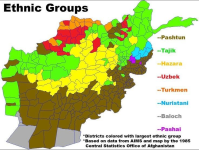
Pashto is the most dalit component in Afghanistan's ethnic makeup along with the Chinese looking Hazara ghareeb. These two ethnicities are racially the lowest castes and seriously looked down upon as untouchables (achhoot) basically.

Its a sad country that Afghanistan and what we unfortunately share with them.....lol

toba toba.......

Look at their faces.......bhungi people:


Taliban arrest education activist in Kabul, sources say​


by The Frontier Post

Wazir-Khan-1024x576-1-810x456.jpg


KABUL (Amu tv): Taliban intelligence forces have arrested Wazir Khan, an education activist who provided free schooling to girls and children in remote areas of Kabul and several provinces, sources told Amu on Tuesday. His whereabouts remain unknown.

The arrest has sparked strong condemnation from human rights activists and advocates for freedom of expression, who have called it arbitrary and unlawful.

“This is a blatant violation of fundamental human rights and a clear attempt to silence independent and pro-freedom voices in Afghanistan,” activists said in a statement.

According to reports, Taliban intelligence forces told Khan’s family that he would be transferred to Bagrami district in Kabul. However, when relatives inquired at local authorities, they were told he was not being held there, raising fears that he had been taken to an undisclosed location.
 

Kabir flays forced deportations from Iran, Pakistan​


The Frontier Post

Kabir-1024x576-1-810x456.jpg


KABUL (Pajhwok): Acting Minister of Refugees and Repatriation Maulvi Abdul Kabir has urged host countries to implement a systematic mechanism for the return of Afghan refugees instead of forced deportations.

He issued the call at separate meetings with Iranian Ambassador Alireza Bigdeli and Pakistani Ambassador Ubaid Ur Rehman Nizamani in Kabul, the Ministry of Refugees and Repatriation said in a statement.

Maulvi Kabir described Pakistan and Iran as friendly and Muslim neighbouring countries, acknowledging their long-standing hospitality toward millions of Afghan refugees.

He urged the nations to show patience and tolerance in dealing with Afghan refugees.

He added: “Recently, mistreatment of Afghan refugees in Pakistan and Iran has increased. We urge host countries to adhere to international refugee principles and treat Afghans with human and Islamic dignity.”

The acting minister reaffirmed the Islamic Emirate of Afghanistan’s (IEA) commitment to regional stability and economic cooperation.

He reiterated that while the IEA encouraged Afghan refugees to return home, the process must be gradual and well-structured.

“Deporting all Afghan refugees from Pakistan by the end of June is unrealistic, as they cannot gather their entire assets in such a short time,” he argued, calling for joint mechanisms and bilateral or trilateral meetings to address the issue.

Maulvi Kabir added closing the Torkham crossing, engaging in conflicts, or resorting to violence would not address the existing challenges.

He urged immediate steps to reopen the key crossing between Afghanistan and Pakistan.
 

Taliban in talks with Russia, China for trade transactions in local currencies​

by The Frontier Post

4604772-1940263886.jpg


KABUL (Reuters): The Taliban administration is in advanced talks with Russia for banks from both sanctions-hit economies to settle trade transactions worth hundreds of millions of dollars in their local currencies, Afghanistan’s acting commerce minister said.

The Afghan government has made similar proposals to China, the minister, Hajji Nooruddin Azizi, told Reuters on Thursday. Some discussions have been held with the Chinese embassy in Kabul, he said.

The proposal with Russia, Azizi said, was being worked on by technical teams from the two countries. The move comes as Moscow focuses on using national currencies to shift reliance away from the dollar and as Afghanistan faces a stark drop in the US currency entering the country due to aid cuts.

“We are currently engaged in specialized discussions on this matter, considering the regional and global economic perspectives, sanctions, and the challenges Afghanistan is currently facing, as well as those Russia is dealing with. Technical discussions are underway,” Azizi said in an interview at his office in Kabul.

The Chinese foreign ministry and the Russian central bank did not immediately respond to requests for comment.

Azizi added that annual bilateral trade between Russia and Afghanistan was currently around $300 million and that was likely to grow substantially as the two sides boost investment. His administration expected Afghanistan to buy more petroleum products and plastics from Russia, he said.

“I am confident that this is a very good option…we can use this option for benefit and interests of our people and our country,’ Azizi said.

“We want to take steps in this area with China as well,” he said, adding Afghanistan had around $1 billion in trade with China each year. “A working team composed of members from the (Afghan) Ministry of Commerce and the Chinese embassy which is an authorized body representing China in economic programs has been formed, and talks are ongoing.”

Afghanistan’s financial sector has been largely cut off from the global banking system due to sanctions placed on some leaders of the ruling Taliban, which took over the country in 2021 as foreign forces withdrew.

Rivalry with China and fallout from Russia’s war in Ukraine have put the dollar’s status as the world’s dominant currency under fresh scrutiny in recent years. In December, Russian President Vladimir Putin questioned the need to hold state reserves in foreign currencies since they could easily be confiscated for political reasons, saying that domestic investment of such reserves was more attractive.

The dollar has had a lock on commodity trading, allowing Washington to hinder market access for producer nations from Russia to Venezuela and Iran.

Afghanistan since 2022 has imported gas, oil and wheat from Russia, the first major economic deal after the Taliban returned to power facing international isolation following 20 years of war against US-led forces.

Billions of dollars in cuts to aid to Afghanistan, accelerated this year by the United States, have meant far fewer dollars, which are flown in cash for humanitarian operations, are entering the country.

Development agencies and economists say the Afghani currency has so far remained relatively stable but may face challenges in future.

Azizi said that the stability of the currency and his administration’s efforts to boost international investment including with the Afghan diaspora, would prevent a shortage of US dollars in the country.
 

Deputy PM Baradar launches 10-megawatt solar power project in Laghman​


by The Frontier Post

Baradar-5-810x488.jpg


KABUL (Ariana News): Deputy Prime Minister for Economic Affairs Mullah Abdul Ghani Baradar launched the implementation of a 10-megawatt solar power project in Afghanistan’s eastern Laghman province on Thursday.

During the inauguration ceremony, Baradar called the project a significant step toward clearn energy production, which will not only help meet part of the country’s demand for sustainable energy but will also play an effective role in addressing climate change.

He said that the Islamic Emirate of Afghanistan (IEA) is committed to achieving self-sufficiency in the electricity sector through vital projects like this.

According to him, these initiatives are not only crucial for electricity generation but also for boosting the national economy, creating employment opportunities, attracting domestic and foreign investment, and improving public services.

The Deputy Prime Minister also noted that seven major electricity generation contracts with a combined capacity of over 228 megawatts have recently been signed nationwide, with the Laghman solar project forming a part of this broader effort.

Baradar reiterated that the Islamic Emirate’s economic strategy focuses on reducing dependence on foreign sources and maximizing domestic capacities.

He noted that Afghanistan currently relies heavily on imported electricity, which not only incurs high costs but also leads to significant currency outflow.

He emphasized that security is the most crucial factor for initiating and completing economic and investment projects and assured full support from the Islamic Emirate to both local and international investors.
 

Beijing pledges development aid amid Kabul’s push for stronger economic ties​


by The Frontier Post

Muttaqi-5-810x486.jpg


KABUL (Khaama Press): Beijing has pledged development aid to Kabul, focusing on health, agriculture, and energy as both sides seek stronger economic ties.

Acting Foreign Minister of the Taliban administration, Amir Khan Muttaqi, met with Luo Zhaohui, head of China’s International Development Cooperation Agency (CIDCA), on Thursday, May 22, to discuss bilateral cooperation and China’s role in Afghanistan’s reconstruction. The high-level meeting marks another step in China’s increasing engagement in Afghanistan following the withdrawal of Western forces.

Muttaqi expressed hope for deeper collaboration between Kabul and Beijing, especially in the sectors of agriculture, energy, and long-term infrastructure development. He described China as a vital development partner in rebuilding the country’s economy and public services.

According to Hafiz Zia Ahmad Takal, deputy spokesperson of the Taliban’s Ministry of Foreign Affairs, the Chinese official pledged development assistance in healthcare, agriculture, infrastructure, and energy. He also expressed interest in launching feasibility studies for oil and gas exploration, and supporting capacity-building initiatives.
 

Silk farming industry sees significant revival in Herat​


by The Frontier Post

vlcsnap-2025-05-22-12h14m53s276.png


HERAT (TOLONews): The Herat Directorate of Agriculture, Irrigation, and Livestock said that the silk farming industry has significantly improved in the province this year.

According to officials from the directorate, more than 6,000 boxes of silkworms have been distributed to farmers and villagers by various institutions this year.

It is said that each box of silkworms can yield up to ten kilograms of cocoons. The price of each kilogram of cocoons ranges between 1,000 to 1,500 afghani in the markets.

Fahim Fayez, the head of the bird, fish, and insect section of the Herat Directorate of Agriculture and Irrigation, said: “In the past, due to the problems in the country, the silk industry had declined. Now, more institutions and the Agriculture Directorate are working to further develop this industry.”

Ahmad Shah Qawami, deputy head of the Herat Silk Farming Union, told TOLOnews: “About 5,500 to 6,000 people are engaged in collecting leaves, working, and raising silkworms in Zindajan district. Silk farming is an industry that engages the entire community, from seven-year-old children to eighty-year-old elders.
 

Gulf Cooperation Council calls for protection of women’s rights in Afghanistan​

The Frontier Post

Gulf-Cooperation-Council.jpg


KABUL (Khaama Press): The Gulf Cooperation Council urged Afghanistan to protect women’s rights, ensure education and work opportunities, and safeguard vulnerable communities.

The Gulf Cooperation Council (GCC) during its 164th ministerial meeting in Kuwait released a statement emphasizing the urgent need to guarantee women’s rights to education and employment in Afghanistan. The statement also highlighted the protection of minority groups as a critical priority.

The GCC ministers from the United Arab Emirates, Bahrain, Saudi Arabia, Oman, Qatar, and Kuwait convened on June 2 to discuss regional security and humanitarian issues. Their joint declaration stressed the importance of restoring peace and stability within Afghanistan.

In the statement, the GCC unequivocally condemned the use of Afghanistan territory by terrorist groups or for drug trafficking activities. The council urged all parties to ensure that Afghanistan’s soil is not exploited for such destructive purposes.

The ministers expressed their solidarity with the Afghanistan people in combating terrorism in all its forms. They reiterated the necessity of enhancing security and political stability to foster sustainable development in Afghanistan.

Moreover, the GCC praised ongoing humanitarian and relief efforts by its member countries and underlined the need for continued international humanitarian, economic, and development assistance to alleviate the hardships faced by the Afghanistan population.

The GCC’s call for safeguarding women’s rights and minority protections aligns with broader international concerns regarding Afghanistan’s future. The council’s emphasis on peace, security, and humanitarian aid highlights the critical role regional cooperation plays in addressing Afghanistan’s complex challenges.

Sustained international engagement, alongside regional support, remains vital to promote stability and human rights in Afghanistan, ensuring the country does not relapse into conflict or become a safe haven for terrorism or illicit activities.
 

Users who are viewing this thread

Pakistan Defence Latest

Latest Posts

Back
Top