Afghanistan's economy Updates

It does.

Its of sizeable value. Has been our family business for a couple of decades.

Anyways I’ll end it here.
I am not talking about family businesses, of course they will be affected, I am talking about national level. this is nothing more than a blip on the radar.
 
To view this content we will need your consent to set third party cookies.
For more detailed information, see our cookies page.
 
To view this content we will need your consent to set third party cookies.
For more detailed information, see our cookies page.


As soon as the name ravinder singh robin appears you know what is being said is worthless, inferior and comical. Talks about destiny of afghanistan but cannot fight and make khalistan a reality. Go figure the intelligence and inferiority here.
 

Afghanistan seeks to boost trade with Central Asia to $10bn

  • Trade with Central Asian countries to Afghanistan’s north came to about $2.7 billion in 2025
AFP
April 5, 2026


1775394717352.png

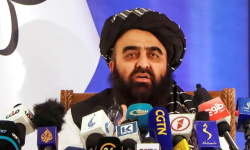
KABUL: Afghanistan aims to increase trade with Central Asian countries to $10 billion within the next three or four years, Foreign Minister Amir Khan Muttaqi said on Sunday.

Trade with Central Asian countries to Afghanistan’s north came to about $2.7 billion in 2025, itself a significant increase over previous years, Muttaqi said.

He stated Afghanistan’s new trade goal with its neighbours at a “constructive dialogue” meeting in Kabul with representatives from Tajikistan, Turkmenistan, Kyrgyzstan, Uzbekistan and Kazakhstan.

The meeting focused on political, economic and security issues, regional cooperation, trade and the expansion of transit routes.

Muttaqi said Afghanistan is seeking to use “its geoeconomic position” to link Central Asia with South and West Asia.
 
The Taliban government is trying to trade with the world, despite international sanctions on its banking sector that make investors wary.

Russia remains the only state to have officially recognised the Taliban authorities, who returned to power in 2021, although countries including Turkey, China, India and the United Arab Emirates have embassies in Afghanistan.

Landlocked Central Asia is trying to regain its historic role as an important trading route. Access to the sea, heading south through Afghanistan, is vital because the route north through Russia is hampered by sanctions.
 
It shares a 2,329-kilometre border with Tajikistan, which has been critical of the Taliban government in the past because of sometimes deadly cross-border incidents.

Muttaqi acknowledged that “certain issues such as the threat posed by the Islamic State group, drug trafficking, and illegal migration are among our shared concerns” but said “there are no longer any security problems along our common borders”.
 

World Bank projects 4pc growth for Afghanistan’s economy in 2026​


by The Frontier Post

image_14.webp


KABUL (Pajhwok): The World Bank has projected that Afghanistan’s economy will grow by 4.0 percent in 2026, driven by stronger domestic demand, higher private investment and the gradual integration of returnees into the labor market.

In its latest report, the World Bank anticipates a 4.0 percent growth for Afghanistan’s economy in 2026, fueled by robust domestic demand, increased private sector investment and better absorption of returnees into the workforce.

The report also highlights that ongoing conflicts in the Middle East could slow economic growth and exacerbate inflation, even if alternative trade routes are partially utilized.

Additionally, the continued return of Afghan migrants from neighboring countries is placing further strain on the economy.

One of the primary risks identified is Afghanistan’s heavy reliance on trade routes through Iran, which account for approximately 60 percent of the country’s total trade. Any disruption—particularly amid the ongoing regional conflicts—could hamper growth and increase inflation, even if alternative routes are partially used.

The report warns that a sudden and large influx of returnees could lead to a further decline in per capita income in the short term, as the labor market struggles to absorb the additional workforce and create sufficient job opportunities.

After a 1.9 percent growth in 2024, Afghanistan’s GDP is expected to accelerate to 4.8 percent in 2025, before moderating slightly to 4.0 percent in 2026. However, per capita growth remained negative in 2025 and is projected to recover only modestly.

The report concludes by noting that Afghanistan’s economy in 2025 will face several external shocks, including a sharp decline in foreign aid, prolonged closures of border crossings with Pakistan, droughts, earthquakes,and the large-scale return of migrants from Iran and Pakistan.
 

$160m Yatim Taq cement plant construction begins in Jawzjan​


by The Frontier Post

Eqtsdi-Mawent-1024x768-1-810x608.jpg


KABUL (Pajhwok): Construction work on the Yatim Taq cement production plant was launched at a cost of $160 million in northern Jawzjan province on Monday, the Office of the Deputy Prime Minister for Economic Affairs said.

Speaking at the inauguration ceremony, Deputy Prime Minister for Economic Affairs Mullah Abdul Ghani Baradar said strengthening domestic industry and supporting local production were essential for economic growth and a gradual transition to a production-based economy, stressing the need to address existing challenges in the sector.

“As part of fulfilling this major responsibility, practical work on this important factory began in Jawzjan today. It will play a significant role in strengthening domestic industry, reducing dependence on imports, and supporting economic growth,” he said.

He added that the Islamic Emirate of Afghanistan (IEA) was focused on strengthening domestic industry and working to shift from exporting raw materials toward domestic processing of resources.

Mullah Baradar called on the international community to enhance engagement with Afghanistan within the framework of formal economic cooperation and to benefit from the country’s “unprecedented security and political stability” and its economic potential.

He said restrictions in the global and regional political and economic environment, the application of exclusionary policies at the international level and the continuation of sanctions could not resolve global political and economic challenges, but instead created threats and reduced opportunities for regional and international cooperation.

According to officials, a Turkish company is investing $160 million in the Yatim Taq cement plant, which will produce 3,000 tonnes of cement per day and create around 5,000 direct and indirect jobs.

The project is expected to be completed within two years.
 

Users who are viewing this thread

Back
Top