Bangladesh Socio-Political Crisis 2024 and onwards

One of the misunderstandings of BD people about Jamat is that they will be like Taliban if they come to power. In reality, I personally think they will run the country like Erdogan, very smartly and tactically prioritizing development. Jamat is the best bet for BD at the moment, I say that at the risk of sounding like a rajakar which I am not.

Running it like Erdogan?
God help Bangladesh then!

Rampant inflation, nepotism and selling oil to Israel to survive!

Islamist parties tend to have fewer external partners due to their extremism.

Fewer external partners means a supply chain bottleneck - result is rampant inflation.

Erdoganism is not even working in a educated and resource rich country like Turkey.

God help when it visits a poorly educated and resource poor country like BD.

@UKBengali
 
Running it like Erdogan?
God help Bangladesh then!

Rampant inflation, nepotism and selling oil to Israel to survive!

Islamist parties tend to have fewer external partners due to their extremism.

Fewer external partners means a supply chain bottleneck - result is rampant inflation.

Erdoganism is not even working in a educated and resource rich country like Turkey.

God help when it visits a poorly educated and resource poor country like BD.

@UKBengali


Jamaat is ok as part of a coalition and as they are relatively less corrupt will put some kind of dampener to the corruption of the larger party.

Erdogan is a total “Islamist” fraud but he has done well supporting the Turkish military industries over the last 2 decades. About the only good thing he has done for Turkey.
 
Who’s in charge in Bangladesh after Sheikh Hasina? Anybody's guess

Does Muhammad Yunus, chief adviser to the interim government, have control over the state of affairs in Bangladesh? Are the student coordinators, who led the movement against Hasina resulting in her fall on August 5 and are now part of the government, allowing him to function freely?

Devadeep Purohit

The Telegraph – November 1, 2024

View attachment 76394


CRISIS CONTINUED: Bangladesh has rid itself of a troubled past, but is yet to discover a clear path into the future.

Close to 90 days after Sheikh Hasina Wazed fled her country to escape waves of street protest, most Bangladeshis seem to be lost on the way ahead. The transition remains an unclear — often fought over — work in progress.

In this chaos, several tantalising questions have reared their heads, with no clear answer to any and uncomfortable possibilities only adding to the miasma of uncertainty.

Does Muhammad Yunus, chief adviser to the interim government, have control over the state of affairs in Bangladesh? Are the student coordinators, who led the movement against Hasina resulting in her fall on August 5 and are now part of the government, allowing him to function freely? Is the Nobel laureate on the same page with the country’s President, Mohammed Shahabuddin? Does Yunus enjoy the confidence of the army chief, Waker-uz Zaman, and vice-versa?

The interim government had taken charge with the promise of undoing all the misdeeds of the “fascist regime” and charting a new course for the Muslim-majority country of over 175 million people.

As the future of a stable Bangladesh, the fastest-growing economy in South Asia for over a decade, critically hinges on the above questions, The Telegraph tried to get answers by talking to a cross-section of people — politicians, bureaucrats, journalists, legal experts and ordinary people — over the phone.

Reality bites

The crux of the response: While a majority of Bangladeshis want “yes” to be the answer to all the above questions, the reality is just the opposite.

“There is major confusion on who is running the government.... Is it the chief adviser or the student coordinators who led the movement against Sheikh Hasina, two of whom are in the government?” said Nurul Haq Nur, president of Gono Odhikar Parishad, a fledgling political party that got its registration in early September.

Nur, a former student leader, had shot into prominence in 2018 when he led a movement demanding reforms in the quota system for government jobs. He had played a role even in the anti-quota protests in July that brought down the Hasina regime.

His answers to the above questions, however, indicate that the young politician — like many other Bangladeshis who had hit the streets in support of the students in July — is upset with the state of affairs in Bangladesh, now helmed by Yunus.

“As the chief adviser, Dr Yunus has power.... But is he exercising it? The other question is, can he exercise it?” he said.

A former minister in the Hasina government, now in hiding, told this correspondent that the main problem in today’s Bangladesh is confusion over whether or not the Constitution is in place.

“The basis of running a state is the Constitution.... After the fall of our government, the Supreme Court gave the opinion that an interim government, to be headed by a chief adviser, could be formed. There was a broad consensus that the Constitution would be upheld. But after Yunus and others took oath as advisers, some said that as a revolution had brought them to power, a lot of reforms, including that to the Constitution, are needed,” he said.

According to the former minister, the first assault on the Constitution came within days of Yunus taking charge. There was an attack on the Supreme Court, which had legitimised the Yunus regime, during which all the judges in the appellate division were forced to resign within 24 hours.

“Since then, there has been no rule of law, and mobocracy has become the order in Bangladesh,” he said.

Chaos in command

Unlike the situation between January 2009 and July 2024, when the Awami League enjoyed complete hegemony over politics and administration, today’s Bangladesh has multiple power centres. With their only binding factor being anti-Hasina politics, their ideological and tactical differences are tumbling out in the open quite often.

Yunus and some of his advisers like Adilur Rahman Khan and Syeda Rizwana Hasan, who had been in the NGO sector and are known as civil society moderates, are running the government primarily with the mandate of the coalition of the students who led the revolt against Hasina. The revolutionary coalition of students is not a homogenous group: a section of them has a Jamaat-e-Islami background while the other faction is ideologically inclined to Leftist Islam.

The Jamaat-e-Islami provides the main ideological direction to the government. Jamaat’s former ally but now adversary, the Bangladesh Nationalist Party --- the main Opposition for over 15 years --- may be on the periphery but has significant clout in the administration because of its mass base.

The army, which has tasted power several times in Bangladesh, is another key player in the political landscape of Bangladesh. At the top, at least on paper, is the country’s President, also the supreme commander of the armed forces.

“Because of their background, one cannot expect these forces to work in tandem.... They are working at cross-purposes and the results are evident,” said a Dhaka-based political observer.

As an example, he mentioned the recent debate on removing the President, a demand of the revolutionary coalition of students with the backing of the Jamaat, which the civil society moderates in the government and the BNP didn’t approve of. The timeline for the next election and whether the Awami League will be allowed to take part in it are two other instances of divergence among the ruling cliques.

“Initially, the BNP wanted an election within three months of the change of guard, but the interim government and the students wanted a longer tenure for the interim regime.... The Jamaat came to their rescue and created a three-year-tenure narrative. The army is talking about a one-and-a-half-year timeframe now and the BNP too is keen on polls by the end of 2025,” the observer said.

“The Jamaat and the student leaders are against the idea of allowing the Awami League to take part in the election, but the civil society moderates and a section in the BNP want a reformed Awami League in the polls.”

With a consensus elusive on these issues, regular “brainstorming” sessions have become the order of the day in Dhaka’s power corridors. Experts representing various interest groups are debating a range of issues like a constitutional revamp and reforms to the police and the judiciary.

“The people of Bangladesh want reform, reconciliation and an inclusive election.... Even if there is a need for changes to the Constitution, an elected government should do it,” a businessman said.

“There is no clarity on what this interim government is up to, as they have so many agendas.... They are wasting time on issues that are hardly of any significance to us.”

The businessman said the Yunus regime had spoiled its image by getting drawn into issues like whether Shakib al Hasan should continue to play for Bangladesh and whether the ilish should be exported to India.

“Then, this needless hounding of businessmen, journalists and dissenters and slapping them with cases.... Ordinary people do not believe the charges on which people are getting arrested,” he said.

Fear factor

The former minister in the Hasina cabinet who spoke to this newspaper held Yunus responsible for this extreme expression of revenge in post-August 5 Bangladesh.

“He had said after taking charge of the government that it would go after those who supported the earlier government.... And the country has seen the consequence — a sense of fear in society,” he said.

The refusal of senior editors, some of whom had been vocal critics of the Hasina regime and welcomed the change of guard, to be interviewed by this newspaper was a confirmation of the sense of fear that has gripped Bangladesh.

“This is not the right time to talk,” said a senior leader of the Jatiya Party, a former ally of the Hasina government that has repositioned itself in recent months.

Several common citizens of Bangladesh told this correspondent that people are scared of the hardcore Islamists in the revolutionary coalition of students, who have been forcing teachers, government officials, judges and even doctors to resign.

“The student leaders have become a menace because they think they are a law unto themselves.... The rule of law was better even when we were ruled by Pakistan as there was a space for opposing voices,” said a septuagenarian who had taken part in the Liberation War of 1971 that led to the formation of Bangladesh.

“Earlier this month, when the student leaders planned to remove the President forcibly by mobilising people outside his official residence, the dramatic fall in their popularity was apparent as barely a few hundred people turned up.”

Repeated attempts to reach Md Sarjis Alam and Hasnat Abdullah, two key student leaders, over the phone and via text messages for their comments on the state of affairs in Bangladesh did not yield any result.

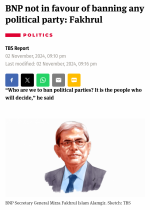
Mirza Fakrul Islam Alamgir, secretary-general of the BNP, however, came to the defence of the student leaders. “They are young boys and you have to consider their age,”he said.

He also said: “Dr Yunus is fully in control and has a fantastic working relationship with the other advisers.... The relationship between all arms of the government, the army chief and the President is absolutely fine. There are vested interests trying to malign the regime.”

The backlash from the silent majority will be epic.

I cannot stand BNP but they will undeservedly suffer the consequences. They will receive much of the blame for the current lot.

No wonder BNP is in a hurry to hold elections.

It suits BAL to have delayed elections - when they can contrast the IG’s record with their’s. And, if Trump is back - then all bets are off.
 
Jamaat is ok as part of a coalition and as they are relatively less corrupt will put some kind of dampener to the corruption of the larger party.

Erdogan is a total “Islamist” fraud but he has done well supporting the Turkish military industries over the last 2 decades. About the only good thing he has done for Turkey.

you might have less corruption but at what cost?

Lower growth, higher inflation, bellicose foreign policy, Islamism?

There’s a reason why BD people don’t like the Mullahs.
 
you might have less corruption but at what cost?

Lower growth, higher inflation, bellicose foreign policy, Islamism?

There’s a reason why BD people don’t like the Mullahs.


They won’t interfere too much in foreign and economic policies.

Of course they will extract a price in terms of more funding for the areas they care about like more Madrassas etc but this will only be a small part of the budget and will be a drop in the ocean of secular society.

It is ok and Jamaat being in coalition is better for the “dampening” effect on corruption they will have.
 
They won’t interfere too much in foreign and economic policies.

Of course they will extract a price in terms of more funding for the areas they care about like more Madrassas etc but this will only be a small part of the budget and will be a drop in the ocean of secular society.

It is ok and Jamaat being in coalition is better for the “dampening” effect on corruption they will have.

More madrasas?

So even more illiterate and poorly qualified youth?

A ticking time bomb for the future!

More spouting of nonsense over loudspeakers at all hours of the day disturbing kids trying to study!

I don’t like your devil’s bargain.
 
More madrasas?

So even more illiterate and poorly qualified youth?

A ticking time bomb for the future!

More spouting of nonsense over loudspeakers at all hours of the day disturbing kids trying to study!

I don’t like your devil’s bargain.


Like I say it will be a drop in the ocean.

95% of BD population are secular and will not send their children to Madrassas.

We need to chill about this as Jamaat are kind of mild religious party and do not have even significant minority support in BD - if BNP/AL were better parties then they will only get low single digit vote in elections.
 
Like I say it will be a drop in the ocean.

95% of BD population are secular and will not send their children to Madrassas.

We need to chill about this as Jamaat are kind of mild religious party and do not have even significant minority support in BD - if BNP/AL were better parties then they will only get low single digit vote in elections.

Trying to impose a “clean politician” on BD is akin to chucking a white towel on mud and expecting it to stay clean.

BAL and BNP are reflection of the BD population.

It really is true!

You always get the politicians you deserve.

There’s no BNP/BAL in US/U.K. - have you seen the amount of animosity even in masque committees lol

Intolerance of plurality is the disease. Making crap up is another.
 
Trying to impose a “clean politician” on BD is akin to chucking a white towel on mud and expecting it to stay clean.

BAL and BNP are reflection of the BD population.

It really is true!

You always get the politicians you deserve.

There’s no BNP/BAL in US/U.K. - have you seen the amount of animosity even in masque committees lol

Intolerance of plurality is the disease. Making crap up is another.

'clean politician' in Bangladesh. Isn't that like an oxymoron? The thing doesn't exist in reality.

To be a politician in Bangladesh takes a certain type of individual who is not generally reflective of the general population.

If a clean politician was to come along and work for the national interest rather than foreign powers (and his own personal aggrandizement and fame) he would be killed even before he reached the mud.
 
'clean politician' in Bangladesh. Isn't that like an oxymoron? The thing doesn't exist in reality.

To be a politician in Bangladesh takes a certain type of individual who is not generally reflective of the general population.

If a clean politician was to come along and work for the national interest rather than foreign powers (and his own personal aggrandizement and fame) he would be killed even before he reached the mud.
'clean politician' in Bangladesh. Isn't that like an oxymoron? The thing doesn't exist in reality.

To be a politician in Bangladesh takes a certain type of individual who is not generally reflective of the general population.

If a clean politician was to come along and work for the national interest rather than foreign powers (and his own personal aggrandizement and fame) he would be killed even before he reached the mud.

Agree 1000%!

Hence the pontifications of our keyboard warriors and “netizens” really makes me laugh.

What corrupt and intolerant societies like BD needs are people who can get things done.

And hope the society evolves gradually where it is able to incubate “clean politicians”.
 
More madrasas?

So even more illiterate and poorly qualified youth?

A ticking time bomb for the future!

More spouting of nonsense over loudspeakers at all hours of the day disturbing kids trying to study!

I don’t like your devil’s bargain.

Madrassahs are a key reason why BD education rate went up over the years. Especially in rural communities. I have seen people studying through Madrassah route and eventually attending top universities in North America. They do study the conventional syllabus apart from religious studies. This is why even Hasina didn't try to get rid of Madrassahs.

What needs to be done is fund the Madrassahs to be able to teach STEM and English better, in addition to Religion.
 
1000027090.png


BNP leadership is seriously compromised and it is increasingly becoming evident. Their senior leaders have no coordination and unity and contradicts each other. I am anticipating there will be a split within BNP if the likes of Mirza Fakhrul continue with BNP. As many have been calling out for sometime now, BNP is going to become BAL 2.0 and become the new Indian puppet party, moving away from their original root of independent Bangladeshi Nationalist ideology.

I liked the comment of Jamaat amir on this issue where he joked and said - BAL committed injustice by preventing elections, now if we force BAL to participate in an election, it is also an injustice. Essentially indicating his position that his party doesn't want BAL in next election.
 
Madrassahs are a key reason why BD education rate went up over the years. Especially in rural communities. I have seen people studying through Madrassah route and eventually attending top universities in North America. They do study the conventional syllabus apart from religious studies. This is why even Hasina didn't try to get rid of Madrassahs.

What needs to be done is fund the Madrassahs to be able to teach STEM and English better, in addition to Religion.

I am not going to dispute your claim that Madrasas played a role in increasing literacy.

I have some very conservative extended family members who would not have sent girls to schools but were ok with Madrasa.

Two of them got married to “Londonis” and managed to pass the language tests albeit after private coaching.

I am against religious schools even in the west.

They toxify society and churn out kids who cannot adjust to the mainstream.

Look at the toxic affect they have had in the US?

There are some madrasas in the U.K. and the products of those also very scary.

Kids have enough challenges at school without burdening them with “religious studies”.
 
I am not going to dispute your claim that Madrasas played a role in increasing literacy.

I have some very conservative extended family members who would not have sent girls to schools but were ok with Madrasa.

Two of them got married to “Londonis” and managed to pass the language tests albeit after private coaching.

I am against religious schools even in the west.

They toxify society and churn out kids who cannot adjust to the mainstream.

Look at the toxic affect they have had in the US?

There are some madrasas in the U.K. and the products of those also very scary.

Kids have enough challenges at school without burdening them with “religious studies”.

I get your point even though I don't necessarily agree with them due to the role religion plays in my personal life. But we can agree to disagree.

My personal view is that we need to understand our religion better, and that way it makes our society less susceptible to falling prey to fake preachers who preach corrupted interpretation of the religion. The best way to counter religious extremism is through proper understanding of the religion in my opinion. That's why religious education still has a very relevant place in our society.

As for religious schools in the West, the issue of getting children isolated from the general society can easily be fixed by active parenting. Take the kids to library or sports programs where they mingle with kids from other communities. That way kids grow up seeing both sides of the world instead of living in a bubble. But most desi parents, especially from the previous generations weren't that active when it comes to parenting, which resulted in the problems you noted.
 
I get your point even though I don't necessarily agree with them due to the role religion plays in my personal life. But we can agree to disagree.

My personal view is that we need to understand our religion better, and that way it makes our society less susceptible to falling prey to fake preachers who preach corrupted interpretation of the religion. The best way to counter religious extremism is through proper understanding of the religion in my opinion. That's why religious education still has a very relevant place in our society.

As for religious schools in the West, the issue of getting children isolated from the general society can easily be fixed by active parenting. Take the kids to library or sports programs where they mingle with kids from other communities. That way kids grow up seeing both sides of the world instead of living in a bubble. But most desi parents, especially from the previous generations weren't that active when it comes to parenting, which resulted in the problems you noted.
I get your point even though I don't necessarily agree with them due to the role religion plays in my personal life. But we can agree to disagree.

My personal view is that we need to understand our religion better, and that way it makes our society less susceptible to falling prey to fake preachers who preach corrupted interpretation of the religion. The best way to counter religious extremism is through proper understanding of the religion in my opinion. That's why religious education still has a very relevant place in our society.

As for religious schools in the West, the issue of getting children isolated from the general society can easily be fixed by active parenting. Take the kids to library or sports programs where they mingle with kids from other communities. That way kids grow up seeing both sides of the world instead of living in a bubble. But most desi parents, especially from the previous generations weren't that active when it comes to parenting, which resulted in the problems you noted.

Problem is parents who send their kids to religious schools do so because they distrust mainstream society.

So, they are the last ones who will take an active role in integrating their kids with the mainstream.
 

Users who are viewing this thread

Pakistan Defence Latest

Back
Top