China Auto Thread


Hongqi HS7 PHEV will start pre-sale on July 11​


Reading Time: 3 minutes

Dong Yi Chen

July 4, 2024


0


News like this to your inbox or phone?​


Weekly summary to your inbox
I want this

Never miss and important news
Get Instant notification once the news is published.
Follow Us

This is Hongqi’s upcoming HS7 PHEV SUV. Its pre-sale will start on July 11 in China, available in two-wheel drive and four-wheel drive variants as well as six- and seven-seater layouts. Currently, the gasoline-powered variant of the Hongqi HS7 is already on the market.

Gasoline-powered variant of the Hongqi HS7Hongqi HS7 PHEV
In the exterior design, the PHEV variant remains largely unchanged compared with the gasoline-powered variant. The front face retains the straight waterfall-style grille and chrome decorations. At the rear, the through-type taillights are forked on both sides, with red light strips on the black lower section inlaid with a chrome strip in the center. There are also dual exhaust outlets on both sides and a “PHEV” tail label.
The Hongqi HS7 PHEV (see spec here) measures 4995/1960/1760 mm, and the wheelbase is 2920 mm, positioned as a medium-to-large SUV. The side features a floating roof design, silver roof racks, chrome outlined windows, traditional door handles, a Hongqi logo under the A-pillar, 20-inch five-spoke rims, and a charging port on the left and right rear fenders, highlighting the car’s positioning as a plug-in hybrid vehicle.

Inside, the overall layout is consistent with that of the gasoline-powered version. At first glance, the vertical large central control screen is eye-catching, coupled with a three-spoke steering wheel, an LCD instrument panel, and a bulky gear lever. The specific dimensions are subject to the official announcement. At the same time, the center console is equipped with a wireless charging panel and a hiddle cup holder.
Additionally, the seats are wrapped in leather materials. The front seats support multi-angle electric adjustment while both the front and rear seats are equipped with heating, ventilation, and massage functions.
Power comes from a plug-in hybrid power system consisting of a 2.0L naturally aspirated engine and an electric motor (model CA4GC20TDH-42), paired with CATL’s 20.14 kWh ternary lithium batteries. The engine has a maximum power of 163 hp and the top speed is 180 km/h. The two-wheel drive variant has a pure electric range of 92 km, and the four-wheel drive version has a pure electric range of 83 km (assuming it is CLTC). Furthermore, the two-wheel drive has a fuel consumption of 5.98L/100km while the four-wheel drive consumes 6.32L/100km.

Source: DongCheDi, AutoHome, CNFOL
 

New Haval H9 with square headlights spied in China​


Reading Time: 3 minutes

Dong Yi Chen

July 4, 2024


0


News like this to your inbox or phone?​


Weekly summary to your inbox
I want this

Never miss and important news
Get Instant notification once the news is published.
Follow Us

On July 3, Great Wall Motor’s new Haval H9 with square headlights was spied testing on Chinese streets. Compared with the launch-pending second-generation Haval H9, the new car has made slight adjustments in appearance. The new Haval H9 is expected to be officially launched at this year’s Chengdu Auto Show, which opens on August 30.

Second-generation Haval H9
Looking at the front face, the most significant difference is that the round headlights of the second-generation Haval H9 have been changed to a square shape and the large grille is filled with black horizontal strips, making it appear more sporty. The dimensions of the new Haval H9 have not been announced at this time. For reference, the previously announced second-generation Haval H9 measures 5070/1960 (1976)/1930 mm with a 2850 mm wheelbase, positioned as a medium-to-large hardcore SUV.
Additionally, it is possible that this new Haval H9 will be launched together with the previously announced second-generation Haval H9 at the Chengdu Auto Show.

From the side, a full black kit is used. The square body, large roof luggage racks, square external mirrors, traditional door handles, and large rims are not absent. It is worth pointing out that the front and rear rims adopt different styles, it may be that because the spied car is a testing vehicle and implies both rims will be offered.
SpyshotSecond-generation Haval H9
Furthermore, the taillights at the rear have also been modified, getting rid of the double ring shape and replaced with a longitudinal rectangular shape. Otherwise, the high-mounted brake light and external rear spare tire remain unchanged, and the tailgate can be opened side way.
Second-generation Haval H9 interior
Although the interior specifications have not been revealed at this time, the cockpit is expected to remain the same with a three-spoke multi-function steering wheel, an instrument panel, a 14.6-inch floating central control screen, and a bulky gear lever.

Furthermore, for reference, the second-generation Haval H9 offers two powertrain variants: 2.0T gasoline engine + 8AT or 2.4T diesel engine + 9AT. The maximum power of the gasoline-powered variant is 165 kW (221 hp) and the peak torque is 385 Nm; while the maximum power of the diesel-powered variant is 137 kW (184 hp) and the peak torque is 480 Nm.
We’ll continue to watch for more information!
Source: QQ, Auto iFeng
 

Xpeng’s smart driving system XNGP gets major upgrade and is claimed to be better than Huawei​


Reading Time: 4 minutes

Mark Andrews

July 4, 2024


0


News like this to your inbox or phone?​


Weekly summary to your inbox
I want this

Never miss and important news
Get Instant notification once the news is published.
Follow Us

Today Xpeng launched a new OTA which includes an upgrade to XNGP. The XOS 5.2.0 Beta version has various user upgrades but the most important for users is the upgrade to the smart driving system. The new capabilities of XNGP are claimed to make the system better than the one offered by Huawei ADS 2.0 in various key areas. There are improvements in 426 situations and these include the ability to cross a roundabout without a map, upgrading the U-turn experience, and also the car’s ability to drive on narrow roads.

The upgrade offers an unlimited XNGP experience allowing AI to drive all over China, furthermore, this is open to almost all users. After enabling intelligent driving a user only needs to set the navigation route and then turn on XNGP and the car can use driving assistance on open roads across the country.
One improved scenario Is the system’s ability to deal with roundabouts. This no longer requires mapping and provides a more natural feeling for the rotation of the steering wheel than the previous version. The system can change lanes within the roundabout and also identify traffic lights at the roundabout, automatically stopping or starting as required. It should be noted that roundabouts are not particularly common in China and neither do drivers have much idea of how to actually negotiate them.

The system’s ability to undertake a U-turn has also been improved. Xpeng CEO He Xiaopeng said, “for the first time I felt that our U-turn was silky smooth.” Through AI models and observation of humans, Xpeng has learned to improve the system which now deals with the U-turn at a speed of about 7 km/h.
For smart driving systems, sudden obstacles can cause a problem, particularly with cars that suddenly stop. XNGP’s ability to deal with such circumstances has improved. Now when a vehicle suddenly stops in front of the car the XNGP system deals with it far more calmly and without an emergency stop. Another common scenario that can give smart driving systems difficulty is where there is an obstacle in the road but also a double yellow line. Most systems will simply refuse to drive or take any action due to the double yellow line. With the new upgrade to XNGP the car will overtake if possible even when faced with the line.
Another new capability for the XNGP system is the ability to deal with ETC gates on highways for paying the toll. The system can now drive smoothly through them without the need for a driver takeover.

Parking ability has been strengthened with the addition of tracking and reversing. Now XNGP has the 2.0 system for parking when not in the car and this greatly improves the success rate of parking.
Xpeng is keen to point out that the system does not replace human drivers completely and that the driver still needs to supervise and take over where necessary. In August last year, the company said it had the technical ability to open the whole country. From January 2024 unlimited XNGP has been open to some media and car owners, however this is now being opened to everyone.
Li Liyun, head of autonomous driving at Xpeng Motors, has said that not all smart driving systems are the same and that there are two development paths. Some companies use a whitelist approach where only certain roads in cities are open along with the system only being open to certain users. For others, there is a blacklist where all areas except secret areas are open and it is open to all users. Xpeng Is of the latter group. The system is available on all Max versions of Xpeng models including the P7i, G6, G9 and X9.

Editor’s note:​

Last year we got to experience the initial version of Xpeng’s XNGP and were quite impressed by the way it worked on the city roads in Shanghai but were less impressed when experiencing it in Guangzhou. One issue we did have in Shanghai was when the car made a U-turn. While it didn’t necessarily make a bad job of it, it went into a lane and then had to immediately do another lane change to get into the correct lane to enter a tunnel. We are interested to see whether the new system improves such situations. Equally in Guangzhou at one point we had to take over because a car blocked the road and we had to overtake it. From what we know the new system should be able to handle such a situation.
Sources: Autohome, Fast Technology
 

BYD Song L DM-i is a 112km CLTC all-electric range SUV plugin hybrid​


Reading Time: 3 minutes

Mark Andrews

July 4, 2024


0


News like this to your inbox or phone?​


Weekly summary to your inbox
I want this

Never miss and important news
Get Instant notification once the news is published.
Follow Us

It is only a month since we first brought you spy shots of a new BYD plugin hybrid SUV. Since then the story has moved quickly, we know the car is called the Song L DM-i and we now know that the CLTC all-electric range is 112 km as the car prepares to launch in the second half of this year. Current estimates of price put the new car in the 150,000 to 180,000 yuan range (20,650 – 24,750 USD).

The BYD Song L uses the company’s DM 5.0 technology. For the Song L, the system uses the original 74 kW 1.5 engine as used in the Qin L and the Seal 06 DM-i (see specs) cars in conjunction with a 160 kW electric motor. Buyers have a choice from 18.316 and 26.593 kWh capacity battery packs. Using WLTC testing these give all-electric ranges of 91 km and 128 km respectively. The CLTC range is reportedly 112 km. Batteries are of course from BYD subsidiary FinDreams and are the blade lithium-ion phosphate battery.
When BYD’s DM 5.0 technology was released there were three key metrics 46.06% thermal efficiency, 2.9 /100 km fuel consumption, and 2,100 km range. While the engine’s thermal efficiency remains the same, other metrics are different from the larger SUV Song L to what the Qin L (see specs) and Seal 06 DM-i cars can achieve. Official WLTC Fuel consumption figures are 4.95 and 4.98 l/100 km respectively according to the two different battery pack sizes. It should be remembered that the 2.9 l/100 km claimed by BYD for the system was firstly with the smaller lighter cars and secondly uses CLTC rather than WLTC.

The Song L measures In at 4780, 1898, 1670 mm (l/w/h) and the wheelbase is 2782 mm. Although the car bears the name Song L It has little relationship to the pure electric car with the same name. It most likely uses the same platform as the Qin L, which has a slightly longer wheelbase of 2790 mm.
At the front, the Song L DM-i adopts the dragon face design language and has a large front grill and narrow headlight clusters. The side is relatively simple and has hidden door handles. At the back there are through-type tail lights with 6 dragon scales inside, and the car also has the split rear spoiler similar to the original Song L.
From previous spy shots we can see that the interior of the Song L DM-i is quite similar to the Qin L DM-I. There’s a large floating central infotainment screen most likely 15.6 inches along with a fully digital embedded instrument panel. We can also see a four-spoke steering wheel which is typical of the dynasty family. There is a wireless phone charging pad with 15-watt power and the leather seats are sports style.

Although there is currently no confirmed combined range figure Chinese sources estimate 2000 km, We will bring you more information about the song L DM-i in the run up to its launch later this year.
Sources: Autohome, Fast Technology
 

China’s EV registrations in Germany in June: Nio 44, BYD 425, MG 5,158​


Reading Time: 3 minutes

Jiri Opletal

July 4, 2024


0


News like this to your inbox or phone?​


Weekly summary to your inbox
I want this

Never miss and important news
Get Instant notification once the news is published.
Follow Us

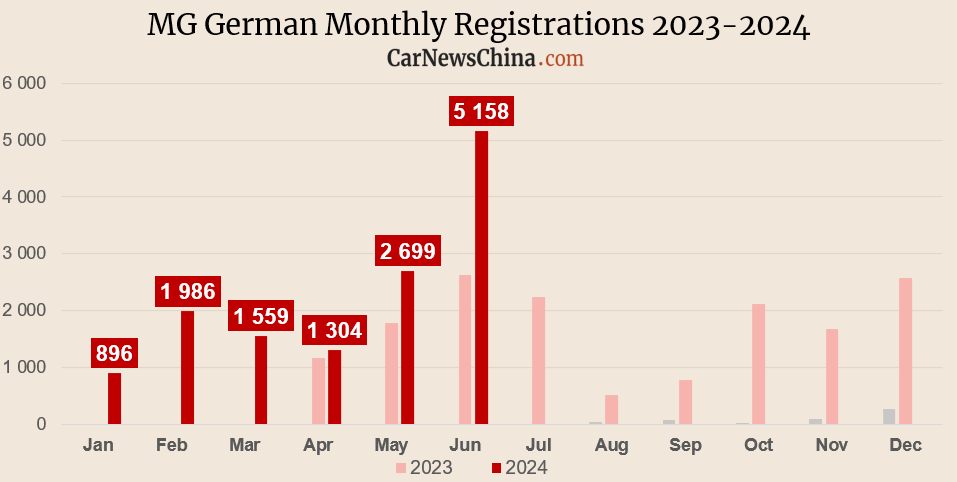
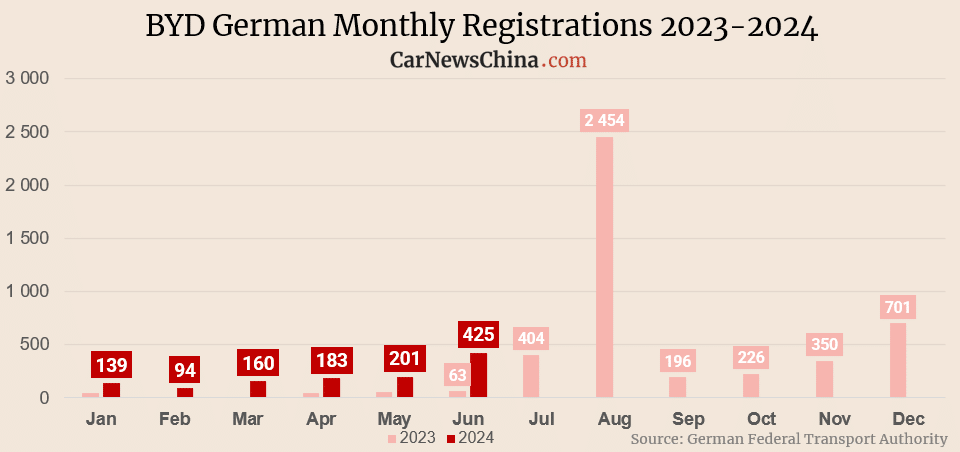
In June, Chinese EV sales in Germany were mostly up, with Polestar being the exception. Nio EV registrations rose 25%, BYD was up 100%, and MG 90% compared with the previous month.

In June, 297,329 passenger vehicles were registered in Germany, up 6.1% from the previous year. 14.6% were battery electric vehicles (BEV), which translates to 43,412 units, down 18.1% from last year. Plug-in hybrid vehicles (PHEV) registered 15,391 units, down 3.4% from the previous year.
Chinese brands registered 8,000 EVs in Germany in June, up 54% from May. The China EVs market share among electric vehicles (BEV + PHEV) reached 14%.

The data are published by the German Federal Motor Authority, which tracks new car plate registrations in the country, and compiled by CarNewsChina.
As usual, MG takes the first spot. It registered a record-breaking 5,158 vehicles, up 91,11% from 2,699 units the month before and 96% from 2,633 the year before.
In the first half of the year, between January and June, MG registered 13,602 vehicles in Germany, up 44.7% from the same period in 2023.


Smart registered 1,626 vehicles, up 7.75% from 1,509 units the month before and down 4.7% from last year. In the first half of the year, Smart registered 8,549 vehicles, up 3.4% from the same period in 2023.
Smart is a brand under Geely Holding that is co-engineered with Mercedes-Benz. According to the company, the Smart EVs are designed by Mercedes-Benz’s global design team, while Geely is responsible for the engineering and developing the new models. Smart cars are produced in China at Geely’s Xi’an plant, which started production in October 2021.
BYD registered 425 vehicles, up 111.44% from 201 units the month before and up 575% from 63 the year before. In the year’s first half, BYD registered 1,202 vehicles, up 427.2% from the same period in 2023.

Polestar registered 334 vehicles, down 19.32% from 414 units the month before and 65% from 950 the year before. In the first half of the year, Polestar registered 1,585 vehicles, down 49.8% from the same period in 2023.
All Polestar EVs are China-made in Geely plants, mainly in Chengdu and Hangzhou.
GWM and its EV brand Ora registered 297 vehicles, up 10.82% from 268 units the month before and up 52% from 196 units the year before. In the year’s first half, GWM registered 1,375 vehicles, up 118.9% from the same period in 2023.
Nio registered 44 vehicles, up 25.71% from 35 units the month before and down 70% from 145 units the year before. In the year’s first half, Nio registered 234 vehicles, down 33.1% from the same period in 2023.
In June, Nio German CEO Marius Hayler stepped down after only eight months in the office and joined Polestar as a director for the Norwegian market. In 2023, Nio registered 1263 vehicles in Germany.
Nio will introduce its mass-market brand Onvo in Europe at the beginning of next year. This will be followed by an entry-level brand codenamed FireFly and its sub-30,000 EUR electric hatchback in 2025. Initially, Firefly was planned to launch in Europe, but after disappointing sales on the Old continent, Nio will launch the brand in China by the end of the year and bring it to Europe later.

Lotus registered 35 vehicles, up 20.69% from 29 units the month before and up 13% from 31 units the year before. In the first half of the year, Lotus registered 153 vehicles, down 0.6% from the same period in 2023.
Aiways registered 16 vehicles, up 300.00% from 4 units the month before and up 7% from 15 units the year before. In the year’s first half, Aiways registered 23 vehicles, down 41.0% from the same period in 2023.
Lynk&Co registered 12 vehicles, up from 1 unit the month before and down 91% from 130 the year before. In the first half of the year, Lynk&Co registered 40 vehicles, down 97.6% from the same period in 2023.
Maxus registered 10 vehicles, down 23.08% from 13 units the month before and up 100% from 5 the year before. In the first half of the year, Maxus registered 44 vehicles, up 214.3% from the same period in 2023.
On June 12, the EU announced additional tariffs on Chinese EVs: BYD 17.4%, Geely 20%, and SAIC 38.1%. These tariffs are on top of the existing 10% duties and will take effect on July 4.
 

BYD Dolphin assembled in Thailand as BYD’s 8 millionth NEV​


Reading Time: 3 minutes

Denis Bobylev

July 4, 2024


0
byd 8 millionth car nev thailand byd dolphinBYD 8 millionth NEV rolled off the production line in Thailand

News like this to your inbox or phone?​


Weekly summary to your inbox
I want this

Never miss and important news
Get Instant notification once the news is published.
Follow Us

On July 4, the right-hand drive BYD Dolphin electric hatchback rolled off the production line in Thailand as the BYD’s 8 millionth NEV. The car was delivered to its owner by BYD Chairman Wang Chuanfu. It took BYD 16 years to produce 8 million new energy vehicles.

BYD Thailand plant
The 8 millionth BYD NEV has rolled off the production line in Thailand. The construction of this facility started in March 2023. And it took a bit less than 16 months to start operating. Moreover, CarNewsChina reported that the trial production at this plant got going in the spring. The plant in Thailand is the first wholly-owned BYD facility overseas. It has a planned production capacity of 150,000 units per year.

BYD 8 millionth car​

BYD manufactured the first plug-in hybrid electric vehicle in 2008. It was the Corolla-based F3 DM sedan. 13 years later, in 2021, BYD rolled off the 1 millionth car, which appeared to be the BYD Han EV. In 2022, BYD quit manufacturing ICE cars, focusing on BEVs and PHEVs. This step helped BYD to leverage its production volume. As a result, it took BYD 12 months to produce the 2 millionth car, and 6 months to make the 3 millionth NEV. The 7 millionth new energy car came off the assembly line on March 24, 2024. 4 months later, BYD produced the 8 millionth NEV.

BYD Chairman Wang Chuanfu (on the right) handed over the 8 millionth BYD Dolphin to its owner
On July 4, the BYD Thailand plant officially started mass production. At the same time, it has manufactured the BYD’s 8 millionth NEV. It appeared to be the BYD Dolphin electric hatchback finished in gray. BYD Chairman Wang Chuanfu handed over the 8 millionth Dolphin’s keys and the certificate to the owner. It is an international variant of the BYD Dolphin, also called the “European version”. It is bigger than the domestic Dolphin (see specs) and has other powertrain options.
The BYD Dolphin for Thailand is a compact car with dimensions of 4290/1770/1570 mm with a wheelbase of 2700 mm. It’s built upon the e-Platform 3.0 architecture and offers up to 490 km range, thanks to a 60.5 kWh LFP battery. The peak power of the Dolphin is 150 kW (201 hp), suitable for zero-to-hundred acceleration in 7 seconds. The starting price of the BYD Dolphin in Thailand is 699,999 baht (19,100 USD).

BYD business in Thailand​

BYD Thailand plant
It is worth noting that BYD is the bestselling EV brand in Thailand. In 2023, it delivered 30,650 cars to its owners. In January-May 2024, BYD sold 12,902 units. The result isn’t remarkable. However, car sales declined in Thailand due to economic conditions, including high loan rejection rates. The factory in Thailand will help BYD to lower retail prices. BYD’s model line in the Kingdom comprises three cars: Dolphin, Atto 3 (Yuan Plus), and Seal.

The production capacity of the Thai plant is 150,000 cars annually. Initially, this plant aims to satisfy the demand of local buyers. But later, it will extend to neighboring ASEAN countries and beyond. We will remind you that BYD also has a JV plant in Uzbekistan with an annual production capacity of 50,000 cars. Another facility is in India, with a capacity of 15,000 units. Other projects of BYD include factories in Indonesia, Brazil, Mexico, and Hungary.
Source: BYD
 

BYD Seal 06GT spotted road-testing, a hot hatch to hit global markets in 2025​


Reading Time: 3 minutes

Adrian Leung

July 4, 2024


0


News like this to your inbox or phone?​


Weekly summary to your inbox
I want this

Never miss and important news
Get Instant notification once the news is published.
Follow Us

The Seal 06GT is BYD’s next fully electric vehicle built on the new e-platform 3.0 Evo. The same platform was found on the Sea Lion 07 (see specs) that we tested earlier. The Seal 06GT stands between the Dolphin and Seal (EV) models, marking itself the biggest hatchback in BYD’s lineup. It is expected to cost 150,000 to 200,000 yuan (20,600 – 27,500 USD).

This cutting-edge model, a new addition to the BYD Ocean series, is set to hit the market in the third quarter of this year. Besides being available in blue (as shown in previous spy shots), new leaked photos indicate the new car will be offered in green, black, and orange paint.
The Seal 06GT, the production version of the BYD Ocean-M concept car, similar to other Seal models, embraces marine aesthetics. It has a closed front design, a three-segment bumper, black honeycomb decorations, and L-shaped air vents. The side profile is clean and elegant, featuring hidden door handles and black accents on the B and C pillars, creating a floating roof effect. The rear has a continuous light strip, a two-stage spoiler, and a rear bumper design that mirrors the front, complete with a diffuser.

According to registration data, the Seal 06GT measures 4630mm in length, 1880mm in width, and 1490mm in height, with a wheelbase of 2820mm. It offers a choice of stylish 18-inch or 19-inch wheels. Inside, it boasts a floating central control screen and a fully digital instrument panel, with the steering wheel and auxiliary instrument panel designed in line with other Ocean series models. It also features integrated sports seats for an added touch of dynamism.
The Seal 06GT offers two power configurations: a single-motor rear-wheel drive and a dual-motor all-wheel drive. The single-motor variant provides two power levels, with maximum outputs of 160 kW and 165 kW. The dual-motor version delivers a front axle power of 110 kW and a rear axle power of 200 kW. Buyers can choose between 59.52 and 72.96 kWh battery packs, promising impressive CLTC ranges of 505 km, 605 km, and 550 km, respectively. The 550 km range is for the all-wheel-drive model.
The Seal 06GT is a fully electric, sporty hatchback that fills a unique spot in the compact car market. Initial sales will commence in China in this year’s third/fourth quarter, and exports are anticipated for early 2025.

Editor’s note:
I recently tested the Sea Lion 07 (see specs) on the latest e-Platform 3.0 Evo. The new platform provides a lively experience for the driver. I look forward to the release of the Seal 06GT, which will have aggressive pricing to compete with other hot hatches such as the Smart #1 Brabus, Smart #3 Brabus, and the MG4 X-Power.
 

Huawei and BAIC to sell 120,000 units of EQS rival Stelato S9 yearly​


Reading Time: 4 minutes

Denis Bobylev

July 4, 2024


0
stelato s9 sedan front side redStelato S9 sedan from BAIC and Huawei

News like this to your inbox or phone?​


Weekly summary to your inbox
I want this

Never miss and important news
Get Instant notification once the news is published.
Follow Us

Huawei and BAIC plan to sell 120,000 units of the Stelato S9 high-end electric car yearly, starting from 2025. This car aims to rival the Mercedes-Benz EQS. It will start deliveries in January 2025 with a price range of 450,000 – 550,000 yuan (68,900 – 76,650 USD).

Stelato is a joint project between Huawei and BAIC. In this project, the Chinese IT giant supplies software and certain parts. BAIC is in charge of platform and manufacturing. This model of cooperation is quite common for Huawei. It works with Chery, JAC, and Seres in the same way. Back to Stelato, the first car under this brand is the S9 luxury sedan. Huawei & BAIC have big plans for it.

Stelato S9’s production volume​

BAIC BluePark’s (NEV subsidiary of BAIC) internal documents revealed insights about the production volume of the Stelato S9. The mass production of this model will kick off in December 2024 with a capacity of 120,000 units per year. It is an ambitious goal for the car with a starting price of 70K USD.

BAIC BluePark
Previously, the official launch ceremony of the Stelato S9 was scheduled for August this year. Four months before the volume production starts. We reckon that Huawei & BAIC want to reveal the final pricing of their first product and check feedback from potential customers. It is a vital thing to do before the production starts. If they miscalculate the demand for such an expensive car, it will be fatal for the entire project.
HIMA stores from Huawei currently sell Aito and Luxeed cars
The goal of selling 120,000 units of a high-end product under a new name yearly is quite ambitious. However, BAIC & Huawei rely on the IT giant’s sales network. Stelato S9 will be available for purchase in Huawei flagship stores and HIMA (Harmony Intelligent Mobility Alliance) stores. At the same time, Huawei has proven it can convince people to buy an expensive product by selling 59,539 units of Aito M9 SUV (see specs) from February to June 2024. The starting price of this crossover is 469,800 yuan (64,600 USD). So, the S9’s production volume is reasonable.

Stelato plans​

It seems Huawei and BAIC are quite confident in the S9’s success because they are already working on two more cars under the Stelato brand. One of them is the station wagon variant of the S9 sedan. It adopts the same BE22 modular architecture. Since wagons aren’t in demand in China, the second car from Stelato may have strong overseas ambitions.

Unofficial render image of Stelato S9 tation wagon
The third model from Stelato is a luxury SUV. There is no further information about this car. Most likely, it will also share the platform with the Stelato S9. And it won’t be cheap.

More about Stelato S9​

Stelato S9 stands on the BAIC BE22 modular architecture. It is a large sedan with dimensions of 5160/1987/1486 mm and a wheelbase of 3050 mm. For clarity, it is 56 mm shorter, 61 mm wider, and 26 mm lower than the Mercedes-Benz EQS. The exterior design of the Stelato S9 stays in line with other Huawei-backed cars like Aito M9 and Luxeed S7 (see specs).
Inside, the S9 adopts a four-seat layout. The center console has a large floating screen, an LCD instrument cluster, and an additional touchscreen for a front passenger. The S9 has optional rear-view cameras. Its second-row adopts two more screens and zero-gravity seats.
The Stelato S9’s powertrain has three options:
  • RWD, 227 kW (304 hp), 79.9 kWh LFP battery, 665 km range (CLTC)
  • RWD, 227 kW (304 hp), 97.6 kWh ternary NMC battery, 721 km range (CLTC)
  • 4WD, 385 kW (516 hp), 97.6 kWh ternary NMC battery, 672 km range (CLTC)
As mentioned, the trims and prices of the Stelato S9 will be revealed in August. However, the mass production of the car starts in December this year. So, the first buyers will likely get their cars in January next year.
Source: BAIC BluePark, MIIT, Weibo
 

Xpeng CEO criticizes auto industry’s lack of focus on technology​


Reading Time: 2 minutes

Naveed Rastegar

July 4, 2024


0


News like this to your inbox or phone?​


Weekly summary to your inbox
I want this

Never miss and important news
Get Instant notification once the news is published.
Follow Us

On the afternoon of July 3rd, in a live-streamed global debut of the Xpeng MONA M03, Xpeng Chairman He Xiaopeng shared his candid views on the current state of the automotive industry. Reflecting on his decade-long journey in the sector, He expressed concern that the industry prioritizes business and marketing over technological innovation.

He Xiaopeng noted that when he first entered the automotive industry ten years ago, there was minimal change in fuel technology. This stagnant environment allowed companies to profit without significant innovation. However, over the past decade, Xpeng has pursued numerous technological advancements. Despite these efforts, He observed that many players in China’s automotive market still prioritize product and marketing strategies over genuine technological progress.
He Xiaopeng remarked, “Integrating technology quickly can lead to success, but it lacks the joy of true innovation. It feels more like a business than a passion.” He emphasized the importance of balancing learning from others with a commitment to deep technological innovation.

Looking ahead, He expressed his hope that Xpeng will continue to approach the next decade with sincerity and a strong focus on technological advancements, aiming to bring more innovations to the market and China.
In his address, he spoke at length about the new Mona M03. This car is a new series under the Xpeng brand. This compact pure electric vehicle measures 4780/1896/ 1445 mm, with a wheelbase of 2815 mm. The trunk offers a spacious 621 liters, comparable to a mid-size SUV.
A significant focus for the Mona M03 was reducing aerodynamic drag. The vehicle underwent 10 extensive wind tunnel tests lasting over 100 hours, optimizing 15 key areas. These efforts reduced the drag coefficient by Cd 0.085, resulting in a claimed 60 km range increase.

Few new details were provided about the powertrain, but it was confirmed that the Mona M03 will offer a choice between 140 kW and 160 kW electric motors, with a top speed of 155 km/h. The car employs BYD blade lithium iron phosphate batteries, available in versions with a range of either 515 km or 620 km.
Xpeng announced that the Mona M03 will be priced under 200,000 yuan (approximately 27,400 USD), with the final price to be revealed in August during its official launch.
Source: Zaker and GSAUTO
 

2024 NIO EC7 The most luxury Chinese Electric Coupe Review | NIO | Chinese Ev​


To view this content we will need your consent to set third party cookies.
For more detailed information, see our cookies page.
 

2025 VOLVO EM90 Electric MPV 738km Range review | Volvo | Geely | ZEEKR 009​


To view this content we will need your consent to set third party cookies.
For more detailed information, see our cookies page.
 

2024 All-New NIO ES8 Luxury Electric 6-seater range 605km review | Nio | China​


To view this content we will need your consent to set third party cookies.
For more detailed information, see our cookies page.
 

2024 HONGQI HQ9 PHEV 833km Range Under $50k | Better than VOLVO EM90 ?​


To view this content we will need your consent to set third party cookies.
For more detailed information, see our cookies page.
 

2024 NIO ES6 Luxury Electric Suv 625km range under $55k | Nio | China​


To view this content we will need your consent to set third party cookies.
For more detailed information, see our cookies page.
 

2024 HONGQI H9 Luxury Chinese S-Class for $40k | HONGQI | China​


To view this content we will need your consent to set third party cookies.
For more detailed information, see our cookies page.
 

Users who are viewing this thread

Latest Posts

Back
Top