China Auto Thread


Hongqi HS3 PHEV will start pre-sale in August in China​


Reading Time: 3 minutes

Dong Yi Chen

July 19, 2024


1


News like this to your inbox or phone?​


Weekly summary to your inbox
I want this

Never miss and important news
Get Instant notification once the news is published.
Follow Us

On July 17, the plug-in hybrid version of the Hongqi HS3 compact SUV made its debut at the Hongqi Fan Festival held in Changchun, China. The expected pre-sale start date is in August.

The wheelbase of the Hongqi HS3 PHEV is 2770 mm, and the overall dimensions are 4655/1900/1668 mm, which are the same as the current gasoline-powered variant. Power comes from a plug-in hybrid system that combines a 1.5T engine with an electric motor, paired with CATL battery packs. The engine has a maximum power of 124 kW (166 hp). The official pure electric range is 115 km and the comprehensive range is 1,100 km. At this time, the detailed specifications have not been officially revealed.
Hongqi HS3 gasoline-powered variantHongqi HS3 PHEV
For the exterior, the PHEV variant continues the design of the gasoline-powered variant, featuring a large waterfall grille with the Hongqi logo running through the front hood, further highlighting its brand identity. The front fenders are also equipped with the Hongqi logo. Two rim sizes are available: 19 and 20 inches.

Declaration images from the Chinese MIIT
The rear adopts a through-type taillight group. The PHEV label has been added to the lower right to indicate its status, according to the declaration images from the Chinese MIIT.
Furthermore, the cockpit has a symmetrical layout and a “zero formaldehyde” interior. There is a multi-function steering wheel, a 12.3-inch full LCD instrument panel, and a 12.6-inch vertical central control touch screen. The air-conditioning outlets are integrated on both sides of the screen. At the same time, a 40W mobile phone wireless charging function and intelligent driving assistance system are not absent.
Earlier in 2023, Hongqi announced its “All in New Energy” initiative to promote the electrification of all models. Xu Liuping, chairman of FAW China, said that starting from the second half of 2022, all of Hongqi’s new technology innovation investment and production capacity will be used on new energy vehicles, except for special-purpose vehicles.

By 2025, Hongqi aims to sell one million vehicles annually, of which new energy vehicles will account for more than 50% of the sales. By 2030, Hongqi targets to sell more than 1.5 million vehicles, of which new energy vehicles will become the main sales force.
Source: Hongqi Weibo, Sohu
 

Zeekr X launched in China’s international hub, Hong Kong, with RHD​


Reading Time: 3 minutes

Adrian Leung

July 19, 2024


0


News like this to your inbox or phone?​


Weekly summary to your inbox
I want this

Never miss and important news
Get Instant notification once the news is published.
Follow Us

Zeekr, Geely’s premium EV brand, has unveiled the Zeekr X (see specs) compact SUV in Hong Kong following its launch in Thailand on July 11. Hong Kong is recognized as China’s international hub, and this rollout highlights Zeekr’s commitment to global expansion.

On July 17, Zeekr introduced two variants of the right-hand drive version of the Zeekr X: a single-motor rear-wheel drive version and a dual-motor four-wheel drive version. The single-motor variant, priced at 249,900 HKD (32,00 USD), boasts a peak motor power of 200 kW with 343 Nm of torque and accelerates from 0 to 100 km/h in 5.6 seconds. At 269,900 HKD (34,600 USD), the dual-motor version offers a combined peak motor power of 315 kW with 543 Nm of torque, achieving 0 to 100 km/h in 3.8 seconds. Both models feature a 66 kWh battery pack, providing a WLTP range of 440 and 420 kilometers, respectively.
The Zeekr X is equipped with five cameras, five millimeter-wave radars, and 12 ultrasonic sensors. It also features Zeekr AD driving assistance, which offers adaptive cruise control and lane change assist functions. Inside, the Zeekr X features an 8.8-inch LCD instrument panel, a 24.3-inch head-up display, and a sliding 14.6-inch central infotainment screen that can move in front of the passenger.

Hong Kong residents can experience these innovative vehicles firsthand starting July 20 at Zeekr showrooms, including the Zeekr Space in Wanchai and the Zeekr Gallery in Taikoo Shing.
Based on Geely’s Sustainable Electric Architecture (SEA), the Zeekr X measures 4450/1836/1572 with a wheelbase of 2750 mm. The model was initially launched in the Chinese mainland on April 12, 2023, with three variants, and subsequent updates have refined it further.
Zeekr is making the Zeekr X an international model, with pre-sales for the right-hand drive version starting in Thailand on March 25 and the official launch on July 11. The first right-hand drive SUVs rolled off the production line on June 6, with deliveries expected in the third quarter. Already in over 25 markets, Zeekr aims to expand to 50 within 2024. At the Hong Kong event, Vice President Chen Yu emphasized this growth strategy, highlighting Zeekr’s innovative spirit and global ambitions with the Zeekr X and the upcoming Zeekr 009.

Stay tuned for tonight’s Zeekr 009 launch. Car News China will cover the event on location at the AsiaWorld Expo in Hong Kong.
 

Robotaxis make friends and enemies on the streets of Wuhan​


Reading Time: 4 minutes

Mark Andrews

July 18, 2024


1


News like this to your inbox or phone?​


Weekly summary to your inbox
I want this

Never miss and important news
Get Instant notification once the news is published.
Follow Us

Only Apollo Go gives way to pedestrians in Wuhan, joke the city’s citizens. Unfortunately, the Baidu driverless taxis were not so good at giving way last week when one hit an e-bike rider running a red light.

Earlier this year, we reported on Baidu’s launch of its sixth generation robotaxi, the RT6, which costs less than a Xiaomi SU7. Plans call for 1,000 of the RT6 robotaxis to be deployed on the streets of Wuhan by the end of 2024. Currently, Apollo Go operates more than 500 robotaxis of varying generations on the streets of Wuhan, the capital of Hubei province.
To say that the robotaxis of Wuhan are having a mixture of reactions is an understatement. The only comment on our previous article about the RT6 robotaxi was one complaining about traffic being clogged up on the streets of Wuhan due to the robotaxis. Many in Wuhan feel this way, and another area for complaint is from drivers who believe they are suffering financially because of them.

Taxi drivers are petitioning Wuhan to limit the use of Apollo Go. One operator said that four of its 159 drivers had quit since April. It’s believed that Apollo Go, at its peak, received an average of 20 orders per day per vehicle. China News Weekly quotes a Beijing ride-hailing driver as saying that these days, he usually gets 16 or 17 orders a day, but two or three years ago, 20 orders a day was not much.
Although there may be an issue with the robotaxi service charging less than regular ride-hailing services, the real issue is more likely the state of the economy. Robotaxis make up only around one percent of the taxi and ride-hailing fleet in Wuhan, so they alone cannot be the reason for falling driver income.
Wuhan’s robotaxis have so far accumulated more than 300 complaints on an official traffic management website. Many of those complaints are about the robotaxis causing an obstruction and being slow to react to events such as traffic lights. There have been many problems with robotaxis not being able to get into the correct lane, mainly due to their interaction with human drivers on the road. Luobo, as Apollo Go is known in Chinese, which means radish, has become synonymous in the Wuhan dialect with being stupid and naïve. A recent video that went viral on social media showed a robotaxi stuck because of a bag in the road which it saw as an obstruction, finally after pedestrians moved the bag the robotaxi slowly left.

Even regular users of the Apollo Go service in Wuhan say that robotaxis journeys take longer than with a human driver. China News Weekly quotes Liu Shuang as saying that one of the routes she takes would take an experienced driver 6 or 7 minutes but takes Apollo Go more than 10 minutes because the robotaxi prioritizes routes using main roads, which have more traffic lights. She also says that the driving is not as smooth and the robotaxis will often brake suddenly because of pedestrians or other obstacles.
Liu who initially tried the Apollo Go robotaxi out of curiosity with her child, has since used the service at least ten times within one month. One of the main reasons she has used it so many times is the price. On a five-kilometer route from her home to the cram school where her child has classes, the cost of a Didi (China’s Uber equivalent) is between 11 and 15 yuan (1.5 – 2 USD); however, using Apollo Go the cost is only 7.5 yuan (1 USD). Using discount vouchers, the fare is reduced even more and sometimes down to just 2.5 yuan (0.35 USD), whereas using vouchers, the Didi fare can be reduced down to 7.5 yuan (1 USD).
When the robotaxis started operating in Wuhan, a safety driver was sitting in the front passenger seat. All robotaxis in Wuhan only allow passengers in the rear seats with a plastic screen to prevent them from interfering with the operations of the robotaxi. The number of robotaxis operating on the streets of Wuhan without a safety driver is increasing, reaching a total of 70% in April, and it is expected to rise to all robotaxis by the end of the year.
No longer requiring a safety driver will be an obvious cost-saving for Apollo Go. Furthermore, Baidu claims that the sixth-generation robotaxi’s price has decreased significantly compared to previous generations. At the launch of the RT6 robotaxi, Baidu showed an official invoice which put the cost for a single taxi at 204,600 yuan (28,350 USD); this compares to around 480,000 yuan (66,100 USD) for the fifth generation. Apollo Go predicts that it will break even within the next year, currently the price of rides is subsidized and the company makes a loss.
Apollo Go’s service area in Wuhan covers 3,000 square kilometers and 3,378.73 km of actual roads. The catchment area is home to 7.7 million people, over half of Wuhan’s population. Although Apollo Go operates in other cities, Wuhan is currently the largest service area. Baidu has previously said that it plans to cover 100 cities with robotaxis by the end of the decade.
Sources: China News Weekly, Sohu, Xueqiu
 

Volvo-backed Lynk & Co Z20 exposed as global EV for Europe​


Reading Time: 3 minutes

Denis Bobylev

July 18, 2024


2
lynk & co z20 lynk & Co 02 BEV back side silverLynk & Co Z20 fastback SUV

News like this to your inbox or phone?​


Weekly summary to your inbox
I want this

Never miss and important news
Get Instant notification once the news is published.
Follow Us

The Lynk & Co Z20 EV was spotted during road tests in China. It is a SEA-based all-electric SUV developed for the global market. It will make its debut in Europe in late 2024.

Lynk & Co was established in 2017 by Geely and Volvo. The brand’s model line comprises eight models. However, Lynk & Co sells a single SUV modestly called 01 worldwide. In May 2023, ex-CEO of Lynk & Co International Alain Visser teased the new model for the European market called 02 BEV. He said it will enter the market in 2024. It seems that the Lynk & Co Z20 crossover is the most likely candidate for the European launch.

Lynk & Co Z20 name and exterior​

The Lynk & Co Z20 was previously known by its codename E335. But it has become part of the recently launched Z-series that comprise the Z10 sedan. CarNewsChina reported this SUV passed cold weather tests in Heihe, Heilongjiang province in February this year. It is a small fastback SUV with an electric powertrain.

The new photos exposed the exterior styling of the Lynk & Co Z20. As expected, it follows the brand’s latest design language first introduced by The Next Day concept car. It has a single taillight unit that looks like a ducktail spoiler.
Spy photos also showed that the Lynk & Co Z20 has much in common with the Zeekr X crossover (see specs) from Geely. It has similar doors, flush handles, side-view mirrors, glass lines, and blackened pillars. The main distinguishing feature of the Z20 is a sloped roof line. It also has funky three-spoke rims.

More on Lynk & Co Z20​

It’s not a surprise the Lynk & Co Z20 stays so close to the Zeekr X as these cars share the same SEA2 platform. It also underpins such cars as Smart #1 and Smart #3. Since it has larger overhangs than the Zeekr X, its body length should be around 4.5 meters. So, it is the BMW iX2 size fastback SUV.

The Z20’s interior has a D-shaped steering wheel and a floating screen. The center tunnel two wireless phone charging pads, a couple of cup holders, and a block of physical buttons. As for the gear shifter, it seats behind the wheel.
Zeekr X
The powertrain of the Lynk & Co Z20 is also similar to the Zeekr X. Its entry-level variant has a 200 kW (268 hp) e-motor in the rear axle. The 4WD variant offers a peak power of 315 kW (422 hp). It also has a 66-kWh battery pack.
Previously, CarNewsChina reported Lynk & Co started testing the L946 flagship SUV with HEV powertrain.
Source: Autohome
 

Geely’s BYD Atto 3 competitor, Galaxy E5 electric SUV launch announced for August 3rd​


Reading Time: 3 minutes

Lawrence Ho

July 18, 2024


3


News like this to your inbox or phone?​


Weekly summary to your inbox
I want this

Never miss and important news
Get Instant notification once the news is published.
Follow Us

Recently, Yang Xueliang, Senior Vice President of Geely, revealed on social media that the Geely Galaxy E5 will be officially launched on August 3rd. The Geely Galaxy E5, previously, began pre-sales earlier this month with a price range of 123,000 to 157,000 yuan (17,000 – 22,000 USD).

Geely’s Galaxy brand was first launched early last year and is positioned as an independent brand with its marketing, website, and dealerships. The brand currently offers Galaxy E8 coupe, Galaxy L6 sedan, Galaxy L7 SUV, and soon the new Galaxy E5 compact SUV. It will comprise of a total of seven models by 2025.

More on the Geely Galaxy E5​

The Geely Galaxy E5 is built on the Geely’s new Geely Electric Architecture (GEA), which is derived from Geely’s Sustainable Experience Architecture (SEA). Geely states GEA can be utilized for EV, EREV, PHEV, and green methanol powertrains. Positioned as a compact SUV, car measures 4615/1901/1670 mm in length, width, and height, with a wheelbase of 2750 mm.

The Geely Galaxy E5 contains design elements from the Geely Galaxy E8, most notably the front featuring slender LED headlights and matrix light closed grille. The side profile of the SUV is simple, equipped with hidden door handles and semi-closed aluminum alloy wheels. The rear is fitted with a through-type LED taillights.
In terms of interior, the car adopts a new layout style, without using the integrated widescreen of the Galaxy E8. The Geely Galaxy E5 offers HUD heads-up display, floating LCD instrument panel, flat-bottom steering wheel, and a floating central control screen.

Galaxy E5 Powertrain​

Picture of Geely’s GEA architecture
The Geely Galaxy E5 uses a front single motor drive, equipped with the Galaxy 11-in-1 intelligent drive system that integrates 11 major components such as the motor, electronic controls, and reducer. It weighs only 79.8 kg and has a volume of 72 liters, supporting a 400-volt platform. The electric motor has a maximum power of 160 kW and a peak torque of 320 Nm, with an acceleration time of 0-100 km/h in 6.8 seconds.

Picture of Geely’s CTB battery body integration
Additionally, the car adopts the CTB battery body integration technology, achieving 50:50 front-to-rear axle load ratio, resulting both a weight reduction and a lower center of gravity.
The Galaxy E5 will also be the first car to use the Geely’s latest Aegis short blade lithium iron phosphate batteries, offering battery capacities of 49.52 kWh and 60.22 kWh. This translates to around 440 km and 530 km respectively of pure electric range, according to CLTC tests.

Fierce competition​

Based on its dimensions and the initially revealed price range, the Geely Galaxy E5’s potential competitors in China are expected to be the BYD Yuan Plus (BYD Atto 3), Aion Y, Chery iCar 03, and other compact pure electric SUVs.
The car is expected to have strong export ambitions as the model was first revealed via official images of road tests in Europe. Moreover, it is rumored the Geely-backed Proton will launch a Galaxy E5 based EV in Malaysia in 2025, under the new Proton eMas brand. The car will likely be a challenger to the widely exported BYD Yuan Plus (BYD Atto 3) both home and aboard. Domestic deliveries are expected to start later this year, with exports starting the first half of next year.
Source: Autohome, IT Home, Yiche
 

BYD accelerates smart driving technology for the sub-20,700 USD vehicle segment​


Reading Time: 2 minutes

Adrian Leung

July 18, 2024


0


News like this to your inbox or phone?​


Weekly summary to your inbox
I want this

Never miss and important news
Get Instant notification once the news is published.
Follow Us

In a recent interview, Zhang Zhuo, General Manager of BYD‘s Ocean series, revealed the company’s latest advancements and strategic plans in intelligent driving technology. BYD aims to rapidly expand the adoption of its proprietary autonomous driving technology, intending to make it standard in vehicles priced at 150,000 yuan (20,700 USD) or less within the next three years.

Zhang Zhuo emphasized that BYD’s R&D team has grown to thousands of employees and has received substantial financial backing, ensuring solid support for ongoing innovation. BYD adheres strictly to a “release and mass-produce” principle, avoiding mere conceptualization and focusing on quickly transforming advanced innovative driving technologies into viable products that enhance consumer safety and convenience.
In the realm of intelligent driving, BYD plans to enhance functionalities such as autonomous driving, automatic parking, and valet parking. Their independently developed Diplot and “God’s Eye” advanced smart driving system undergoes rapid iterative upgrades, ensuring leading-edge technology and continuous optimization of user experience through frequent updates.

Highlighting BYD’s competitive edge in cost control, Zhang Zhuo noted that it will continue leveraging its “low-cost” advantage by developing smart driving systems in-house. This strategic move enhances BYD’s market competitiveness and drives the broader adoption and development of innovative driving technologies across BYD’s wide range of cars.
BYD also targets bringing features such as “refrigerators, televisions, and sofa seats” to the mass market. Zhang Zhuo affirmed BYD’s commitment to doing so. BYD’s proprietary compressor refrigerator can cool to -6°C, enhancing onboard convenience for users. BYD’s flagship model, Denza Z9 GT, has dual refrigerators supporting cooling and heating functions.
BYD’s ambitious plans for smart driving and integrated vehicle functionalities underscore its commitment to innovation and accessibility. As it continues advancing its technologies and lowering costs, it potentially democratizes smart driving for a broader consumer base.
 

BYD Yuan UP Vitality Edition with 401 km range launched, priced at 13,700 USD​


Reading Time: 3 minutes

Dong Yi Chen

July 18, 2024


0


News like this to your inbox or phone?​


Weekly summary to your inbox
I want this

Never miss and important news
Get Instant notification once the news is published.
Follow Us

On July 18, BYD added a new trim to its small SUV – Yuan UP, called Vitality Edition, priced at 99,800 yuan (13,700 USD). The new trim has a range of 401 km and small configuration differences compared with the existing versions. For reference, the BYD Yuan UP (see spec here) previously had three trims on sale with a price range of 96,800 – 119,800 yuan (13,300 – 16,500 USD).

The size of the new trim remains unchanged, measuring 4310/1830/1675 mm, with a 2620 mm wheelbase, built based on BYD’s e-platform 3.0. The car runs on 215/65 R16 tires and 16-inch carbon steel rims.
As a new trim, the overall design of Yuan UP Vitality Edition continues the current trim’s Dragon Face design concept, featuring family-style narrow LED headlights connected by a black trim with the ‘Yuan’ Chinese character in the middle, through-type LED taillights, semi-hidden door handles, and a floating roof.

Consumers can choose from four exterior body colors: Relaxed Green, White, Cool Gray, and Courageous Pink.
The interior has a beige and pink background, equipped with an 8.8-inch LCD instrument panel, a 10.1-inch central control screen, and a W-HUD. The steering wheel adopts a four-spoke style and has a flat bottom. Additionally, the center console has a 15W mobile phone wireless charging panel, numerous physical buttons, and a crystal gear shift knob.
At the same time, ISOFIX child seat configuration is supported as well as in-car Bluetooth, in-car Wi-Fi, four speakers, an intelligent voice interaction system, digital car keys, remote control, and OTA updates, to name a few. The configurations are a mixture of the three existing trims.

Power comes from a 70 kW (94 hp)/180 Nm AC permanent magnet synchronous motor and a 45.12 kWh Blade battery pack, providing a CLTC cruising range of 401 km (the previous versions offered 301 km and 401 km ranges). The integration utilizes BYD’s CTB technology. Its 0 – 100 km/h acceleration time is 12.9 seconds. Under fast charging, it takes 30 minutes to replenish the battery from 30% to 80%. The charging port is located on the front fender. Similar to the configurations, the powertrain specification is also a mixture of the three existing trims.
From January to June 2024, BYD Yuan UP’s cumulative sales volume was 49,085 vehicles.
Source: BYD, MyHomeOk
 

Chery unveils 2025 Exeed Exlantix ES: pre-sales start July 19​


Reading Time: 3 minutes

Adrian Leung

July 18, 2024


1


News like this to your inbox or phone?​


Weekly summary to your inbox
I want this

Never miss and important news
Get Instant notification once the news is published.
Follow Us

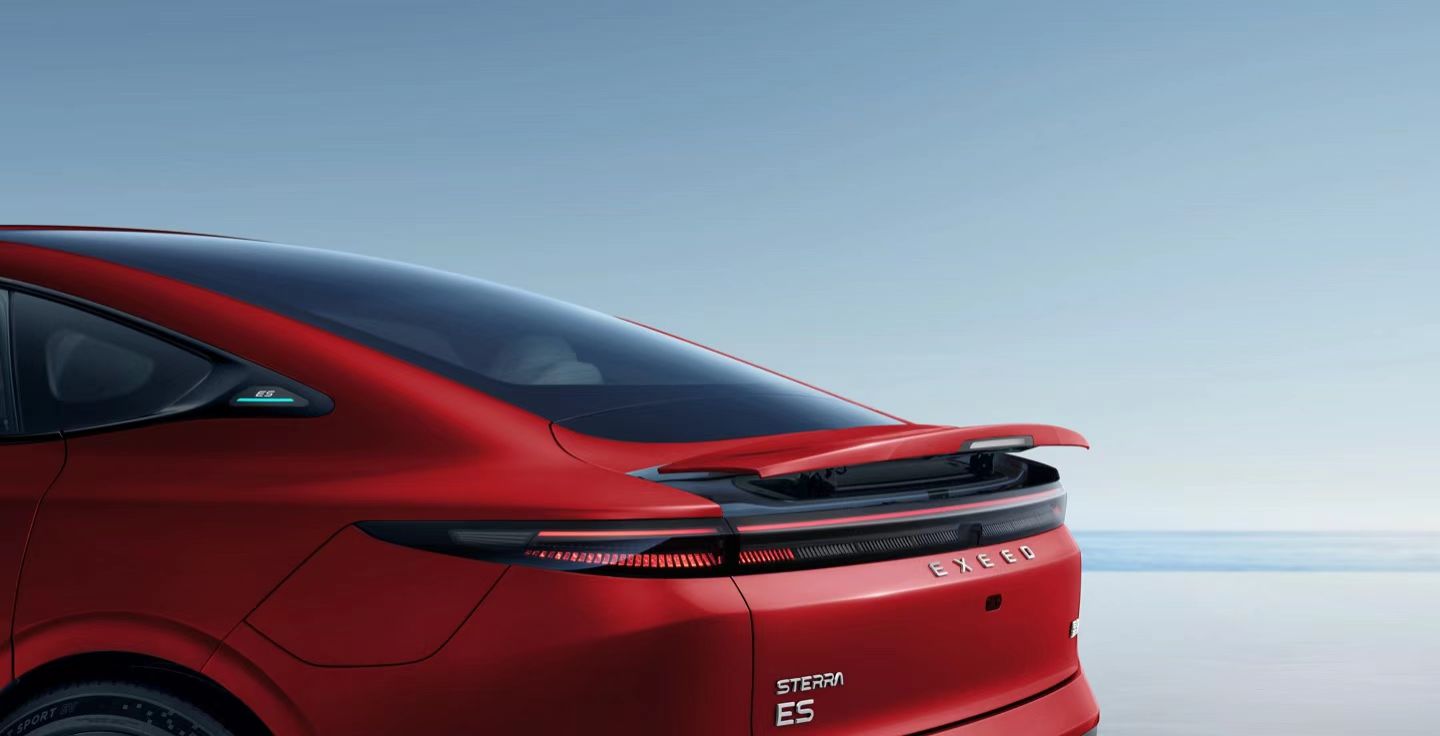
Chery has unveiled the 2025 Exeed Exlantix ES coupe (see specs), slated for pre-sales from July 19 and a full launch later in August. This model retains the sleek design of its predecessor while introducing an 800V architecture.

The Exlantix ES features a streamlined coupe silhouette and updated exterior colors, including red, purple, and blue. Notable design elements include a continuous LED light bar at the front and slim headlamp units. The rear has a continuous taillight with a retractable spoiler. It has a low drag coefficient of 0.205 Cd. The car sits on 21-inch alloy wheels and incorporates side rear-view cameras.
The cabin continues the previous model’s wraparound design with a new red-black interior. It includes a slim all-digital instrument cluster, a floating central control screen, and conveniences like door-mounted electric seat adjustments and a wireless charging pad.

Exlantix ES includes three variants. The lower-trim offers features such as Continental tires, NEP high-speed intelligent driving, ISD interactive headlights, and a 77 kWh CATL battery with a range of 680 km. The mid-trim adds laser radar, a three-zone air conditioner, and a 100 kWh battery with an 880 km range. The top trim includes a dual-motor all-wheel-drive system and a 100 kWh lithium battery with a CLTC range of 710 km. It comes standard with air suspension, CDC, new 21-inch Michelin tires, zero-gravity passenger seats, six-piston brake calipers, leather seats, electric steering columns, an OMS (Occupant Monitoring System), and electronic safety belts.
The Exlantix ES is built on Chery’s E0X platform, tailored for electric vehicles and range extenders. This platform, also used for the Luxeed S7 developed with Huawei, underscores Chery’s commitment to advanced EV technology. Pier Luigi Ferrari, formerly of Pininfarina, crafted an exterior design that blends performance and aesthetic appeal.
Internationally, Chery introduces the Exlantix series as a high-end electric vehicle brand. The lineup, known domestically as Sterra, was launched at the Geneva Motor Show in Doha. By 2026, Exlantix plans to expand to six models.

With the 2025 Exeed Exlantix ES, Chery aims to redefine luxury electric vehicles, offering sophisticated design, cutting-edge technology, and performance to global markets.
 

Volkswagen ID.UNYX all-electric SUV officially enters market starting at 28,900 USD​


Reading Time: 3 minutes

Dong Yi Chen

July 18, 2024


2


News like this to your inbox or phone?​


Weekly summary to your inbox
I want this

Never miss and important news
Get Instant notification once the news is published.
Follow Us

On July 17, Volkswagen’s pure electric coupe SUV called ID.UNYX was officially launched in China with a price range of 209,900 – 249,900 yuan (28,900 – 34,400 USD), manufactured by Volkswagen Anhui. Consumers can choose from a total of three trims (Pro, Ultra, Max) and two cruising range options: 621 km and 565 km.

The car is built on Volkswagen’s MEB platform, positioned as a compact SUV, the size of the car is 4663/1860/1610 mm with a 2766 mm wheelbase and comes with a five-seater layout. Five exterior paints are available: Sunrise Gold, Awaking Grey, Dreamy White, Shadow Black, and Moonlight Silver.
The Volkswagen ID.UNYX adopts the ID.UX series’ golden logo. The front has a closed design coupled with the IQ. Light Matrix headlight comprised of 13 LED sources of high beam that can be controlled independently.

Inside, the cockpit is equipped with a 5.3-inch LCD instrument panel, a 15-inch 2K floating central control screen, an AR-HUD, and a flat-bottom steering wheel. The logo on the steering wheel is also golden. The air-conditioning outlet is located below the central control screen.
Additionally, the vehicle operating system is supported by the ID.S 5.0 OS. It also comes standard with Volkswagen’s IQ Drive safety features that support lane change assist, adaptive cruise control, and lane keep assist. Furthermore, the car’s IQ. Park capability supports intelligent parking assist, remote parking assist, and trained parking assist (autonomous parking in common parking space).
Other configurations include double cup holders and wireless charging panels on the center console, an AI assistant, nine airbags, and 12-way electrically adjustable seats. Apple CarPlay, Baidu CarLife, and Huawei HiCar are all supported. At the same time, the rear seats of mid- and high-end trims come with foldable armrests.

The Volkswagen ID.UNYX is offered in single-motor two-wheel drive and dual-motor four-wheel drive. The maximum power of the single-motor variant is 170 kW (228 hp) while the combined maximum power of the dual-motor variant is 250 kW (335 hp). The 82.4 kWh ternary lithium battery pack provides two CLTC cruising ranges of 621 km and 565 km, respectively.
Source: Volkswagen
 

Geely-backed Lynk & Co Z10 is officially arriving at dealerships starting July 20​


Reading Time: 3 minutes

Adrian Leung

July 18, 2024


0


News like this to your inbox or phone?​


Weekly summary to your inbox
I want this

Never miss and important news
Get Instant notification once the news is published.
Follow Us

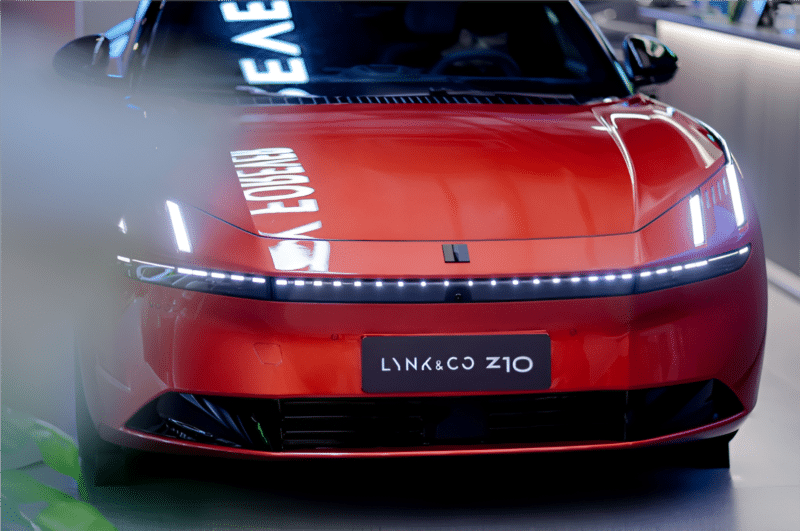
The Lynk & Co Z10 will be available for pre-order in late July and officially launched in August. Starting July 20, it will arrive at dealerships nationwide in 203 cities across 386 stores in China. The Lynk & Co Z10 marks a significant milestone in the company’s transition to fully electric vehicles.

The Z10 is a mid-to-large sedan measuring 5028mm in length, 1966mm in width, and 1468mm in height, with a wheelbase of 3005mm. It features a sleek design inspired by Lynk & Co’s “The Next Day” concept, including a closed grille, separate daytime running lights, and a continuous taillight strip. The vehicle’s drag coefficient is an impressive 0.198cd.
The Z10 has a 3.4-meter interactive light strip integrated with 414 RGB LED lights capable of displaying 256 colors and various dynamic effects. The rear also sports an active spoiler that deploys at speeds above 70 km/h and retracts below 30 km/h.

Inside, the Z10 has a traditional T-shaped dashboard featuring a 12.3:1 narrow horizontal screen for essential information, a 15.4-inch 2.5K touchscreen, and a HUD. The two-spoke steering wheel, inspired by spacecraft controls, adds a futuristic touch, while Nappa leather seats offer luxury with features such as heating, ventilation, and massage functions.
The Z10’s infotainment system is powered by the Flyme Auto platform, developed in collaboration with Meizu and running on a high-performance chipset surpassing the Qualcomm Snapdragon 8295. The sound system features a 23-speaker Harman Kardon setup with WANOS surround sound technology.
Performance-wise, the Z10 offers rear-wheel and four-wheel drive options, with the latter boasting a combined maximum power of 580kW. This enables a 0-100 km/h acceleration in just 3.5 seconds and a 250 km/h top speed. The 800V architecture allows for a range of up to 800 kilometers on a single charge, and the battery can be charged to provide 573 kilometers of range in just 15 minutes. The Z10 is equipped with dual-chamber air suspension and CDC damping for an optimal balance of comfort and handling.

The Z10 also includes advanced autonomous driving capabilities, featuring lidar and the Nvidia Orin-X chip, supporting highway and urban Navigation on Autopilot (NOA).
With its luxury, technology, and performance blend, the Lynk & Co Z10 will rival models like the Xiaomi SU7 (see specs) and Zeekr 001 (see specs). Expected to be priced between 200,000 and 250,000 yuan (approximately $27,500 to $34,400), the Z10 aims to attract a young and tech-savvy audience.
 

BYD Song L DM-i to start sales and deliveries on July 25​


Reading Time: 3 minutes

Denis Bobylev

July 17, 2024


0
byd song l dm-i front side blueBYD Song L DM-i is ready for the launch in China

News like this to your inbox or phone?​


Weekly summary to your inbox
I want this

Never miss and important news
Get Instant notification once the news is published.
Follow Us

The BYD Song L DM-i plug-in hybrid crossover will start sales and deliveries on July 25, according to Chinese insider. It has already reached dealers. The price range of the Song L DM-i is rumored to lie in 99,800 – 139,800 yuan (13,700 – 19,250 USD) range.

BYD Song L DM-i is a mid-size SUV under the Dynasty series. It is slightly bigger than the BYD Song Plus (see specs), available in Europe as Seal U. The Song L DM-i applied for the sales license in June. And now, Chinese sources have disclosed information about its launch date.

BYD Song L DM-i launch and deliveries​

BYD Song L DM-i delivered to a dealership
Chinese insider with nickname “源之头2018” reported the BYD Song L DM-i has already entered dealerships across China. He claimed this model will start sales on July 25. Deliveries are scheduled for the same date.

First mass-produced batch of the BYD Song L DM-i crossovers
Chinese netizens shared a photo of car carriers filled with BYD Song L DM-i crossovers. This shot was made near the BYD’s factory in Zhengzhou, China. According to a banner held by the plant workers, it is the first mass-produced batch of the Song L-DM-i SUVs. It means BYD has officially kicked off volume assembly of this model, having prepared for the sales start.
BYD Song L DM-i
Previously, CarNewChina reported the Song L DM-i has four trim levels: 112 km Leading, 112 km Transcend, 160 km Transcend, and 160 km Brilliant. It has a four body color options: Ice Blue, Emerald, White, and Gray. The new crossover has a single interior color option called “Golden Sand Ceramic”. Its price range is 99,800 – 139,800 yuan (13,700 – 19,250 USD).

BYD Song L DM-i specs​

Interior of the Song L DM-i stays in line with other BYD-branded cars
The BYD Song L DM-i crossover follows the brand’s distinguishing Dragon Face design language. Its dimensions are 4780/1898/1670 mm, with a wheelbase of 2782 mm. Its powertrain comprises a 1.5-liter naturally aspirated ICE for 74 kW (99 hp) and a 160 kW (215 hp) electric motor.

The Song L DM-i has two LFP battery options made by BYD subsidiary FinDreams for 18.3 kWh and 26.6 kWh, suitable for 112-160 km of CLTC range. Another feature of this SUV is DM 5.0 PHEV technology. This system has a thermal efficiency of 46%, 2.9 L/100km fuel consumption, and up to 2,100 km range. However, the fuel consumption and range of the Song L DM-i will differ from the mentioned metrics.
 

Europe-bound Lynk & Co works on L946 full-size PHEV SUV​


Reading Time: 2 minutes

Denis Bobylev

July 17, 2024


0
lynk & co l946 spotted in chinaLynk & Co L946 full-size crossover

News like this to your inbox or phone?​


Weekly summary to your inbox
I want this

Never miss and important news
Get Instant notification once the news is published.
Follow Us

The Lynk & Co L946 full-size plug-in hybrid SUV was spotted in China. It stands on the SPA architecture. The L946 will enter the Chinese market next year as the brand’s new flagship SUV.

Lynk & Co is a joint brand under Geely and Volvo established in 2017. Its headquarters is in Sweden. However, the production and R&D of Lynk & Co vehicles are mostly located in China. Lynk & Co sells eight models domestically. Nowadays, Chinese netizens shared a photo of a new car from the Geely-Volvo brand. It will become the Lynk & Co’s flagship SUV.

Lynk & Co L946 spotted in China​

The first information about the Lynk & Co L946 appeared online in March 2024. It was exposed as the SPA-based full-size crossover with a plug-in hybrid powertrain system. SPA is the Volvo Scalable Product Architecture that underpins Volvo XC90, Volvo EX90, Polestar 3, and more. No further information was provided at that time.

Now, the Lynk & Co L946 has been spotted in China wearing heavy camouflage. It is an impressively sized crossover with a high bonnet line and a LiDAR sensor on the roof. Its high beams sit in the front bumper. Other features of the L946 are frameless side-view mirrors, a trapeze-shaped air intake, 10-spoke wheels, and a flat roofline.
Chinese designer Sugar Design made unofficial render images of the L946 crossover. In render images, this SUV follows the design language of 06 EM-P (see specs), 07 EM-P (see specs), and 08 EM-P (see specs) models. It has distinguishing running lights, a millimeter-wave radar, and retractable door handles.
Lynk & Cp 09 EM-P
The exact dimensions of the Lynk & Co L946 have yet to be revealed. However, it was said to be larger than the 09 crossover (see specs), which boasts hefty dimensions of 5042/1977/1780 mm with a wheelbase of 2984 mm. So, the length of the Lynk & Co L946 could reach 5.2 meters.

There is no information about the powertrain system of the Lynk & Co L946. It will likely adopt a 1.5-liter turbocharged engine for 120 kW (161 hp) and two e-motors for 316 kW (424 hp). The L946 will enter the market in 2025 to rival the Li Auto L9, Wey Lanshan, Aito M9, and other full-size crossovers. Its starting price for China can be over 300,000 yuan (41,300 USD).
Source: Weibo
 

Hongqi self-driving mini-bus spied in China​


Reading Time: 3 minutes

Dong Yi Chen

July 17, 2024


1


News like this to your inbox or phone?​


Weekly summary to your inbox
I want this

Never miss and important news
Get Instant notification once the news is published.
Follow Us

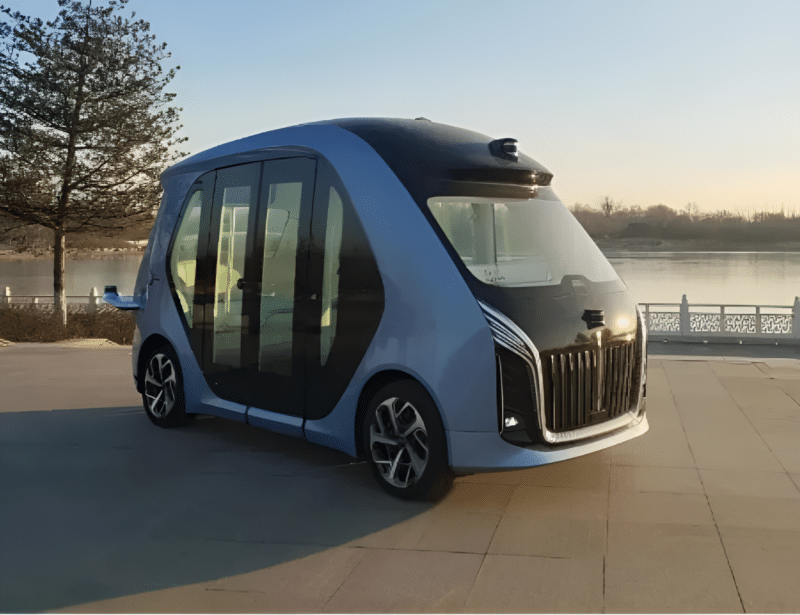
Recently, self-driving cars made several headlines in China as several major Chinese cities are launching public testing of driverless vehicles such as in Shanghai and Shenzhen as well as Baidu’s Robotaxi. And now, Hongqi’s autonomous mini-bus also joined the mix and was spied on Chinese streets.

Hongqi autonomous mini-bus
In addition to driverless mini-bus, Chinese media also reported that Hongqi is conducting Robotaxi testing. It is worth mentioning that earlier on July 10, Hongqi announced that it received the green light for road testing of its third-generation Level 4 Robotaxi from the Beijing Intelligent & Connected Vehicle Policy Pilot Zone. Hongqi also noted that its Robotaxi has completed more than 100,000 km of autonomous driving public road tests in the Pilot Zone.
The front of the mini-bus retains Hongqi’s family design of a chrome straight waterfall grille. From the side, the mini-bus has two doors and a lidar.

Inside, the interior has numerous metal bars, a red button (could be an emergency stop button), sofa seats, and a ceiling screen.
Global Market Insights data shows that the global autonomous vehicle market size was valued at USD 2 trillion in 2023, while China’s autonomous vehicle market size was valued at 8.01 billion USD in 2023, according to Renub Research.
As the automotive industry shifts from electrification to intelligence, autonomous driving technology has also jumped on this wagon to grow rapidly in China, from Level 2+ assisted driving gradually becoming standard to unmanned delivery vehicles, unmanned sanitation vehicles, and Level 4 Robotaxi.

Baidu’s LuoBoKuaiPao Robotaxi
At the same time, some humans are afraid that driverless vehicles will take over their jobs and some are not confident about the safety aspect of driverless vehicles. For example, in May this year, people in Wuhan, China, complained on the Internet that Baidu’s LuoBoKuaiPao Robotaxi are causing traffic jams, saying that the vehicles exhibited unusual behaviors such as stopping in the middle of the road for no reason, stagnating when turning, and driving too slowly during peak hours in the morning and evening, which brought a lot of inconvenience to people’s travel.
As driverless vehicles are becoming common in our society, it will be interesting to see how they will integrate into our lives.
Source: Sohu, FAW
 

Cambodian PM claims BYD will build a factory in Cambodia, months after BYD hits problems in Vietnam​


Reading Time: 3 minutes

Mark Andrews

July 16, 2024


1


News like this to your inbox or phone?​


Weekly summary to your inbox
I want this

Never miss and important news
Get Instant notification once the news is published.
Follow Us

On July 15, Cambodian Prime Minister Hun Manet posted on X, formerly known as Twitter, that he had met with Liu Xueliang, CEO of BYD Asia Pacific Auto Sales Division, and claimed that BYD would build a 20,000-unit capacity factory in the country. The tweet follows a previous announcement on June 27 by Hun at a small and medium-sized enterprise day held in the Cambodian capital, Phnom Penh, that BYD would open an assembly plant in Cambodia in the near future.

The announcement of a plant in Cambodia comes months after BYD’s expansion into Vietnam hit trouble. In May 2023, the Vietnamese government announced that BYD would be building a plant in Phu Tho province to produce EVs, but it is believed that this plan was put on hold in favor of a plant in Indonesia.
If the reports are correct, the decision to put on hold a plant in Vietnam but go ahead with one in Cambodia seems a strange decision. First off, sales of electric vehicles were only recorded in Cambodia for the first time in 2020 when sales were all of five units. This increased to 63 in 2021 before hitting a peak of 663 in 2022 before sales reduced to 604 last year. The term electric vehicles in this data include not only four-wheeled vehicles but also those with two and three wheels.

As of February this year, the total number of electric vehicles registered in Cambodia was 1,887, of which 906 were four-wheeled. Public charging infrastructure amounts to 18 charging stations. The “Electric Vehicle Development Policy (2024-2028)” forecasts the number of electric vehicles (four-wheel) to increase to 30,000 by 2030, of which 25,000 will be cars.
Various Chinese media outlets are gushing about the potential of the Cambodian market, quoting various Cambodian politicians. Sun Chanthol, Cambodia’s Deputy Prime Minister, in October 2023, speaking to BYD’s vice president, said, “We can supply the Greater Mekong Subregion (GMS) – a huge, potential market in six countries including Vietnam, Laos, Cambodia, Myanmar, and Thailand.” What Sun seemed to be forgetting is that BYD already has a plant in Thailand with a capacity of 150,000 and is also building a plant in Indonesia. Plans call for the Indonesian factory to start production in early 2026, and it will also have a capacity of 150,000 cars.
Meeting on July between Sun Chanthol, Deputy Prime Minister and First Vice President of the Council for the Development of Cambodia (CDC) and Liu Xueliang, General Manager of BYD Asia Pacific Auto Sales Division. From Khmer Times
Against this background of a limited market in Cambodia and better-placed BYD factories elsewhere for export, the prospects for the Cambodian factory do not look particularly good.

2023 saw a total of 33,683 cars sold in Cambodia, according to data from Focus2Move, a market intelligence company. That was a nearly 11% year-on-year increase. There are currently six car assembly plants in Cambodia. In Hun Manet’s speech in June, he reportedly also mentioned that Ford, Toyota, and Hyundai had decided to set up car assembly and production plants in Cambodia.
BYD initially entered the Cambodian market in 2020, and this year, two new stores opened in Phnom Penh. There are currently ten international companies selling new energy vehicles in the Cambodian market, including BMW, Tesla, and Toyota, along with from China, Hongqi, Wuling, and GAC Aion, in addition to BYD.
BYD, however, has established market leadership and, in the first half of 2024, sold 658 cars, more than 40 percent of the 1,614 electric cars sold during the period.
To put the alleged plan for Cambodia in context against Vietnam, car sales in Vietnam were 404,294 units last year. EVs are believed to have made up about 6% of the sales, and BMI Research forecasts a compound annual growth rate of 26% between now and 2032, meaning an estimated market of 65,000 vehicles per year by 2032.

Editor’s note:​

It should be noted that BYD has not made any announcement about a Cambodian plant. Until more details are known, we remain highly skeptical about the plan and its likelihood of seeing a factory that reaches production.
Further casting doubt on the whole plan is that Cambodia notoriously has some of the highest electricity prices in the region for both domestic and industrial users. The country suffers from problems producing enough electricity to meet demand and with the infrastructure to deliver it.
Vietnam, in terms of market size, growth projection, and infrastructure, is a far better location for a BYD factory than Cambodia.
Sources: X, Khmer Times, Finance Associated Press, Yiche, Pandas go to sea, Focus2Move, Khmer Times,
 

China EV registrations in W28: Xiaomi 2,300, Nio 3,400, Tesla 11,400, BYD 61,800​


Reading Time: 3 minutes

Jiri Opletal

July 16, 2024


0


News like this to your inbox or phone?​


Weekly summary to your inbox
I want this

Never miss and important news
Get Instant notification once the news is published.
Follow Us

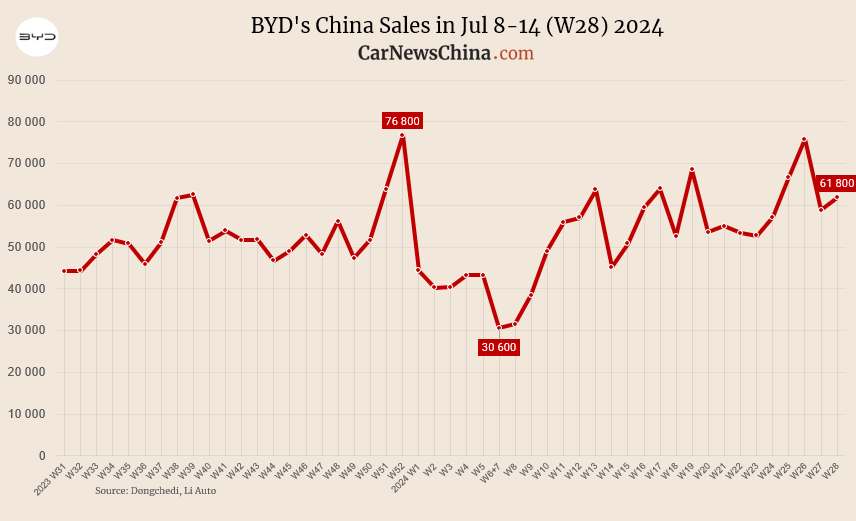
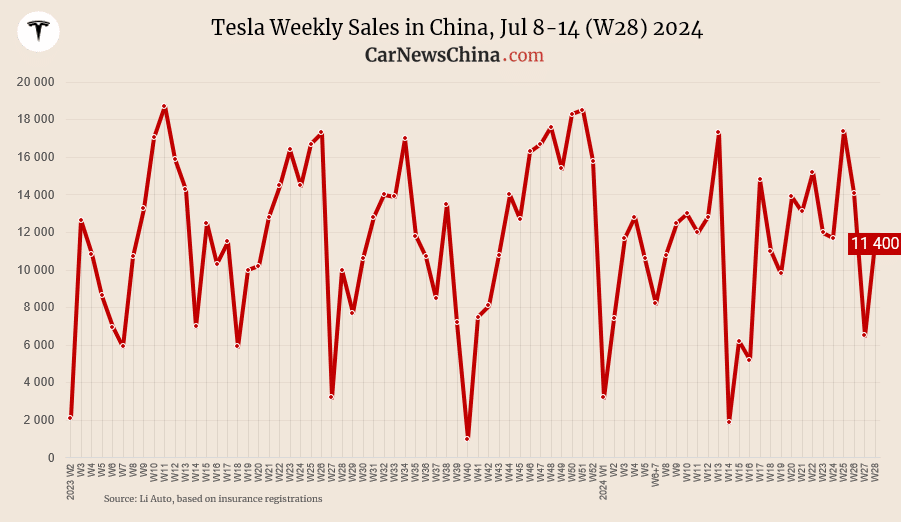
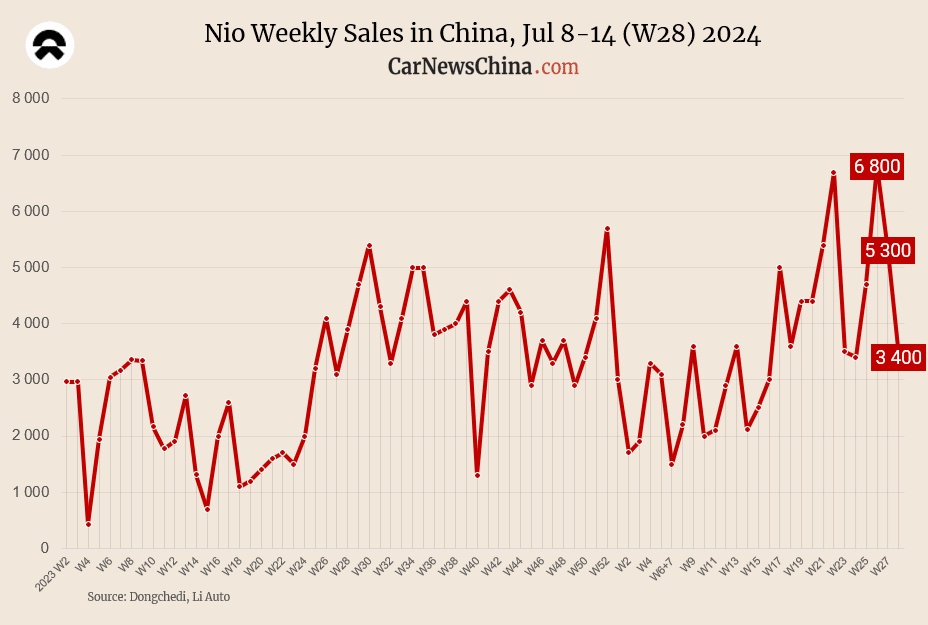
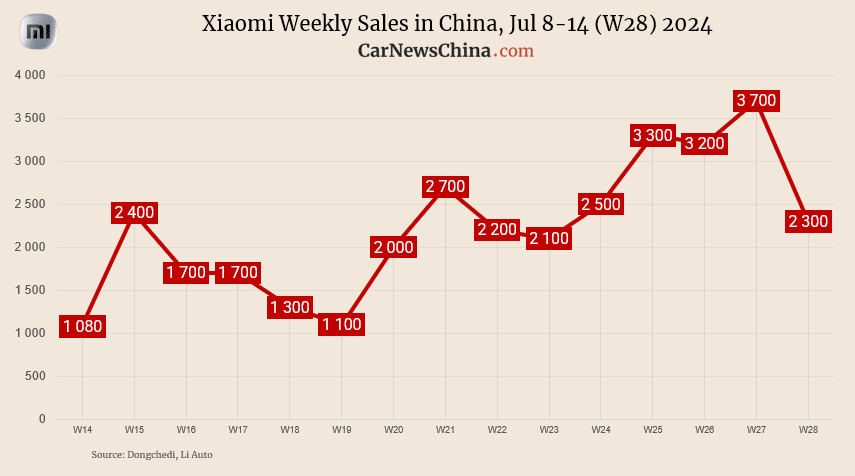
The second week of July was primarily up with several exceptions. Tesla sales grew 75% compared with the week before, BYD was 5% up, and Nio and Xiaomi were down 35%. The NEV market was up 8.8%.

Week 28 of 2024 (W28) is between July 8 and 14. The week W28 of 2023, used for year-on-year comparison, was between July 10 and 16.
The weekly sales are published by Li Auto, and despite Li’s not explicitly saying it, they are based on insurance registration data. The numbers are rounded and present new energy vehicles (NEV) sales, the Chinese term for BEVs, PHEVs, and EREVs (range extenders). To be completely precise, it also includes hydrogen vehicles (FCEVs), but their sales are almost non-existent in China. The data show only passenger vehicles (PVs).

Market situation​

3,3A total of 365,000 passenger vehicles were registered in China, up 4.9% from the week before but down 4.9% year-on-year.
NEVs had a 51% market share with 186,000 insured units, up 8.8% from the week before and 35% year-on-year. ICE registrations were 27% down from the previous year.

Automakers​

BYD was the first, as usual, with 61,800 registrations, up 5.10% from 58,800 units registred the week before. In the first half of the month, between July 1 – 14, BYD registred 120,600 vehilces in China.


Tesla registred 11,400 EVs, up 75.38% from 6,500 units the week before and 14% up from 10,000 units in the same week the year before.
In the first half of the month, Tesla registred 17,900 EVs in China.

Li Auto registered 11,300 EVs, up 41.25% from 8,000 units the week before and 46.75% up from 7,700 units in the same week the year before. In the first half of the month, Li Auto registered 19,300 EVs in China.
Aito registered 9,400 EVs, up 18.99% from 7,900 units the week before and 944.44% up from 900 units in the same week the year before. In the first half of the month, Aito registered 17,300 EVs in China.
Wuling registered 7,800 EVs, up 16.42% from 6,700 units the week before. In the first half of the month, Wuling registered 14,500 EVs in China.
GAC Aion registered 7,100 EVs, up 4.41% from 6,800 units the week before. In the first half of the month, GAC Aion registered 13,900 EVs in China.
Leapmotor registered 4,500 EVs, up 18.42% from 3,800 units the week before and 73.08% up from 2,600 units in the same week the year before. In the first half of the month, Leapmotor registered 8,300 EVs in China.
Volkswagen registered 3,600 EVs.
Nio registered 3,400 EVs, down 35.85% from 5,300 units the week before and 12.82% down from 3,900 units in the same week the year before. In the first half of the month, Nio registered 8,700 EVs in China.

Zeekr registered 3,300 EVs, down 13.16% from 3,800 units the week before and 43.48% up from 2,300 units in the same week the year before. In the first half of the month, Zeekr registered 7,100 EVs in China.
Deepal registered 3,300 EVs, down 2.94% from 3,400 units the week before and 26.92% up from 2,600 units in the same week the year before. In the first half of the month, Deepal registered 6,700 EVs in China.
Xiaomi registered 2,300 EVs, down 37.84% from 3,700 units the week before. In the first half of the month, Xiaomi registered 6,000 EVs in China.

Denza registered 1,900 EVs, up 11.76% from 1,700 units the week before and 24.00% down from 2,500 units in the same week the year before. In the first half of the month, Denza registered 3,600 EVs in China.
Xpeng registered 1,700 EVs, down 5.56% from 1,800 units the week before and 19.05% down from 2,100 units in the same week the year before. In the first half of the month, Xpeng registered 3,500 EVs in China.
 

Users who are viewing this thread

Pakistan Defence Latest

Country Watch Latest

Back
Top