China Auto Thread


Zeekr adds phoneless EV public charging to its cars​


Reading Time: 2 minutes

Mark Andrews

July 24, 2024


0


News like this to your inbox or phone?​


Weekly summary to your inbox
I want this

Never miss and important news
Get Instant notification once the news is published.
Follow Us

Perhaps the biggest advantage of Tesla’s supercharger network is its ease of use. Public charging using other networks often involves multiple apps and stages to charge an EV. At one time in China, it was necessary to have in the region of five to ten apps on your phone, along with sometimes physical cards, to be able to find public chargers, access them, and pay for them. The situation may be becoming better, but it still does not offer the Tesla-like simplicity. Geely-owned Zeekr brand is changing that and has now introduced phoneless EV Charging.

Under the new regime, the whole process can be done through the in-vehicle system for Zeekr’s self-built charging network. To use it while driving, the driver goes to the charger location map screen and chooses the Zeekr charger they want. The car will then navigate to that charging station, and during the journey, the vehicle’s battery system will automatically adjust to the optimal charging temperature. The advantage of this is that the car will charge at a speed closer to normal despite varying ambient temperatures.
If the charging station is underground, the navigation will provide accurate guidance in the car park to help you find the actual charging station. Previously, the driver would have to scan a QR code to make an appointment, but now it is possible to lower the parking space barrier using voice control automatically.

Once parked, the car will automatically start charging after the charging cable is plugged into the car’s charging port. The driver doesn’t need to take any additional actions.
When the charging has finished the system will automatically take payment, without any need for payment to be made by phone. Zeekr also provides a parking fee discount if the charging time meets certain conditions.
Source: Fast Technology
 

Xiaomi’s second car, the MX11 SUV, spied testing in China​


Reading Time: 2 minutes

Mark Andrews

July 24, 2024


0


News like this to your inbox or phone?​


Weekly summary to your inbox
I want this

Never miss and important news
Get Instant notification once the news is published.
Follow Us

Recently, a video on the Internet exposed the Xiaomi SUV being tested in China. Believed to be codenamed MX11, the car has a sporty, low-lying SUV design. This reflects the SU7 sedan and inherits the design concept in terms of styling.

Presumably, the car in the video is a high-spec version due to its lidar. With the SU7, only the Pro and Max versions are equipped with Lidar. If the new car follows a similar equipment specification level as the sedan, then we can assume that the test car captured is dual-motor and uses 800V architecture. The Lidar unit itself looks very similar to the one used by the Xiaomi SU7, and if that is the case, it is a 128-line unit.

At the front, the car looks very slender and may retain the shape of the SU7. On the sides, the window line rises as it reaches the rear. This is mirrored by the steeply sloping roof line at the back, which smoothly runs into the rear. Notably, the car seen testing uses the same 5-spoke alloys previously seen on other spy shots.

Commentators have already been very keen to point out that the Xiaomi MX11 has proportions similar to the Ferrari Purosangue. Xiaomi’s first car very obviously followed the design of the Porsche Taycan, and it seems that the MX11 may do this once again. Lei Jun, Xiaomi’s CEO, has said that he aimed to produce a dream car for the masses with the SU7.
The previous spy shots of the MX11 have spurred multiple renderings on the Internet of what people think the Xiaomi SUV might look like. However, at the moment, real details are thin on the ground. Batteries, however, are expected to be sourced from Sunwoda, which contrasts with the SU7, which uses batteries from BYD in the Standard and CATL in the Pro and Max. If this is true, then it could suggest that the MX11 might be even more competitively priced.
The Xiaomi SUV is expected to be launched on the market in 2025.

Source: Fast Technology
 

Smart #5 electric SUV will debut on August 28 in China​


Reading Time: 3 minutes

Dong Yi Chen

July 24, 2024


1


News like this to your inbox or phone?​


Weekly summary to your inbox
I want this

Never miss and important news
Get Instant notification once the news is published.
Follow Us

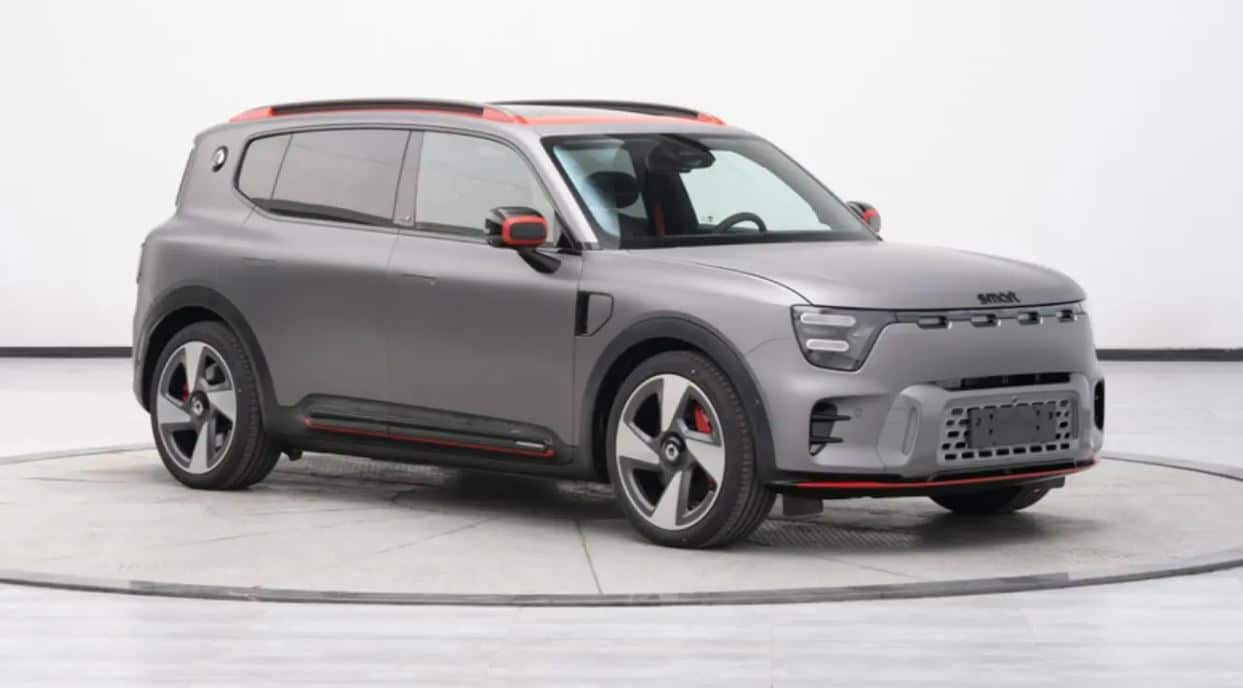
On July 23, Smart announced that the production version of its Smart #5 pure electric SUV will officially debut on August 28 in China. The new car focuses on outdoor attributes and was declared by the Chinese MIIT earlier in June. The official launch is expected to be later this year.

For the exterior, Smart #5’s front face adopts a new design language, different from previous models’ rounded style, and features a through-type light strip connecting the polygonal headlights on both sides as well as a silver bumper. The sides are outlined with square lines and are equipped with hidden door handles and roof luggage racks, further enhancing the toughness of the vehicle. The new car also runs on semi-enclosed rims.
At the rear, the through-type taillights are symmetrical with the headlights, with the Smart brand letter on the top, a large spoiler on the roof, and a silver bumper that echoes the front. Positioned as a medium-sized SUV, the Smart #5 has body dimensions are 4705/1920/1705 mm and the wheelbase is 2900 mm. The curb weight ranges from 1,800 kg to 2,450 kg.

Both single-motor and dual-motor trims will be offered. The single-motor version can output a maximum power of 250 kW and 267 kW; the dual-motor version can output a maximum power of 165 kW and 267 kW, respectively; the Brabus version has a dual-motor with a maximum power of 165 kW and 310 kW, respectively. Additionally, two battery pack options will be offered: 76 kWh and 100.01 kWh, offering a cruising range of 570 km, 660 km, 670 km, 720 km, and 740 km (assuming CLTC). Furthermore, the Smart #5 will support all-terrain driving modes including off-road, sand, snow, mud, and rock.
In June, the Smart brand sold 4,443 vehicles, a year-on-year decrease of 25.3%:
  • Smart #1 (see spec here): 3,046 units
  • Smart #3 (see spec here): 1,397 units
From January to June 2024, the cumulative sales volume of the Smart brand was 13,173 vehicles.

Source: Sohu, My Home Ok
 

Geely’s Farizon Auto unveils new commercial battery with 10 years of service life​


Reading Time: 2 minutes

Lawrence Ho

July 24, 2024


0


News like this to your inbox or phone?​


Weekly summary to your inbox
I want this

Never miss and important news
Get Instant notification once the news is published.
Follow Us

On July 23, Geely’s Farizon Auto unveiled its new commercial battery named the “Black Tortoise Battery”. The new battery boasts a service life of 10 years and 800,000 km, and have a 150 mm thin shell.

Farizon Auto’s V7E commercial van is going to be the first model with this battery installed. Later, other models like the smaller Farizon V6E Plus will follow. With the new battery, the Farizon V7E is estimated to have a CLTC range of 305 km. A Geely tested range is 285 km.

Farizon Auto​

Farizon Auto was established by Geely in 2016 to focus on the development and sales of new energy commercial vehicles in China. The brand’s currently offers a lineup of all-electric light commercial vehicles, urban buses, light trucks, and methanol-powered heavy trucks.

The company raised over 300 million USD from a pre-seed funding round led by Asian logistics firm GLP’s investment arm Hidden Hill Capital in 2022. More recently, the company raised 600 million USD in 2023 with a Series-A funding round led by Boyu Capital and Yuexie Industrial Fund. Farizon Auto has said their key focus outside of China will be Europe. It aims to become one of Europe’s top three electric cargo van suppliers.

Farizon V7E​

The Farizon V7E was launched earlier this year in April. It will soon feature the new “Black Tortoise Battery” with a retail price of 149,800 yuan (20,600 USD). The starting price of the V7E with a regular battery is 112,800 yuan (15,500 USD). With the new battery, the V7E boasts cargo space of 7 cubic meters, with a compartment length 3260 mm and a rated load of 1.3 tons. The external dimensions measures at 5305/1745/1985 mm. And the internal compartment measures at 3260/1630/1320 mm.
The battery features a liquid-cooling fast charging system that can handle over 6000 charge cycles per cell. A maximum of 4C fast charging and 2C continuous fast charging is supported. It allows to achieve 200 km of range in 10-minute charging. The integrated drive system has an energy efficiency of up to 97.86%. The chemistry of this battery has yet to be revealed. But it is most likely an LFP pack.

Farizon has so far delivered over 100,000 vehicles receiving orders from Europe, Asia-Pacific, South America, and the Middle East. The first batch of the Farizon V6E was shipped to for the first time Turkey earlier this year. And the Farizon V7E is expected to also be exported in the future.
Source: IThome, Yiche
 

Second-gen GAC Aion V all-electric SUV launched with 750 km range, price starts at 17,800 USD​


Reading Time: 4 minutes

Dong Yi Chen

July 24, 2024


0


News like this to your inbox or phone?​


Weekly summary to your inbox
I want this

Never miss and important news
Get Instant notification once the news is published.
Follow Us

On July 23, GAC Aion’s first global strategic model, the second-generation Aion V, was officially launched on the market, priced between 129,800 – 189,800 yuan (17,800 – 26,000 USD), which is 20,000 – 50,000 yuan (2,750 – 6,900 USD) less than the old version. Consumers can choose from seven trims. Within 1 hour and 20 minutes of its launch, the car had received more than 10,000 orders, according to GAC Aion.

The second-gen GAC Aion V is based on the brand’s AEP electrical vehicle platform. Officially positioned as a “hard-core intelligent driving SUV”, the car measures 4605/1854 (1876)/1660 (1686) mm, and the wheelbase is 2775 mm. In comparison, the first-gen Aion V Plus has a size of 4650/1920/1720 mm with a wheelbase of 2830 mm. The second-gen Aion V is smaller in all dimensions.
As a replacement model, the second-generation GAC Aion V adopts a new design language in its exterior styling relating to the Tyrannosaurus Rex, GAC Aion claimed. The rectangular front headlights adopt an “H” shape, representing the dragon’s claws. At the same time, the new car runs on multi-spoke petal-style rims, with matching tires from the Maxxis Victra Sport 5 series, with a specification of 225/45 R19.

Furthermore, the 650 Lidar trim is equipped with a lidar on the roof as well as five millimeter-wave radars, 11 cameras, and 12 ultrasonic radars to support the ADiGO Pilot intelligent driving assistance system, powered by an NVIDIA Orin-X chip.
Coming to the interior, it has a standard five-seater layout.
The interior design is similar to that of the previous generation, further simplifying the physical buttons in the car and featuring a 14.6-inch central control screen and a full LCD instrument panel (dimension was not announced). Additionally, details such as the door handles and air-conditioning vents are made of metal.

There are also dual mobile phone wireless charging panels and an ambient light strip on the center console. A 6.6 L box is under the center console that supports heating, cooling, and freezing. The lowest temperature can reach -15° Celsius and the heating temperature can reach 50° Celsius. Other configurations include a Belgian Premium audio system with an 8-inch subwoofer.
The standard trunk volume is 427 L, which can be expanded to 987 L after the rear seats are folded down.
Power comes from two electric motor types: high and low power, depending on the trims. The low-power electric motor outputs 150 kW/240 Nm and the high-power electric motor outputs 165 kW/240 Nm. The 0 – 100 km/h acceleration time is 7.9 seconds. The entire series is equipped with lithium iron phosphate battery packs, available in capacities of 62.268 kWh, 62.27 kWh, 62.681 kWh, 74.976 kWh, 75.26 kWh, and 90.215 kWh, offering 520 km, 650 km, and 750 km cruising range options (assuming CLTC). Additionally, the car’s 400V silicon carbide platform and 3C fast charging technology can achieve 370 km of range with 15 minutes of charging time.
Source: GAC Aion, DongCheDi
 

Honda to cut auto output capacity in China for 1st time on weak sales​

KYODO NEWS - 4 hours ago - 14:08 | All, Japan

Honda Motor Co. will reduce its annual car output capacity in China by 50,000 units amid struggling sales, an official said Thursday, its first such cut in the Asian nation that has served as the automaker's largest production base.

Honda has been capable of producing 1.49 million units per year in China. While planning to increase production of electric vehicles by 240,000 cars, the automaker will shed 290,000 units, mainly gasoline-powered cars, pushing down its overall output capacity of four-wheel vehicles.

The Japanese carmaker will halt production at one plant each of GAC Honda Automobile Co. and Dongfeng Honda Automobile Co., its joint ventures with local automakers, around October and November, respectively.

The latest development underscores the plight of Japanese automakers in China where their sales are plummeting due to an intensifying price competition and the rise of locally made EVs.
 

Deepal S07 SUV launches and is the first car with Huawei’s ADS 3.0 vision-based system​


Reading Time: 4 minutes

Mark Andrews

July 25, 2024


0


News like this to your inbox or phone?​


Weekly summary to your inbox
I want this

Never miss and important news
Get Instant notification once the news is published.
Follow Us

On the evening of July 25, the Deepal S07 was officially launched in both pure electric and range-extended versions. Deepal is a brand from Changan, and the S07 is largely an update of the car previously known as the Deepal S7. There are ten versions of the Deepal S07 ranging in price from 149,900 to 212,900 yuan (20,700 – 29,450 USD); they are as follows:

VersionPrice
125 Pro EREV149,900 yuan (20,700 USD)
215 Pro EREV159,900 yuan (22,100 USD)
215 Max EREV169,900 yuan (23,500 USD)
215 Max ADS SE EREV189,900 yuan (26,250 USD)
285 Max EREV179,900 yuan (24,900 USD)
285 Max ADS SE EREV199,900 yuan (27,650 USD)
520 Pro EV169,900 yuan (23,500 USD)
520 Max EV179,900 yuan (24,900 USD)
520 Max ADS SE EV199,900 yuan (27,650 USD)
628 Max ADS SE EV212,900 yuan (29,450 USD)
Both the range-extended EREV version and the all-electric Deepal S07 (see specs) have the same look. There is a closed front face and a slender headlight group. Integrated into the fender are the intelligent interactive light cluster units, which use 696 LED light sources. These can display customized interactive patterns, messages to pedestrians, and other such uses. Right at the bottom of the fender is a small air intake.
The Deepal S07 would like to say Hello to you
Again, at the side, little has changed on the Deepal S07, and most noticeable is a new set of alloy wheels. The car has hidden door handles, and the window line kicks up sharply towards the rear. At the back, there are through tail lights, and the Deepal S07 has a split spoiler mounted on the roof.

Dimensions for the car remain identical to the S7 being 4750, 1930, and 1625 mm (l/w/h) along with a wheelbase of 2900 mm. According to range the EREV versions weigh 1875, 1950, and 2025 kg respectively. Meanwhile, the three lower-spec versions of the all-electric Deepal S07 weigh 2025 kg, while the top-spec version weighs 2035 kg.
Inside, the car does not have an instrument panel but does, as standard, have a head-up display. All versions of the car have a 15.6-inch 2.5K resolution central infotainment screen and higher spec versions also add a 12.3-inch entertainment screen for the front passenger. Highest spec versions of the car get zero gravity seats for both the front passenger and driver, along with heating and ventilation. Only the front passenger gets a massage function and only on highest spec versions. The car has either eight or fourteen speakers according to trim. The car uses the Qualcomm Snapdragon 8155 chip, and this enables features such as face recognition and voice interaction. The car’s entertainment system has QQ Music, Bilibili, iQiyi, and other Chinese apps.
Four versions of the car come with the new Huawei Qiankun ADS 3.0 SE system. This is a vision-based version of the new Huawei Smart driving system. It provides high-speed driving assistance in areas such as national highways, urban expressways, and ring roads. It can undertake lane changes, intelligent obstacle avoidance, intelligent cornering, controlling the speed, and entering and exiting ramps. The system also provides intelligent parking, which is claimed to support more than 160 parking scenarios.

A 1.5-liter JL473QJ engine, with a maximum power of 70 kW, provides range extension in the EREV version. Actual power to the wheels is provided by an electric motor, which in the four cheaper EREV versions is a 175 kW motor delivering 320 Nm of torque. For the two higher-priced EREV versions, the motor is the same as in the all-electric version, namely a 190 kW electric motor, which also provides 320 Nm of torque.
The 125 version of the EREV uses an 18.99 kWh Battery Pack, while the 215 gets 31.73 kWh, and the 285 has a 39.05 kWh battery pack. The number in the name of each version corresponds to the CLTC range. Fuel consumption as declared by MIIT using the WLTC testing cycle for the three ranges is 5.5, 5.6, and 5.7 l/100 km, respectively. Comprehensive ranges are 1045, 1130, and 1200 km, respectively.
As with the EREV, the number in the name of each pure electric version corresponds to the range, so giving ranges of 520 and 628 km. There are two battery sizes, 68.82 and 79.97 kWh. All batteries used in the Deepal S07 are lithium iron phosphate and support 3C charging and can charge from 30-80% in 15 minutes. Equally, all cars can support 6KW electric discharge, meaning that the car can power devices when required using V2L.
Deliveries are likely to begin very soon. This car will also be part of the Deepal brands export plans.
Sources: Autohome, Dongchedi
 

Volkswagen ID.4 self-drives through Beijing using Horizon SuperDrive​


Reading Time: 4 minutes

Mark Andrews

July 25, 2024


0


News like this to your inbox or phone?​


Weekly summary to your inbox
I want this

Never miss and important news
Get Instant notification once the news is published.
Follow Us
Horizon Robotics released a video shot yesterday in Beijing featuring the self-driving capability of a Volkswagen ID.4 car fitted with the Horizon SuperDrive system. In the video, Horizon Robotics founder and CEO Dr Yu Kai takes Volkswagen China CEO Ralf Brandstätter for a drive through rain-soaked Beijing during the evening rush hour.

Although the video was obviously planned, as there are some exterior shots of the car going by, what could not be planned is the weather. When the video was shot, Beijing was experiencing heavy precipitation that lasted for 30 hours. The area to the northwest, where the headquarters of Horizon Robotics is located, reported some of the heaviest rainfall in the city, reaching 30 mm.

It should be stressed that the Horizon SuperDrive system is not currently fitted to production VW ID.4 (see specs) cars in China. The video accompanying the announcement appears to show the whole journey, albeit some parts are sped up. What is very notable is that Dr Yu, who was in the driver’s seat, didn’t have to intervene at any point during the route. Given the unpredictability of Chinese urban environments, this in itself is an achievement, but added to this was the inclement weather, which is something that could not be prepared for.

Over the route, the car encountered several occasions where the system could well have had problems. At one point, the car encountered a congested intersection and inched its way along to the center, even though at the time, the left turn it wanted to make was blocked by a car immediately in front. Once that car moved, the VW completed the left turn.
8ff8b8d9-d5a0-4bdd-b63a-9451792a43ae.gif

In many Chinese cities normal road conditions are influenced by major construction projects such as either the building of subway lines or new underground or sometimes overhead roads. These often involve creating temporary roads around the construction site, and the road will usually be littered with both the old and new road markings, making the path far from clear. Such a situation can present a significant challenge to self-driving cars. Once again, the SuperDrive system managed to successfully make a left turn despite the very wide construction area, which was blocking a lot of the normal route.
Other situations the car experienced included bus lanes, where the car successfully realized that the lane on the right was a bus lane and navigated itself into the correct lane. Also, it encountered situations where cars tried to pull out but didn’t actually pull out, and the VW, rather than jamming on the brakes, successfully dodged past those cars.

Bus lane (left) avoiding pulling out car (right)
The route also involved one roundabout. These are pretty uncommon in China, and road users generally do not know how to use them. In the video, it can be seen that the car does break to an extent when one car in front cuts into the roundabout, but it successfully navigates its way around the roundabout and takes the appropriate exit.
Overall, the video shows that the action of the SuperDrive system is very smooth and like that of a human driver. With many such systems, there can be situations where the car will break suddenly or simply refuse to move, but this does not appear to happen during the route.
The Horizon SuperDrive is a full-stack autonomous driving system launched earlier this year by the company. It is a smart driving solution that covers everything from ADAS to all-scenario NOA (navigation on autopilot). Horizon Robotics claims the system focuses on safety, comfort, and convenience for users. It says the system can handle complex road conditions in a similar way to experienced drivers, providing obstacle avoidance, gentle breaking, dynamic speed control, and smooth execution of unprotected left turns.
It is not clear what the hardware requirements of the system are. However, from external pictures of the VW ID.4 undergoing the test yesterday, we can see that the car appears to be fitted with a lidar unit above the windshield. It should be noted that the Volkswagen ID.4 does not, as standard, have such a unit.
In 2022, Volkswagen, through its software company Cariad, forged a partnership with Horizon Robotics to improve ADAS and autonomous driving systems for the Chinese market.
Sources: Horizon Robotics, Fast Technology
 

iCar V23 electric car from Chery and Xiaomi to cost 16,500 USD in China​


Reading Time: 3 minutes

Denis Bobylev

July 25, 2024


0
chery iCar v23 price leakedChery iCar V23

News like this to your inbox or phone?​


Weekly summary to your inbox
I want this

Never miss and important news
Get Instant notification once the news is published.
Follow Us

The iCar V23 electric SUV developed by Chery and Xiaomi’s subsidiary Zhimi Technology will start from 119,800 yuan (16,500 USD) in China. This information comes from the brand’s internal documents leaked online. The iCar V23 will likely sell overseas under the Jaecoo/Lucano name.

iCar-branded vehicles will sell under Jaecoo brand overseas (photo credit: Paultan)
Most people think of Apple when they hear the word iCar. However, the American phone maker canceled the car manufacturing project. The iCar is a non-Apple-related NEV (new energy vehicle) brand launched by Chery in 2023. Its model line currently comprises a single model, the iCar 03 crossover. However, Chery isn’t brave enough to use the iCar name for global sales. So, the iCar 03 was introduced as Jaecoo J6 (Lucano J6) to the overseas countries.

iCar V23 price leaked​

According to the leaked documents, the starting price of the iCar V23 with 2WD and 401 km range is 119,800 yuan (16,500 USD). The car will become available for blind orders for 2,000 yuan (275 USD). And the final payment is 117,800 yuan (16,235 USD). The car’s market debut is scheduled for this year.

For comparison, the bigger iCar 03 costs 109,800 – 169,800 yuan (15,100 – 23,400 USD). The iCar V23 is positioned higher than the brand’s first model.

More on iCar V23​

The iCar V23 is the brand’s second model. As mentioned, Chery and Xiaomi’s subsidiary Zhimi Tech jointly created it. In this project, the Zhimi team is responsible for product definition, planning, and engineering. Chery takes care of manufacturing, supply chains, sales, deliveries, and after-sales. It seems the two companies are happy with their collaboration as they plan to launch six to eight cars in the next three years.
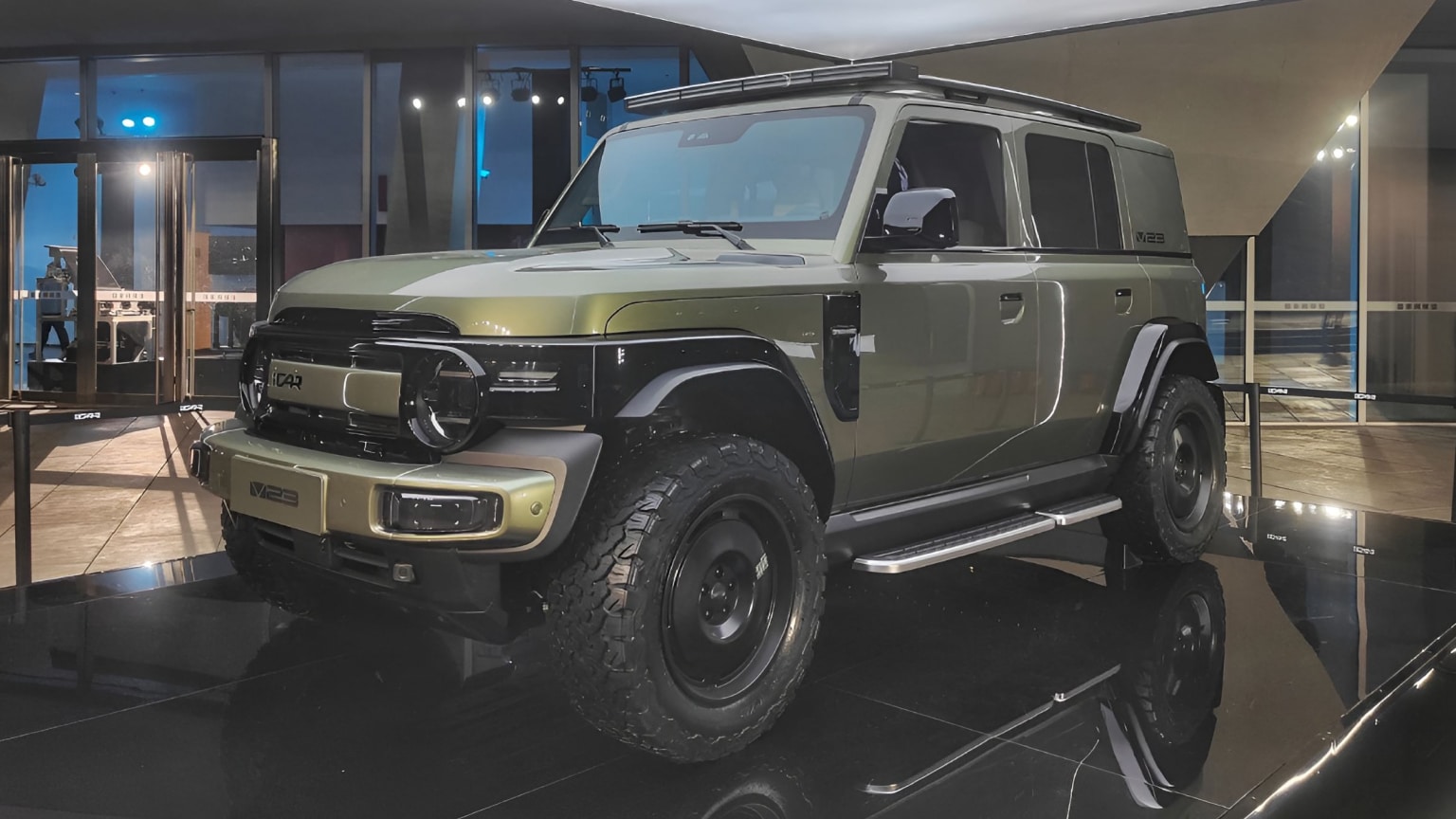
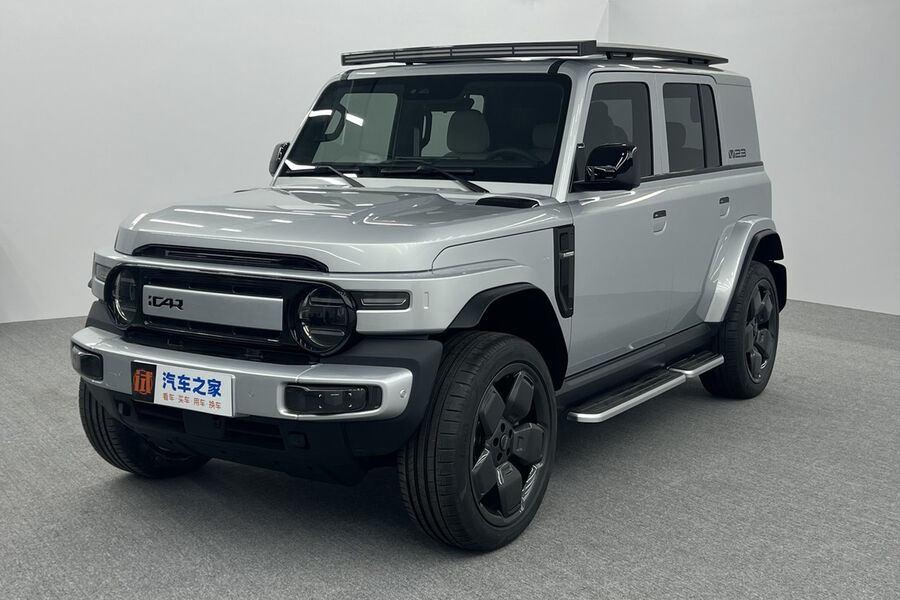
The iCar V23 follows the boxy styling of the iCar 03. Its distinguishing features are round headlights, wide wheel arches, flush door handles, and raised bumpers. The overall look of this model feels like a mix of BAW 212, G-Class, and Wrangler.

iCar V23 in camouflage
The iCar V23 is a small car with dimensions of 4220/1915/1845 mm. Yet it boasts a long wheelbase of 2730 mm. Thanks to short overhangs, the V23’s approach and departure angles are 43 and 41 degrees, respectively. Chery positions this car as an off-roader with 4WD and a ground clearance of 212 mm. The iCar will also have a 2WD variant with 206 mm ground clearance.
Inside, the iCar V23 has a clean styling with a large floating screen, a three-spoke round steering wheel, and physical controls. The gear shifter sits behind the wheel. Other features of this small but sturdy off-roader are lots of mm-wave radars and Qualcomm’s Snapdragon 8155 chip inside.
There is no information about the powertrain of the iCar V23. We know it will offer two range variants: 300 km and 500 km. Some netizens said the V23 can have an 80-kWh ternary NMC pack from CATL on board. But it is unlikely since this vehicle is quite small. For clarity, the bigger iCar 03 with a body length of 4.4 meters has two battery options for 50.6 and 65.7 kWh. And it still has 400-500 km of range. The V23 with an 80 kWh battery would offer up to 700 km.
Source: Autohome, Weibo
 

Chery shows what the updated Tiggo 8 Pro Max crossover will look like 17:52​


Anika
By ANIKA
July 25, 2024

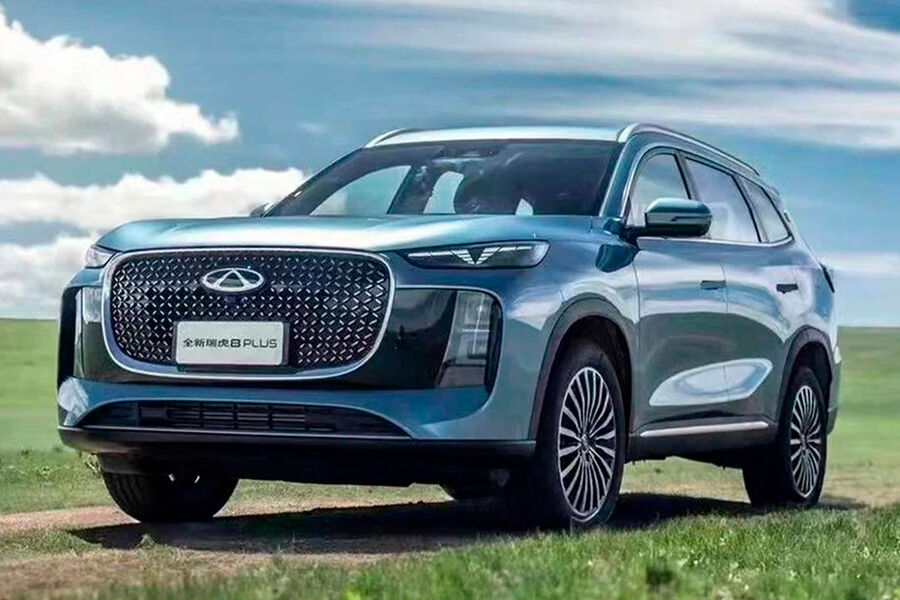
Chinese automaker Chery has released the first images of the updated Tiggo 8 Plus crossover. reports autohome.com.cn. In Russia, the car is known as Tiggo 8 Pro Max.
It is stated that the crossover received a new grille and front bumper. The lighting technology became two-tiered: headlights with V-shaped elements are located towards the hood. At the rear, the bumper became more massive and received trapezoidal exhaust system elements.
The updated Chery Tiggo 8 Plus will receive two turbo engines to choose from: 1.6 and 2.0 liters. With an output of 197 and 254 hp, they are combined with a seven-speed robotic transmission or an eight-speed automatic transmission.
Sales of the updated Chery Tiggo 8 Plus crossover in China will begin at the end of 2024.
It happened before that knownThe Chinese company Chery has revised the line of trim levels for the Arrizo 8 sedan in Russia, the company said.
Previously available in Comfort, Prestige, Ultimate and Ultimate SE versions, the car is now offered in Active, Comfort and Prime trim levels. In addition, the price of the basic sedan equipment has increased by 50 thousand rubles and now costs 2.85 million rubles.
Standard equipment includes 17-inch wheels, full-LED optics, rear parking sensors with rearview camera, a full “winter package” and dual-zone climate control.
Previously reportedProduction of Russian Atom cars will begin in July 2025, he said.


Source: Gazeta
 

The premiere date of the first car of the Meizu brand has been announced 15:33​


Anika
By ANIKA
July 26, 2024

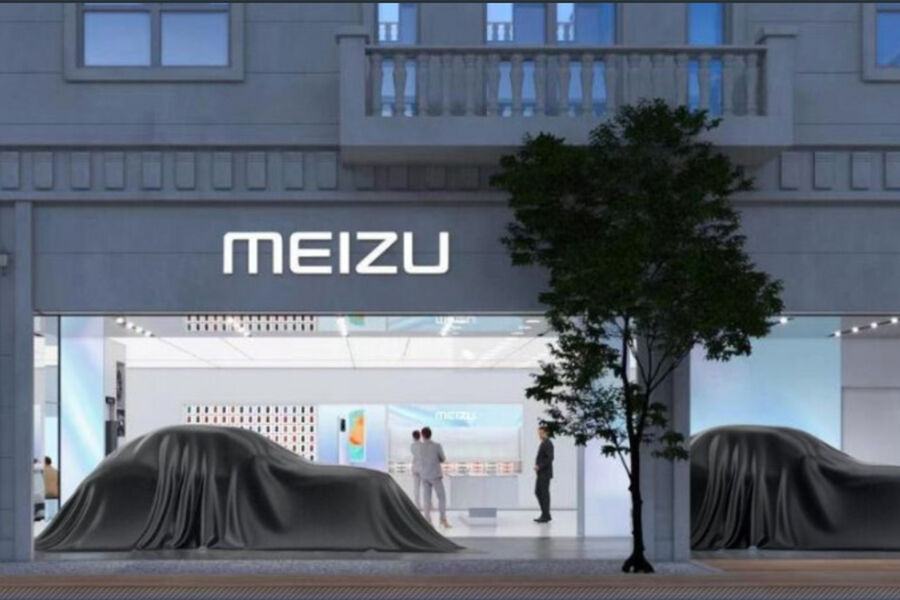
Chinese smartphone maker Meizu plans to introduce its first car later this year. reports carnewschina.com. The cars will be produced by Geely.

It is stated that the design of the Meizu car has already been approved. It will be a crossover with a low silhouette and a large panoramic roof. Nothing is known about the technical data of the car yet.

In January 2024, Meizu created the DreamCar MX community, an interactive communication platform for fans of the brand. It allows you to exchange ideas and participate in the design and development process of cars. This will help the company understand and satisfy users’ needs.

In the community, members can collaborate to create and discuss car customization details, as well as showcase their own creativity and ideas.

Previously, buyers started in droves to reject from previously ordered Xiaomi cars.


Source: Gazeta
 

The cost of the new crossover created by Chery and Xiaomi was announced 12:17​


Anika
By ANIKA
July 26, 2024

In China, the new iCar V23 crossover will cost 119.8 thousand yuan (1.4 million rubles at the exchange rate at the time of publication). About this reports carnewschina.com.

Automaker iCar, a sub-brand of Chery, has created the V23 electric crossover together with Zhimi Technology, a subsidiary of Xiaomi.

In terms of dimensions, the Chery iCar V23 (4220x1915x1845 mm) is longer and wider than the iCar 03. The ground clearance is 212 mm. The car was equipped with massive bumpers, side steps, a roof rack and round headlights. The model will be available in rear-wheel drive and all-wheel drive versions with a CATL battery that will last 500 km. It is assumed that the V23 will have a similar powertrain to the iCar 03.

The vehicle will be launched this year. In foreign markets, the crossover will be sold under the Jaecoo brand.

Previously reportedIt appears that Chinese auto brands have significantly overtaken AvtoVAZ in car sales to Russians.


Source: Gazeta
 

Chery launches hybrid crossover Fulwin T10 17:02​


Anika
By ANIKA
July 27, 2024

Chinese company Chery has launched its new plug-in hybrid car Fulwin T10. reports carnewschina.com. Prices start from 189.9 thousand yuan (2.24 million rubles at the exchange rate at the time of publication).

The car is a mid-size crossover with a body length of 4850 mm, a width of 1930 mm, a height of 1712 mm and a wheelbase of 2820 mm. The interior of the crossover features a 12.3-inch digital instrument cluster, an infotainment system based on the Qualcomm Snapdragon 8155 chip with a 12.3-inch central display and a 50-inch head-up display.

The crossover will be offered with a power plant consisting of a 1.5-liter turbo engine producing 154 hp. and one or two additional electric motors. The car can travel up to 200 km on “pure” electricity. The power reserve is more than 1,400 km.

It happened before that knownThe Chinese company Chery has revised the line of trim levels for the Arrizo 8 sedan in Russia, the company said.

Previously available in Comfort, Prestige, Ultimate and Ultimate SE versions, the car is now offered in Active, Comfort and Prime trim levels. In addition, the price of the basic sedan equipment has increased by 50 thousand rubles and now costs 2.85 million rubles.

Standard equipment includes 17-inch wheels, full-LED optics, rear parking sensors with rearview camera, a full “winter package” and dual-zone climate control.

Previously reportedJetour said that Russian sales of the X50 crossover will begin in September.


Source: Gazeta
 

Zeekr to start blocking “grey” electric cars outside China 13:14​


Anika
By ANIKA
July 27, 2024

Chinese automaker Zeekr will begin blocking “grey” electric cars that are unofficially imported to other countries. reports Kazakh publication Tengri Auto cites a letter from the car brand.

“Zeekr vehicles coming off the assembly line after July 15 will receive warning notifications if they are found outside of China or if they use SIM cards not authorized by the manufacturer. If this warning is ignored, the second notification will disable display functions, the message states.

According to representatives of the international Zeekr office, this measure was taken to support official sales channels.

It happened before that knownZeekr has revealed its updated 009 minivan.

The updated car has additional chrome trim on the front bumper and a lidar (laser radar) on its roof, which is the information on which the active safety and driver assistance systems are based. There are also additional chrome trims on the lower body sides.

The pre-designed 009 is available with two layout options, with four or six seats. A seven-seater version will also be available for the updated minivan, with separate seats in the first and second rows and a solid three-seater sofa in the rear.

The car is also now available in a rear-wheel drive version with two power outputs (340 and 421 hp). All-wheel drive versions will also remain in the range.

Previously reportedGeely has reportedly launched an upgraded Galaxy L6 sedan.


Source: Gazeta
 

Geely launches upgraded Galaxy L6 sedan 09:14​


Anika
By ANIKA
July 27, 2024

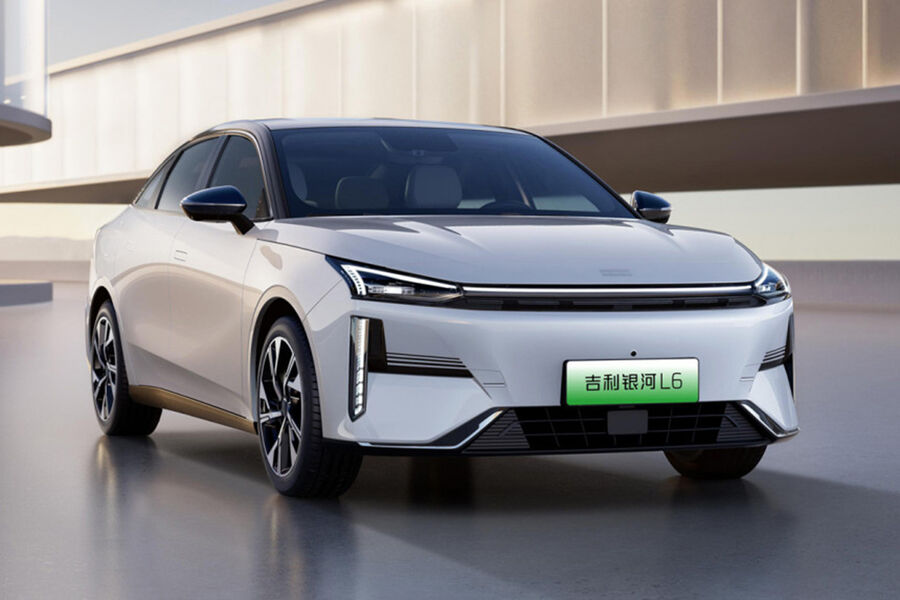
Chinese automaker Geely has launched a new version of the Galaxy L6 sedan L6. About this reports carnewschina.com. Price – 129.8 thousand yuan (1.5 million rubles at the exchange rate at the time of publication).

The car received a two-tone body and several additional options, in particular, interactive LED headlights, 18-inch wheels, an electric tailgate and a large panoramic roof.

The length of the car is 4782 mm, the wheelbase is 2752 mm. The power plant consists of a 1.5-liter gasoline turbo engine, two electric motors and a three-speed DHT Pro transmission. The total power of the unit is almost 400 hp. Acceleration from 0 to 100 km/h is 6.3 seconds, and the top speed is 247 km/h.

Inside there is an LCD instrument panel and a large vertical multimedia tablet. There is space for a head-up display. The number of physical buttons inside the machine has been kept to a minimum.

Previously reportedThe price of the new V23 crossover from Chery and Xiaomi will be the same as the Lada Niva Travel.


Source: Gazeta
 

Users who are viewing this thread

Back
Top