Navigation
Install the app
How to install the app on iOS
Follow along with the video below to see how to install our site as a web app on your home screen.
Note: This feature may not be available in some browsers.
More options
Style variation
You are using an out of date browser. It may not display this or other websites correctly.
You should upgrade or use an alternative browser.
You should upgrade or use an alternative browser.
Chinese Aircraft Carriers - Liaoning, Shandong, Fujian and the future
- Thread starter SiliconBit (silicon0000)
- Start date
More options
Who Replied?


Hendarto
Registered Member
Drills by the Fujian, China's top carrier, raise regional alarm over creeping military footprint near Korean Peninsula
By Yang Ji-ho,
Park Su-hyeon
Published 2025.06.06. 12:32

 www.chosun.com
China’s newest and most advanced aircraft carrier has conducted fighter jet takeoff and landing drills in the Provisional Measures Zone (PMZ) of the West Sea (Yellow Sea) — a disputed body of water between China and the Korean Peninsula — for the first time, multiple South Korean government sources confirmed to The Chosun Ilbo.
The exercises, carried out by the Fujian, China’s third and largest carrier, mark a historic first: no Chinese aircraft carrier has previously conducted this kind of training inside the PMZ. The move comes as Beijing continues to install maritime structures and buoys in the area — actions Seoul views as part of a gradual push to assert de facto control over the region.
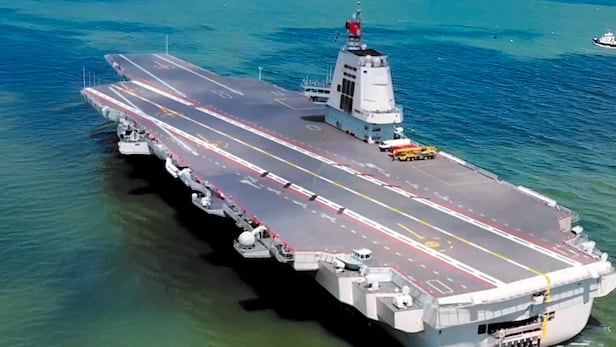
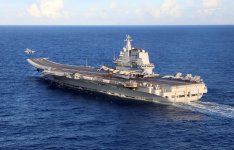
The Fujian, China’s third and largest aircraft carrier.
According to officials briefed on the situation, the Fujian conducted flight operations involving carrier-based aircraft from May 22 to 28. During this period, China also declared no-sail zones in three parts of the PMZ, citing live-fire drills. Prior to arriving in the Yellow Sea, the Fujian and its escort ships held exercises in the South China Sea before heading north for nearly a week of operations off the Korean Peninsula.
South Korea’s Joint Chiefs of Staff confirmed they are tracking and analyzing the activity, estimating the duration of the carrier drills at just under a week.
Launched in 2022, the Fujian is a conventionally powered supercarrier with an estimated displacement of 80,000 tons and a length of 320 meters. It is the first Chinese carrier equipped with an electromagnetic catapult system (EMALS), a technology previously exclusive to the U.S. Navy’s Gerald R. Ford-class carriers.
Named after the coastal province facing Taiwan, the Fujian’s designation is widely seen as a signal of Beijing’s intent to project power across the Taiwan Strait. Since its maiden sea trial in May 2024, the vessel has completed at least eight training rounds in preparation for full operational deployment.
Ahead of the Yellow Sea exercises, the Fujian was reported to have conducted EMALS tests near the mouth of the Yangtze River, likely involving advanced aircraft such as the KJ-600 early warning plane and the GJ-11 stealth drone. Analysts are also watching closely for signs that the J-35, China’s stealth fighter believed to resemble the U.S. F-35, was launched or recovered during the latest drills.
“If they’ve started carrier-based trials for the J-35, it means China’s stealth airpower could soon extend far beyond the mainland,” said Yang Wook, a research fellow at the Asan Institute for Policy Studies.
While the PMZ is considered international waters — not designated as a territorial sea or exclusive economic zone — China’s decision to deploy its most advanced carrier into the area is seen as a calculated display of military strength.
“Militarily, it’s not ideal terrain for carriers,” a South Korean defense source said. “This is more about asserting that ‘we can do whatever we want in our front yard.’”
China has steadily expanded its physical presence in the PMZ since 2018, installing unauthorized maritime structures and increasing the number of suspected surveillance buoys to at least 13.
The Fujian’s operations coincided with a separate deployment of the Liaoning, China’s first aircraft carrier, which conducted more than 120 aircraft sorties near Taiwan’s southeastern waters in late May, according to Taiwanese and Japanese authorities. Japan’s Defense Ministry reported the Liaoning later sailed through waters between Okinawa and Miyako Island into the Pacific, where further operations were observed.
As Beijing ramps up its naval activities in both the East and South China Seas, these twin carrier drills — one near Taiwan and the other near the Korean Peninsula — appear to signal a more assertive stance amid renewed U.S. efforts to counter China in the Indo-Pacific under President Donald Trump’s second term.
In response to Japan’s concerns about the Liaoning’s proximity, China’s Ministry of National Defense said the exercises were “in line with international law and not directed at any specific country,” calling Tokyo’s reaction an “overreaction.” Regarding the Fujian’s expanding trials, the ministry stated that the carrier’s sea training is “a necessary step” in its development and will continue as scheduled.
By Yang Ji-ho,
Park Su-hyeon
Published 2025.06.06. 12:32
Exclusive: China sends its most advanced carrier into disputed waters near Korea
Exclusive: China sends its most advanced carrier into disputed waters near Korea Drills by the Fujian, Chinas top carrier, raise regional alarm over creeping military footprint near Korean Peninsula
www.chosun.com
China’s newest and most advanced aircraft carrier has conducted fighter jet takeoff and landing drills in the Provisional Measures Zone (PMZ) of the West Sea (Yellow Sea) — a disputed body of water between China and the Korean Peninsula — for the first time, multiple South Korean government sources confirmed to The Chosun Ilbo.
The exercises, carried out by the Fujian, China’s third and largest carrier, mark a historic first: no Chinese aircraft carrier has previously conducted this kind of training inside the PMZ. The move comes as Beijing continues to install maritime structures and buoys in the area — actions Seoul views as part of a gradual push to assert de facto control over the region.
The Fujian, China’s third and largest aircraft carrier.
According to officials briefed on the situation, the Fujian conducted flight operations involving carrier-based aircraft from May 22 to 28. During this period, China also declared no-sail zones in three parts of the PMZ, citing live-fire drills. Prior to arriving in the Yellow Sea, the Fujian and its escort ships held exercises in the South China Sea before heading north for nearly a week of operations off the Korean Peninsula.
South Korea’s Joint Chiefs of Staff confirmed they are tracking and analyzing the activity, estimating the duration of the carrier drills at just under a week.
Launched in 2022, the Fujian is a conventionally powered supercarrier with an estimated displacement of 80,000 tons and a length of 320 meters. It is the first Chinese carrier equipped with an electromagnetic catapult system (EMALS), a technology previously exclusive to the U.S. Navy’s Gerald R. Ford-class carriers.
Named after the coastal province facing Taiwan, the Fujian’s designation is widely seen as a signal of Beijing’s intent to project power across the Taiwan Strait. Since its maiden sea trial in May 2024, the vessel has completed at least eight training rounds in preparation for full operational deployment.
Ahead of the Yellow Sea exercises, the Fujian was reported to have conducted EMALS tests near the mouth of the Yangtze River, likely involving advanced aircraft such as the KJ-600 early warning plane and the GJ-11 stealth drone. Analysts are also watching closely for signs that the J-35, China’s stealth fighter believed to resemble the U.S. F-35, was launched or recovered during the latest drills.
“If they’ve started carrier-based trials for the J-35, it means China’s stealth airpower could soon extend far beyond the mainland,” said Yang Wook, a research fellow at the Asan Institute for Policy Studies.
While the PMZ is considered international waters — not designated as a territorial sea or exclusive economic zone — China’s decision to deploy its most advanced carrier into the area is seen as a calculated display of military strength.
“Militarily, it’s not ideal terrain for carriers,” a South Korean defense source said. “This is more about asserting that ‘we can do whatever we want in our front yard.’”
China has steadily expanded its physical presence in the PMZ since 2018, installing unauthorized maritime structures and increasing the number of suspected surveillance buoys to at least 13.
The Fujian’s operations coincided with a separate deployment of the Liaoning, China’s first aircraft carrier, which conducted more than 120 aircraft sorties near Taiwan’s southeastern waters in late May, according to Taiwanese and Japanese authorities. Japan’s Defense Ministry reported the Liaoning later sailed through waters between Okinawa and Miyako Island into the Pacific, where further operations were observed.
As Beijing ramps up its naval activities in both the East and South China Seas, these twin carrier drills — one near Taiwan and the other near the Korean Peninsula — appear to signal a more assertive stance amid renewed U.S. efforts to counter China in the Indo-Pacific under President Donald Trump’s second term.
In response to Japan’s concerns about the Liaoning’s proximity, China’s Ministry of National Defense said the exercises were “in line with international law and not directed at any specific country,” calling Tokyo’s reaction an “overreaction.” Regarding the Fujian’s expanding trials, the ministry stated that the carrier’s sea training is “a necessary step” in its development and will continue as scheduled.


Hendarto
Registered Member
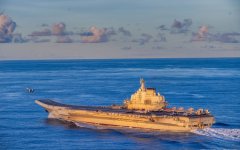
Unprecedented Chinese carrier sails past the second island chain. The maturing of Chinese carrier operations. It takes a long time, almost a decade and a half
PLA Navy aircraft carrier formations of Liaoning, Shandong conduct training in Western Pacific: spokesperson
https://www.globaltimes.cn/page/202506/1335817.shtml
By Global Times Published: Jun 10, 2025 06:50 PM
Formations of PLA Navy's aircraft carrier Liaoning and Shandong have recently conducted training in Western Pacific and other waters to test the forces' capabilities in far seas defense and joint operations, said Senior Captain Wang Xuemeng, a spokesperson for the PLA Navy on Tuesday, according to China Bugle, an official media account affiliated with the PLA news media center.
These are routine training organized in accordance with the annual training plan, aimed at continuously enhancing the vessels' ability to fulfill their missions, which are consistent with relevant international laws and international practices and are not targeted at any specific country or objective, Wang said.
China's Liaoning and Shandong aircraft carriers sail beyond second island chain
https://www.scmp.com/news/china/mil...raft-carriers-sail-beyond-second-island-chain
The two carrier groups have been spotted in the western Pacific Ocean, with the Liaoning's passage taking it past Guam
Liu Zhen
Published: 4:26pm, 10 Jun 2025|Updated: 6:14pm, 10 Jun 2025
In an unprecedented show of strength, the Chinese aircraft carriers Liaoning and Shandong have been conducting exercises in the western Pacific Ocean beyond the second island chain.
The People's Liberation Army's Navy said on Tuesday it had deployed two carrier groups in the Western Pacific and surrounding waters and conducted exercises to test their "far-sea defences and joint operational capabilities".
"It is a routine training exercise organised according to the annual plan, aiming to continuously strengthen mission fulfillment capabilities. It complies with relevant international laws and practices and is not targeted at any specific country or objective," Wang Xuemeng, senior captain of PLA Navy, said in a statement.
In a statement on Monday, the Japanese defence ministry said the Shandong strike group was spotted earlier that day, conducting take-off and landing operations of its jet fighters and helicopters about 500km (311 miles) southwest of Iwo Jima and north of Okinotori.
It followed the ministry's statement on Sunday that the Liaoning group had been located on Saturday 300km (186 miles) southwest of Minamitori Island. It was seen again on Sunday, a little further away. The carrier was also reported to be operating its ship-borne air wings.
All of the isles mentioned are in Japan's Ogasawara Islands, also known as the Bonins. Alongside Guam and the rest of the Marianas, as well as the western Carolines and other small Pacific archipelagos, they form a strategic band known as the second island chain.
Most notably, the Liaoning group travelled further east than Guam, the most fortified US military base in the band, marking the first time a Chinese navy carrier has reached beyond the second island chain.
Previous deployments – by the Liaoning in December 2022 and the Shandong in April 2023 – were some distance northwest of Guam. The Liaoning's easternmost recorded location this time was about 3,200km (1,990 miles) from Midway Atoll and 5,500km (3,420 miles) from Hawaii.
The two 60,000-tonne Kuznetsov-class vessels – the PLA Navy's only active carriers, with the Fujian still undergoing sea trials – were escorted by warships of significant size, representing China's most powerful maritime strike forces to date.
With the Shandong is the 12,000-tonne Type 055 destroyer Zunyi and the 7,500-tonne Type 052D guided-missile destroyer Zhanjiang, as well as the 4,000-tonne Type 054A guided-missile frigates Yuncheng and Hengshui, along with the fast combat support ship Chaganhu.
The Liaoning on Saturday was accompanied by Type 055 guided-missile destroyer the Wuxi and Type 052D guided-missile destroyer the Tangshan, in addition to the fast combat support ship Hulunhu.
On Sunday, the Liaoning was joined by another fleet which included the Type 055 destroyer Nanchang, Type 052D destroyer Qiqihar, Type 054A guided-missile frigate Yantai, and another replenishment ship Kekexilihu.
The Japan Maritime Self-Defence Force said it dispatched warships and aircraft to monitor the Chinese activities.
According to Tokyo, the Liaoning and its escorts entered the Pacific from the East China Sea through the international waterway between the Japanese islands of Okinawa and Miyako between May 26-27 and headed southeast until May 30.
The carrier group was next reported near Minamitori, Japan's easternmost island, on Saturday. Guam lies between the two known locations, suggesting it was passed by the Liaoning at some point. How closely the carrier and its escorts sailed to the US base is unknown.
It is also unknown whether the Liaoning and Shandong groups are planning to join forces in the Pacific. The two carrier fleets last conducted joint exercises in October, in the South China Sea.
When asked at the end of last month about the Liaoning's voyage, the Chinese defence ministry said the training exercise was "not targeting any country", and that Japan was "overreacting".
On Monday, Chinese foreign ministry spokesman Lin Jian said the carrier's activities "completely comply with international law and practices".
"China has always pursued a defensive national defence policy. We hope that Japan can see this in an objective and rational manner," Lin told the ministry's regular news conference.

PLA Navy aircraft carrier formations of Liaoning, Shandong conduct training in Western Pacific: spokesperson
https://www.globaltimes.cn/page/202506/1335817.shtml
By Global Times Published: Jun 10, 2025 06:50 PM
Formations of PLA Navy's aircraft carrier Liaoning and Shandong have recently conducted training in Western Pacific and other waters to test the forces' capabilities in far seas defense and joint operations, said Senior Captain Wang Xuemeng, a spokesperson for the PLA Navy on Tuesday, according to China Bugle, an official media account affiliated with the PLA news media center.
These are routine training organized in accordance with the annual training plan, aimed at continuously enhancing the vessels' ability to fulfill their missions, which are consistent with relevant international laws and international practices and are not targeted at any specific country or objective, Wang said.
China's Liaoning and Shandong aircraft carriers sail beyond second island chain
https://www.scmp.com/news/china/mil...raft-carriers-sail-beyond-second-island-chain
The two carrier groups have been spotted in the western Pacific Ocean, with the Liaoning's passage taking it past Guam
Liu Zhen
Published: 4:26pm, 10 Jun 2025|Updated: 6:14pm, 10 Jun 2025
In an unprecedented show of strength, the Chinese aircraft carriers Liaoning and Shandong have been conducting exercises in the western Pacific Ocean beyond the second island chain.
The People's Liberation Army's Navy said on Tuesday it had deployed two carrier groups in the Western Pacific and surrounding waters and conducted exercises to test their "far-sea defences and joint operational capabilities".
"It is a routine training exercise organised according to the annual plan, aiming to continuously strengthen mission fulfillment capabilities. It complies with relevant international laws and practices and is not targeted at any specific country or objective," Wang Xuemeng, senior captain of PLA Navy, said in a statement.
In a statement on Monday, the Japanese defence ministry said the Shandong strike group was spotted earlier that day, conducting take-off and landing operations of its jet fighters and helicopters about 500km (311 miles) southwest of Iwo Jima and north of Okinotori.
It followed the ministry's statement on Sunday that the Liaoning group had been located on Saturday 300km (186 miles) southwest of Minamitori Island. It was seen again on Sunday, a little further away. The carrier was also reported to be operating its ship-borne air wings.
All of the isles mentioned are in Japan's Ogasawara Islands, also known as the Bonins. Alongside Guam and the rest of the Marianas, as well as the western Carolines and other small Pacific archipelagos, they form a strategic band known as the second island chain.
Most notably, the Liaoning group travelled further east than Guam, the most fortified US military base in the band, marking the first time a Chinese navy carrier has reached beyond the second island chain.
Previous deployments – by the Liaoning in December 2022 and the Shandong in April 2023 – were some distance northwest of Guam. The Liaoning's easternmost recorded location this time was about 3,200km (1,990 miles) from Midway Atoll and 5,500km (3,420 miles) from Hawaii.
The two 60,000-tonne Kuznetsov-class vessels – the PLA Navy's only active carriers, with the Fujian still undergoing sea trials – were escorted by warships of significant size, representing China's most powerful maritime strike forces to date.
With the Shandong is the 12,000-tonne Type 055 destroyer Zunyi and the 7,500-tonne Type 052D guided-missile destroyer Zhanjiang, as well as the 4,000-tonne Type 054A guided-missile frigates Yuncheng and Hengshui, along with the fast combat support ship Chaganhu.
The Liaoning on Saturday was accompanied by Type 055 guided-missile destroyer the Wuxi and Type 052D guided-missile destroyer the Tangshan, in addition to the fast combat support ship Hulunhu.
On Sunday, the Liaoning was joined by another fleet which included the Type 055 destroyer Nanchang, Type 052D destroyer Qiqihar, Type 054A guided-missile frigate Yantai, and another replenishment ship Kekexilihu.
The Japan Maritime Self-Defence Force said it dispatched warships and aircraft to monitor the Chinese activities.
According to Tokyo, the Liaoning and its escorts entered the Pacific from the East China Sea through the international waterway between the Japanese islands of Okinawa and Miyako between May 26-27 and headed southeast until May 30.
The carrier group was next reported near Minamitori, Japan's easternmost island, on Saturday. Guam lies between the two known locations, suggesting it was passed by the Liaoning at some point. How closely the carrier and its escorts sailed to the US base is unknown.
It is also unknown whether the Liaoning and Shandong groups are planning to join forces in the Pacific. The two carrier fleets last conducted joint exercises in October, in the South China Sea.
When asked at the end of last month about the Liaoning's voyage, the Chinese defence ministry said the training exercise was "not targeting any country", and that Japan was "overreacting".
On Monday, Chinese foreign ministry spokesman Lin Jian said the carrier's activities "completely comply with international law and practices".
"China has always pursued a defensive national defence policy. We hope that Japan can see this in an objective and rational manner," Lin told the ministry's regular news conference.
ChineseTiger1986
Trusted Member
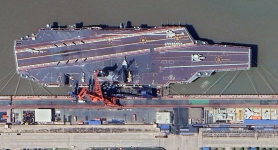
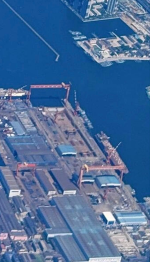
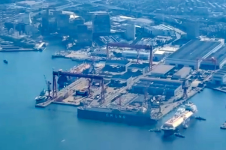
An aerial update from Dalian on whatever it will become ... I still don't see this as an aircraft carrier, but at least some larger parts are clearly visible now!
View attachment 126660
The waterline width of this monster is expected to be around 43-44 meters, while 41 meters for Fujian and Ford/Nimitz.
This gonna be the first 120,000 tonnes class supercarrier for the humanity.
Because the J-50 has a takeoff weight of 45 tonnes, it requires a hull that large to host it.
And its island structure looks like that because it is a nuclear-gas turbine hybrid like its predecessor Fujian.

Abdul q
Trusted Member


God speed…. The balance in east and west is finally hereThe waterline width of this monster is expected to be around 43-44 meters, while 41 meters for Fujian and Ford/Nimitz.
This gonna be the first 120,000 tonnes class supercarrier for the humanity.
Because the J-50 has a takeoff weight of 45 tonnes, it requires a hull that large to host it.
And its island structure looks like that because it is a nuclear-gas turbine hybrid like its predecessor Fujian.
ChineseTiger1986
Trusted Member
God speed…. The balance in east and west is finally here
The USS Gerald Ford is plagued with a ton of problems because the steam turbine generators powered by the A1B pressurized water reactors cannot generate the electric power fast enough to meet the demand of the EMALS.
China has solved this problem by making its nuclear + gas turbine hybrid since the gas turbines are way more flexible to generate some extra electric power to meet the demand of the EMALS, while the steam turbine generators powered by the pressurized water reactors to generate the electric power to power the ship itself.
The waterline width of this monster is expected to be around 43-44 meters, while 41 meters for Fujian and Ford/Nimitz.
This gonna be the first 120,000 tonnes class supercarrier for the humanity.
Because the J-50 has a takeoff weight of 45 tonnes, it requires a hull that large to host it.
And its island structure looks like that because it is a nuclear-gas turbine hybrid like its predecessor Fujian.
Come on, the Fujian is NOT a nuclear-gas turbine hybrid!
By the way, .... slowly, slowly whatever it is is getting bigger at Dalian!
(Image via @Captain小潇 from Weibo)

iblini
Trusted Member

This is a big one.Come on, the Fujian is NOT a nuclear-gas turbine hybrid!
By the way, .... slowly, slowly whatever it is is getting bigger at Dalian!
(Image via @Captain小潇 from Weibo)
View attachment 127108
ChineseTiger1986
Trusted Member
Come on, the Fujian is NOT a nuclear-gas turbine hybrid!
By the way, .... slowly, slowly whatever it is is getting bigger at Dalian!
(Image via @Captain小潇 from Weibo)
View attachment 127108
Fujian has the same propulsion like the Type 004.
The Type 004 is about 120,000 tonnes, and it cannot be conventionally powered.
It seems that China is never going to build a pure nuclear PWR carrier to power the EMALS. Otherwise, it gonna be plagued with a ton of problems like the CVN-78.
The only type of pure nuclear suparcarrier that China could build in the future gonna be the MSR one.
The MSR + supercritical carbon dioxide propulsion is going to be much more energy efficient compared to the current PWR + steam turbine combo.
The CVN-18 and CVN-19 are only improved PWR + steam turbine propulsion by adding up the gas turbines.
I am wondering if the CVN-20 gonna be powered by the MSR + supercritical carbon dioxide propulsion.
Last edited:
Hendarto
Registered Member
The aggregate displacement and firepower of Chinese naval forces that entered the Western Pacific in early June were among the largest for such deployments. They broke out from the First Island Chain with two carrier forces and a couple of other smaller formations.The naval ships involved included the 2 STOBAR carriers, 4 Type 055 large destroyers, 5 Type 052D destroyers, 7 Type 054A frigates, 1 Type 901 fast combat support ship, and 1 Type 903A replenishment oiler. Type 093A/B nuclear submarines almost certainly escorted this formation as well.The Liaoning carrier group has sailed past Guam and the Second Island Chain, entering the central Pacific proper.
Hendarto
Registered Member
Cat and mouse game in the Western Pacific
 www.newsweek.com
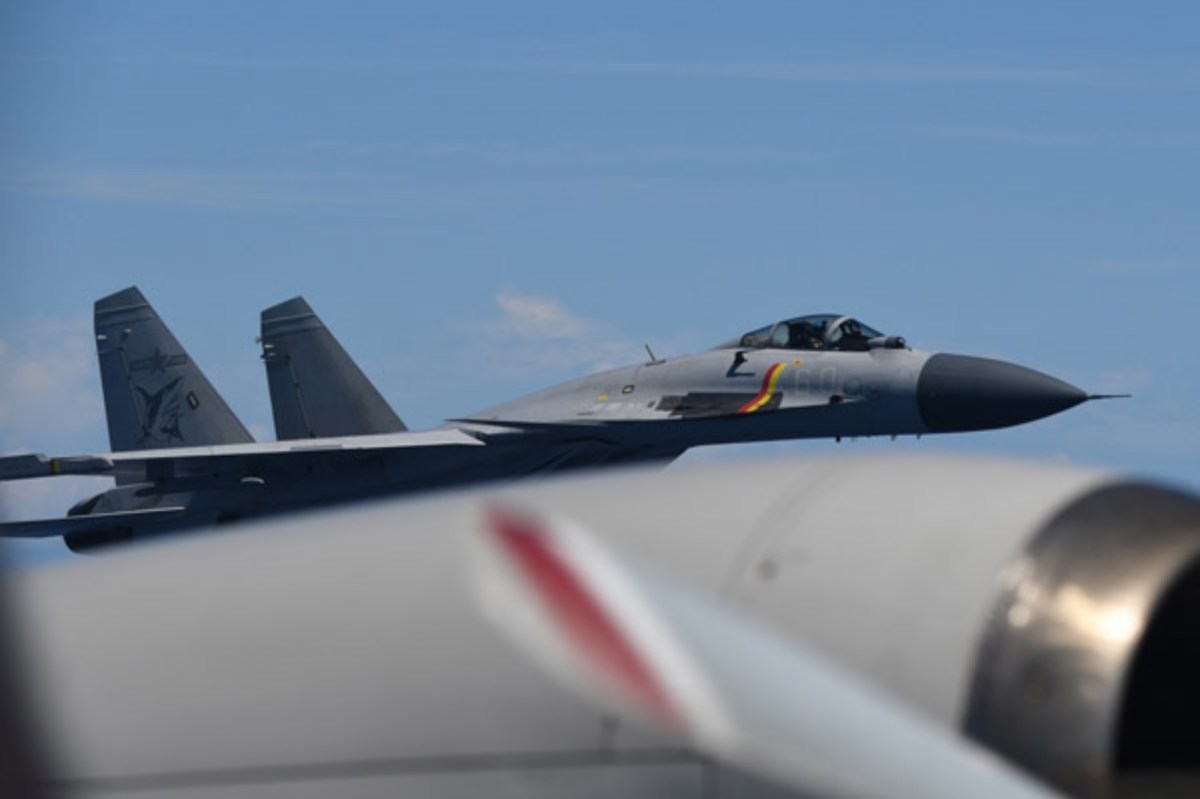
Patrol aircraft dispatched by Japan—a treaty ally of the United States—was intercepted by fighter jets launched from a Chinese aircraft carrier operating in the wider western Pacific.
Newsweek has contacted the Chinese Defense and Foreign Ministries via email for comment.
In April, Beijing's state media released undated footage showing a Chinese J-15 flying close to a U.S. F/A-18 carrier-based fighter over an undisclosed maritime location.
Aerial intercepts—if conducted in an unsafe or unprofessional manner—can lead to midair collisions, resulting in the loss of aircraft and aircrew. In 2001, a U.S. intelligence plane and a Chinese fighter jet collided near China, killing a Chinese pilot.
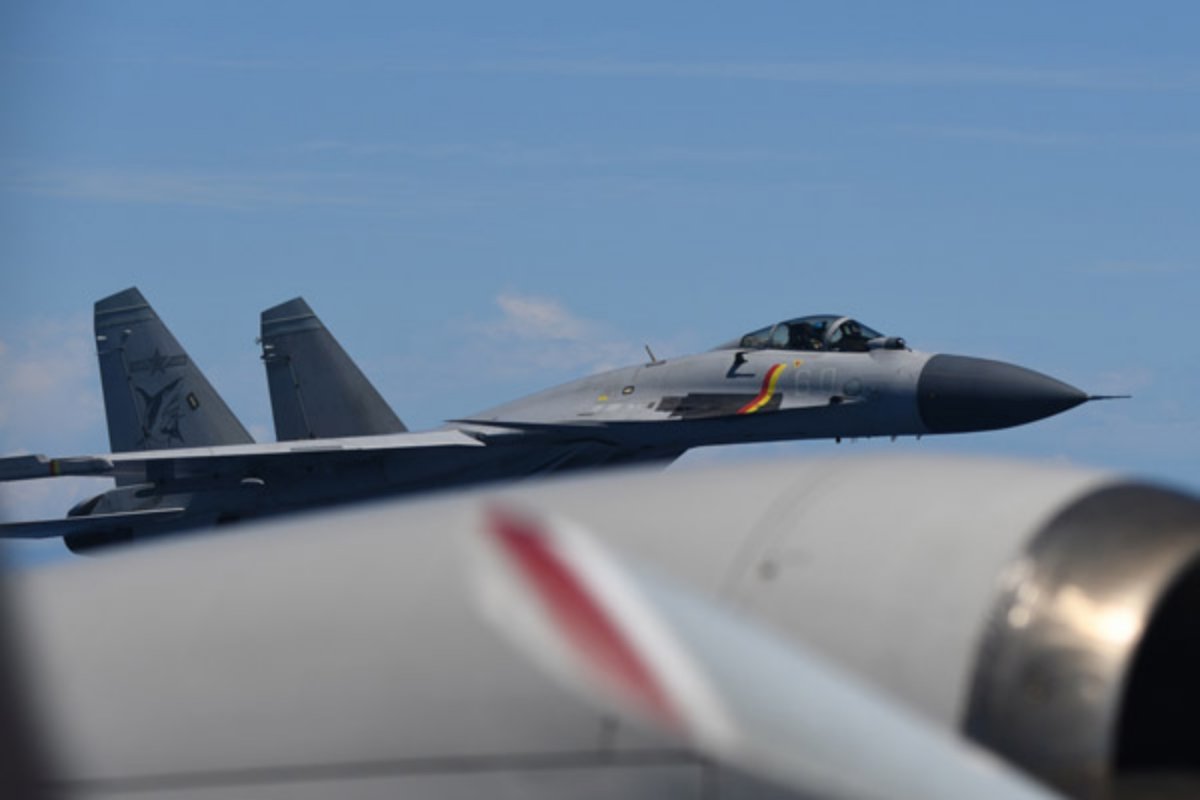
A Chinese J-15 fighter jet flies alongside a Japanese P-3C patrol aircraft over the Pacific Ocean on June 8, 2025. Japanese Defense Ministry
In the first incident, which occurred between 10:30 a.m. and 11 a.m. local time on Saturday, Chinese fighter jets were spotted flying as close as 45 meters (147 feet) from the Japanese aircraft at the same altitude, which was conducting an unspecified surveillance mission.
The following day, between 2 p.m. and 3 p.m. local time, Chinese fighter jets launched from the Shandong intercepted the Japanese aircraft for a second time, passing in front of it at a much greater distance—900 meters (2,952 feet)—while maintaining the same altitude.
One of the photos taken from the Japanese aircraft shows a Chinese fighter jet flying with a missile visible beneath its wing. Another photo shows a jet flying alongside the Japanese plane. The horizontal distance between them in the photos remains unknown.
Read more China
Pictures show Chinese jet buzzing US ally from aircraft carrier
The Japanese military has been tracking two Chinese aircraft carriers in the wider western Pacific Ocean.
www.newsweek.com
Patrol aircraft dispatched by Japan—a treaty ally of the United States—was intercepted by fighter jets launched from a Chinese aircraft carrier operating in the wider western Pacific.
Newsweek has contacted the Chinese Defense and Foreign Ministries via email for comment.
Why It Matters
China, which has the world's largest navy by hull count—deployed both of its two aircraft carriers in active service beyond the First Island Chain on Saturday. The island defense line, comprising Japan, Taiwan, and the Philippines, is in place to keep China's forces in check.In April, Beijing's state media released undated footage showing a Chinese J-15 flying close to a U.S. F/A-18 carrier-based fighter over an undisclosed maritime location.
Aerial intercepts—if conducted in an unsafe or unprofessional manner—can lead to midair collisions, resulting in the loss of aircraft and aircrew. In 2001, a U.S. intelligence plane and a Chinese fighter jet collided near China, killing a Chinese pilot.
What To Know
On Wednesday, the Japanese Defense Ministry reported an "unusual approach" by Chinese military aircraft toward the Maritime Self-Defense Force, stating that a P-3C patrol aircraft had two encounters with J-15 fighter jets—launched from the aircraft carrier CNS Shandong—over the weekend while flying in international airspace over the Pacific Ocean.
A Chinese J-15 fighter jet flies alongside a Japanese P-3C patrol aircraft over the Pacific Ocean on June 8, 2025. Japanese Defense Ministry
In the first incident, which occurred between 10:30 a.m. and 11 a.m. local time on Saturday, Chinese fighter jets were spotted flying as close as 45 meters (147 feet) from the Japanese aircraft at the same altitude, which was conducting an unspecified surveillance mission.
The following day, between 2 p.m. and 3 p.m. local time, Chinese fighter jets launched from the Shandong intercepted the Japanese aircraft for a second time, passing in front of it at a much greater distance—900 meters (2,952 feet)—while maintaining the same altitude.
One of the photos taken from the Japanese aircraft shows a Chinese fighter jet flying with a missile visible beneath its wing. Another photo shows a jet flying alongside the Japanese plane. The horizontal distance between them in the photos remains unknown.
Read more China
Users who are viewing this thread
Total: 1 (members: 0, guests: 1)
Pakistan Defence Latest


Country Watch Latest


Latest Posts
-
 Makkah Defence Alliance: Turkey, Saudi Arabia, and Pakistan, news & updates (14 Viewers)
- Latest: Watandar
-
-

-

-