Chinese Economy: General News, Updates and Discussions

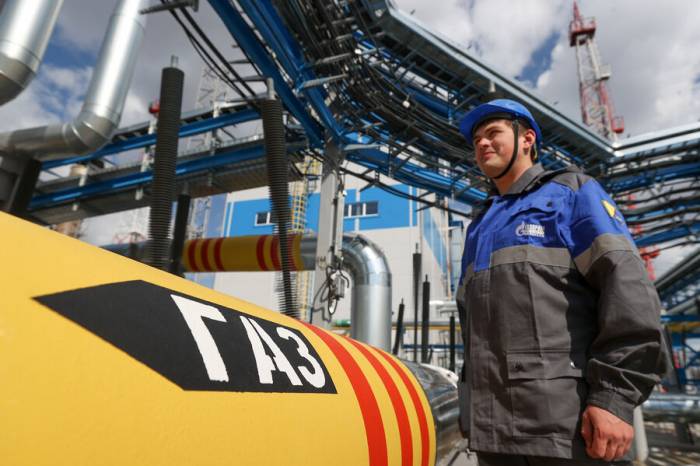
Russia boosts gas exports to China, aiming to catch up with Turkmenistan

21 Oct 2024 07:38

In the first nine months of 2024 Russian pipeline gas exports to China surged by 23% compared to the same period last year, according to data from China's General Administration of Customs. The monetary value of Russian gas deliveries during this period reached $6.1 billion, underscoring a significant strengthening of ties between the two countries in the energy sector.


The increase in exports can be attributed to several key factors. Firstly, the expansion of infrastructure and increased capacity of the "Power of Siberia" pipeline enabled Russia to boost its export volumes to China. Secondly, rising demand for natural gas in China, driven by the shift towards cleaner energy sources and the need to offset domestic energy shortages, has also played a crucial role.

Despite this significant growth, Russia remains the second-largest supplier of pipeline gas to China, behind the market leader, Turkmenistan. During the first nine months of 2024, Turkmenistan exported gas worth $7.4 billion, maintaining its position as China’s largest partner in this sector. This leadership status is attributed to long-standing, robust contracts that Beijing and Ashgabat have sustained at a high level over the years.

Following Russia, Kazakhstan ranks third in the Chinese market with $1.05 billion in exports, followed by Myanmar ($1.04 billion) and Uzbekistan ($499 million). This lineup underscores China’s active diversification of its gas sources to mitigate risks and strengthen its energy security.

A notable achievement for Russia was the record gas exports via the "Power of Siberia" pipeline in 2023, when shipments to China increased by 1.5 times, reaching 22.7 billion cubic meters. This milestone marked a significant chapter in Russia-China energy cooperation, laying the groundwork for further growth in export volumes.

In 2024, Gazprom once again exceeded its initial supply plan, exporting over 1 billion cubic meters more than initially planned. This indicates a growing mutual interest and Russia’s readiness to expand its export capacity to meet China’s demand.

The intensification of gas trade between Russia and China is significant not only from an economic standpoint but also politically. For Russia, the Chinese market has become a key focus amid restrictions on exports to Europe due to sanctions. Strategic partnership with China allows Russia to diversify its export routes and offset the loss of European clients. This also bolsters economic ties between the two major global powers, maintaining a balance of interests amid global competition.

For China, Russian gas is an essential component of its energy strategy. Beijing aims to reduce coal dependence and increase the share of gas and renewable energy in its energy mix. Russian pipeline gas ensures stable supplies at competitive prices, aligning with China’s long-term goals of securing energy security.

With the expansion of pipeline infrastructure, including plans to construct new branches of the "Power of Siberia," further growth in export volumes can be expected. However, several challenges remain. These include the need to negotiate new long-term contracts, maintain competitive pricing, and address political risks associated with potential changes in global energy markets.

China is actively investing in its own gas exploration projects and expanding LNG terminal capacity to reduce reliance on imports. Therefore, Russia must consider potential shifts in China’s energy policy and adapt its strategy accordingly in the long run.

Russian pipeline gas exports to China in 2024 demonstrate steady growth and the strengthening of Russia's position in the Chinese energy market. Despite competition from Turkmenistan and other suppliers, Russia-China energy cooperation continues to grow and deepen, opening new opportunities for both countries. Amid geopolitical challenges and shifts in global markets, such partnerships are not only economically beneficial but also strategically significant.
 
To view this content we will need your consent to set third party cookies.
For more detailed information, see our cookies page.

And the pressure from the grassroots continues to mount. Some provinces in Northeast China are in a very difficult situation indeed, with incomes falling sharply and authorities having serious difficulties in meeting Xi's almost unattainable goals. Another problem that has been growing exponentially is that many local authorities are turning to the private sector to extract money, and this is seriously damaging the Chinese private sector.
 
To view this content we will need your consent to set third party cookies.
For more detailed information, see our cookies page.

And the pressure from the grassroots continues to mount. Some provinces in Northeast China are in a very difficult situation indeed, with incomes falling sharply and authorities having serious difficulties in meeting Xi's almost unattainable goals. Another problem that has been growing exponentially is that many local authorities are turning to the private sector to extract money, and this is seriously damaging the Chinese private sector.


I have been listening to China collapsing for the past 30 years, every few years there's a 3 gorges dam collapse, and the a few years later a submarine sinking all without any proof published in 'respected' outlets too. The there will be a giant crack on the aircraft carrier, funny how we 100s deliver carrier sized tankers with no problem
 
I have been listening to China collapsing for the past 30 years, every few years there's a 3 gorges dam collapse, and the a few years later a submarine sinking all without any proof published in 'respected' outlets too. The there will be a giant crack on the aircraft carrier, funny how we 100s deliver carrier sized tankers with no problem
I was expecting a more contextualized comment, but your statement has no connection with my comment. The fact is that China's economy also has serious structural problems. Regarding the context, the author of the thesis is a Chinese woman named Hanyu Zhao, an employee of JP Morgan in Shanghai, a profile here on Linkedin for research.

Her article: https://dash.harvard.edu/handle/1/37375535

Just to demonstrate one of these structural problems: Chinese SOEs.

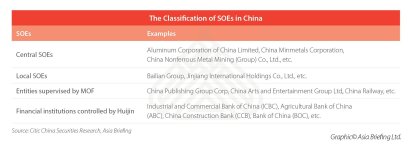
China’s SOEs contribute about 30 percent of the country’s GDP. The proportion far exceeds that of developed countries. SOEs in China can be divided into four groups based on their regulators:
1. Central industrial state-owned enterprises supervised by the central SASAC; https://en.wikipedia.org/wiki/State...dministration_Commission_of_the_State_Council
Central and local industrial state-owned enterprises are supervised by the State-owned Assets Supervision and Administration Commission of the State Council (SASAC), a special commission directly under the State Council.

2. Local industrial state-owned enterprises supervised by local SASACs;

3. Financial institutions controlled by Central Huijin Investment Co., Ltd (Huijin); and financial institutions are generally controlled by Central Huijin Investment Co., Ltd (Huijin), an investment company owned by the Chinese government.
State-owned

4. Entities supervised by the Ministry of Finance (MOF).

In addition, the Ministry of Finance (MOF) also regulates some enterprises subordinate to central administrative institutions, some financial companies, and SOEs that have financial relationships with the MOF.

The-Classification-of-SOEs-in-China-1.jpg
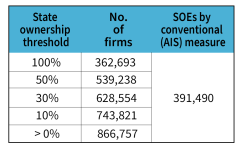
By conventional measures, China has 391,000 state-owned enterprises, but a new analysis of state ownership among all 40 million registered companies in China reveals that 363,000 companies are 100% state-owned, 629,000 companies are 30% state-owned, and nearly 867,000 companies have at least some state ownership.

imagem 2.png
State capital invested by the central government fell from 37% in 1999 to 31% in 2017, while that of provincial governments increased from 9% to 35% over the same period, both of which were relative to the total capital of firms in the network. Furthermore, while central and local governments are investing in a greater number of firms, their average shareholding in firms is declining. Taken together, the evidence suggests that while maintaining their shareholding in firms, governments are moving more toward indirect control of state-owned firms.

Problem???

SOEs are ineffective at returning value and boosting productivity. The government’s State-owned Assets Supervision and Administration Commission (SASAC) wants its local counterparts to improve how they monitor the debt of SOEs under their supervision, assessing debt levels, debt structure, profitability, cash position, asset quality and off-balance sheet debt, according to guidelines released today.

Although SOEs account for a large share of GDP, their success can be questioned because SOEs’ returns are so low, not even half the cost of capital, that many are over-indebted, especially local SOEs. This has become a drag on China’s economic growth. Ironically, however, SOEs are less common in the industrial sector, which partly explains the success of Chinese industry as a whole. The economic growth of recent decades has been impressive despite its state-owned enterprises, not because of them; this has been the cost of poor governance.

Mixed state and private ownership is associated with higher business growth, productivity and profitability. Companies with closer ties to the Chinese government tend to grow faster, but are less profitable and efficient than those with more distant ties. The state allows state-owned enterprises to dominate all markets where there is potential for profit, such as telecommunications, insurance, infrastructure and banking. It has liberalized certain sectors that are highly competitive, such as retail, services, agriculture, low-cost manufacturing, etc., all with tight profit margins.

Imagine if an SOE operated under the same conditions as other companies, there would be a fantastic boom in productivity, increasing economic growth and the purchasing power of the population. For example, the banking system is not yet liberalized and is not fully commercial, but it is still used to support state-owned enterprises. Thanks to the rapid growth in 2008-2011, banks have accumulated large amounts of bad loans, and SOEs are often given easier access to credit, allowing them to survive even when they cannot service their debts. Between 2010-2012, private firms received on average half of all loans made to all firms, while producing between two-thirds and three-quarters of China’s GDP. With SOEs earning less than their cost of capital, interest rate liberalization would result in increased credit flows to private-sector firms, since they can pay higher rates and still be profitable.

It is an entire ecosystem that feeds on itself inefficiently, which has fundamental consequences for China's progress. And I am not saying that this is something that China does only, a good example of this is Fannie Mae and Freddie Mac in the US, but the difference is that in other countries the influence of SOEs on the economy is much smaller than in China and their negative repercussions are much less felt. And it is worth noting that I am not even touching on the issue of existing corruption, which greatly affects the performance of SOEs, the only argument here is the cost of poor governance of the SOEs portfolio felt in the economy.

As you saw above, China is trying to reform. The SASAC chief executive said that the guidelines aim to prevent or effectively resolve the main debt risks of SOEs, noting that any regional and systemic financial risks would be a red line that should not be crossed. For SOEs that are heavily indebted, local SASACs should help them deleverage through measures such as restricting new investment, introducing strategic investors or converting debt into equity, the guidelines say. In addition, local SASACs should address the SOEs’ default risks by helping them ease payment pressure. Regulators can direct SOEs to work with their bondholders to extend payment terms. Meanwhile, local SASACs should not tolerate misconduct such as fraudulent bond issuances and debt evasion, the guidelines say. This is part of the reform that began in the 1990s, when China implemented a first wave of reforms of state-owned enterprises as it faced mounting losses to more savvy private competitors. Many have been shut down and others have been listed on the stock markets, which initially boosted productivity and returns, but the state-owned sector has been losing ground despite preferential treatment from regulators and state-owned banks. SOE reform has been redefined from the 2013 vision. Eleven years ago, Chinese leaders made three promises about state-owned enterprises: (1) SOEs would be concentrated in key and pillar industries, leaving normal commercial industries to the market; (2) SOEs would be restructured to operate more efficiently; and (3) SOEs would help increase spending on the social safety net. Beijing remains far from achieving these goals. Such scenarios can be seen here and here.

I won't go into that.
 
My comment was written bearing in mind the peculiar social structures and social characteristics of India.

India is, in cultural terms, and in terms of social behaviour, strikingly different from East Asia. Only a madman would even try to encapsulate this culture and this social behaviour on the pages of a forum as short-winded as this and similar ones. If one must risk grievous loss of face and public ridicule in upholding the situation as it exists, in the settled areas (outside the forests and the hills), people comfortably form small teams at work, they work well on very sophisticated handiwork, typically, as a starting point, on handicrafts, their productivity is affected by the climate, they are distracted by social and religious functions, and they tend to adhere to existing work relationships far beyond the international norm.

One could go on, but this is the stuff of many dozens of doctoral theses.
how come you write better English than all the American or British posters here?? damn..
 
I was expecting a more contextualized comment, but your statement has no connection with my comment. The fact is that China's economy also has serious structural problems. Regarding the context, the author of the thesis is a Chinese woman named Hanyu Zhao, an employee of JP Morgan in Shanghai, a profile here on Linkedin for research.

Her article: https://dash.harvard.edu/handle/1/37375535

Just to demonstrate one of these structural problems: Chinese SOEs.

China’s SOEs contribute about 30 percent of the country’s GDP. The proportion far exceeds that of developed countries. SOEs in China can be divided into four groups based on their regulators:
1. Central industrial state-owned enterprises supervised by the central SASAC; https://en.wikipedia.org/wiki/State...dministration_Commission_of_the_State_Council
Central and local industrial state-owned enterprises are supervised by the State-owned Assets Supervision and Administration Commission of the State Council (SASAC), a special commission directly under the State Council.

2. Local industrial state-owned enterprises supervised by local SASACs;

3. Financial institutions controlled by Central Huijin Investment Co., Ltd (Huijin); and financial institutions are generally controlled by Central Huijin Investment Co., Ltd (Huijin), an investment company owned by the Chinese government.
State-owned

4. Entities supervised by the Ministry of Finance (MOF).

In addition, the Ministry of Finance (MOF) also regulates some enterprises subordinate to central administrative institutions, some financial companies, and SOEs that have financial relationships with the MOF.

View attachment 77814
By conventional measures, China has 391,000 state-owned enterprises, but a new analysis of state ownership among all 40 million registered companies in China reveals that 363,000 companies are 100% state-owned, 629,000 companies are 30% state-owned, and nearly 867,000 companies have at least some state ownership.

View attachment 77815
State capital invested by the central government fell from 37% in 1999 to 31% in 2017, while that of provincial governments increased from 9% to 35% over the same period, both of which were relative to the total capital of firms in the network. Furthermore, while central and local governments are investing in a greater number of firms, their average shareholding in firms is declining. Taken together, the evidence suggests that while maintaining their shareholding in firms, governments are moving more toward indirect control of state-owned firms.

Problem???

SOEs are ineffective at returning value and boosting productivity. The government’s State-owned Assets Supervision and Administration Commission (SASAC) wants its local counterparts to improve how they monitor the debt of SOEs under their supervision, assessing debt levels, debt structure, profitability, cash position, asset quality and off-balance sheet debt, according to guidelines released today.

Although SOEs account for a large share of GDP, their success can be questioned because SOEs’ returns are so low, not even half the cost of capital, that many are over-indebted, especially local SOEs. This has become a drag on China’s economic growth. Ironically, however, SOEs are less common in the industrial sector, which partly explains the success of Chinese industry as a whole. The economic growth of recent decades has been impressive despite its state-owned enterprises, not because of them; this has been the cost of poor governance.

Mixed state and private ownership is associated with higher business growth, productivity and profitability. Companies with closer ties to the Chinese government tend to grow faster, but are less profitable and efficient than those with more distant ties. The state allows state-owned enterprises to dominate all markets where there is potential for profit, such as telecommunications, insurance, infrastructure and banking. It has liberalized certain sectors that are highly competitive, such as retail, services, agriculture, low-cost manufacturing, etc., all with tight profit margins.

Imagine if an SOE operated under the same conditions as other companies, there would be a fantastic boom in productivity, increasing economic growth and the purchasing power of the population. For example, the banking system is not yet liberalized and is not fully commercial, but it is still used to support state-owned enterprises. Thanks to the rapid growth in 2008-2011, banks have accumulated large amounts of bad loans, and SOEs are often given easier access to credit, allowing them to survive even when they cannot service their debts. Between 2010-2012, private firms received on average half of all loans made to all firms, while producing between two-thirds and three-quarters of China’s GDP. With SOEs earning less than their cost of capital, interest rate liberalization would result in increased credit flows to private-sector firms, since they can pay higher rates and still be profitable.

It is an entire ecosystem that feeds on itself inefficiently, which has fundamental consequences for China's progress. And I am not saying that this is something that China does only, a good example of this is Fannie Mae and Freddie Mac in the US, but the difference is that in other countries the influence of SOEs on the economy is much smaller than in China and their negative repercussions are much less felt. And it is worth noting that I am not even touching on the issue of existing corruption, which greatly affects the performance of SOEs, the only argument here is the cost of poor governance of the SOEs portfolio felt in the economy.

As you saw above, China is trying to reform. The SASAC chief executive said that the guidelines aim to prevent or effectively resolve the main debt risks of SOEs, noting that any regional and systemic financial risks would be a red line that should not be crossed. For SOEs that are heavily indebted, local SASACs should help them deleverage through measures such as restricting new investment, introducing strategic investors or converting debt into equity, the guidelines say. In addition, local SASACs should address the SOEs’ default risks by helping them ease payment pressure. Regulators can direct SOEs to work with their bondholders to extend payment terms. Meanwhile, local SASACs should not tolerate misconduct such as fraudulent bond issuances and debt evasion, the guidelines say. This is part of the reform that began in the 1990s, when China implemented a first wave of reforms of state-owned enterprises as it faced mounting losses to more savvy private competitors. Many have been shut down and others have been listed on the stock markets, which initially boosted productivity and returns, but the state-owned sector has been losing ground despite preferential treatment from regulators and state-owned banks. SOE reform has been redefined from the 2013 vision. Eleven years ago, Chinese leaders made three promises about state-owned enterprises: (1) SOEs would be concentrated in key and pillar industries, leaving normal commercial industries to the market; (2) SOEs would be restructured to operate more efficiently; and (3) SOEs would help increase spending on the social safety net. Beijing remains far from achieving these goals. Such scenarios can be seen here and here.

I won't go into that.

Before we read the copy pasted text, have you ever been to China? Stayed here or worked here? Lol
 
Before we read the copy pasted text, have you ever been to China? Stayed here or worked here? Lol
Do the silly people who comment on India and Indian affairs have any time spent in India?
LOL.
 
Before we read the copy pasted text, have you ever been to China? Stayed here or worked here? Lol
I posted both links to the argument I demonstrated at the end of the comment, but also from a book:

About going to China, I've never been to China. Does that mean I have to have been to China or be Chinese to argue about facts?
 
Do the silly people who comment on India and Indian affairs have any time spent in India?
LOL.
His argument is completely flawed. So, does that mean that only an American can talk about the American economy or someone who has visited the US, only a Chinese can talk about the Chinese economy or someone who has visited it, only a Brazilian can talk about the Brazilian economy or someone who has visited it.
 

Government Cracks Down on SOEs but Runs Risks​

 
I posted both links to the argument I demonstrated at the end of the comment, but also from a book:

About going to China, I've never been to China. Does that mean I have to have been to China or be Chinese to argue about facts?
Facts? Visit China to understand the socioeconomic condition first. You copy pasting a long article is no different from someone writing a doomsday article on China 20 years ago. The Chinese economy is a hybrid economy, certain highly profitable industries like banking, telco and oil are controlled by the government. Profits are kept low for the society. Competitive, highly agile industries like electronics and online services, retail are open for all, and the best survives. Is the system bad or good? We are number 2 now right? Unlike US where wealth is concentrated with the top 1% billionaires, in China, the government is the wealthiest, hence we don't have to resort to printing money when we need funding. HSR and mass transit are indespensible to our economy and yet it is losing money, how do we maintain such an infrastructure and how does it act as economic multiplier?
 
Do the silly people who comment on India and Indian affairs have any time spent in India?
LOL.
Yes I did, Bangalore and Delhi. Apart from a few pockets of modernity, looks like a giant you know what i mean.
 

48 hours in China's Shenzhen city 🇨🇳 China Is Living in the Future!​

To view this content we will need your consent to set third party cookies.
For more detailed information, see our cookies page.
 

Users who are viewing this thread

Back
Top