Chinese Economy: General News, Updates and Discussions

If guaranteed at a price of 15 cents/kwh

I did not know China charged this much for electricity.
Electricity in China costs about 8 cents/kwh. But it's impossible for China to provide power to the entire world at that price.15 cents/kwh is a good price, and it's already lower than many places in the world.
 
There would be no demand for an international electricity currency not backing the yuan. Electricity is perishable, you can't make perishable things into money. This is basic economics.
 
So yuan would be fiat. The US would have bitcoin and China would trade using electricity money.

Nations don't need Chinese electricity, that is a national sovereignty issue. If nations are skeptical of the BRI on mere trade, electricity from China is a bridge too far for most developed nations. It would be a regional thing to sell electricity.

Chinese sees China makes over abundance of electricity and want to turn it into money, literally not only sales.

Still does not make sense. You can barter electricity, you can't turn it into a currency.

Money has three main functions:

  1. Medium of Exchange: You can use it to buy things.
  2. Unit of Account: You can price goods in it.
  3. Store of Value: You can save it and use it later.

Electricity is not a medium of exchange, nor a store of value..
 
A medium of exchange is an intermediary instrument or system used to facilitate the sale, purchase, or trade of goods and services. It is one of the three primary functions of money, alongside being a unit of account and a store of value.

For something to be a true medium of exchange, it must be:

  • Widely Accepted: People are willing to take it in payment.
  • Divisible: Can be divided into smaller units.
  • Portable: Easy to carry and transfer.
  • Durable: Does not spoil or degrade.
Money (like the U.S. Dollar, Euro, etc.) is the medium of exchange. You don't exchange a medium for money; the medium is the money.
 
So yuan would be fiat. The US would have bitcoin and China would trade using electricity money.

Nations don't need Chinese electricity, that is a national sovereignty issue. If nations are skeptical of the BRI on mere trade, electricity from China is a bridge too far for most developed nations. It would be a regional thing to sell electricity.

Chinese sees China makes over abundance of electricity and want to turn it into money, literally not only sales.

Still does not make sense. You can barter electricity, you can't turn it into a currency.

Money has three main functions:

  1. Medium of Exchange: You can use it to buy things.
  2. Unit of Account: You can price goods in it.
  3. Store of Value: You can save it and use it later.

Electricity is not a medium of exchange, nor a store of value..
You just can't understand a world where electricity is the currency.
 

China imports no US soybeans in September for first time in seven years​

It comes as Chinese buyers continue to shun American cargoes amid ongoing trade tensions.
China imports no US soybeans in September for first time in seven years

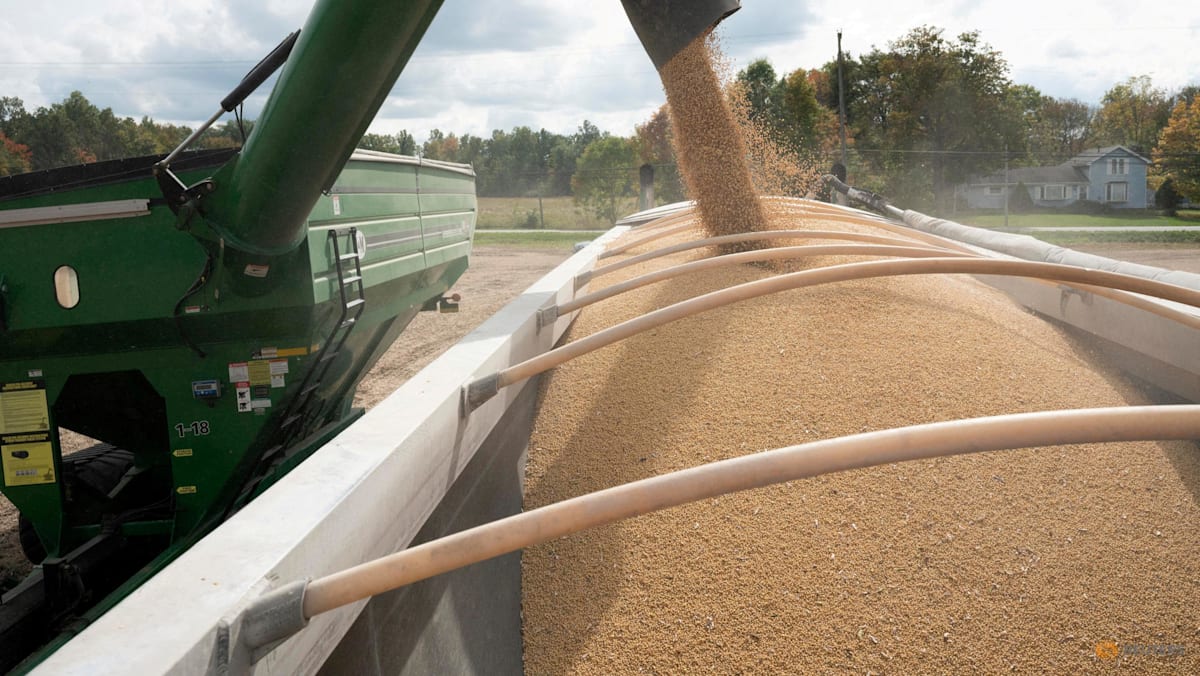
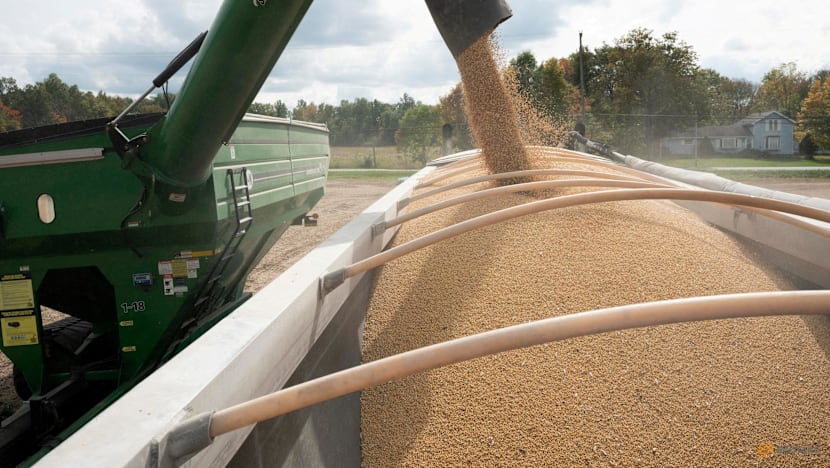
Soybeans are loaded into a truck from a transfer hopper during harvest season in Deerfield, Ohio, US, Oct 7, 2021. (File photo: Reuters/Dane Rhys)
21 Oct 2025 02:08PM(Updated: 21 Oct 2025 02:09PM)
Bookmark
WhatsAppTelegramFacebookTwitterEmailLinkedIn

BEIJING: China imported no soybeans from the US in September, the first time since November 2018 that shipments fell to zero, while South American shipments surged from a year earlier, as buyers shunned American cargoes during the ongoing trade dispute between the world's two largest economies.

Imports last month from the US fell to zero from 1.7 million metric tons a year earlier, data from China's General Administration of Customs showed on Monday (Oct 20).

Shipments fell because of the high tariffs China has imposed on US imports and as previously harvested US supplies, known as old-crop beans, have already been traded. China is the world's biggest soybean importer.

"This is mainly due to tariffs. In a typical year, some old-crop beans would still enter the market," said Wan Chengzhi, an analyst at Capital Jingdu Futures.
Brazil arrivals last month jumped 29.9 per cent year-on-year to 10.96 million tons, accounting for 85.2 per cent of China's total imports of the oilseed, customs data showed, while shipments from Argentina rose 91.5 per cent to 1.17 million tons, or 9 per cent of the total.

China's soybean imports reached 12.87 million metric tons in September, the second-highest level on record.
China has not purchased any US soybean cargoes from this autumn's harvest. The window for US soybean purchases is rapidly closing as buyers secure shipments through November, largely from Brazil and Argentina, helped by Argentina's brief tax holiday.

Without a breakthrough in trade talks, US farmers could face billions in losses as Chinese crushers continue sourcing from South America. Beijing, however, may also face a potential supply crunch early next year before Brazil's new crops hit the market.


"A soybean supply gap may emerge in China between February and April next year if there's no trade deal in place. Brazil has already shipped a huge volume, and no one knows how much old-crop stock remains," said Johnny Xiang, founder of Beijing-based AgRadar Consulting.

Trade negotiations between Beijing and Washington appear to be regaining momentum after weeks of fresh tariff threats and export controls. US President Donald Trump said on Sunday he believed a soybean deal would be reached.

For the January-September period, China imported 63.7 million tons from Brazil, up 2.4 per cent year-on-year, and 2.9 million tons from Argentina, up 31.8 per cent year-on-year.

Even as Chinese buyers are shunning this year's US harvest, purchases earlier in 2025 mean that year-to-date imports of American beans have totalled 16.8 million tons, up 15.5 per cent, data showed.
Source: Reuters/lk(ht)
 
China instead chose to import from south American countries such as Brazil.

This will put immense pressure on American farmers.

And strengthens the BRICS states eventually.
 
The market cap of milk is undeterminable. Does it include spoiled milk, how about milk thrown down the drain. Money has to be durable and not perishable. How about the years production of milk to determine market cap of milk and value of milk as commodity money. Except most has been drank and consumed. This is why things that are consumed can't be money.

Market cap of electricity. If you take the entire year, that energy is gone. Are you talking electric bills for the year? None of this makes sense as money. And if use it as money, you can only cover as a regional currency, it can't threaten Western money as it is fixed to energy costs and supply. This is how to survive without dethroning the dollar or its replacement.

Calling this an international currency and not effecting the yuan due to lack of supply was a misdirection by the resident Chinese (so my criticism remains sound):

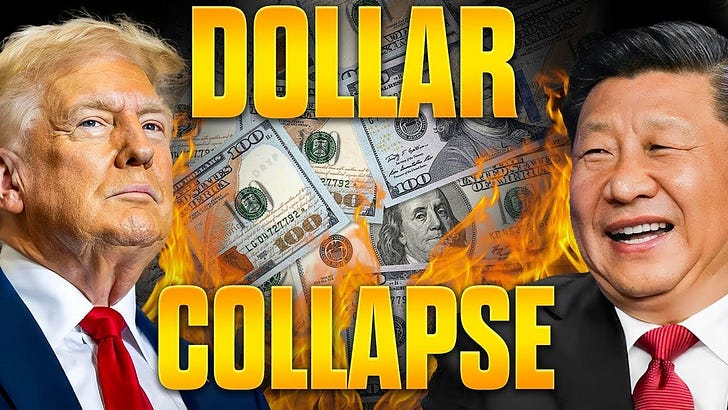
China's New Currency: The Electricity-Backed Yuan​

How an electricity-backed Chinese currency could replace the petrodollar and redefine global power.​


Petrodollar only gave demand, it did not back the dollar.

US treasuries and debt held by international institutions also gave demand to US dollars that were invented in debt.
 
China's New Currency: The Electricity-Backed Yuan

How an electricity-backed Chinese currency could replace the petrodollar and redefine global power.​

That is China's grand plan. To give demand to the yuan based on foreign purchases of electricity. It can never back the yuan, it serves the same purpose as oil does for the dollar. There is nothing on the dollar, saying redeemable in oil/backed by oil. The US gets oil producers to sell their oil in dollars to force global demand of dollars. This keeps the dollar from collapsing due to debt, wars...

Electric Yuan, not an electricity-backed yuan because that is impossible... It keeps China as a regional player not threatening US dominance of the globe. As this is not for global electric production, it is only for Chinese electricity. Yeah it can serve a smaller role that the petro played to the dollar, though it does not challenge the US. The only thing supporting the dollar for petro dollars are foreign purchases of oil in dollars. Domestic purchases of oil in dollars of domestic oil does not serve the petrodollar role of getting foreigners to support the dollar with demand of dollars in oil purchases. So too, it would not be the entire energy grid that would support the yuan, it would be foreign purchases of Chinese energy and these are minimal. Obviously oil from the US consumed in the US are in dollars. This is not the petrodollar of nations forced to trade in dollars for oil. That is the petrodollar -foreign oil paid in dollars. Chinese paying their electric bills as they did for decades in yuan is not the electricyuan. Selling surplus and electricity to other nations paid in yuan is the electricyuan. So using the sum total of the Chinese electric usage is presently using the yuan as payment is not the electricyuan. It is normal domestic economic activities.

If China bought the global utilities and around the globe, your energy bill went to Chinese companies. And then China says you must pay in yuan, you are getting closer to the magnitude of the petrodollar. Until then ... .

Though it is no where near reserves backing a currency. You are giving support to the currency via demand.

Electricyuan same as petrodollar is fiat and not backed/redeemable. Once you back a currency with a commodity, you move away from fiat.
 
Last edited:

ZF opens new brakes plant in Wuhan, China​

The EPB plant is the third major facility built by ZF in Wuhan in the last two years.

October 22, 2025

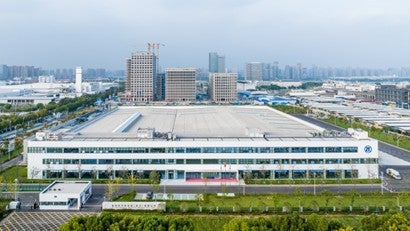
Germany automotive components manufacturer ZF Group has launched operations at its newly built electronic parking brake (EPB) plant in the Wuhan Economic & Technological Development Zone (WEDZ), in China’s Hubei Province.

The new EPB plant is the third major facility built by ZF in Wuhan in the last two years, following the company’s recently completed construction of a major airbag manufacturing base and airbag R&D facility in the city.
 
China’s Gold Policies: Reshaping the Global Monetary Landscape
China is undertaking a series of strategic initiatives to comprehensively reshape the global gold market structure, aiming to challenge the dominance of the U.S. dollar and build a gold-backed financial system independent of the West.

China Is Using Gold To Replace the U.S. Dollar​


To view this content we will need your consent to set third party cookies.
For more detailed information, see our cookies page.


By linking the RMB to green electricity and associating it with gold reserves and 90% of imported commodities, China can create a ‘Green RMB’ system as a viable alternative to the petrodollar model.
 
Last edited:
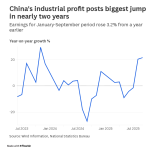
China’s industrial profits surge 21.6% in September, biggest jump in nearly two years
PUBLISHED SUN, OCT 26 20259:40 PM EDT
KEY POINTS
  • China’s industrial profits soared 21.6% in September from a year ago.
  • That sharp jump represented the biggest jump since November 2023.
  • For the first nine months of the year, profits at major industrial firms grew 3.2%, the official data showed.
JINHUA, CHINA - APRIL 01: Employees work on the assembly line of new energy vehicles at a factory of Chinese EV startup Leapmotor on April 1, 2024 in Jinhua, Zhejiang Province of China. (Photo by Shi Kuanbing/VCG via Getty Images)

Employees work on the assembly line of new energy vehicles at a factory of Chinese EV startup Leapmotor on April 1, 2024 in Jinhua, Zhejiang Province of China.
Shi Kuanbing | VCG | Visual China Group | Getty Images

China’s industrial profits soared 21.6% in September from a year ago, the National Bureau of Statistics said Monday, as Beijing’s campaign to curb price wars helped ease pressure on manufacturers despite persistent trade tensions with the U.S.

That sharp jump, extending a strong rebound that began in August when the industrial profits jumped 20.4% year-on-year, marked the biggest gain since November 2023.


For the first nine months of the year, profits at major industrial firms grew 3.2%, the official data showed, accelerating from a 0.9% rise in the January to August period.

The rebound in corporate profitability was largely helped by Beijing’s policies aimed at curtailing fierce price competition across industrial sectors, at a time when deflation in producer prices stretched into its third year.
微信图片_2025-10-27_105443_760.png

China’s consumer prices fell more than expected in September, slipping 0.3% from a year earlier, while the producer price index slumped 2.3%.

Profits for the manufacturing sector jumped 9.9% from a year earlier in the January to September period, and earnings from electricity, heat, fuel and water supply companies climbed 10.3%. The mining sector, however, saw profits drop 29.3%.

Yu Weining, chief statistician at NBS, said high-tech manufacturing helped drive broader profit growth, with sector earnings surging 26.8% in September.

Among industrial firms, profits at state-owned enterprises dipped 0.3%, compared with gains of 4.9% for foreign industrial firms — including those with investment from Hong Kong, Macau and Taiwan — and 5.1% for private companies.

Chinese manufacturers have weathered uncertain trade policies with the U.S. and tepid consumer confidence at home as the world’s second-largest economy grappled with a prolonged housing downturn, weak labour market conditions and growing headwinds on its exports.

While the country’s overall exports have remained resilient this year, analysts expect the trade growth to slow in the final quarter, in part due to the high base last year.

“We expect export growth to slow in Q4, after an increase to 6.6% y-o-y in Q3 from 6.2% in Q2, due to a high base and rising trade barriers globally,” said a team of economists at Nomura.

China’s economy expanded 4.8% in the third quarter, marking the slowest rate in a year. Fixed-asset investment unexpectedly contracted 0.5% in the first nine months of the year — the first such decline since 2020 during the pandemic — according to data going back to 1992 from Wind Information.

Industrial output grew faster than expected in September, climbing 6.5% from a year ago, and up from 5.2% growth in the previous month.

The resilient headline figures suggest Beijing may not see much urgency in rolling out more stimulus measures to achieve its growth target of around 5% for this year, analysts said.

While Chinese policymakers pledged to boost domestic demand at a high-profile economic planning meeting earlier this month, they also stressed the need for technological breakthroughs and for upgrading the country’s industrial capabilities.

“References to ‘expanding domestic demand’ and ‘improving livelihoods’ are present but comparatively much less prominent,” said Louise Loo, head of Asia Economics at Oxford Economics.

“These suggest that while policymakers recognise weak household sentiment and a savings overhang, they don’t envision large-scale consumption stimulus over the next five years,” Loo added.


Users who are viewing this thread

Pakistan Defence Latest

Back
Top