Navigation
Install the app
How to install the app on iOS
Follow along with the video below to see how to install our site as a web app on your home screen.
Note: This feature may not be available in some browsers.
More options
Style variation
You are using an out of date browser. It may not display this or other websites correctly.
You should upgrade or use an alternative browser.
You should upgrade or use an alternative browser.
Chinese Economy: General News, Updates and Discussions
- Thread starter Beijingwalker
- Start date
More options
Who Replied?


chinasun
Registered Member

At least five major canal projects costing hundreds of billions of RMB are either being built or planned by provincial governments as the government steps up its long-term strategy to turn China’s inland waterways into a network of interconnected arteries that will boost trade and economic growth.

People ride on a boat along the grand canal in Beijing, China on 11 October 2024. (Adek Berry/AFP)
(By Caixin journalists Li Rongqian and Wang Xintong)
China is in the grip of canal fever.
As the government steps up its long-term strategy to turn the country’s inland waterways into a network of interconnected arteries that will boost trade and economic growth, at least five major canal projects costing hundreds of billions of RMB are either being built or planned by provincial governments.
They include the 135-kilometre Pinglu Canal in Southwest China, the first manmade waterway connecting a river to the sea to be built since the founding of the People’s Republic of China in 1949, the 1,988 km Zhejiang-Jiangxi-Guangdong (Zhe-Gan-Yue) north-south canal system — which will be even longer than the Beijing-Hangzhou Grand Canal built 2,000 years ago — and an ambitious project led by the Henan provincial government that reportedly involves connecting waterways between the Yellow River, Huai River, and Yangtze River and provide direct access to the Yangtze River Delta.
Preparatory work on a major section of the Zhe-Gan-Yue canal, which will link the eastern provinces of Zhejiang and Jiangxi with the southern export powerhouse Guangdong, is pushing ahead. In mid-October, China Design Group Co. Ltd., a Shanghai-listed engineering design firm, announced that it had won a bid to conduct a pre-feasibility study for that section of the waterway, a project the Jiangxi provincial government dubbed the “project of the century” when it was announced in January 2021.
The projects are part of a strategy started almost two decades ago to develop a “high-class” inland waterway transport (IWT) network … as part of an integrated, modern transport and logistics system.
A Caixin analysis of public information about the five waterway projects, and a sixth canal that went into operation in 2023, indicates the total investment could exceed 850 billion RMB (US$117 billion), with funding coming from a range of sources including central government grants and subsidies, the proceeds of special-purpose local government bonds, and low-interest long-term loans from policy banks.
The projects are part of a strategy started almost two decades ago to develop a “high-class” inland waterway transport (IWT) network — mainly waterways rated as navigable for vessels with loading capacity of 1,000 tons (Class 3) to 3,000 tons (Class 1) — as part of an integrated, modern transport and logistics system.
Grand plans
China has the world’s longest navigable inland waterway system at around 128,000 km, with the Yangtze River accounting for around half the total at 64,818 km, government data show. But even today, only some 15,400 km of waterways are suitable for navigation by larger vessels and barges, limiting their usefulness for transport purposes.
For areas unsuitable for navigation by large vessels, improving canal systems greatly aids the shift from road to water transport, Chen Feier, deputy director of the Research Institute of Ports and Shipping at Shanghai Jiao Tong University, told Caixin. Canals have relatively large traffic capacity which enables them to cope well with a sudden increase in demand, she said.
IWT has long been the poor relation of the Chinese transport system, with investment in inland waterways neglected compared with the massive spending on building modern, high-class road and rail networks.
But a big shift began in 2007 when the government published a national plan to develop the country’s inland waterways and ports until 2020. Among the targets were to increase the length of high-class waterways to around 19,000 km from less than 9,000 km in 2006, accounting for 15% of the total length of the country’s inland waterways, up from 7% in 2005, and to connect 25% of cities with a population of over 500,000.
Yet despite almost two decades of pledges, development of inland waterways has lagged far behind that of highways and railroads.
IWT got a further boost starting in 2019 when China published a long-term plan pledging to turn itself into a transportation powerhouse by 2035. The strategy included expanding navigable waterways, modernising infrastructure such as ship locks and dams, promoting sustainability through environmentally friendly vessels powered by clean energy and stricter pollution controls, improving inland port facilities, and linking inland waterways with international shipping routes to better support the Belt and Road Initiative.
In 2021, a flurry of related plans was released, setting ambitious targets such as increasing the length of high-class waterways to 25,000 km by 2035, although the country had, at the end of 2023, only achieved 81% of its 2020 goal of 19,000 km.
Yet despite almost two decades of pledges, development of inland waterways has lagged far behind that of highways and railroads. By the end of 2023, China’s navigable inland waterways had increased by just 1%, or 1,900 km, since 2014, according to data from the Ministry of Transport (MOT). Over the same period, the national highway network had expanded 64%, and the railway network had grown 42%.For areas unsuitable for navigation by large vessels, improving canal systems greatly aids the shift from road to water transport, Chen Feier, deputy director of the Research Institute of Ports and Shipping at Shanghai Jiao Tong University, told Caixin. Canals have relatively large traffic capacity which enables them to cope well with a sudden increase in demand, she said.
IWT has long been the poor relation of the Chinese transport system, with investment in inland waterways neglected compared with the massive spending on building modern, high-class road and rail networks.
But a big shift began in 2007 when the government published a national plan to develop the country’s inland waterways and ports until 2020. Among the targets were to increase the length of high-class waterways to around 19,000 km from less than 9,000 km in 2006, accounting for 15% of the total length of the country’s inland waterways, up from 7% in 2005, and to connect 25% of cities with a population of over 500,000.
Yet despite almost two decades of pledges, development of inland waterways has lagged far behind that of highways and railroads.
IWT got a further boost starting in 2019 when China published a long-term plan pledging to turn itself into a transportation powerhouse by 2035. The strategy included expanding navigable waterways, modernising infrastructure such as ship locks and dams, promoting sustainability through environmentally friendly vessels powered by clean energy and stricter pollution controls, improving inland port facilities, and linking inland waterways with international shipping routes to better support the Belt and Road Initiative.
In 2021, a flurry of related plans was released, setting ambitious targets such as increasing the length of high-class waterways to 25,000 km by 2035, although the country had, at the end of 2023, only achieved 81% of its 2020 goal of 19,000 km.
Yet despite almost two decades of pledges, development of inland waterways has lagged far behind that of highways and railroads. By the end of 2023, China’s navigable inland waterways had increased by just 1%, or 1,900 km, since 2014, according to data from the Ministry of Transport (MOT). Over the same period, the national highway network had expanded 64%, and the railway network had grown 42%.
Last edited:

ety
Trusted Member

A core commodity in US-China trade! China's soybean import dependence will decrease from 90% to below 30% in the next decade.
Written by:Guancha.cnpublishing:2025-12-13 15:30renew:2025-12-13 15:30

Soybeans are a key ingredient in edible oil and animal feed, and a core commodity in Sino-US trade relations, making their strategic importance to China self-evident. According to a South China Morning Post report on the 12th, a research report released this week by Goldman Sachs analysts indicates that as China accelerates its progress towards food self-sufficiency, including strengthening its food supply chain to withstand trade shocks, China's soybean import dependence will decrease from 90% to below 30% over the next decade.
The report points out that China's soybean demand management strategy has reduced annual consumption by 15 million tons between 2021 and 2024. This initiative, launched during the first round of the US-China trade war in 2018, "has played a crucial role in alleviating trade barriers and uncertainties between the US and China, as well as between China and Latin America."

Monthly US soybean exports and exports to China. (Screenshot from a paper published by Purdue University in September)
China imports over 100 million tons of soybeans annually, accounting for approximately 60% of global soybean trade, and has long been the largest buyer for US soybean farmers. In recent years, due to escalating trade frictions, climate change, and the reality of limited arable land for a population of 1.4 billion, the importance of soybeans as China's largest single agricultural import for food security has become increasingly prominent.
In their assessment report, Goldman Sachs analysts wrote, "Soybeans are a core pain point in China's food security, facing problems such as low self-sufficiency, supply vulnerability to trade fluctuations, and a high concentration of import sources."
The report points out that China has taken several measures, including reducing the proportion of soybeans added to animal feed, improving feed conversion efficiency, and optimizing feed protein formulation. This soybean strategy "is gradually increasing soybean substitution capacity, thereby strengthening the food security defense line."

On August 27, 2025, in Waterman, Illinois, soybean farmer Ryan Frieders stands in his soybean field. (Reuters)
Analysts assess that, overall, China has "achieved remarkable results," successfully reversing the trend of continuously increasing soybean import dependence over the past 30 years.
Furthermore, data from three years ago estimated that, squeezed by both increasing demand and limited arable land resources, China's equivalent arable land gap could reach 90 million hectares by 2032. (This refers not to the actual amount of arable land shortfall, but rather Goldman Sachs' calculation after converting grain imports into arable land area.) The new report has revised this estimate, stating, "Thanks to advancements in farming technology, we now estimate that China's arable land gap has narrowed to 84 million hectares, and there is a clear roadmap indicating that this gap will further narrow to 5 million hectares by 2035."
Goldman Sachs analysts believe that China may further reduce its soybean imports in the future. These measures may be implemented after making relevant commitments to Washington. Trump administration officials recently stated that China has agreed to purchase at least 12 million tons of US soybeans "this season" and at least 25 million tons annually for the next three years.

The photo shows a shipment of soybeans being dumped into a grain silo in Ohio, USA, on October 7, 2021. (Reuters)
According to NBC News, since resuming purchases in late October, China has conducted at least 10 rounds of soybean purchases from the United States, with cumulative purchases reaching approximately 2.85 million tons as of Tuesday.
The U.S. Department of Agriculture also announced on Monday that a private exporter had informed it of an additional 132,000 tons of soybean orders to China. Some U.S. media outlets immediately seized on this, claiming that China's soybean purchases in recent weeks have fallen far short of the White House's stated target of "completing the agreed-upon purchase volume by the end of December this year."
In the past two weeks, U.S. Treasury Secretary Bessant and Trade Representative Greer have both stated that China has consistently adhered to the terms of its bilateral trade agreement with the United States. They also directly refuted the claim that "China's soybean purchases have stalled." On December 9, local time, at a Senate hearing, Greer responded to a question by stating that the deadline for China to purchase 12 million tons of soybeans from the United States was not the end of December this year, but rather the end of the soybean growing season.

U.S. Treasury Secretary Scott Bessent said on October 26 that China has refused to buy U.S.-grown soybeans during the U.S.-China trade conflict. He responded, "I'm a soybean farmer myself, so I feel the pain just as much." (Reuters)
The NBC report noted that Bessant, in his recent statements, also used the term "growing season" to describe China's procurement deadline. At the time, he emphasized that China's current procurement pace was "fully capable of successfully achieving" the 12 million-ton procurement target. Regarding the specific deadline, he mentioned, "I think it will be February 28th (2026)."
Soybean trade is of great importance to U.S. agriculture. Data from the U.S. Department of Agriculture shows that in 2024, soybeans accounted for approximately 20% of U.S. cash crop revenue, valued at $46.8 billion, with about a quarter of that going to China. However, due to the trade war initiated by the Trump administration, China suspended its purchases of U.S. agricultural products for several months, resulting in billions of dollars in losses for American farmers and grain traders.
The latest developments in China-US trade negotiations show that both sides are pushing for the implementation of the agreement through high-level dialogue. On December 5, He Lifeng, the Chinese lead negotiator for China-US trade negotiations and Vice Premier of the State Council, held a video call with the US lead negotiators, US Treasury Secretary Bessant and Trade Representative Greer. The two sides conducted in-depth and constructive exchanges and agreed to continue to leverage the China-US trade consultation mechanism, continuously expanding the list of cooperation areas and reducing the list of issues, to promote the sustained and stable improvement of China-US economic and trade relations.
冖_冖
Registered Member
South China's Guangxi sees 10-pct growth in trade with ASEAN in Jan-Nov period
South China's Guangxi Zhuang Autonomous Region saw a year-on-year growth of 10 percent in trade with
 www.bastillepost.com
South China's Guangxi sees 10-pct growth in trade with ASEAN in Jan-Nov period
South China's Guangxi Zhuang Autonomous Region saw a year-on-year growth of 10 percent in trade with
www.bastillepost.com
South China's Guangxi sees 10-pct growth in trade with ASEAN in Jan-Nov period
2025-12-14 17:38 Last Updated At:18:37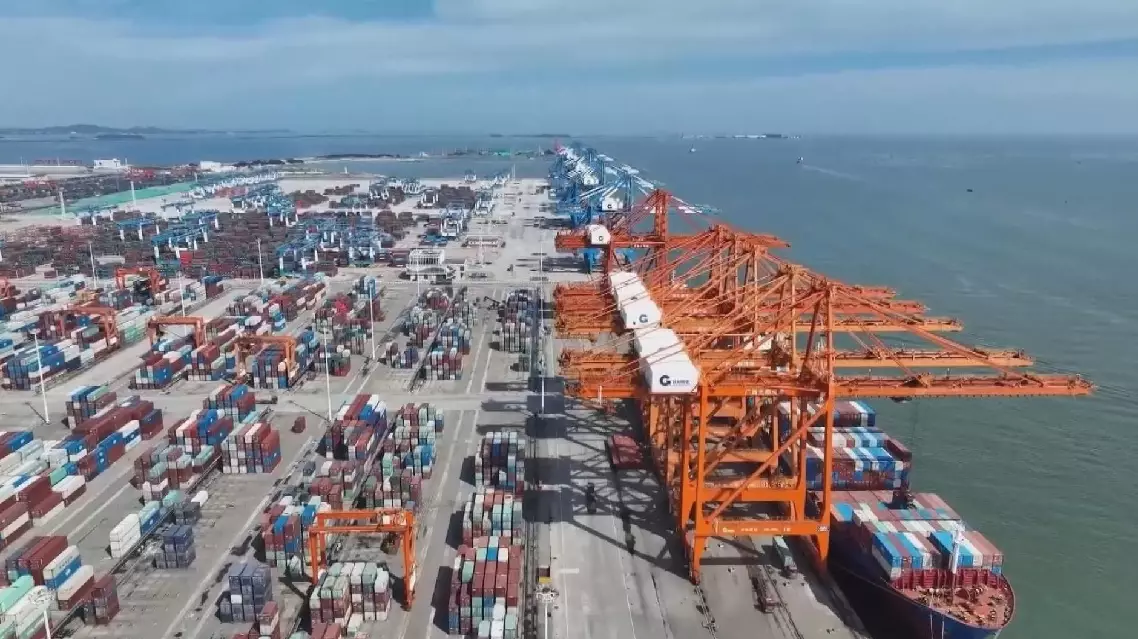
South China's Guangxi sees 10-pct growth in trade with ASEAN in Jan-Nov period
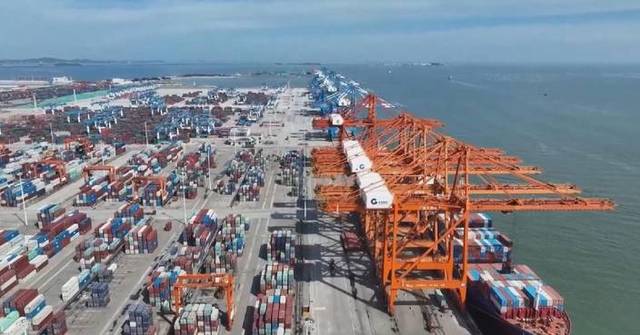
South China's Guangxi Zhuang Autonomous Region saw a year-on-year growth of 10 percent in trade with countries of the Association of Southeast Asian Nations (ASEAN) from January to November this year, according to Nanning Customs.
In the first 11 months of 2025, Guangxi's imports and exports with ASEAN members reached 384.22 billion yuan (about 54.46 billion U.S. dollars), accounting for 52.9 percent of the provincial-level region's total foreign trade during this period, said the authority.
Among them, Vietnam remained Guangxi's largest trading partner in the ASEAN region, with trade growing by 7.1 percent. The growth rates with Indonesia and Singapore were also remarkable, standing at 51.7 percent and 62.7 percent respectively.
During the same period, Guangxi imported and exported a total of 726.54 billion yuan worth of goods, increasing by 9.5 percent year on year, the customs data showed.
Nan Yang
Registered Member

Breaking | Hong Kong’s Jimmy Lai found guilty on all charges in national security trial
Ex-media boss, who has spent years in solitary confinement at his own request, faces ruling on sedition, collusion charges in high-profile security case
SCMP Reporters
Published: 9:48am, 15 Dec 2025Updated: 10:50am, 15 Dec 2025
This story has been made freely available as a public service to our readers. Please consider supporting SCMP’s journalism by subscribing. Get faster notifications on the latest updates by downloading our app.
Three Hong Kong judges who presided over former media boss Jimmy Lai Chee-ying’s high-profile national security trial for more than 1½ years are set to return their verdict on Monday.
The 78-year-old founder of the now-defunct Apple Daily has spent most of the past five years in solitary confinement, an arrangement made at his own request, after he was first denied bail in December 2020. Lai has denied two counts of conspiracy to collude with foreign forces and a third of conspiracy to print seditious articles.
The businessman turned opposition activist is the most prominent figure yet to be prosecuted under the national security law imposed by Beijing in June 2020.
He allegedly used his news outlet and social media platforms to trigger international sanctions and incite public disaffection towards authorities between April 2019 and June 2021.
He is also said to have provided financial backing to the “Fight for Freedom, Stand with Hong Kong” lobbying group to instigate hostile actions by the West.
He and the three companies he owned, namely Apple Daily Limited, Apple Daily Printing Limited and AD Internet Limited, were charged under the national security law.
Lai could face life in prison if convicted.
Hong Kong authorities have warned against any attempt to interfere with judicial independence in Lai’s trial, saying it may constitute perverting the course of justice, after Western politicians consistently denounced the prosecution as an attack on press freedom and demanded his immediate release.
Beijing reaffirmed on Friday its support for Hong Kong in “safeguarding national security in accordance with the law and punishing crimes that endanger national security”.
The Post provides the latest updates as Madam Justice Esther Toh Lye-ping delivers her ruling in a case closely watched locally and abroad.
Reporting by Brian Wong, Fiona Chow, Harvey Kong, Connor Mycroft and Jeffie Lam
Jimmy Lai found guilty of conspiracy charges
Lai was found guilty on all three charges: conspiracy to print, publish, sell, offer for sale, distribute, display and/or reproduce seditious publications; and two charges of conspiracy to commit collusion with a foreign country or with external elements to endanger national security.Other defendants in the trial – Apple Daily Limited, Apple Daily Printing Limited and AD Internet Limited – are also found guilty of conspiracy to print, publish, sell, offer for sale, distribute, display and/or reproduce seditious publications, and one count of conspiracy to commit collusion with a foreign country or with external elements to endanger national security.
‘Now is not the time for rhetoric but to exact punishment on China’
Toh notes that before Lai’s failed attempt in June 2020 to appeal against a travel ban arising from a separate charge and ahead of the implementation of the national security law, he had drafted a letter to The New York Times that had been arranged by Mark Simon.She recites part of the contents of the letter: “Xi’s clampdown on Hong Kong’s rule of law with the new national security law is just the beginning of aggression on Taiwan and neighbours in South China Sea. Now is not the time for rhetoric but to sanction and exact punishment on China, even the best time for America to create a perfect storm to rock the demise of the [Chinese Communist Party].”
‘Trump knows how powerful Hong Kong is as trade leverage’: Lai
Describing Simon as a “mysterious character,” Toh says he was clearly a facilitator for Lai to meet with senior US officials, and to lobby and seek their support against the central and Hong Kong governments.
She also cites a 2019 message between Lai, Simon and Martin Lee Chu-ming, the founding chairman of the now-defunct Democratic Party, in which Lai said: “[US President] Trump knows how powerful Hong Kong is as a leverage for his trade deal and beyond. The new cold war has just unfolded officially.”
Mark Simon ‘helped Lai arrange meetings with US officials’
Judge Toh says that it was also evident from WhatsApp messages received by Lai that his right-hand man, Mark Simon, was working hard behind the scenes to help Lai arrange meetings with government officials in Washington.She cites a series of messages sent in 2019 to Lai by Simon, a former US naval intelligence officer, about arrangements to meet with US officials including former National Security Advisor John Bolton.
She also points to a meeting Lai held with then US vice-president Mike Pence and secretary of state Mike Pompeo in which Lai requested Washington to impose sanctions, blockade or engage in hostile activities against China and Hong Kong in relation to the extradition bill, which triggered the months-long social unrest in 2019.
Lai ‘clearly conspired’ on sanctions call
Toh says Lai’s “constant invitation” to the US to help bring down the Chinese government would be analogous to a situation where an American asked for help from Russia to bring down the US government.“We’re satisfied that the evidence plainly shows that [Lai] clearly conspired with the senior management in [Apple Daily] and corporate defendants,” she says, referring to the two charges of conspiracy to commit foreign collusion.
Toh also says the court is “satisfied” that there is “indisputable evidence” that Lai conspired with others to request foreign countries to impose sanctions or blockade or engage in other hostile activities against China, Hong Kong or both.
Lai resented China for ‘many of his adult years’, court says
Judge Toh says that it is clear from the evidence that the defendant from an early stage, long before the national security law was implemented, applied his mind as to what leverage the United States could use against China.There is “no doubt” that Lai harboured his “resentment and hatred” of the People’s Republic of China for many of his adult years, she says. Among evidence she cites is his live chats and interviews on Fox News.
Proceedings begin
The three judges presiding over the case enter a packed courtroom.Madam Justice Esther Toh Lye-ping warns that anyone who disturbs the proceedings will be asked to leave the courtroom.
She says the judgment is 855-page long, adding she will not read out the whole document.
Family, activists arrive for hearing
Among those arriving for the hearing are Lai’s wife and son, as well as retired Cardinal Joseph Zen Ze-kiun.Veteran opposition activists are seen entering the courtroom, including Tsang Kin-shing and Emily Lau Wai-hing from now-defunct groups League of Social Democrats and Democratic Party, respectively.
Speaking to the Post while queuing, Tsang says he is hoping to attend the verdict hearing as it is “Hong Kong people’s business”.

Heavy police presence around court building
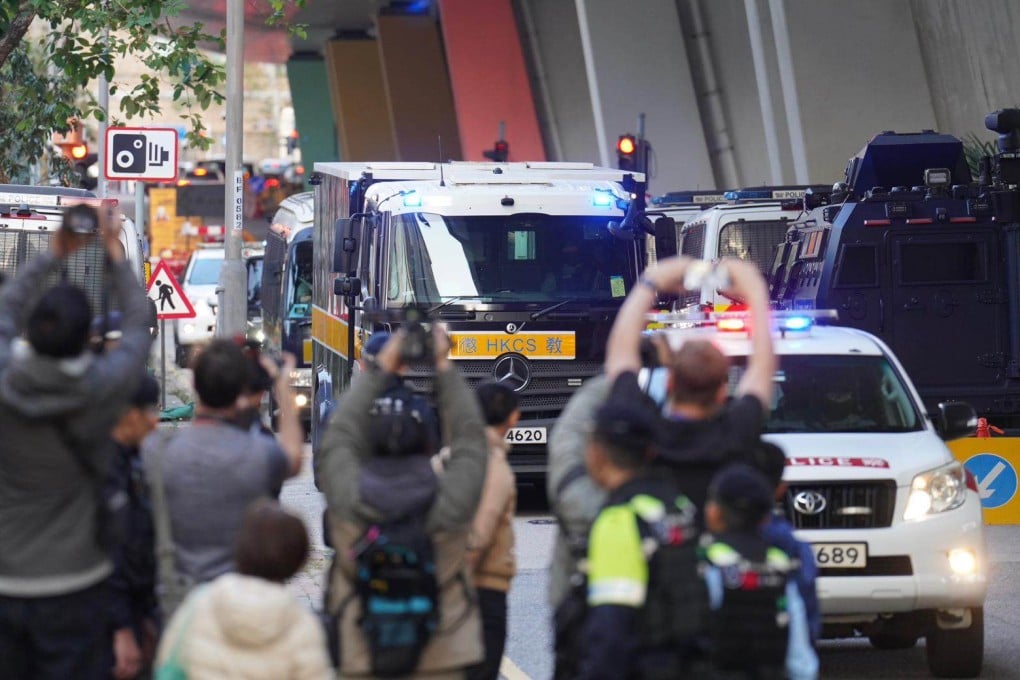
More than 100 officers are patrolling around the West Kowloon Court building, with areas cordoned off and police tents set up.Officers are standing near the entrance to keep control of people entering the building. Two police dogs are also by the entrance.
Police vans, including an anti-riot armoured vehicle known as a “sabre-toothed tiger”, are positioned outside the building.
Officers across the street stop and ask some residents for identification. A young man dressed in a black coat and wearing a surgical mask is among those stopped.
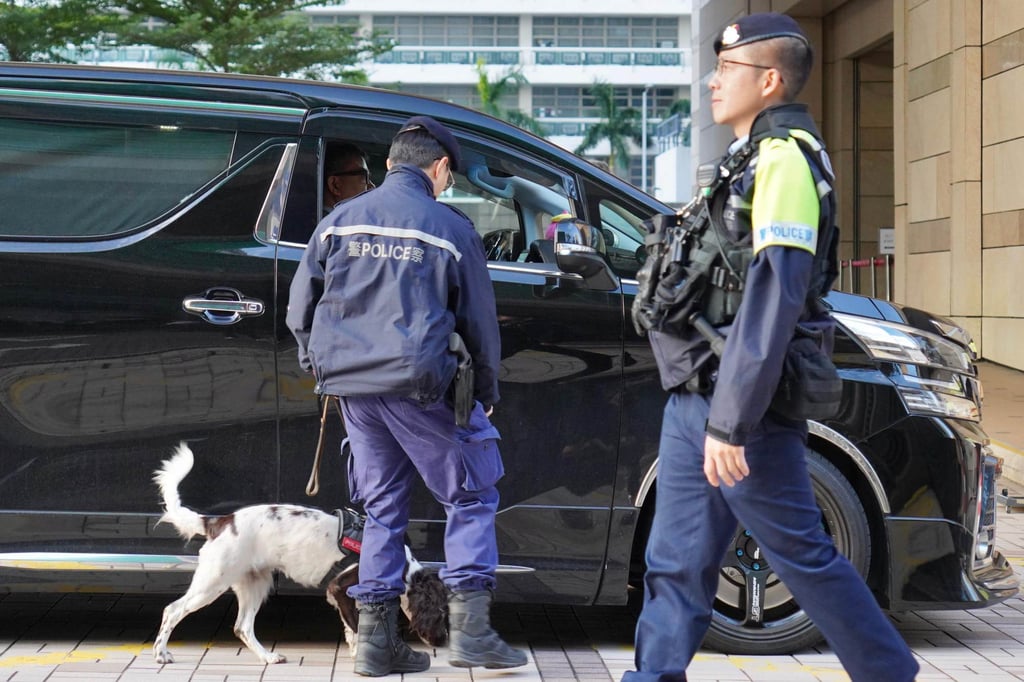
Police stop and search vehicles passing through Tung Chau Street outside West Kowloon Court. Photo: Karma Lo
Diplomats arrive
A group of about 16 Western diplomats arrives at the court at around 8.20am, with representatives from the UK, the US, the EU and Canada among them.They include acting UK consul general Sarah Robinson, Matthias Kauffman, the deputy head of the European Union office in Hong Kong, and US deputy consul general David Schlaefer.
Kauffman says the EU and its member states have been observing the trial against pro-democracy activists in Hong Kong under legislation such as the national security law.
“We do so to signal our close interest in those cases,” he says. “Openness and transparency are vital facets of Hong Kong’s judicial system; they allow for interested observers to participate in those court hearings.”
Kauffman adds that observing trials is something the EU does around the world and signals its commitment to human rights and the rule of law.
Robinson says that the case of Lai, who is a British national, is a priority for the British government.
“I am here on the instructions of the foreign secretary to observe the verdict,” she says.
Ticket plan for hearing
The judiciary has announced earlier that tickets for the public gallery and press will be handed out 45 minutes before the hearing.It has reserved 58 seats in the public gallery and another 42 for the press in the main courtroom. Of those, 21 are allocated to local media, 14 to international outlets and seven to digital news platforms.
The remaining tickets are distributed among six courtrooms, which will broadcast the hearing.
Residents wait since Sunday morning
A 70-year-old retiree, surnamed Lam, says she has been queueing for the trial since 11am on Sunday.“It was really cold. Thankfully, I was able to withstand it,” she says.
“Lai is really standing firm on his principles, so I am here to support him. I have been here every time there is a court hearing.”
Lam says that she has no expectations for the verdict, adding that she hopes Lai will be allowed to leave prison for medical treatment.
Another 70-year old retiree, who is near the front of the queue, also says she has been queuing since Sunday morning.
She says she has come to hear Lai’s fate.

Mastermind of anti-China conspiracies: prosecutors
Prosecutors accused Lai of using his newspaper and social media platforms to instigate foreign sanctions and incite public disaffection against authorities.They also argued that Lai provided financial backing to the “Fight for Freedom, Stand with Hong Kong” (SWHK) lobbying group to incite hostile actions by the West.
The prosecution relied heavily on Lai’s pursuit of sanctions and other measures targeting mainland China before the implementation of the national security law in June 2020, contending that he was resolute in furthering his cause through statements on social media, in newspaper columns and in interviews even after collusion became a crime.
‘Fight for freedom’ ended as city ‘beyond redemption’: Lai
Lai spent 52 days in the witness box refuting accusations that he tried to influence foreign policy on Hong Kong or China, and that he used his friendships with overseas politicians to push a political agenda.While admitting that he had called for “draconian” sanctions from the US before the national security law took effect, Lai said he had ceased all acts that would be considered criminal under the new legal order.
He added that the city under Beijing’s tightened grip was “beyond redemption” and that it was “useless to fight for Hong Kong now”.
Lai sought sanctions via indirect advocacy, court heard
Prosecutors argued that Lai continued to seek punitive measures from abroad through indirect appeals after the national security law took effect.Those alleged attempts included supporting the US’ revocation of Hong Kong’s preferential trade status, the imposition of embargoes on hi-tech exports to mainland China, as well as the British government’s decision to offer citizenship to Hongkongers.
Lai stressed his comments were merely his analyses of current affairs and were not meant to instigate further actions from the West.
Lai authored four-step road map to China’s ‘implosion’: witness
The prosecution alleged that Lai supported SWHK from behind the scenes and drew three of its core members into a grand plan to trigger mainland China’s economic and political collapse through international lobbying.A key prosecution witness told the court how the Apple Daily founder had encouraged them to disseminate news about the city abroad, appeal for international intervention, link up with overseas officials and influence foreign policies from “under the table”.
Lai rejected the witness’ claims as fabrication and said his only purpose in meeting the group’s members was to urge them to de-escalate the 2019 anti-government protests.
Minimum of 10 years in prison for ‘principal offender’
Lai pleaded not guilty to two conspiracy counts of collusion with foreign forces, and a third count of conspiracy to print and distribute seditious articles.Collusion with foreign forces, one of four offences criminalised by the national security law, carries a maximum sentence of life imprisonment. The law stipulates a three-tier sentencing regime for the offence, with a minimum jail term of 10 years applicable to a “principal offender”.
Sedition, meanwhile, carries a maximum sentence of two years’ imprisonment for a first offence under the now repealed sections 9 and 10 of the colonial-era Crimes Ordinance.
Lai’s children renew calls for father’s release
Claire Lai Choi, the tabloid founder’s daughter who had visited him in prison regularly, spoke to Western media for the first time in recent days about his father’s “rapidly deteriorating” health and allegedly demoralising treatment behind bars.She told multiple news outlets that her father, who is diabetic, had been suffering from waist pain, swollen limbs and heart palpitations.
“We have waited for a very, very long time for his cases to be resolved, and we do not believe that they will be through the domestic system. Our only hope is outside,” she said in one interview.
Lai’s son, Sebastien Lai Sung-yan, said it was only “humane” and “right” for Beijing to free his father and send him away after putting him “through this hell”.
Fresh round of appeals for anti-China sanctions from US
The 2025 annual report of the US Congressional-Executive Commission on China (CECC), published on December 10, cited Lai’s prosecution and incarceration as a reason for Washington to sanction Hong Kong officials, prosecutors, judges, police and foreign financial institutions over the “systematic erosion” of the city’s autonomy and fundamental freedoms.In a statement released last Friday, the Hong Kong government dismissed the CECC report’s “biased, slandering and smearing” findings as another attempt to undermine the city’s prosperity and stability.
Chinese foreign ministry spokesman Guo Jiakun also said that Beijing firmly supported Hong Kong in “safeguarding national security in accordance with the law and punishing crimes that endanger national security”.
Government slams ‘baseless’ criticism of Lai’s prison treatment
In its Friday press release, the Hong Kong government also rejected allegations in the CECC report that Lai was being treated unfairly in prison, calling them “completely baseless”.The government statement cited representations by Lai’s lawyers in court that he had received daily medical check-ups and had no qualms about the arrangements.
It also stressed that Lai’s segregation from other inmates had “all along been made at his own request” and had been approved by the correctional service in accordance with law.

MH.Yang
Trusted Member
During the period when he was inciting riots in Hong Kong, his children were already adults. I do not believe his children were not involved in riot-related crimes; they should be considered accomplices. The Hong Kong police should include all his children in the investigation list.
Additionally, the Chinese government should sanction Western politicians linked to criminals, confiscate the assets of these politicians and their family members in China, and refuse to allow Western companies associated with these politicians to engage in trade with Chinese companies.
Additionally, the Chinese government should sanction Western politicians linked to criminals, confiscate the assets of these politicians and their family members in China, and refuse to allow Western companies associated with these politicians to engage in trade with Chinese companies.
冖_冖
Registered Member
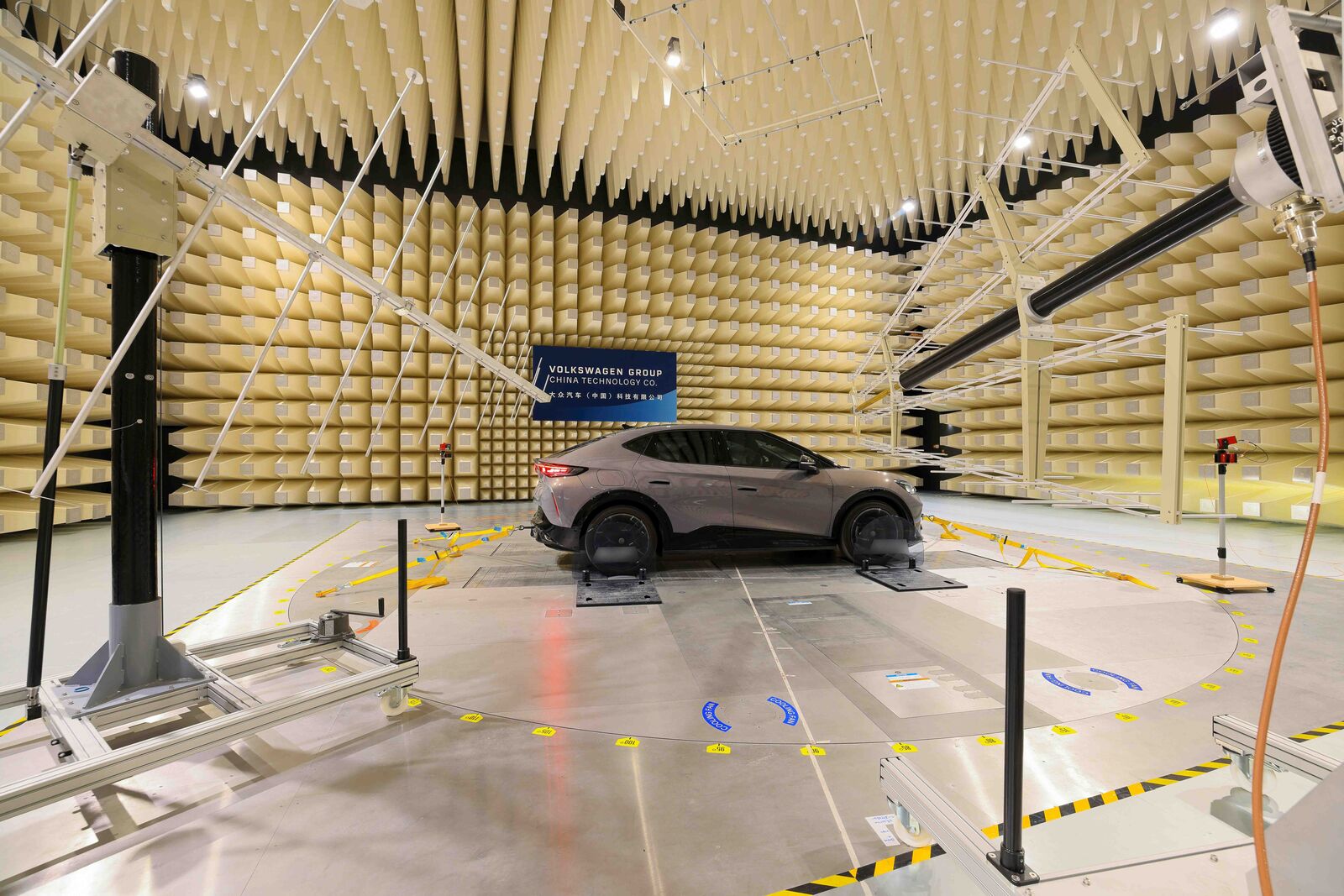
Test Center Complete: Volkswagen Group Now Able to Fully Develop and Validate Products in China for China
With the opening of its first Test Workshops in Hefei, Volkswagen Group China Technology Company (VCTC) has accomplished its final expansion stage, now bringing end-to-end development capabilities directly to the Chinese market. The new facilities significantly expand the Group’s local R&D...www.volkswagen-group.com
Volkswagen Group Now Able to Fully Develop and Validate Products in China for China
11/25/2025 Press Release
Strategic Milestone reached: For the first time in Volkswagen Group’s history, new vehicle platforms and key technology can be fully developed and brought to market readiness with all approval processes outside Germany.
Comprehensive capabilities: Around 100,000 m² of space with over 100 advanced laboratories integrating software–hardware testing, battery and powertrain validation, and full-platform verification at the Volkswagen Group China Technology Company (VCTC) in Hefei, Anhui province, completing the centres expansion.
China Speed: New facilities contribute directly to slash development time by 30%, accelerate the rollout of the Group’s China Electronic Architecture (CEA), and deliver tailor-made digital cockpit features, advanced driving assistance system (ADAS) functions and over-the-air (OTA) upgrades for Chinese customers.
Beijing/Hefei. With the opening of its first Test Workshops in Hefei, Volkswagen Group China Technology Company (VCTC) has accomplished its final expansion stage, now bringing end-to-end development capabilities directly to the Chinese market. The new facilities significantly expand the Group’s local R&D strength and integrate software, hardware, and whole-vehicle validation under one roof — enabling faster decision-making, closer customer alignment, and accelerated rollout of next-generation technologies.
With the completion of the new Test Workshops, VCTC has become the Group’s most comprehensive R&D hub beyond its home market. For the first time in Volkswagen’s history, it can support the development and validation of new vehicle platforms from very early phases outside Germany. The new Test Workshops feature over 100 state-of-the-art laboratories across around 100,000 square meters, delivering powerful testing capabilities. These include software–hardware integration, battery and powertrain testing, and full vehicle-level validation.
Oliver Blume, CEO Volkswagen Group: “Our ‘In China for China’ strategy continues to gain momentum. At our development centre in Hefei, China, we have now created all the conditions necessary to develop, test and locally manufacture the next generation of intelligent connected vehicles. This milestone makes us even faster and more efficient – and brings us even closer to our customers. This will enable us, as the Volkswagen Group, to consolidate our position in the world's largest automotive market with the clear goal of becoming the global technology driver of the automotive industry."
Ralf Brandstätter, Member of the Board of Management of Volkswagen AG responsible for China, and Chairman and CEO of Volkswagen Group China: “China is the world’s most competitive automotive market, and our customers here expect rapid innovation and flawless quality. This is why we are taking our development capabilities in China for China to the next level. By expanding our footprint in Hefei, we are strengthening our ability to respond quickly to local needs and to shape technologies directly where they will be used. This step deepens our commitment to China and ensures that our future products reflect the preferences and expectations of Chinese customers from the very beginning.”
VCTC plays a pivotal role in Volkswagen Group’s “In China for China” strategy. As the Group’s most comprehensive R&D hub beyond its home market, it is also the only Group R&D center dedicated exclusively to electric, intelligent and connected vehicles. VCTC is integrating core development units and decision-making processes for local vehicle and technology projects, while coordinating developmental processes with the R&D units of joint ventures. By deepening integration into the local technology ecosystem, VCTC can proactively address China’s market-defining trends — such as digitalization and autonomous driving — at an early stage, allowing the company to fully harness the growth momentum and innovative vitality of the Chinese market.
Delivering CEA at China Speed
Right in Hefei Software-hardware test workshop, VCTC and CARIAD China are launching the first delivery of the China Electronic Architecture (CEA) – the Group’s first zonal E/E architecture specifically tailored to the needs of Chinese customers, within 18 months. Enabled by the all-new Software-Defined-Vehicle development process, the overall vehicle development cycle can be shortened by 30%. Leveraging local development and early supplier integration during the
concept phase of new cars and technologies, the cost of a new model can be reduced by up to 50% in specific key projects. CEA also ensures seamless integration of digital cockpit functions, Advanced Driving Assistance System functions, and whole-vehicle level over-the-air upgrades.
Thomas Ulbrich, CTO of Volkswagen Group China and CEO of VCTC: “The new workshops give our engineering teams an entirely new level of integration. We can now run software, hardware, and full-vehicle validation processes in parallel, shorten decision loops, and bring innovations to maturity much faster. This environment enables us to push forward next-generation intelligent-vehicle technologies with high precision and efficiency.”
Volkswagen DNA, Engineered in China
Safety, durability and reliability have long defined the Volkswagen DNA. The new Test Workshops in Hefei further strengthen the Group’s commitment in China by enabling earlier and more comprehensive validation of core vehicle systems, while also validating products and technology for export to regions like ASEAN and the Middle East.
At the Battery & Powertrain Integration Testing Center, engineers can test up to 500 battery systems per year. Tests cover performance, lifetime, safety and environmental robustness, as well as E-Drive, thermal management, electronics and battery cell components.
The Platform & Module Testing Center follows the same philosophy. Its advanced Electromagnetic Compatibility (EMC) laboratory safeguards the reliability of vehicle electronics, while a full-vehicle durability test bench could simulate all global driving road conditions within the workshops.
Together with the City Test Track, Volkswagen Group has established a full design–build–test–validate cycle in Hefei, in close collaboration with its global R&D network.
More capabilities at the gate
Volkswagen Group continues to expand the capabilities of Hefei. The Functions Integration Test (FIT) Laboratory comes online in mid-2026 — one of only two in the Group — to simulate extreme environment conditions. These efforts establish a future-ready foundation for Volkswagen’s next chapter in intelligent and connected mobility.

VW to develop cars 30% faster in China plants
Volkswagen Group said on Tuesday that its China arm will be able to fully develop new vehicle platforms and key technologybreakingthenews.net
Volkswagen Group said on Tuesday that its China arm will be able to fully develop new vehicle platforms and key technology "with all approval processes outside Germany," for the first time in the automaker's history. The company said that the process will allow the cost of some new models to be cut by up to 50%. In addition, the overall vehicle development cycle can be shortened by 30%.
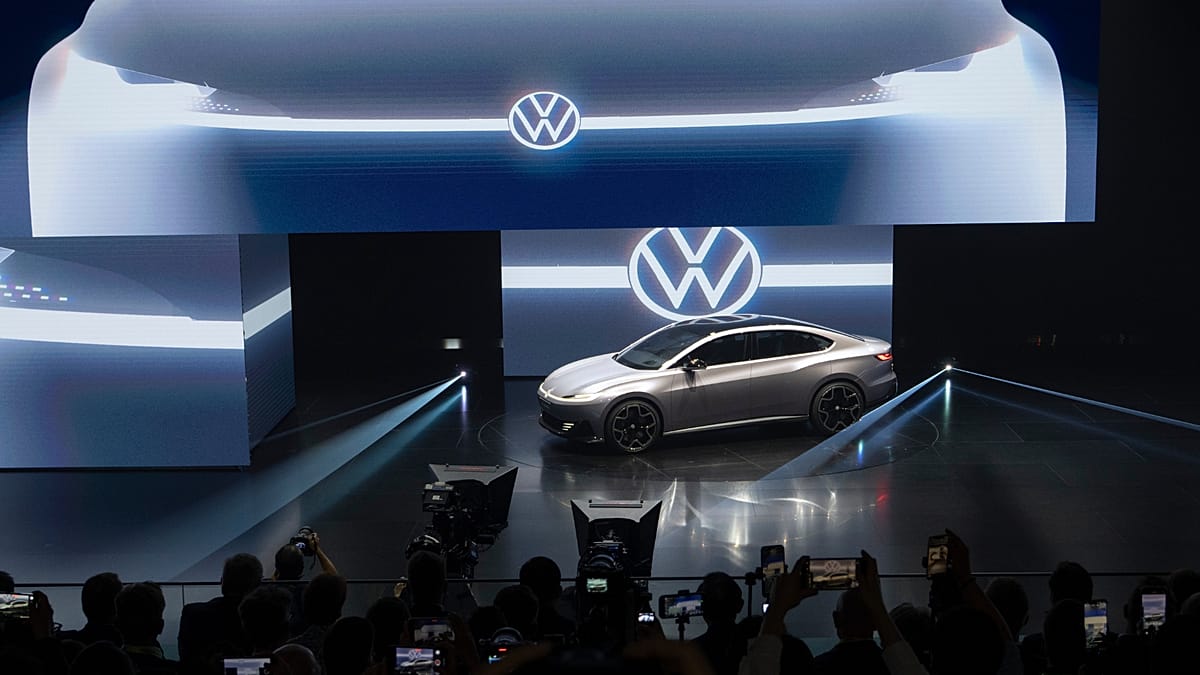
Volkswagen's €3bn gamble: Can it win back market share in China?
VW is developing cars tailored to Chinese drivers — vehicles that will likely never be seen on European roads, though they may make their way to markets in the Middle East and Southeast Asia.
 www.euronews.com
Volkswagen's €3bn gamble: Can it win back market share in China?
By AP with Euronews
Published on 15/12/2025 - 9:01 GMT+1
VW is developing cars tailored to Chinese drivers — vehicles that will likely never be seen on European roads, though they may make their way to markets in the Middle East and Southeast Asia.
Volkswagen is making a major bet in China, the largest and one of the most cutthroat auto markets in the world. The question is whether it will work.The German carmaker, which once dominated the market with a more than 50% share, has invested €3 billion in a sprawling research and development center — its largest outside its home country — in Hefei, a central China city of 10 million people.
It’s a dramatic change from how foreign automakers operated in China for decades by making cars they developed overseas, sharing their technology with local partners. That strategy has been shoved aside by fast-rising local competitors who have sharply cut into the sales of foreign brands.
“This business model is now gone,” said Thomas Ulbrich, the chief technology officer of the Volkswagen Group in China.
The Chinese consumer is king
In what Ulbrich calls a paradigm shift, Volkswagen started its latest overhaul of its approach to China in 2022.It is developing vehicles specifically tailored to Chinese drivers — cars that will likely never be seen on European roads, though they may make their way to markets in the Middle East and Southeast Asia.
As the new models roll out, Volkswagen will find out if the investment will pay off by helping it to catch up with the likes of Chinese makers BYD and Geely and win back market share.
Such a strategy is key to regaining competitiveness within China, said Rella Suskin, an equity analyst at Morningstar covering the European automotive sector.
But, she predicted: “it will enable them to maintain market share levels in line with current levels, rather than allow them to regain the market share that has been lost over the last few years."
The question is whether it can make money in a hypercompetitive market that has driven prices down to bankrupting levels.
Audi, part of the Volkswagen Group, led the way with this year's introduction of a new brand dubbed “AUDI” — its name in capital letters. VW is gearing up to launch new 2026 models developed “in China, for China”, as the carmaker likes to say.
“It’s a million-dollar question whether this strategy will pay off,” said Claire Yuan, director of corporate ratings for China autos at S&P Global Ratings. “We have to monitor, but I think they are on the right track of catching up in the race.”
China speed leaves competitors in the dust
Foreign automakers fell behind because of dramatic changes in the Chinese market over the past five years.Electric vehicles have shot up to about half of new car sales. And buyers expect them to come with the latest digital features, from big iPad-like touch screens to autonomous driving capabilities such as effortless backing into a parking space.
Volkswagens were no longer the right fit in a major market that accounts for about one-third of its global sales. That's 40 years after it began making sedans in Shanghai with its state-owned local partner, SAIC. For years, basic VW Santana and Jetta sedans were a mainstay of taxi fleets, and the first cars purchased by many city dwellers.
Now, it needs to revamp its lineup at what has become known as “China speed”. In a market as competitive as China’s, survival depends on pushing out new models and features quickly, said Bill Russo, the CEO of Automobility, a Shanghai-based consultancy.
Chinese EV makers bring new cars to market in 12 to 18 months, versus three to five years for global automakers. “The pace is not a choice but a necessity — and that pressure fuels global competitiveness,” Russo said.
China emerges as a source of innovation
In the mid-1990s, Ulbrich worked in northeastern China, where VW made sedans with another state company, FAW, or First Auto Works, importing everything from seats to wheel rims. The parts weren't available locally.Thirty years later, nearly everything is made in China. And now it's being designed here. To speed up product development, Volkswagen headquarters has given decision-making power to the local operation.
Other foreign automakers have reacted in different ways. Some have reduced their operations or even pulled out. Japan’s Toyota, like Volkswagen, has transferred authority to its China team to accelerate decision-making, giving them "unprecedented autonomy in product planning and development,” Yuan said.
Volkswagen is looking to pick up know-how from China's EV start-ups. It has teamed up with electric vehicle maker Xpeng to bring new models to market more quickly and develop its own electronic architecture — essentially the internal computer system that runs all a car's functions.
The approach reflects a growing recognition among foreign automakers that they can learn from China, and not just vice versa. For many, the key is how quickly Chinese firms can turn an idea into a product, slashing development costs, and delivering what customers want in a timely way.
“Knowledge flows are a two-way street between China and Germany,” said Martin Hofmann, a Volkswagen executive who is the chair of the German Chamber of Commerce in North China.
In a recent survey of the chamber’s membership, about half of the more than 600 responding companies said they expect Chinese competitors to become innovation leaders in the next five years — and 9% said they already are.
冖_冖
Registered Member

Rethinking Joint Ventures in China’s Evolving Market - The US-China Business Council
Alan MacCharles spent 27 years with Deloitte, including 18 years in China, where he was a strategy and M&A partner. Today, he advises foreign multinationals on forming joint ventures in China, while also serving as head of the Executive Education program at Duke Kunshan University. He is a...
 www.uschina.org
Rethinking Joint Ventures in China’s Evolving Market - The US-China Business Council
Alan MacCharles spent 27 years with Deloitte, including 18 years in China, where he was a strategy and M&A partner. Today, he advises foreign multinationals on forming joint ventures in China, while also serving as head of the Executive Education program at Duke Kunshan University. He is a...
www.uschina.org
Rethinking Joint Ventures in China’s Evolving Market
Expert Insights: Alan MacCharles
December 15, 2025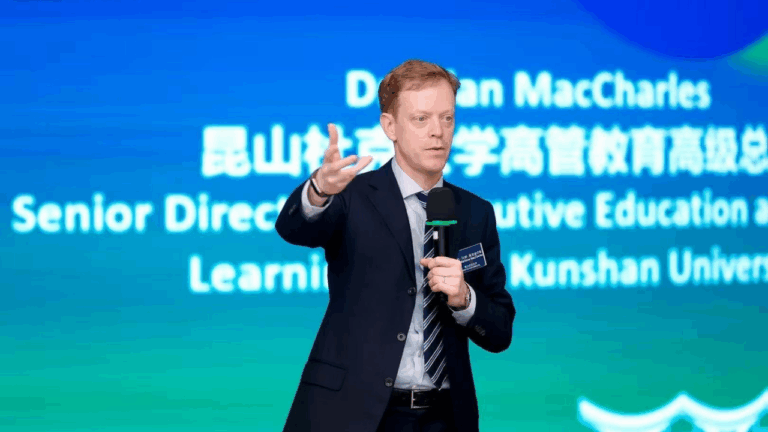
Alan MacCharles spent 27 years with Deloitte, including 18 years in China, where he was a strategy and M&A partner. Today, he advises foreign multinationals on forming joint ventures in China, while also serving as head of the Executive Education program at Duke Kunshan University. He is a co-author of the book “Unlocking International Joint Ventures: Keys to Formation Success through Cultural, Commercial, and Legal Decision-Making.”
Are joint ventures (JVs) having a revival in China? If so, what forces are shaping this phenomenon? Are JVs being used as a hedge against geopolitical tensions or potential regulatory restrictions?
It’s hard to tell if joint ventures are enjoying a resurgence. The data will take time to emerge, and we will only be able to observe those that are ultimately successful. Last week, a local business chamber suggested that in 2023, JV formation had a 44% year-on-year growth in China. Pre-pandemic, 8% of non-Chinese Fortune 500 companies did a JV in China per year, on average. Most of these JVs had predictable drivers: market access, growth potential, and access to local resources.But JVs have also always been about finding balance — between opportunity and risk, between access and control, and between two different systems of thinking about business. Thirty years ago, China was an emerging economy with vast labor reserves and limited capital. Today, it’s a hyper-competitive market with advanced technology, mature supply chains, and a rapidly evolving policy landscape.
Given that hyper-competitiveness, plus US tariffs, export controls, and other geopolitical instabilities, the motivations for JVs in China have evolved. JVs are increasingly being used to build ecosystem resilience, support partial exits, and limit tariff risk while maintaining access to critical technologies or materials.JVs are increasingly being used to build ecosystem resilience, support partial exits, and limit tariff risk while maintaining access to critical technologies or materials.
Many of these structures are about long-term survival and adaptation. They reflect a pragmatic understanding that neither side can operate in isolation. Foreign companies must adapt to China’s regulatory expectations, and Chinese partners must navigate global scrutiny and shifting supply chain requirements. For this reason, JVs remain resilient and high value. Increasingly, corporate structures may matter less than their strategic purpose: protecting global competitiveness while leveraging China’s scale, speed, and talent.
For foreign companies, what are the advantages of having a JV in China today versus 30 years ago? Are Chinese partners bringing different assets to the table (e.g., technological capabilities or supply chain networks versus market access)?
Technology transfer is again at the center of JV discussions — but not like before. What we’re seeing now is a two-way flow. Some JVs are returning technologies that once moved from the United States or Europe to China, while others are tapping into Chinese leadership in sectors like green energy and electric vehicles.Yet the more strategic issue is not intellectual property; it’s supply chains. Once technology is embedded in local production, the practical control shifts to where the supply chain is based. That’s why governments in Washington and Brussels are rethinking how to secure domestic manufacturing capacity, sometimes encouraging JV structures that ensure local know-how and production resilience.What we’re seeing now is a reversal of roles: the United States, which originally transferred this technology to China decades ago, has effectively lost parts of that capability.
What we’re seeing now is a reversal of roles: the United States, which originally transferred this technology to China decades ago, has effectively lost parts of that capability. Let me illustrate with a deal I’m currently working on.
In this new JV arrangement, the Chinese partner performs the first stage of a chemical process — the part that is particularly environmentally harmful — and then ships the intermediate product to the United States. That intermediate product probably represents just 10% of the value that used to be imported. The remaining processing is completed in the United States, so the final product is “Made in America.” No new environmentally intensive plants are being built in the United States; those early-stage activities stay where the plants already exist.
The US partner is also dependent on the Chinese side for the know-how needed to finish the process. That know-how has been lost in the United States (even though that is where the technology originated). It’s a striking reversal from the last 30 years. It is also important to note that the supply chain integration is not being reduced, either. This model allows the Chinese company to survive (the JV helps offset the losses in sales) and re-localizes part of the production in the United States.
Chinese firms are bringing more than just technology. They bring supply chain strength; a mindset geared toward rapid commercialization, including getting to “good enough” quickly rather than waiting for perfection; and greater comfort with lower margins that enable entry into new markets. Their overall operating behavior is quite different from Western companies.
Chinese partners also possess critical manufacturing know-how. Legally, the IP may belong to a multinational, but the practical expertise — the people, the process engineering, and the supplier relationships — often exists only within the China operations. That means capability that was once transferred from the United States to China now sits primarily on the Chinese side of the organization.
As a result, China has become a powerful source of outbound innovation, talent, and production expertise. If structured correctly, the same technology and skills transfer that flowed from west to east in the late 1990s and early 2000s could now move in the opposite direction. Consider, for example, how to best harness talent in China to drive long-term success for a global business. Great companies have cultures that supersede the national cultures of individuals and enable the movement of people globally.
On a related note, what role does technology transfer play in renewing interest in JVs, and how has the calculus around IP protection changed?
China’s strategic focus has shifted. A few years ago, the government emphasized JVs as a way to ensure technology transfer. Policy thinking today is more sophisticated and pragmatic.Whether a multinational enters through a JV or a wholly-owned greenfield operation no longer matters as much. The prevailing view is that once the IP and know-how are being manufactured in China by Chinese engineers, those capabilities are effectively in the country, even if the foreign firm still technically owns and controls the IP. We are starting to see this thinking in Europe and the United States — with the requirement to manufacture certain products (such as automotive batteries) in market.Once the IP and know-how are being manufactured in China by Chinese engineers, those capabilities are effectively in the country, even if the foreign firm still technically owns and controls the IP.
You have written at length about foreign JVs in China. If there was a handbook for success, what are the primary rules that foreign companies should heed?
If you’re doing a JV, do it quick. The longer the formation process drags on, the less likely the deal is to complete. In our book, there’s an eight-point framework on how to do them quickly (see Figure 1.)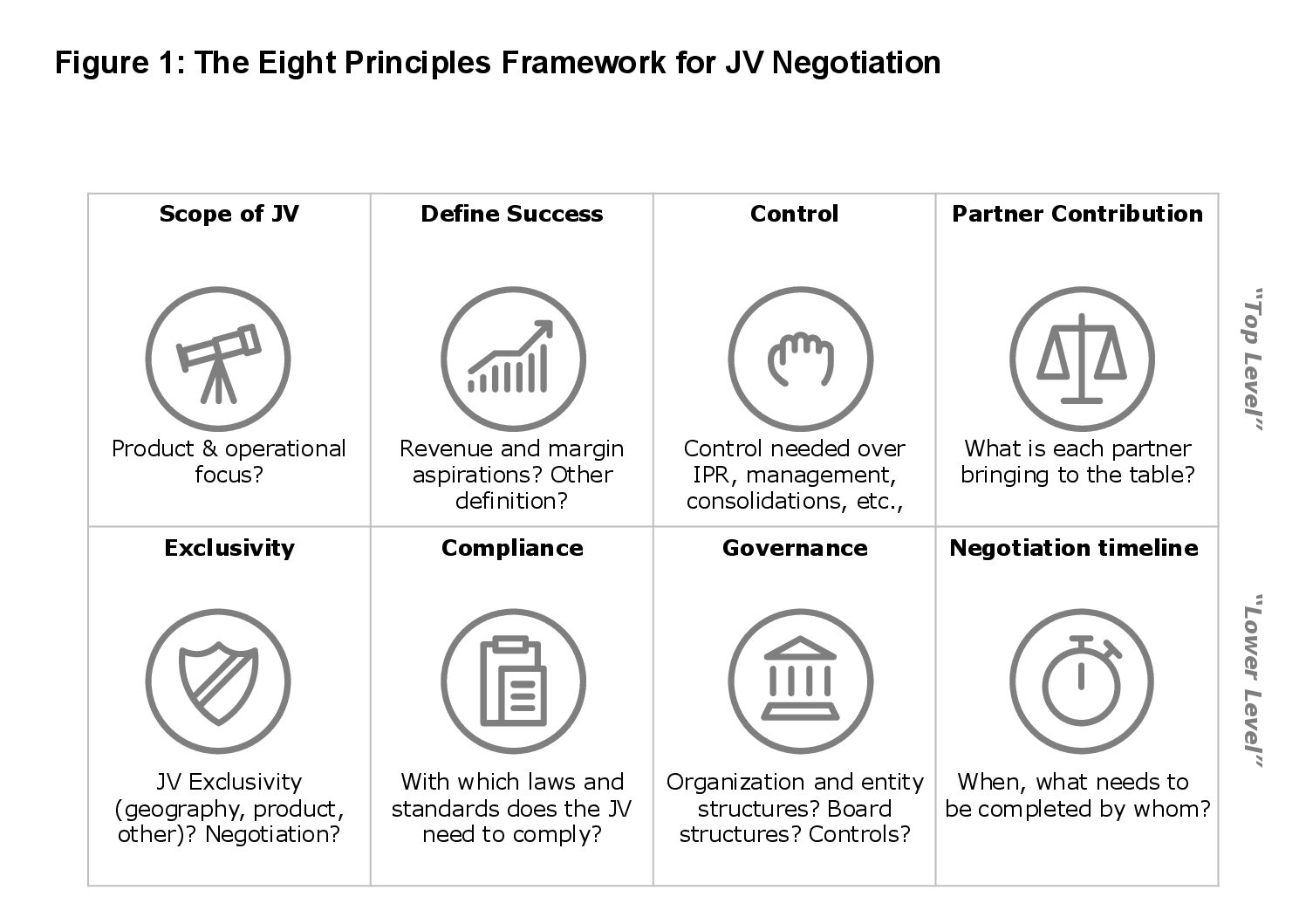
Start by making sure you’ve got a viable deal with a trustworthy partner. And pay attention to good governance. A lot of companies get into trouble because of sloppy governance. If you’re an American company, you should have some Americans in your business structure. If you’re a Finnish company, some Finns. It’s needed to help with communication back to headquarters and to make sure that know-how is exchanged so that the organization’s culture is transplanted into the subsidiaries or JV. There can be a different culture on the ground, but the core needs to be the same. Those transplanted individuals do not need to be the CEO, but they need to be trusted and respected so that help from headquarters is available when required.
Beyond lack of control, what are the primary disadvantages of ceding ownership to a Chinese partner?
The key disadvantage is you don’t own it anymore, and that means your dividends and flexibility to move employees and make decisions is reduced. Those disadvantages need to be offset by the ability to take capital out or raise capital locally, increased market access, and other protections or advantages that a partner may bring.What other kinds of ownership models are available to foreign companies in China besides a JV or sole ownership? Are any of these enjoying a revival?
There’s a spectrum being put into use. Increasingly, companies are thinking about their China business as part of a portfolio. In that portfolio, there may be pieces they own wholly. There may be pieces in a JV. There could be pieces with private equity. There are ecosystem plays with fund structures to deal with some of the costs but then take a series of micro investments. There’s a whole series of partnership plays with no equity involved. That could be in the R&D space — we see a lot in life sciences. It’s a very active and dynamic market, as executives are figuring out how to protect the MNC position but also manage hypercompetition and continue to be successful by taking the best of China to the world.When you look at foreign companies restructuring their ownership models in China, do you see industrial or sectoral differences? For example, do JV dynamics differ between business-to-business (B2B) versus business-to-consumer (B2C)?
The whole economy is under tremendous pressure. There are segments in B2B that are doing well. Most of those companies are keeping a low profile. There are also segments in B2C that are doing well. Overall, however, most companies are finding that the market has gotten significantly more difficult, and that growth has slowed. I don’t see much industrial or sectoral difference.You also see the mimicking of deals. There’s a perception that the McDonald’s CITIC Capital deal was hugely successful, so now Starbucks is doing one with Boyu Capital, trying to replicate or find that secret sauce.
I see differences in managerial mindsets where the governance or decision-making responsibility is located in the market rather than retained at headquarters. This delegated authority mindset and in-China decision making will probably have bigger impacts for companies pursuing innovative structuring models or investing than those doing defensive plays. Structurally, however, the innovative model and the defensive model usually look very similar on paper. For example, a JV can be both a forward-thinking investment and/or a partial exit. Using the example above, McDonald’s bought its stake back from Citic Capital; is Starbucks planning the same once the issues are fixed, or is it selling down? Most likely, Starbucks doesn’t know the answer and views the deal as an option to be exercised in the future.
Looking forward 10 or 20 years from now, what do you expect to be the primary business model for Western companies operating in China?
I don’t think there’s a primary business model. The best model is always when you own it yourself and you’re in a stable, long-term situation. A lot of companies start as JVs and eventually become wholly-owned subsidiaries. Over the long term, you would expect that to be the default position, but in any dynamic and highly volatile market like the United States, Western Europe, or China, you would hope to see all kinds of business models in play. MNCs with larger operations have several different business models (and corporate structures) in play.Chinese companies are now going overseas. Do you anticipate that many will choose to do so with Western partners? How many of those partnerships will be founded in partnerships now operating in China? Will the models of those JVs be different as Chinese companies go overseas?
For several reasons, they’ll choose Western partners. In many cases, Western partners are 100 years ahead of them, and they have distribution or other infrastructure on the ground that makes it highly desirable to partner. For machinery maintenance or anything requiring service infrastructure, for example, it’s much easier to partner with someone than to build it from scratch. There is also know-how and trust that’s been built up between these companies, particularly where they’ve cooperated in China, and that lays a foundation.Another driver is the demand for supply chains to be re-localized. There are Chinese companies that are very comfortable manufacturing in China and don’t want to leave because their supply chain is there, their efficiency is high, and their automation is high. They’ve invested in their plants but are being told if they want to retain work, they need to set up operations overseas. This will drive them into JV relationships.
As global supply chains recalibrate, Western governments are rediscovering the role of industrial policy. So, just as the Chinese government did 20 and 25 years ago, Western governments will force JV and tech transfer arrangements in certain sectors. The United States and Europe have already started, particularly in clean energy, semiconductors, and advanced manufacturing. It’s a natural cycle that some industry needs to return to a home market. These governments need to be a little more prescriptive and defensive in certain sectors to ensure that there’s a manufacturing base, a supply chain, and the know-how to function in the modern economy.Just as the Chinese government did 20 and 25 years ago, Western governments will force JV and tech transfer arrangements in certain sectors.
Any final thoughts?
The lasting value of a JV lies in its ability to link complementary capabilities, align diverse interests, and drive innovation across boundaries that no single company can cross alone. But that value only materializes when the JV is structured properly: interests are aligned, governance is clear, and trust is actively maintained. Using frameworks like the eight principles below, partners can navigate these complexities, bridge cultural and operational gaps, and create a foundation for long-term collaboration and sustainable competitiveness.Done right, a JV transforms differences into shared advantages and opens opportunities that would be impossible to achieve independently.
冖_冖
Registered Member
China launches island-wide special customs operations in Hainan FTP
The move is widely seen as a landmark step in China's ongoing efforts to promote free trade and expand high-standard opening-up at a time of rising protectionism worldwide.
Published: 10:47, December 18, 2025 | Updated: 11:00, December 18, 2025
China launches island-wide special customs operations in Hainan FTP
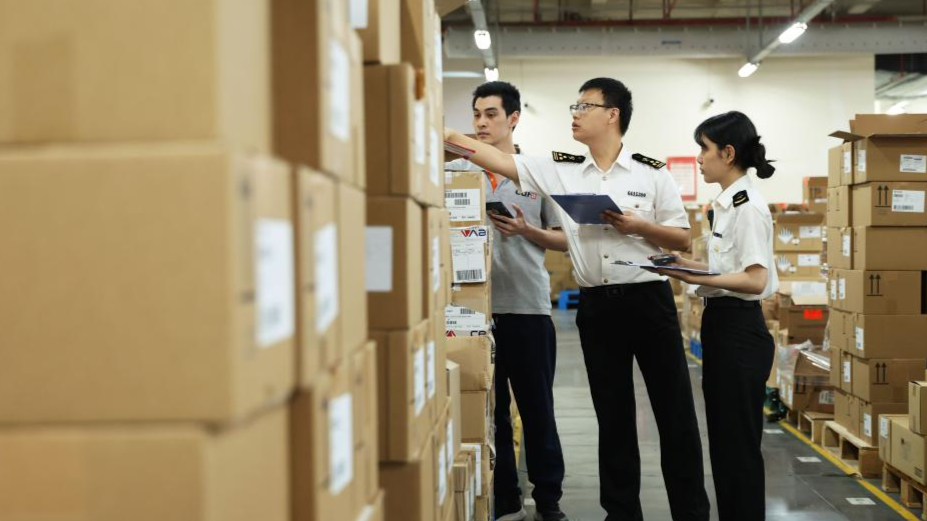
HAIKOU - China on Thursday launched island-wide special customs operations in the Hainan Free Trade Port (FTP), the world's largest FTP by area, allowing freer entry of overseas goods, expanded zero-tariff coverage and more business-friendly measures.
The move is widely seen as a landmark step in China's ongoing efforts to promote free trade and expand high-standard opening-up at a time of rising protectionism worldwide.
Under the new arrangements, the tropical island of more than 30,000 square km has been designated as a special customs supervision zone. This marks a new stage in the development of the Hainan FTP, which enables freer flows of goods, capital, personnel and data, supported by zero tariffs, low tax rates and a simplified tax system.


Breaking | Hong Kong’s Jimmy Lai found guilty on all charges in national security trial
Natan Sharansky’s Letter to Jimmy Lai
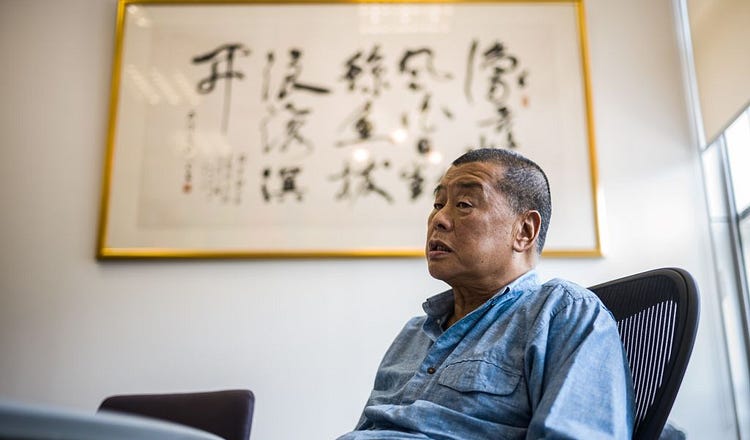
Although Jimmy Lai, 78, was found guilty on false charges, Natan Sharansky implores him to hold on to his “inner freedom.” (Anthony Wallace/AFP via Getty Images)
‘This regime thinks that you are facing a life sentence. In fact, these dictators will be the ones living as slaves all their lives.’
By Natan Sharansky 12.15.25 —International
On Monday, Jimmy Lai, the Hong Kong pro-democracy activist and founder of the newspaper Apple Daily, was found guilty of false charges of sedition and collusion with foreign forces. He now faces a potential sentence of life in prison, after already spending more than 1,800 days in solitary confinement.
The Free Press is proud to publish a letter written by Natan Sharansky to his friend Lai. Sharansky can relate to what Lai is going through. He was imprisoned by the Soviet Union in 1977 on manufactured charges of treason. His real crime was trying to emigrate to Israel.
Below, Sharansky writes to Lai about how proud he is of him for standing up for the people of Hong Kong, and offers advice from lessons he learned in a Soviet prison. —Frannie Block
Dear Jimmy,
I heard you kept cool as you listened to the judge hand down your guilty verdict, and then you waved to encourage your family. I was sure this is how you would react.
But I want to warn you: After this powerful feeling that you have won, that you stayed to the end and didn’t give up, some hours later you may experience a minute of weakness when suddenly this burden of the sentence will follow you, and you’ll think, My God.
Read
The Dissident Beijing Can’t Break
I’m sure it will be only one short moment, and you will come back quickly to this feeling of victory over them. Of course, one could ask how I can compare and rely on my own experience. After all, I was only 30 when I had to hear my sentence, and you are 78—exactly as I am today. But note, because I remember and cherish every moment of our long conversations that we had before you were arrested, you knew then that maybe in a couple of weeks, or maybe even in a couple of days, you would be arrested, and you were preparing yourself for it. And, at some moment, I asked you: “Jimmy, but you have British citizenship and you are a rich man, so it would be no problem for you to get on an airplane and run away. Don’t you want to try to do that?”
And you answered: “I cannot do it. I will not betray my people. They listened to me, and they trusted me. I will not leave them.”
Read
He Fought for Freedom. Then He Chose Prison.
This regime, these dictators in China and Hong Kong, want you to suffer every day. And every day they want you to be tempted to ask for mercy, to give up, but I know that you will continue to be a proud, free person. And every day of your freedom—your inner freedom—will be another day of your victory. And I’m sure you feel it.
These dictators think that you are facing a life sentence. In fact, they are the ones who will be living as slaves all their lives. One day, the people of Hong Kong, whom you love so much, will be free, and you will forever stay with them.
I’m very proud to be your friend, Jimmy. I love you. Bless you and your family. Be strong.
Natan
Users who are viewing this thread
Total: 3 (members: 0, guests: 3)
Pakistan Defence Latest
-
 PTI Murad Saeed in Afghanistan, was 'controlling KP govt' from there: Rana Sanaullah (1 Viewer)
- Latest: Meengla
-
-
-

-


