Chinese Economy: General News, Updates and Discussions

India’s trade deficit with China crosses $100 billion​

16 Mar

  • Exports to US: India’s exports fell 12.88% YoY to $6.88B in February, affected by high tariffs; imports from the US rose 36.53% to $4.48B.
  • Trade Deficit with China: India’s trade deficit widened past $100B, with exports at $17.54B and imports at $119.55B for April-February, despite export growth of 32.37% in February.
  • Global Trade Trends: Exports grew to countries like Germany, Hong Kong, Italy, while declining to the UK, Netherlands, Saudi Arabia; imports surged from Switzerland (gold) and other nations, but fell from UAE, Russia, and Thailand.
India’s exports to the US declined 12.88 per cent year-on-year to $6.88 billion in February, weighed down by high tariffs, while the country’s trade deficit with China widened past $100 billion during the April-February period of the current fiscal, according to commerce ministry data released on Monday.

Exports had contracted in September, October, December and January, although they registered a 22.61 per cent rise in November. Indian goods were attracting sweeping 50 per cent levies in the US.

 
To view this content we will need your consent to set third party cookies.
For more detailed information, see our cookies page.
 
To view this content we will need your consent to set third party cookies.
For more detailed information, see our cookies page.
 

Kazakhstan, Russia discuss boosting Russian oil transit to China to 12.5 mln t per year, Kaztransoil says​

Published on 03/17/2026 at 02:49 am EDT

Kazakhstan and Russia are in talks to increase Russian oil transit to China to 12.5 million metric tons per year from 10 mmt, Kazakh pipeline company Kaztransoil said on Tuesday.

China oil majors resume seeking Russian oil after a 4-month halt, sources say​

March 17, 20263:43 PM GMT+8Updated 1 hour ago

SINGAPORE, March 17 (Reuters) - Chinese state oil majors looking to head off supply shortages caused by the war in the Middle East have resumed seeking Russian crude cargoes after a four-month hiatus, taking advantage of a U.S. sanctions waiver, five trade sources said.

Trading arms under state-run ‌Sinopec and PetroChina have this week made inquiries with suppliers for possible purchases of Russian oil, which would be their first since November, said five sources close to or involved in Russian oil trade.

While no deals were known to have been struck as of Tuesday, two of the sources said transactions were likely to be imminent as Russian oil remains cheap versus rival supplies from Brazil and West Africa despite surging ⁠prices and premiums triggered by the U.S.-Israel war on Iran that began on February 28.

Chinese oil majors were "assessing" the situation, said a state oil trader, including whether payment and delivery could be completed within the 30-day waiver window that began on March 12 and applies to cargoes that had already been loaded.

Sinopec and PetroChina did not immediately respond to requests for comment.
 
Last edited:

Exclusive: First Chinese Supertanker Loads Saudi Crude via Red Sea, Bypassing Strait of Hormuz​

Published: Mar. 17, 2026

A supertanker owned by a Chinese state-run firm is sailing to China with Saudi crude loaded at a Red Sea port, marking the first such shipment to bypass the Strait of Hormuz since conflict in the Middle East made the vital waterway perilous for shipping.

The “Kai Jing,” a Very Large Crude Carrier (VLCC) operated by Shanghai-listed China Merchants Energy Shipping Co. Ltd., passed through the Bab el-Mandeb Strait in the early hours of March 16 and is expected to deliver 2.2 million barrels of crude to Meizhouwan Port in Fujian province in early April.
 
Right now, China has energy self-sufficiency of 86%. Contrary to many people may believe, China doesn't depend that much on foreign energy supplies. Energy supply crisis created in Hormuz strait is definitely manageable by China.
 
This is called leadership far-sightedness and strategically planning ahead.
Agreed, but it also involves patience and hard work. China is a great model to learn from but many countries are simply lazy and impatient.
 

China pursuing non-violent unification with Taiwan, unlikely to invade in 2027: US intel​


By Timothy Nerozzi
March 18, 2026 4:00 pm

The People’s Republic of China is unlikely to invade Taiwan by the end of 2027, U.S. intelligence officials claim in a new report.

Director of National Intelligence Tulsi Gabbard released this year’s Annual Threat Assessment of the U.S. Intelligence Community on Wednesday, which found that Beijing would rather not resort to belligerence to bring the island under its control.

“The [intelligence community] assesses that Chinese leaders do not currently plan to execute an invasion of Taiwan in 2027, nor do they have a fixed timeline for achieving unification,” the report asserted.

The document noted that China still “publicly insists that unification with Taiwan is required to achieve its goal of ‘national rejuvenation’ by 2049” — the centennial anniversary of the communist regime’s founding.

Intelligence experts claim that despite the regular saber-rattling seen in the strait between Taiwan and the mainland, the Chinese Communist Party would much prefer a unification strategy that did not require military belligerence, as an invasion would be “extremely challenging and carry a high risk of failure, especially in the event of U.S. intervention.”

The Chinese have long claimed that their desire for unification with Taiwan is a peaceful one, characterizing the island as a wayward province that has been politically captured by separatist radicals.

“Beijing probably will continue seeking to set the conditions for eventual unification with Taiwan short of conflict,” the report asserted. “China, despite its threat to use force to compel unification if necessary and to counter what it sees as ‌a ⁠U.S. attempt to use Taiwan to undermine China’s rise, prefers to ⁠achieve unification without the use of force, if possible.”

The same day that the intelligence report was published in Washington D.C., China’s Taiwan Affairs Office spokesman Chen Binhua told reporters that “peaceful reunification” would offer the island energy security amid the global crisis posed by the Iran conflict.

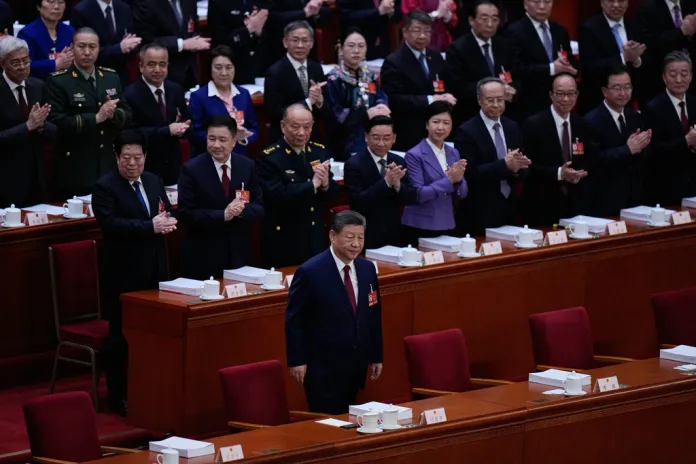
Xi stands in front of the National People's Congress


Chinese President Xi Jinping arrives for the opening session of the National People’s Congress in Beijing, Thursday, March 5, 2026. (AP Photo/Andy Wong)

“We are willing to provide Taiwan compatriots with stable and reliable energy and resource security, so that they may live better lives,” Chen said.

A Taiwanese official told the Washington Examiner that clandestine efforts to bring the island under Beijing’s control include “subtly penetrating Taiwan’s political, media, and social spheres to cultivate support for eventual reunification.”

“China’s non-violent strategies for reunification primarily focus on economic integration, political incentives, social influence, and covert infiltration, including promoting cross-strait trade, investment, cultural exchanges, and leveraging pro-Beijing networks,” the official told the Washington Examiner.

If the Chinese are selling a friendly coming-together, the Taiwanese public isn’t buying.

CHINA HOPES TRUMP’S GAMBLE ON IRAN AND CUBA LOSES THE US MORE THAN IT GAINS

The vast majority of Taiwanese citizens prefer to maintain the “status quo” — neither provoking China by seeking international recognition, nor entertaining the idea of joining the mainland.

A poll in November of last year found that even if the ambiguous “status quo” of Taiwan could not be maintained, only 21% of Taiwanese would favor unification with the mainland compared to a whopping 61% who preferred formal independence.

But what the Taiwanese believe about the fundamental identity of their country remains muddy and complicated by their unique geopolitical history.

The right-wing Kuomingtang, which founded the Republic of China and settled the island of Taiwan as an escape from the Chinese Communist Party, agrees with Beijing that there is indeed only “one China.” Their strategy is to prolong the process of unification — smile and wave from across the Taiwan Strait while building up defensive infrastructure — hoping that the Communist government will collapse or reform.

The ruling Democratic Progressive Party, headed by President Lai Ching-te, considers Taiwan already independent and sovereign.

President Donald Trump’s administration has maintained a cold but supportive position on the Taiwan issue since January 2025.

The president accepted a phone call from then-President Tsai Ing-wen after winning his first election in 2016, which roiled the Chinese Communist Party. After winning in 2024, he conspicuously avoided answering the phone when Lai called.

WESTERN-STYLE PROGRESSIVISM COMES TO TAIWAN, CHALLENGING ITS NATIONAL IDENTITY

Yet Trump has not hesitated to sell the island military technology necessary for deterring a Chinese invasion.

The U.S. government is in the process of finalizing a massive weapons deal that would provide Taiwan with $11 billion worth of military resources. Provisions include Javelin systems, anti-tank missiles, howitzers, and Javelins.
 

US Intelligence Agencies Soften Outlook on China’s Plans for Taiwan​


By Tony Capaccio
March 19, 2026 at 2:15 AM GMT+8

A new US intelligence assessment backed away from previous projections that China wants to be ready to retake Taiwan by force as early as next year, reflecting a broader push by the Trump administration to adopt a more conciliatory tone toward Beijing.

The intelligence community’s annual threat assessment said instead that Beijing has no set timeline and would rather unify with the island “without the use of force, if possible.”


How China Could Turn the Iran War Into an Energy Advantage

By Haley Zaremba - Mar 18, 2026, 12:00 PM CDT
  • China’s massive oil reserves are helping shield it from the worst of the global energy shock.
  • Its supergrid and renewable buildout give it a deeper structural advantage than most major economies.
  • If the conflict drags on, China could come out stronger in both energy and geopolitics.

China could come out on top – or at the very least vindicated – as a result of the United States’ and Israel’s war in Iran. As the world reels from skyrocketing oil prices and general energy market volatility, China is reaping the rewards of the huge energy stockpiles that it has been hoarding for years in case of just such a crisis. China’s ‘supergrid’ could not only buffer the world’s second-largest economy from energy market fallout, but it could make China a major economic winner at the end of the day.

As the United States and Israel bombard Iran with missile strikes, Iran is fighting back with the most powerful geopolitical leverage it has – the Strait of Hormuz. About one-fifth of the world’s oil and gas passes through the narrow waterway, and Iran has slowed that trade to a trickle as the war rages on. Iranian Foreign Minister Abbas Araghchi says the Strait of Hormuz “is open, but closed to our enemies, to those who carried out this cowardly aggression against us and to their allies.”

But while the Strait of Hormuz has remained closed to the United States and its allies for over two weeks now, Iran has continued to send at least 11.7 million barrels of crude oil through to China. This is on top of China’s already significant strategic oil stockpiles, which it built to new heights in the months leading up to the war. The nation boasts a record 851 million barrels of crude oil in onshore commercial inventories – a staggering amount. This stockpile will give China major breathing room to make measured and calculated decisions about its economic and energy strategies going forward, while the rest of the world scrambles to keep the lights on at any cost.

But China’s secret to energy security in the face of a global energy crisis comes down to far more than its massive crude oil supplies. The country’s true advantage will come from its ‘supergrid’ and its years-long push to wean itself off of fossil fuel imports and buildout of renewable energies to become the world’s first electro-state.


A huge part of China’s energy spending has been directed toward building out and fortifying its power grid for greater resilience. “China’s infrastructure build-out is far more efficient than that of most countries, and the power grid is no exception,” Penny Chen, a senior director with Fitch Ratings, recently told Fortune. And as AI and manufacturing continue to ramp up strain on global power grids, this will give China an even greater leg up in the competition for global tech and energy production – a race that it's already winning handily.

“In some ways, the grid investments highlight how energy security — once viewed as a lofty, long-term goal of President Xi Jinping — is now becoming an immediate and crucial source of economic insulation,” reports Fortune.

To be sure, China still faces a massive challenge to energy security and its political positioning with Iran – a major supplier of the crude oil that the Chinese economy still relies on to a considerable, if lessening, extent – if the closure of the Strait of Hormuz continues to drag on, and Donald Trump tries to strongarm Beijing into an alliance to open up the waterway. But if China can wait out the conflict, buffered by its major investments into its diversified grid and backup energy sources, it could very well come out the other side as a stronger force than ever in global geopolitics.

“People out there tweeting that this is destabilizing China may be wishing that were the case, but tweets are not reality,” Josh Freed, head of climate and energy at center-left think tank Third Way, was recently quoted by the Washington Post. “This is a shock China can absorb. It will end up in a stronger position on the other side.”


S. Korea, China industry ministers hold first talks in 4 yrs, discuss supply chains​

19:43 March 18, 2026

SEOUL, March 18 (Yonhap) -- Industry ministers of South Korea and China held talks Wednesday to discuss ways to stabilize supply chains amid heightening geopolitical uncertainties and promote bilateral cooperation in advanced industries, Seoul's industry ministry said.

South Korean Industry Minister Kim Jung-kwan met with Chinese Minister of Industry and Information Technology Li Lecheng in Beijing to discuss ways to advance the two countries' industrial cooperation in advanced industries, such as semiconductors and batteries, according to Kim's office.

Their talks marked the first such meeting between the two countries' industry ministers since 2022.

In particular, Kim and Li explored measures to stabilize supply chains connecting the two countries in the battery industry, while agreeing to cooperate for the smooth operation of Korean companies' semiconductor facilities in China, the ministry said.

Separately, Kim also met with Chinese Minister of Commerce Wang Wentao where they agreed to immediately activate their hotline channel in the event of logistics delays or disruptions in raw material supplies, according to the ministry.

They also agreed to make efforts to increase the predictability of supply chains between the two countries through export control dialogue and a fast-track system for key industrial items, including rare earths and permanent magnets.

In trade, the two sides agreed to hold a joint free trade agreement (FTA) committee within the first half of this year to make progress in negotiations for upgrading the bilateral trade deal to include services and investment, the ministry said.

Seoul and Beijing will also resume talks to produce measures to protect the intellectual property rights of Korean music, film and other cultural content in China, it added.
 
Many posters on the forum esp in the Iran War Forum want China to invade Taiwan at this opportunistic time as a way to relieve tensions in the Mideast. I stated its unrealistic. In Chinas Anti-Succession Law passed decade ago stipulated that China will use non-peaceful means to take over Taiwan only when Taiwan is about to be permanently separated from China because of Taiwans own actions or by foreign force occupation. These two scenarios are the only times China will use force against Taiwan otherwise China will steer the course of peaceful reunification. Its the American agencies for some purpose are making the loud claim that China is about to invade Taiwan any time soon, lol.
 
Currently, the Mainland of China and Taiwan Province of China have close exchanges. Many young people from Taiwan Province travel to the mainland for tourism and to look for relatives.

This is a positive sign. The people of Taiwan Province are gradually emerging from the influence of separatist organizations and Japanese brainwashing education. When they see the gap between Taiwan Province and mainland cities, when they see how Chinese law punishes fraudsters, and when they see a government and military that serve the people, they will understand that the pseudo-government of Taiwan Province has deceived them.

When China evacuates its citizens from the Middle East, travelers from Taiwan Province can return to China together. This has happened many times.

We still hope that the Taiwan Province issue can be resolved peacefully. If Japan provokes a war, beating Japan and then achieving the peaceful return of Taiwan Province to China would be a better choice.
 
Everyday, the Americans:
  • China wil invade Taiwan in that year. US Intelligence.
  • China could invade Taiwan in that year. US Intelligence.
  • China might invade Taiwan in that year. US Intelligence.
The year comes, no invasion.

We now believe, China won't Taiwan this year, but we think China will invade in that other year. US Intelligence.

The same propaganda then continues year-after-year with the clueless US intelligence just making more stupid guesses:
  • China wil invade Taiwan in that year. US Intelligence.
  • China could invade Taiwan in that year. US Intelligence.
  • China might invade Taiwan in that year. US Intelligence.
 

Users who are viewing this thread

Pakistan Defence Latest

Country Watch Latest

Latest Posts

Back
Top