Chinese Economy: General News, Updates and Discussions

today is very similar to that during the pandemic, so as long as this round of the US-Iran war continues for another two months, most Southeast Asian orders will flow back to China; if it lasts four months, manufacturing in Japan, South Korea, and Europe will shrink by about 20% year-over-year; if it lasts a year, China's manufacturing will account for more than 40% of the global total, and foreign trade exports will account for more than 25% of the global total.
 

China’s factory output and consumption beat forecasts, while property investment contraction slows​

PUBLISHED SUN, MAR 15 202610:07 PM EDT

KEY POINTS
  • Retail sales for the first two months of the year rose 2.8% from a year earlier.
  • Industrial output climbed 6.3%, also exceeding expectations for a 5% jump.
  • Investment in fixed assets, which includes property, advanced 1.8% from a year earlier.
  • Urban unemployment rate edged up to 5.3% in the first two months this year.
China’s economy started on a strong footing this year, with consumption and production both beating expectations as holiday spending and strong foreign demand provided an early boost.

Retail sales for the first two months of the year rose 2.8% from a year earlier, according to data from the National Statistics Bureau on Monday, beating economists’ forecast for a 2.5% growth. That growth, however, reflected a notable slowdown from the 4% growth in the January-February period in 2025.


Industrial output climbed 6.3%, also exceeding expectations for a 5% jump in a Reuters poll. Industrial production has been a relative bright spot in the world’s second-largest economy, thanks to resilient external demand, particularly from European and Southeast Asian nations.

Investment in fixed assets, which includes property, advanced 1.8% from a year earlier, compared with the forecast of a 2.1% drop. Within fixed-asset investment, that in real estate development continued to decline as a real estate crisis dragged on, falling 11.1% in January and February, moderating from the 17.2% drop in 2025.

Excluding property development, investment rose 5.2% from a year earlier, supported by flows into infrastructure and manufacturing.

The fixed asset investment saw an unprecedented slump in 2025, declining 3.8% year over year, as a deepening property downturn and tighter constraints on local governments’ borrowing hampered one of China’s traditional growth drivers.

Chinese leadership unveiled its annual economic goals for 2026 just last week, tamping down the GDP growth target to a range of 4.5% to 5%, the least ambitious goal on record going back to the early 1990s.

Urban unemployment rate stood at 5.3% in the first two months this year, official data showed, compared with 5.1% in December.


China economy shows surprise rebound before West Asia war disruptions​

Industrial production climbed 6.3% in the January-February period from a year ago, its fastest growth since September and up from 5.2% in December​


China, China economy


Beijing lowered its annual economic growth target to 4.5 per cent-5 per cent — the least ambitious goal since 1991 | Image: Bloomberg
Bloomberg
4 min read Last Updated : Mar 16 2026 | 8:59 AM IST

China’s main economic indicators fared better than forecast to start the year, in a sign that momentum was improving before the war in Iran roiled the outlook for global growth and inflation.

Industrial production climbed 6.3 per cent in the January-February period from a year ago — its fastest growth since September and up from 5.2 per cent in December. Fixed-asset investment unexpectedly expanded 1.8 per cent, according to data released by the National Bureau of Statistics on Monday, after contracting for the first time on record in 2025.

Retail sales rose 2.8 per cent in the first two months, accelerating from 0.9 per cent in December and topping the 2.5 per cent median forecast of economists surveyed by Bloomberg.

“In January and February, the main economic indicators showed a marked rebound, and the economy was off to a good start,” the NBS said in a statement accompanying the data release. “But we also need to see that the impact is deepening from changes in the external environment, and geopolitical risks keep rising.”
charts
“In January and February, the main economic indicators showed a marked rebound, and the economy was off to a good start,” the NBS said in a statement accompanying the data release. “But we also need to see that the impact is deepening from changes in the external environment, and geopolitical risks keep rising.”

The figures provide the first official snapshot of the state of the world’s second-biggest economy this year. China usually publishes combined data for January and February to smooth out distortions caused by the irregular timing of the Lunar New Year holiday.

China’s economy unexpectedly entered the year on a strong footing after ending 2025 with the slowest growth since the reopening from Covid lockdowns in late 2022. As domestic consumption and investment cooled, gross domestic product growth decelerated in the fourth quarter to 4.5 per cent from a year earlier.

But in the past two weeks, the widening conflict in the West Asia has upended energy markets and caused a new disruption to trade. While China is less vulnerable to an oil price shock than other major economies in Asia, its export machine is exposed to the threats to global growth and inflation.

China’s property investment plunged 11.1 per cent in the first two months from a year ago, a narrower decline than the 19.3 per cent drop predicted by economists. The urban unemployment rate went up to 5.3 per cent, worse than every forecast in a Bloomberg survey.

Beijing lowered its annual economic growth target to 4.5 per cent-5 per cent — the least ambitious goal since 1991, though from a much larger base of gross domestic product. While exports were surprisingly strong in the first two months of 2026, the outlook now hinges in part on the duration and intensity of the war, which began with US and Israeli strikes against Iran on Feb. 28.

What Bloomberg Economics Says...​

“The market is taking a sharp dive as the Iran war intensifies. If the conflict drags on, the market turmoil could spill into the real economy. For China, the main risk isn’t inflation. It’s the secondary shock — a sharp downturn in global demand for exports. That could add to the challenge of achieving the government’s growth target.”

— David Qu, Eric Zhu and Chang Shu. To read the full note, click here.

So far, authorities have adopted a cautious approach, choosing to observe how the situation unfolds instead of rushing out new policies. Earlier this month, the government unveiled a slightly scaled back fiscal stimulus plan for this year.

Chinese leaders are known for delivering economic goals they set for themselves, but how they achieve the more modest target this year will be key. The country’s growing reliance on exports to drive growth is fueling tensions with trading partners and failing to benefit households.

 
Reuters: Sources say that China’s Hua Hong Group has developed advanced chip manufacturing technology that can be used to produce AI chips, marking a significant milestone in the Chinese government’s efforts to achieve technological self-sufficiency.Sources stated that Hua Li Microelectronics, the contract chip manufacturing business under Hua Hong, is preparing to enable 7-nanometer chip manufacturing processes at its Shanghai factory.It is reported that Huawei has already collaborated with Hua Hong on 7-nanometer .
1773635821978.jpeg
To view this content we will need your consent to set third party cookies.
For more detailed information, see our cookies page.
 

China's crude oil output returns to growth in first two months​

Source: Xinhua
2026-03-16 17:17:15

BEIJING, March 16 (Xinhua) -- China's crude oil production returned to growth in the first two months of the year, while crude processing and natural gas output continued to expand, data from the National Bureau of Statistics (NBS) showed Monday.

From January to February, China's industrial crude oil output reached 35.73 million tonnes, up 1.9 percent year on year, reversing the 0.6 percent decline in December 2025. The average daily production stood at 606,000 tonnes, according to the data.

Crude oil processing also maintained steady growth during the period. Total crude throughput at industrial refineries reached 122.63 million tonnes, up 2.9 percent year on year, with an average daily processing volume of 2.079 million tonnes.

Meanwhile, natural gas production continued to grow steadily. Output from industrial enterprises above a designated size totaled 44.6 billion cubic meters in the first two months, up 2.9 percent from a year earlier, with an average daily production of 760 million cubic meters, according to the NBS.
 

Gulf crisis to strengthen, not weaken, China’s industrial edge

Iran war and Hormuz disruption will accelerate the green energy transition, with China dominating every stage of the supply chain
By ZOHAIB ALTAF
MARCH 16, 2026

China-Solar-Panels-Renewable-Energy.jpg


China’s solar dominance is at the core of its clean power leadership. Photo: Asia Times Files / Supplied

Geopolitical crises rarely produce only short-term economic shocks. More often they reshape how governments think about long-term economic security and industrial resilience. A serious disruption in the Persian Gulf could therefore have consequences far beyond temporary oil price spikes.

When such instability coincides with the rapid expansion of artificial intelligence-driven economies, policymakers are forced to reconsider how their industries will be powered in the future. In a world increasingly defined by electricity-intensive technologies, China’s ability to supply large, reliable and affordable power systems will gain a strategic advantage.

Recent developments surrounding the 2026 Iran–Israel–US crisis highlight the scale of potential disruption. Analysts warn that serious interruptions to shipping through the Strait of Hormuz could raise global inflation by roughly 0.6 to 1.2 percentage points as oil prices surge above $100 to $120 per barrel.

Regions heavily dependent on imported energy, particularly Europe and parts of Asia, could see inflation approach 4%. The economic consequences extend beyond fuel markets.

Nearly 30% of global fertilizer trade passes through the strait, and the crisis has already pushed urea prices up by around 30% while maritime insurance premiums and freight costs have surged by as much as 250%.

Such disruptions quickly translate into higher food prices, industrial costs and broader inflation pressures, reminding governments how vulnerable modern economies remain to geopolitical energy shocks.

These shocks matter not only because of the immediate economic damage they cause, but because they reveal structural weaknesses in the global energy system. Dependence on imported fossil fuels exposes economies to sudden price volatility and supply disruptions that can ripple across financial markets and industrial supply chains.

As a result, governments increasingly view energy security as a question of long-term infrastructure rather than short-term fuel supply. This shift in thinking comes at a time when global economic growth itself is increasingly dependent on electricity.

According to the International Energy Agency, global electricity demand is projected to grow by about 3.3% in 2025 and 3.7% in 2026, following a sharp 4.4% increase in 2024. Much of this increase is linked to electrification across transportation, manufacturing and digital industries.

The same projections indicate that nearly all additional demand growth between 2025 and 2027 will come from low-emissions electricity sources. As economies electrify more sectors, reliable electricity generation becomes a core element of economic resilience. Artificial intelligence is now accelerating this transformation.

AI systems require enormous computational capacity, and the infrastructure that supports them consumes large amounts of electricity. Data centers have become critical nodes in the global digital economy, yet they are also among the most energy-intensive facilities ever built.

The International Energy Agency estimates that electricity consumption by data centres could more than double to roughly 945 terawatt hours by 2030, with demand growing at around 15% annually between 2024 and 2030.

Countries hoping to compete seriously in the AI economy therefore require power systems that are not only large but also stable and scalable. When this rapid growth in electricity demand intersects with volatility in oil markets, governments are pushed toward a strategic response that emphasizes electrification.

Electrification offers a way to expand energy supply while reducing exposure to oil market instability. Renewable generation, battery storage, electric mobility and modern power grids form part of an integrated energy ecosystem capable of supporting both industrial growth and digital infrastructure.

Electric vehicles reduce dependence on oil-based transport fuels, batteries stabilize electricity systems and solar generation expands domestic power capacity that can support factories as well as data centers. Global projections reflect the scale of this transition.

The International Energy Agency expects renewables, particularly solar photovoltaic, to account for nearly 80% of global electricity capacity expansion through 2030, while nuclear energy is entering a new growth phase as countries explore advanced reactor technologies.

As electrification accelerates, control over the supply chains behind these technologies becomes increasingly important.

In this emerging industrial landscape, China occupies a uniquely strong position. Chinese companies dominate several stages of the global solar manufacturing supply chain, holding market shares exceeding 80% in segments such as polysilicon processing, wafer production and solar module assembly.

Since 2011, China has invested more than $50 billion in solar manufacturing capacity, enabling it to supply equipment for renewable energy projects worldwide. The country has also become a major exporter of electric vehicles, accounting for roughly 40% of global EV exports in 2024, equivalent to about 1.25 million vehicles.

China’s influence is equally significant in battery production, which is essential for both electric mobility and energy storage systems. The country produces approximately 80% of global battery cells, and battery pack prices in China in 2025 were about 30% lower than in the United States and 35% lower than in Europe.

These cost advantages make Chinese technologies particularly attractive for countries attempting to expand electricity systems rapidly while keeping infrastructure costs manageable. Industrial capacity alone, however, does not fully explain China’s global reach.

China also combines manufacturing strength with large-scale infrastructure financing. Research by AidData estimates that China directed roughly $2.2 trillion in overseas loans and grants between 2000 and 2023 across more than 200 countries and territories, with more than two-thirds of the funding focused on infrastructure projects.

This financial capacity allows Chinese companies to offer integrated packages that combine equipment supply, engineering services and project financing. For governments seeking to expand power generation capacity or modernize electricity networks, this approach offers a practical pathway for rapid development.

None of this suggests that China will escape the economic consequences of the expanding Gulf crisis. As the world’s largest crude oil importer, it will also face higher energy costs if global oil prices continue to surge sharply.

In reality, geopolitical shocks rarely affect all actors equally. They tend to strengthen those best positioned for the structural adjustments that follow.

If governments conclude that future economic resilience depends on electricity systems capable of powering both industry and artificial intelligence, then countries able to deliver renewable energy technologies, batteries, electric vehicles and power infrastructure at scale will gain influence.

By that measure, China appears particularly well positioned for the next phase of the global economic transition.
 

China's foreign trade records strong start to 2026 with double-digit growth

03-16-2026 05:38 PM CET
China's foreign trade records strong start to 2026 with

China's foreign trade has posted a robust start to the year, with the total value of trade in goods recording double-digit growth, surging 18.3 percent year on year in the January-February period, latest official data showed.

BEIJING - March 16, 2026 - China's foreign trade has posted a robust start to the year, with the total value of trade in goods recording double-digit growth, surging 18.3 percent year on year in the January-February period, latest official data showed.

Data released Tuesday by the General Administration of Customs (GAC) revealed that total goods trade value had reached 7.73 trillion yuan (about 1.12 trillion U.S. dollars) during this period.

Exports rose 19.2 percent from the same period last year to total 4.62 trillion yuan, while imports went up 17.1 percent to reach 3.11 trillion yuan, according to the data.

In the first two months of 2026, China's exports of high-tech and high value-added mechanical and electrical products posted a year-on-year increase of 24.3 percent.

Meanwhile, strong consumer spending spurred by the extended Spring Festival holiday boosted import demand. During the first two months, China's imports of mechanical and electrical products, iron ore and crude oil all posted double-digit growth.

RESILIENT TRADE GROWTH

China's foreign trade has continued to demonstrate resilience and vigor in 2026, after the nation's foreign trade had expanded by 3.8 percent year on year in 2025.

Analysts observed that since the start of this year, different Chinese regions and departments have made proactive efforts in seeking to bolster foreign trade, while a large number of foreign trade companies have endeavored to secure orders and explore markets.

Huang Qunhui, a researcher at the Institute of Economics of the Chinese Academy of Social Sciences, said that this strong start has laid a solid foundation for China's 2026 foreign trade prospects.

Huang noted that the transformation and upgrading of China's manufacturing industry and the expansion of domestic demand to strengthen imports, have combined to deliver added fresh impetus to the high-quality development of foreign trade.

At a press conference held last week on the sidelines of the fourth session of the 14th National People's Congress, Minister of Commerce Wang Wentao said China's foreign trade has largely maintained the momentum and characteristics seen in 2025.

However, he said that the external environment facing foreign trade remains "complex and severe" and that there was pressure to ensure stable trade growth. "Recent escalating geopolitical conflicts have impacted the international economic order and global industrial and supply chains, making the situation even more volatile and uncertain," Wang explained.

DIVERSIFIED TRADING PARTNERS

Broken down by region and country, the Association of Southeast Asian Nations (ASEAN) remained China's largest trading partner, with China-ASEAN trade value hitting more than 1.24 trillion yuan in the first two months of 2026, up 20.3 percent year on year.

This was followed by the European Union's 998.94 billion yuan in goods trade with China during the same period, an increase of 19.9 percent year on year. Meanwhile, China's trade with Latin America and Africa grew 19.7 percent and 34.2 percent year on year, respectively, the data showed.

China's trade with the United States stood at 609.71 billion yuan during this period, down 16.9 percent year on year, the data revealed.

The GAC data also showed that trade with countries participating in the Belt and Road Initiative [https://eng.yidaiyilu.gov.cn/] had reached 4.02 trillion yuan during the first two months of 2026, with year-on-year growth of 20 percent.

During the same press conference, the commerce minister said China will promote balanced trade growth this year by stabilizing exports while sharing more opportunities in its domestic market. He pledged increased imports of agricultural products, premium consumer goods, advanced equipment and key components.

He also said that China will accelerate the development of digital trade and green trade, and promote the export of artificial intelligence products, green power equipment and other products, as it seeks to foster new drivers of foreign trade.

 
To view this content we will need your consent to set third party cookies.
For more detailed information, see our cookies page.
 
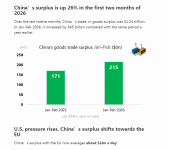
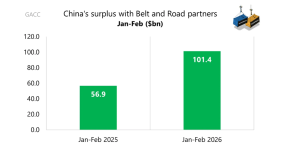
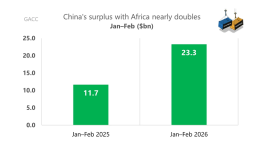
" China’s exports grew 21.8% year-on-year in January and February — the fastest pace since January 2022 — with semiconductors up 72.6%, autos up 67.1%, and ships up 52.8%. China’s trade surplus hit $213.6 billion over those two months, a 26.2% increase from the same period a year earlier. One detail worth noting: value growth outpaced volume growth for China’s key exports, meaning goods moved at higher prices rather than just higher quantities."
 
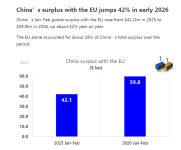
China’s surplus with the EU now averages about $1bn a day
搜狗截图20260317040645.png
 

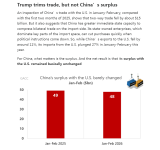
Trump trims trade, but not China’s surplus​

China's trade surplus with US remains unchanged

搜狗截图20260317041106.png
 
" China’s exports grew 21.8% year-on-year in January and February — the fastest pace since January 2022 — with semiconductors up 72.6%, autos up 67.1%, and ships up 52.8%. China’s trade surplus hit $213.6 billion over those two months, a 26.2% increase from the same period a year earlier. One detail worth noting: value growth outpaced volume growth for China’s key exports, meaning goods moved at higher prices rather than just higher quantities."
China now is exporting less goods, but making more money.
 

Users who are viewing this thread

Pakistan Defence Latest

Country Watch Latest

Latest Posts

Back
Top