Navigation
Install the app
How to install the app on iOS
Follow along with the video below to see how to install our site as a web app on your home screen.
Note: This feature may not be available in some browsers.
More options
Style variation
You are using an out of date browser. It may not display this or other websites correctly.
You should upgrade or use an alternative browser.
You should upgrade or use an alternative browser.
Chinese Economy: General News, Updates and Discussions
- Thread starter Beijingwalker
- Start date
More options
Who Replied?

冖_冖
Registered Member

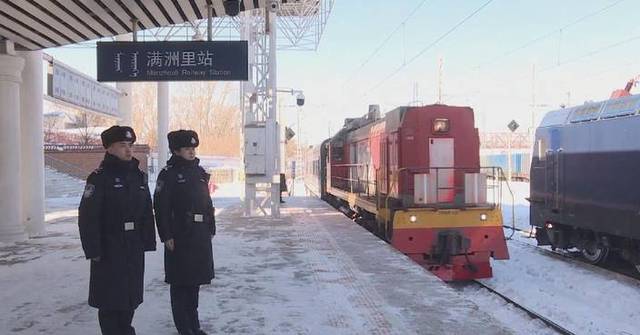
China-Russia passenger train resumes operation after 6 years
The passenger train service connecting Manzhouli City in north China's Inner Mongolia Autonomous Reg
 www.bastillepost.com
China-Russia passenger train resumes operation after 6 years
2026-03-08 19:32 Last Updated At:03-09 11:58The passenger train service connecting Manzhouli City in north China's Inner Mongolia Autonomous Region with Zabaykalsk in Russia officially resumed operations on Sunday after suspending for six years.
At 11:00, an inbound train from Zabaykalsk arrived at Manzhouli Station, marking the reopening of another vital passenger transport corridor on the China-Russia border.
Trains will run in both directions twice a week, covering a distance of 9.8 kilometers in approximately 25 minutes.
To ensure efficient and smooth customs processing, Manzhouli Station has upgraded its international waiting area, adding multilingual signage and consultation windows. The ticketing and customs verification processes have been simplified, and a collaboration mechanism with border inspection and customs departments has been in place, reducing traveler's customs processing time by nearly one hour.
Manzhouli Port, located at the tri-junction of China, Russia, and Mongolia, serves as a crucial hub connecting the Eurasian Land Bridge and handles over 65 percent of land transport for China-Russia trade.
冖_冖
Registered Member

Amazon Haul Has Over 3,000 Sellers
Amazon Haul, Amazon's direct-from-China section for items under $20, has reached over 3,000 sellers since launching in November 2024, establishing itself as a credible competitor to Temu and Shein, though still smaller in scale.
Amazon Haul Has Over 3,000 Sellers
March 5, 2026Amazon Haul, Amazon’s direct-from-China section for items under $20, has reached over 3,000 sellers since launching in November 2024, establishing itself as a credible competitor to Temu and Shein, though still smaller in scale. The milestone validates Amazon’s commitment to the “low and slow” direct-from-China marketplace model despite ongoing tariff volatility and confusion around imminent tariff rates.
According to Marketplace Pulse data, 3,287 sellers currently participate in the Amazon Haul program in the U.S. The platform shows clear segmentation by price point: 994 sellers average under $10 per item across their catalogs, another 636 average between $10 and $15, and 424 average between $15 and $20. The remaining 1,233 sellers average above $20, suggesting they’re testing Haul with limited catalog integration rather than fully committing to the ultra-low-price model. Sellers in the under-$10 cohort average approximately $498,000 in annual revenue, while those in the $10-$15 band average $943,000, and those in the $15-$20 band average $1.3 million.
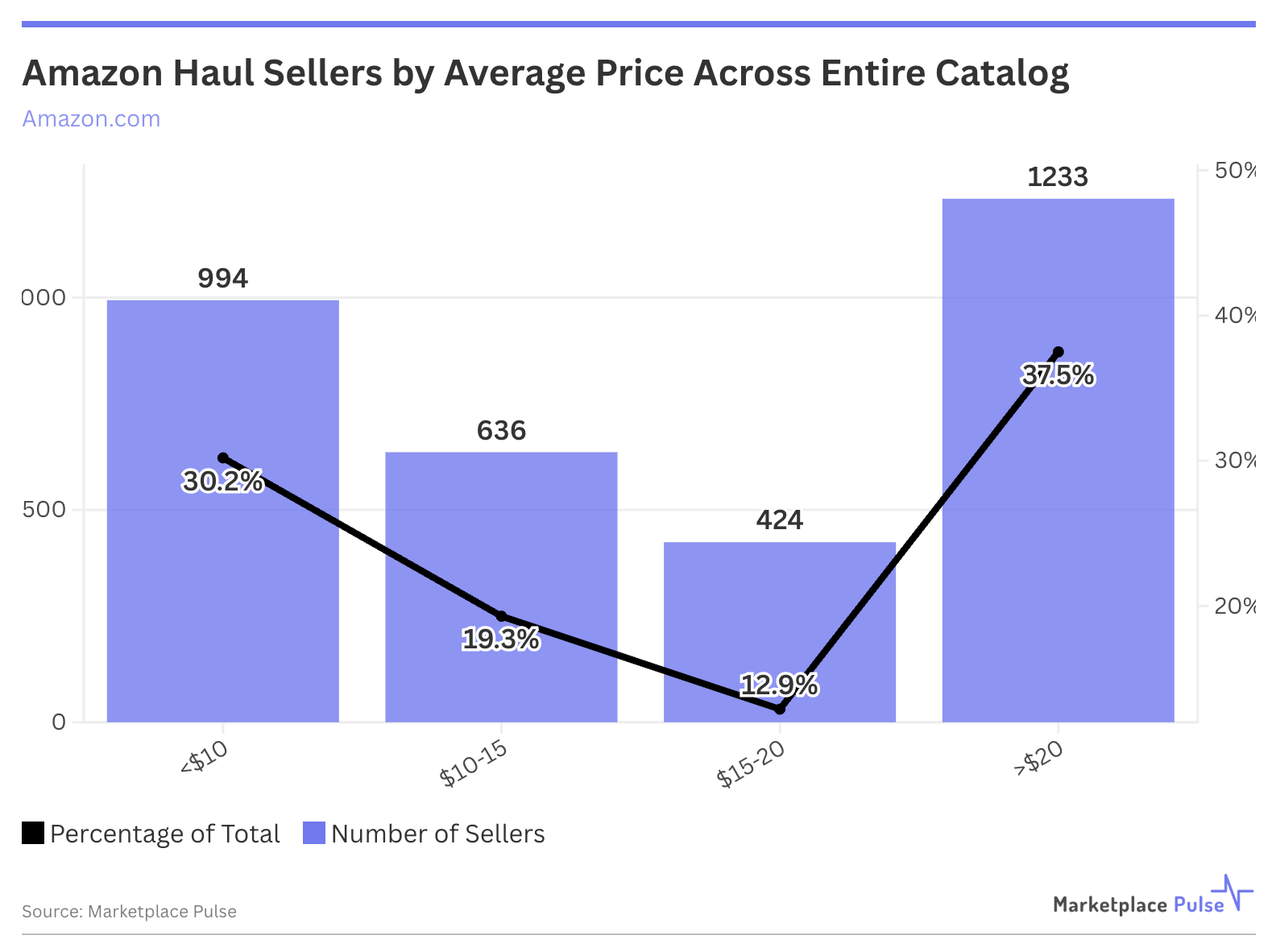
Based on overall seller economics across all cohorts, Marketplace Pulse estimates Amazon Haul generates approximately $2 billion in annual GMV. The seller base remains overwhelmingly China-registered, with 97.5% of sellers averaging under $10 per item operating from China or Hong Kong, though the actual percentage is likely higher as some Chinese entities register U.S.-based legal entities.
The growth aligns with Amazon’s recent earnings call claim that Haul selection has surpassed 1 million SKUs priced under $10. The company has aggressively subsidized growth through discounts reaching 90% off and expanded globally through Amazon Bazaar to over 25 markets. According to product page messaging, 75% of orders are delivered within 11 days, embodying the low-cost, slow-delivery trade-off that defines the direct-from-China model.
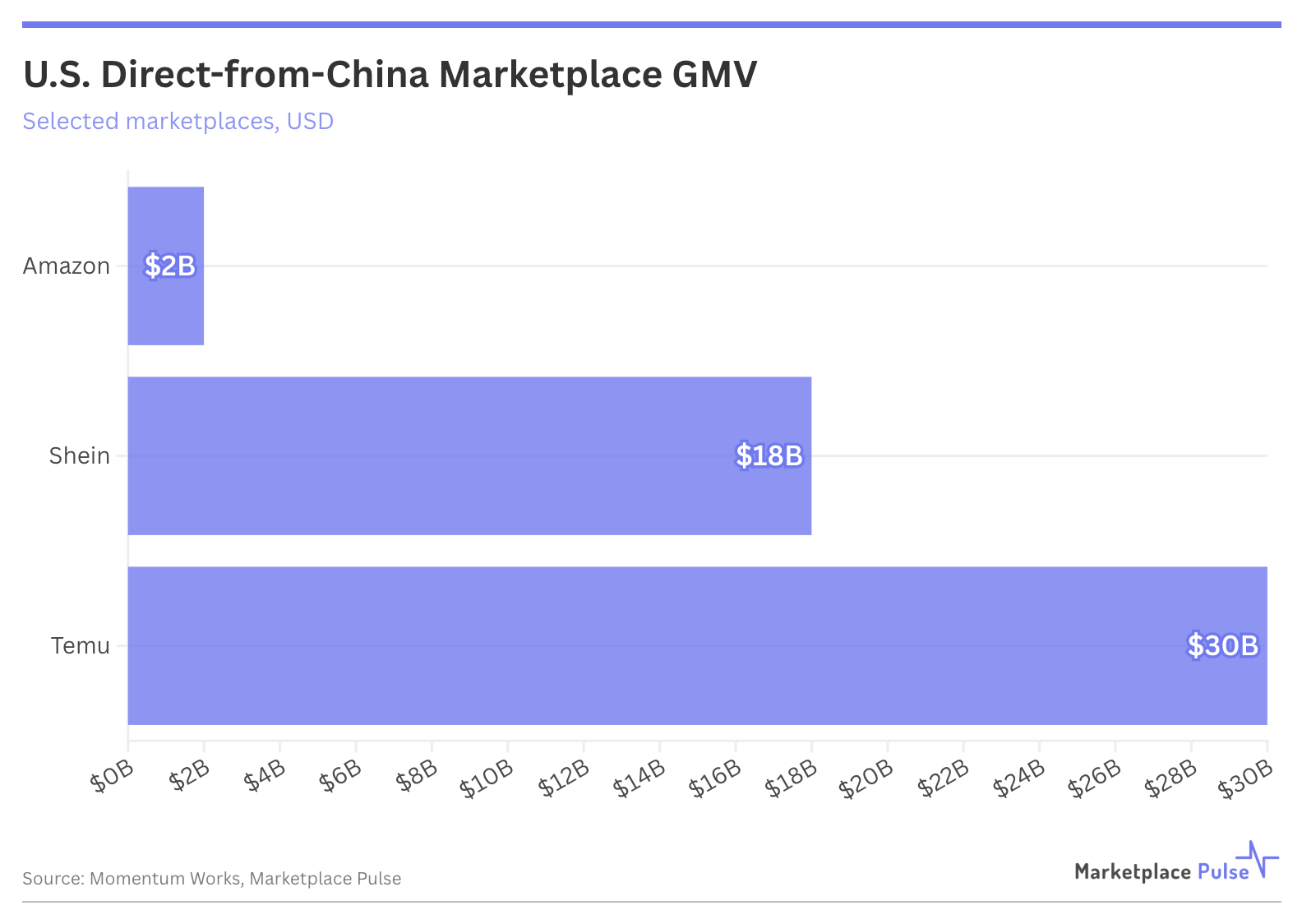
Yet Haul remains dwarfed by its direct competitors. Temu generates approximately $30 billion in U.S. GMV and Shein around $18 billion, making Haul’s $2 billion a single-digit percentage of the direct-from-China market.
The tariff landscape complicates long-term strategy. While Amazon expands Haul globally and Temu and Shein pivot toward local fulfillment, the fundamentals enabling ultra-cheap direct imports face persistent regulatory pressure. The May 2025 suspension of the de minimis exemption forced Chinese platforms to restructure operations entirely, and the recent Supreme Court ruling striking down Liberation Day tariffs has created renewed uncertainty around tariff rates.
Amazon appears willing to absorb losses to maintain its market position in a segment that runs counter to decades of Prime optimization. The contradiction, though, could well be the strategy: rather than allowing competitors to define ‘cheap’ as the opposite of ‘fast,’ Amazon is proving it can compete on any dimension shoppers value. Haul’s progress demonstrates Amazon can build a meaningful direct-from-China business, but the ongoing test is whether it can do so profitably as subsidies eventually end in a regulatory environment that has already eliminated the tariff arbitrage that made the model viable.

冖_冖
Registered Member

North Korea-China Passenger Train Service Resumes After Six-Year Hiatus
North Korea-China Passenger Train Service Resumes After Six-Year Hiatus First-Day Tickets Sold Out as Four Weekly Round Trips Restore Key Bilateral Exchange Channel
 www.chosun.com
North Korea-China Passenger Train Service Resumes After Six-Year Hiatus
First-Day Tickets Sold Out as Four Weekly Round Trips Restore Key Bilateral Exchange ChannelBy Lee Beul-chan
Published 2026.03.10. 15:27Updated 2026.03.10. 16:57

The Jochung Friendship Bridge in Dandong, Liaoning Province, connects North Korea and China. /Chosunilbo
Passenger train services between Pyongyang, North Korea, and Beijing, China, will resume for the first time in six years following the COVID-19 pandemic. The resumption of North Korea-China train operations, halted in January 2020 due to the pandemic, symbolizes the normalization of bilateral exchanges.
According to the China State Railway Group and other sources on the 10th, the Pyongyang-Beijing international train will restore its round-trip route starting on the 12th. Trains will depart from both Pyongyang and Beijing, with a stop at Dandong, a border city between the two countries. It is reported that the service will operate four round trips per week (Monday, Wednesday, Thursday, and Saturday).
When this newspaper contacted the service center of the China State Railway Group on the same day, a response stated, “The Beijing-bound train to Pyongyang on the 12th is already fully booked, and reservations are available from the 14th.” The Pyongyang-bound train departs Beijing at 5:30 p.m., arrives at Dandong at 7:35 a.m. the following day, and reaches Pyongyang at 6:00 p.m. the same day. Ticket prices for sleeper compartments range from 1,067 yuan (approximately 220,000 Korean won) to 1,467 yuan (approximately 290,000 Korean won) depending on the class. Since North Korea still restricts tourist visa issuance for Chinese citizens, only those with business visas or similar can board the train. A Beijing-based source said, “Traders and travel agency representatives are flocking to the ticket office for the Pyongyang-bound train at Dongdan in Beijing to secure tickets.”
Even after China fully lifted its COVID-19 lockdowns in January 2023, only freight train operations were partially resumed, while passenger train routes remained suspended. However, ahead of the Beijing-North Korea summit in September last year, an international passenger train waiting hall was newly established at Dandong Station. The resumption of passenger train services coincides with the conclusion of the Two Sessions, the largest political event in China.
If the North Korea-China border fully reopens, allowing Chinese tourists to visit North Korea freely, the country is expected to earn around 200 million dollars (approximately 300 billion Korean won) annually in foreign currency. In 2019, before the pandemic, 350,000 Chinese visitors accounted for over 90% of all foreign tourists to North Korea. The cost of a one-day North Korea-themed tour from Dandong, including a cruise ship ride, starts at 300 yuan (approximately 60,000 Korean won).
Some analysts suggest the resumption of North Korea-China passenger train services is a decision made in anticipation of the upcoming U.S.-China summit scheduled for late this month. President Donald Trump may aim to showcase Sino-North Korean friendship ahead of the talks and highlight that China’s influence over North Korea remains intact, thereby strengthening its negotiating position. There are also observations that North Korea’s strategic importance has grown as China focuses on “neighboring country diplomacy.”
With the normalization of train operations, a key channel for North Korea-China human exchanges, bilateral interactions are expected to expand across all sectors. Kyodo News stated, “Before North Korea restricted foreign visits due to the pandemic, Chinese citizens were the largest group of foreigners visiting the country,” adding, “North Korea-China relations are expected to become more active in the future.” A Chinese diplomatic source commented, “Despite ups and downs, North Korea-China relations have been consistently managed, and the resumption of passenger train services and strengthened exchanges are natural developments given the recent flow of bilateral interactions.”

FHN
Trusted Member
Total exports jumped 21.8 per cent from a year earlier – the biggest gain in four years – to US$656.58 billion in the combined figures for January and February released by customs authorities on Tuesday.


FHN
Trusted Member
China currently holds about 1.4 billion barrels (approximately 190 million metric tons) of strategic crude oil reserves. Even if all of the country's imports from the Middle East were cut off, these stockpiles could cover a six-month supply shortfall
FHN
Trusted Member
All its exports are rising very rapidly but the one export that's rising the fastest, at a crazy +72.6% growth year on year, is... semiconductors!As you can see in the trade data China sold $43.32 billion worth of 集成电路 ("integrated circuits") in Jan-Feb 2026, vs $25.10 billion for Jan-Feb last year.Interestingly, volume is "only" up 13.7% year on year, which means the increase in revenue is mostly driven by higher prices per chip, which probably suggests that a) China is climbing up the value chain (selling more expensive chips) b) demand for their chips far exceeds supply - which is the exact opposite of "overcapacity". You don't get +53% price increases per unit in a market with overcapacityAnd all in all, it goes to show that China is definitely a force to be reckoned with in the semiconductor world. Global semiconductor sales were $791.7 Billion in 2025 (https://semiconductors.org/global-annual-semiconductor-sales-increase-25-6-to-791-7-billion-in-2025/) and projected to be ~$975 billion this year. China selling $43.32 billion in 2 months means its doing $260 billion annualized: that's over a quarter of the entire global semiconductor market.So much for the idea that export controls would freeze China out of the semiconductor industry..

retaxis
Trusted Member

Trump is MCGA (Make China Great Again)
In the first two months of 2026,
China's exports surged by 21.8% (nearly 22%) in U.S. dollar terms compared to the previous year.
This growth significantly outperformed economist expectations, which had predicted a much more modest increase of around 7.1% to 7.2%.
Key Drivers of Growth
Economic Context
In the first two months of 2026,
China's exports surged by 21.8% (nearly 22%) in U.S. dollar terms compared to the previous year.
This growth significantly outperformed economist expectations, which had predicted a much more modest increase of around 7.1% to 7.2%.
Key Drivers of Growth
- Electronics and Tech: The surge was primarily fueled by "red-hot" demand for electronics, including a 72.6% jump in semiconductor exports linked to the global AI investment boom.
- High-End Manufacturing: Other high-performing categories included automobiles (up 67.1%) and ships (up 52.8%).
- Market Diversification: While exports to the U.S. fell by 11%due to ongoing trade tensions and tariffs, this was offset by massive gains in other regions:
- Africa: +49.9%
- ASEAN: +29.4%
- European Union: +27.8%
Economic Context
- Record Trade Surplus: This performance pushed China's trade surplus to a record $213.6 billion for the January-February period.
- Internal Challenges: The export boom comes as China faces domestic economic headwinds, including a property market crisis and weak consumer spending.
- Emerging Risks: Analysts warn that this momentum may face disruption from the outbreak of war in Iran, which has already begun to impact global energy prices and shipping routes through the Strait of Hormuz.
Bloomberg.com +5
FHN
Trusted Member
China's Ministry of Transport has held talks with Maersk Group and Mediterranean Shipping Company. Clearly, China is warning them that if they continue to illegally operate the Panama Canal (which was originally operated by a Chinese company), China will impose sanctions on them.Americans originally thought the Panama Canal incident was over, but that's not the case. China won't let it rest.As mentioned before, Maersk and MSC have huge interests in China, and the Chinese have plenty of leverage
FHN
Trusted Member
China's layout in the energy sector is astonishingly intricate and far-sighted:
1. Developing nuclear energy: After the major earthquake in Japan triggered a nuclear crisis, the vast majority of countries around the world halted nuclear power construction, with some regions even resorting to "power generated by love," Germany dismantling all its nuclear plants, and the United States stopping nuclear energy development as well. Yet China plans to build 39 more nuclear power stations by 2030, adding nuclear generation capacity that exceeds the global total
2. Establishing record-breaking reserves: China seems to have anticipated the crisis in the Strait of Hormuz long ago, building up unprecedented crude oil reserves—official reserves at 500 million barrels, commercial reserves at 800 million barrels, plus some hard-to-quantify figures, potentially totaling a staggering 2 billion barrels. This is enough to hedge against 200 days of net imports.
3. Developing new energy sources: Roughly 50% of every country's imported oil ends up as vehicle fuel, but China's push into new energy vehicles is rapidly reducing dependence on this segment. Meanwhile, massive investments in solar and wind power are helping China build enormous energy hedges. While China can't extract as much oil from the ground as the United States, the growth of these new industries is autonomously generating the equivalent of "oil."
4.Diversified import channels: China has established vast pipelines from Russia and Central Asia, ensuring that even if Persian Gulf oil supplies are cut off, it still has 50% of its alternative import channels intact.
1. Developing nuclear energy: After the major earthquake in Japan triggered a nuclear crisis, the vast majority of countries around the world halted nuclear power construction, with some regions even resorting to "power generated by love," Germany dismantling all its nuclear plants, and the United States stopping nuclear energy development as well. Yet China plans to build 39 more nuclear power stations by 2030, adding nuclear generation capacity that exceeds the global total
2. Establishing record-breaking reserves: China seems to have anticipated the crisis in the Strait of Hormuz long ago, building up unprecedented crude oil reserves—official reserves at 500 million barrels, commercial reserves at 800 million barrels, plus some hard-to-quantify figures, potentially totaling a staggering 2 billion barrels. This is enough to hedge against 200 days of net imports.
3. Developing new energy sources: Roughly 50% of every country's imported oil ends up as vehicle fuel, but China's push into new energy vehicles is rapidly reducing dependence on this segment. Meanwhile, massive investments in solar and wind power are helping China build enormous energy hedges. While China can't extract as much oil from the ground as the United States, the growth of these new industries is autonomously generating the equivalent of "oil."
4.Diversified import channels: China has established vast pipelines from Russia and Central Asia, ensuring that even if Persian Gulf oil supplies are cut off, it still has 50% of its alternative import channels intact.
FHN
Trusted Member
“if the IEA is already calling Beijing it means they know the reserve release could just end up filling China’s tanks instead of calming global prices seen that movie before in 2022”
Agrees not to fill SPR
Does it anyway
Users who are viewing this thread
Total: 3 (members: 0, guests: 3)
Pakistan Defence Latest
-
 Federal cabinet gives nod to imposition of emergency in KP; summary sent to president (22 Viewers)
- Latest: Forsvaret
-

-
-
PTI Murad Saeed in Afghanistan, was 'controlling KP govt' from there: Rana Sanaullah (2 Viewers)
- Latest: Blain2
-

Country Watch Latest


Latest Posts
-

-
-
Federal cabinet gives nod to imposition of emergency in KP; summary sent to president (22 Viewers)
- Latest: Forsvaret
-

-