Chinese Economy: General News, Updates and Discussions

In the UN there is something called the "Coffee Club," which is founded by Italy, Pakistan, Mexico and Egypt. It is called Coffee Club because the Italian ambassador invited founders for a coffee to discuss common interests in the UN/UNSC. The purpose of this club is to prevent the expansion of UNSC permanent membership, especially the inclusion of India, Germany, Japan, and Brazil. Several countries have now joined the club, including Turkey, South Korea, Spain, and Argentina.

Although people don't tend to hear much about the club it seems (at least to me) that behind the curtains it has an influence on changes in UNSC. So, hypothetically speaking, even if China somehow agrees to India's permanent membership the Coffee Club is unlikely to. If memory serves me right, although I am not sure that it does (anymore), I think Germany once asked Pakistan for support but Pakistan pulled out the Coffee Club card on them.

It is possible that China also secretly supports the club.
 
Last edited:
India will never a permanent member of the Security Council, no matter friend of China or not.
 

G7 vs China: Can Washington and allies challenge Beijing?

May 25, 2025

A communiqué issued at the end of a Group of Seven (G7) meeting in Canada last week criticised China — albeit indirectly. Though not named, the target was obvious. The statement spoke of how “non-market policies and practices (NMPPs) aggravate imbalances” and “impact the economic security of other countries.”

It added: “We agree on the importance of a level playing field and taking a broadly coordinated approach to address the harm caused by those who do not abide by the same rules and lack transparency.” That was a roundabout way of condemning China.

But does the G7 — the USA, UK, France, Germany, Japan, Italy, and Canada — have the strength and resources to confront Beijing? On paper, it does. Home to about 780 million people — nearly 10% of the global population — the G7 accounts for roughly 50% of the world’s nominal net wealth, 30% of GDP by purchasing power parity, and 44% of nominal GDP, according to Wikipedia.

China stands to lose billions in a confrontation. The US is its third-biggest trading partner, after ASEAN and the European Union, and Japan is its fifth, after South Korea. A showdown with the G7 could cost it EU business as well, since France, Germany and Italy are all EU members.

Golden geese​

In fact, the US and EU are China’s golden geese: it runs its biggest trade surpluses with them. In 2024, China exported $438.9 billion worth of goods to the US and imported $143.5 billion, according to the Office of the US Trade Representative. Exports to the EU totalled €515.9 billion, and imports €223.6 billion, in 2023, according to the European Commission.

Clearly, China has every reason to keep them happy — except that it hasn’t.

The G7 is furious over these trade imbalances and is threatening coordinated action. Even Germany, long friendly with China, has soured, as its carmakers lose market share to Chinese electric vehicles. The anger isn’t baseless: China is growing rich at their expense and threatening their industries and workers. Overcapacity in Chinese industries depresses global prices, hurting Western producers. US steelmakers face underpriced, subsidised Chinese steel.

One might think it’s in China’s interest to avoid a clash. But if past behaviour is a guide, President Xi Jinping won’t back down. He didn’t flinch when President Donald Trump raised tariffs. The two nations eventually reached a truce, lowering tariffs for 90 days on May 12. The current G7 sabre-rattling may follow a similar script.

In reality, few have the option of cutting ties with China. It is indispensable in key areas. A former Apple executive told the BBC World Service that Apple could not exit China because it relies on the country’s sophisticated manufacturing capacity. Apple may shift some iPhone production to India — but it’s not leaving China.

China dominates​

From solar panels to rare earths, China dominates. It supplies at prices no one else can match, thanks to state subsidies. It is also the world’s top producer of rare earth elements essential for electric vehicles, wind turbines, consumer electronics, robotics, and drones. While the US and Australia follow in rare earth production, China leads in the complex refining and processing stages.

According to The Wall Street Journal, China’s tech prowess is advancing fast. Its electric-car firms rival the best, its AI startups compete with OpenAI and Google, its factories run on cutting-edge robotics, and its cargo vessels and satellites dominate the globe.

Last year, China spent $500 billion on R&D — triple what it did when Xi took office in 2012. By contrast, the Trump administration is cutting spending to reduce the deficit. Governments in the UK, France, Germany, and Italy also face fiscal pressures.

Meanwhile, China is investing heavily at home and abroad — funding infrastructure, creating dependencies. It has built the Pokhara airport in Nepal, the Gwadar port in Pakistan, Indonesia’s Whoosh high-speed train, and Malaysia’s East Coast Rail Link. Its reach spans Africa to South America.

Yes, the G7 could still contain China with coordinated sanctions and trade restrictions. Losing the US and EU markets would hurt China. ASEAN — China’s top trading partner, with $797.63 billion in bilateral trade in the first 10 months of 2024, according to Chinese sources — cannot compensate for that loss.

But a trade war would also hurt the G7 nations. Cheap Chinese goods may harm local industries, but they keep prices low. Consumers benefit. And nothing upsets voters more than rising costs. Inflation during the Biden administration is said to have helped Trump’s return. Now, Trump’s poll numbers may be dipping amid fresh inflation fears. No G7 country wants to spark a crisis that raises the cost of living.

There may be sanctions and embargoes — but a full-blown trade war? That’s a nightmare no one’s willing to entertain.

The West should not target China, otherwise it will miss the time window to deal with internal problems.
 
China’s Tsinghua University tops multiple global rankings for computer science

China’s Tsinghua University has emerged as the world’s top institution in computer science across multiple major global rankings, marking a symbolic shift in a field once dominated by American universities.

For the first time, Tsinghua now leads lists ranging from the widely recognised US News Best Global Universities to CSRankings, a system seen as rigorously academic and historically US-centric within the research community.

In the latest CSRankings results – which weigh institutions by faculty publications in top-tier conferences across artificial intelligence, computer systems, theory and interdisciplinary research – Tsinghua has overtaken long-time leader Carnegie Mellon University to claim the top spot.

Shanghai Jiao Tong University, Zhejiang University and Peking University followed in third, fourth and fifth place. The top 10 is now evenly split between Asian and US universities, underscoring Asia’s growing strength in the field.
 
India is the fastest growing economy in the world it's only just surpassed 4 trillion last year but in two decades will be 20 trillion gdp and quarter of the worlds total gdp and consumer spender
No country or bloc can afford to ignore india

Your mentioned indoneasia it's gdp is one quarter of India's
 

Apple’s Sales Rebound In China Is Causing Competitors Problems – Base iPhone 17 Is Outselling Standard Xiaomi 17; More Bad News In Tow​

A revamp in the iPhone 17 lineup has turned around Apple’s fortune, particularly in China, where the competition is fighting tooth and nail to retain every percentage point of market share. Fortunately, the Cupertino firm delivered an exceptional value proposition to consumers who do not want to spend flagship-level funds by giving them the iPhone 17, which is outselling competitors like the Xiaomi 17. According to an analyst, there is more bad news lurking around the corner for Chinese phone makers as Apple is preparing another model.

Xiaomi and other local brands have a fight on their hands, as Apple is scheduled to announce the iPhone 17e in H1 2026 to boost its market share​

TF International Securities analyst Ming-Chi Kuo states on X that the total shipment volume of the Xiaomi 17 has reduced by 20 percent, with the original initial target being 10 million units. Assuming there are no aggressive pricing strategies or marketing campaigns launched to bolster the lineup’s popularity, the aforementioned figure is estimated to drop to 8 million units. As for why there has been a shipment reduction, Kuo notes that the base iPhone 17’s popularity in China has outshone its competitors.

The standard version is selling better than the Xiaomi 17, which is hardly surprising, given that Apple introduced three stellar upgrades this year, one of which ended up being its greatest strength. You get double the starting storage at 256GB instead of 128GB, coupled with the 3nm A19 chipset and the LTPO OLED panel, making it a huge step-up over the 60Hz displays that Apple has continued to employ on its non-Pro models.

To view this content we will need your consent to set third party cookies.
For more detailed information, see our cookies page.


With the screen upgrade, which the company calls ProMotion technology, iPhone 17’s refresh rate can operate in the 1Hz to 120Hz range, conserving battery life when required and offering that buttery-smooth scrolling experience when needed. We have discussed in-depth why this display upgrade is a significant deal, and what is even more impressive is that Apple has successfully incorporated all of these additions while maintaining that $799 price, making it unchanged from the iPhone 16 but offering considerable value in return.


However, the California-based giant is not taking a breather because Kuo states that in the first half of 2026, the iPhone 17e will be added to the family, with Apple targeting a lower price bracket for consumers who cannot fork over $799 for the iPhone 17. Examining this scenario, it appears that Apple’s struggles in China might be over, with demand for even Huawei’s high-end smartphones also witnessing a slump due to these devices running HarmonyOS.
 
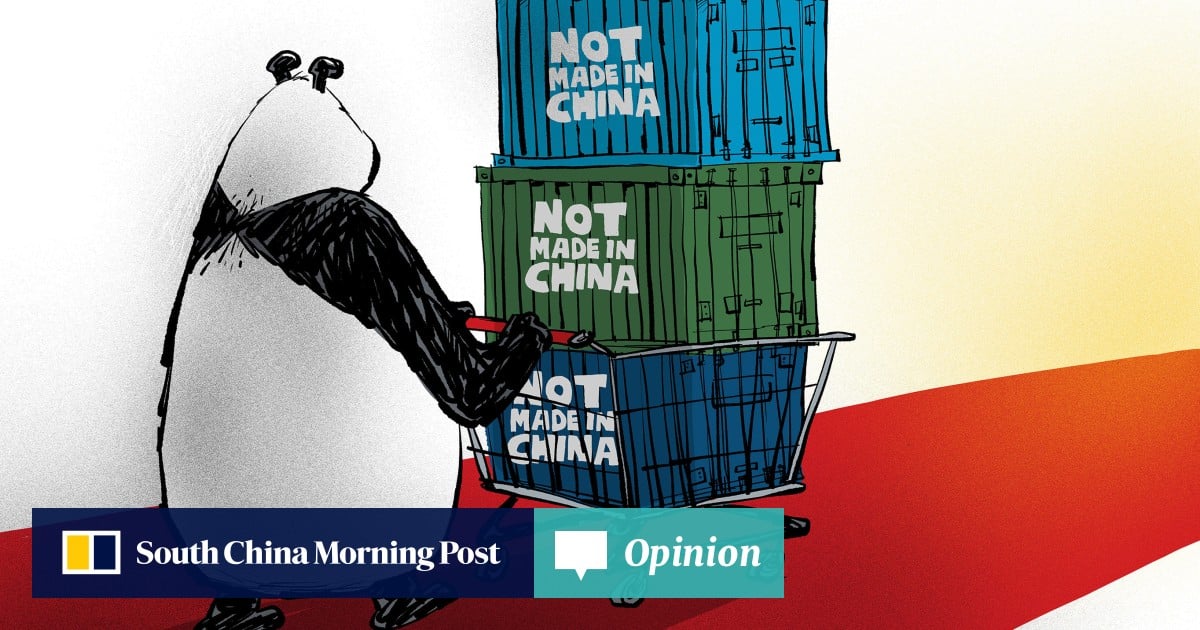
Opinion | China needs to chart a new course to become world’s largest importer
It is time to embrace a new era in which the goal is not ‘made in China’ but ‘consumed in China’

Published: 5:30am, 6 Oct 2025

In 2009, China surpassed Germany to become the world’s largest exporter of goods, a position it has maintained for the past 16 years. This export dominance has been instrumental in propelling China’s economy forward, enabling it to overtake Japan in 2010 as the second-largest economy in nominal GDP, trailing only the United States.

By 2013, China had also eclipsed the US as the world’s largest trading nation in goods, measured by the combined value of imports and exports. These milestones underscore its remarkable transformation from an inward-focused economy to a global powerhouse.

Now, as China’s leadership prepares to meet from October 20-23 to deliberate on the 15th five-year plan, it is imperative for Beijing to chart a new course: overtaking the US to become the world’s largest importer within the next five to 10 years.

This shift would not only mark a pivotal evolution in China’s economic strategy, it would also carry profound geopolitical and economic implications for the nation, its key trading partners and the rest of the world.

The five-year plan, a legacy of the Soviet-style planned economy, has evolved far beyond its original rigid production targets and ideological framework. Today, it serves as a comprehensive blueprint encompassing economic development, environmental protection, education and social welfare programmes.

The upcoming plan is particularly critical as China aims to achieve its goal of becoming a “modern socialist country”. Central to this ambition is accelerating the transition to a consumption-driven economy, addressing structural imbalances that have long prioritised investment and exports over domestic demand.

During the past four decades of “reform and opening up”, China’s growth has relied heavily on fixed-asset investments, such as infrastructure, real estate and exports. These engines have fuelled unprecedented expansion, but their sustainability has waned in recent years. Fixed-asset investments, particularly in the real estate sector, have lost steam amid overcapacity and debt concerns. While still robust, exports have sparked intensifying frictions with several trading partners.

China’s exports surged in 2024, contributing to a record trade surplus of nearly US$1 trillion. This surplus has drawn sharp criticism, with trading partners arguing that China is effectively exporting its overcapacity and relying on foreign demand to sustain growth, potentially at the expense of jobs and industries abroad.

A stark illustration of this imbalance is China’s steel sector, where production exceeded 1 billion tonnes in 2024, with exports reaching around 110 million tonnes. Such overproduction exemplifies the cutthroat “involution-style” competition plaguing many industries – excessive price wars driven by oversupply and weak domestic demand, resulting in razor-thin margins or losses. This phenomenon extends to exporters, undermining global trade fairness.

Meanwhile, China’s imports grew modestly by 2.3 per cent to about US$2.6 trillion in 2024, compared to US imports of goods and services, which rose 6.6 per cent to a record US$4.1 trillion. At first glance, bridging this gap to surpass the US as the top importer might seem daunting, but it aligns perfectly with China’s pressing need to rebalance its economy.

To facilitate this transition, China must confront deep-rooted challenges, including boosting domestic consumption. Opening up areas such as education, healthcare, sports and elderly care to foreign investment and services could invigorate these industries.

China’s ageing population, projected to see more than 400 million people aged 60 and above by 2035, amplifies the urgency for imported healthcare solutions, including advanced drugs and technologies. Lowering the cost of items such as medications to treat cancer, as Beijing has done in recent years, directly addresses this demand and supports consumption upgrades.

The geopolitical significance of China becoming the largest importer cannot be overstated. Amid escalating trade tensions, exemplified by US President Donald Trump’s imposition of new tariffs on Chinese goods in April, boosting imports would signal China’s commitment to balanced global trade.

The EU and others have echoed concerns over China’s surpluses, viewing them as a threat to their manufacturing bases. By actively expanding imports, Beijing could help ease these frictions, reduce retaliatory measures and enhance its image as a responsible global power.

Furthermore, as Trump has erected tariff barriers against products from most of the world, China’s efforts to boost imports would win more friends. By becoming the world’s largest importer, China would also set global standards and influence supply chains, rules and norms. The move aligns with President Xi Jinping’s repeated assertions that China does not seek deliberate surpluses, as evidenced by initiatives such as the annual China International Import Expo.

Economically, the benefits for China are multifaceted. Boosting imports extends beyond goods to encompass technology, talent and capital inflows, fostering innovation and productivity. Moreover, reducing the country’s reliance on exports by curtailing subsidies and lowering administrative barriers to imports would curb involution at home and abroad. This shift would stimulate domestic demand, creating a virtuous cycle where higher imports fuel consumption, job creation and economic resilience.

In a post-pandemic world, where global supply chains remain fragile, positioning China as the largest importer would integrate it more deeply into these chains, not as a mere supplier but as a key demand driver. As China’s leaders finalise the 15th five-year plan, setting a clear target to become the world’s largest importer is not just ambitious but essential. This would mark a new phase in China’s development, shifting the focus from “made in China” to “consumed in China”.

The path ahead requires bold policy actions – tariff reductions, market openings and consumption incentives – but the rewards for China and the world are immense. Failure to act risks perpetuating imbalances that could hinder long-term prosperity. Now is the time for China to embrace this transformative goal.
 
Asian investors tend to favor physical metal (although there is growing interest in ETFs in the East). Bar and coin demand was up by 11 percent in H1, rising to 582 tonnes, with Chinese and Indian investors leading the way.

Chinese bar and coin demand grew by 44 percent year-on-year in H1. Chinese investors snapped up 115 tonnes of gold bars and coins in the second quarter alone. It was the strongest H1 for physical gold buying since 2013.

India bar and coin demand grew by 7 percent through the first half of the year.

But in the U.S., selling was the dominant theme in the physical bullion market. Year-on-year bar and coin sales plummeted by 53 percent in H1. Demand in the second quarter was only 9 tonnes, the lowest quarterly level since Q4 2019.


China is pulling heavy weights.

My only complaint is the comex has stockpiles of silver, the West has the ammo to fight back from going to gold/silver. So while things are bad for the US with the price of silver going up too, the scenario of the US caught with their pants down is not there. Prices are allowed to go up because the US is making it more difficult to buy silver and gold cheap and then go to a gold backed or silver backed currency. The US is trying to get ahead of the game by buying up supplies before scenarios develop that could lead to a gold backed SCO/BRICS/Yuan currency. That is why the price is not the concern, you want the West to have no supplies at their exchanges, so China can easily go her way with a path she has considered for a while.

So keep buying physical. The price is irrelevant, the supply/demand is more important. Try to keep supplies low in the West.

When there is news that should favor gold and silver buying, such as a fed rate cut, vast selling is done to prop the image that the US is not weak. It is a facade. This is countered by taking delivery from the exchanges. The US counters this with long positions to later sell. You want the price to go up, though you want the price to go up with shortages in the West. If prices go up with stockpiles in the West, then the West can manipulate the news on silver and gold. The less they hold, the more China determines the news and their agenda is unquestionable.
 
Silver and gold are economic guns. The US want to own them to suppress the price at vital occasions, to make gold and silver unattractive and for dollars and Trump coins to be seen as the economic guns.

The US has been at war with gold and silver. To make them a relic. The US can't control the global economy with gold and silver as money. As precious metals are too widely distributed and bypass SWIFT and dollar hegemony.
 
As for rare earth, it's just a small card China can play, and good luck with the west to find alternatives.

View attachment 143565View attachment 143566

To view this content we will need your consent to set third party cookies.
For more detailed information, see our cookies page.
 
Because China has a veto power. China will never support any country in the world to become another permanent member if it is not a friend of China.
To view this content we will need your consent to set third party cookies.
For more detailed information, see our cookies page.

The Indian got totally blasted by Victor Gao.
 
China has two main leverages over the US.

First are AI chips made in Taiwan. China can annex Taiwan and cut off supplies of chips to the West. Though this could cause sanctions and the end of the Chinese Trade Empire. If China goes to gold and silver as money and monetizes gold and silver, then the 10+ fold increase in the price of gold and silver would make the Chinese very rich, allowing them to have a domestic consumer economy, no longer needing their vast trade empire. So China would not be overly reliant on trade then and could survive an annexation of Taiwan.

The second is going to a gold backed currency before Trump forces bitcoin on the globe.

Once Taiwan has their TSMC plant in Arizona with the equipment ready, China lost TSMC to the West as the US replaces Taiwan and could nationalize the Arizona plant in an emergency.

If Trump forces bitcoin on the global economy before China goes to precious metals, then China loses another leverage on the US.

The US goal is to cause leverage over the US to have an expiration date at its choosing.

Once China has no more leverage, the US can have a conflict with China without consequence. If the US starts a war now, China could invade Taiwan. If Taiwan move their manufacturing to Arizona, the US does not care if the rest of the globe loses out on AI chips, the Arizona plant would supply the US with needed chips.

So a war on Taiwan after the factory opens in Arizona would benefit the US cutting off supplies to rivals and foes. US wants TSMC destroyed after the US gets the technology. US would then have the monopoly.

So annexation has to happen before the plant in Arizona gets going. If there is to be annexation. Pressure on Taiwan to cancel their factory in Arizona should be tried with treat of force. Though this risks sanctions and loss of partners for a gold backed yuan or a gold BRICS currency.

China waiting for a green yuan or for 2045 is too late. China should try to keep Taiwan as the nearly sole maker of AI chips. The US uses Chinese threats on Taiwan to get Taiwan to capitulate to the West demands. So a carrot and stick approach could be useful for Taiwan. Meaning China could offer no threat of annexation so long as Taiwan does not export production of AI chips to non-Chinese nations. This is the best strategy. China could offer billions in investment to Taiwan if Taiwan cancels their CHIPS Act deal and the deal with Trump.

Do the unexpected and throw off the plans of the US for hegemony.
 
Kenya to make $215m savings after converting Chinese railway loan into yuan

NAIROBI, Oct 7 (Reuters) - Kenya has completed converting three railway construction dollar-denominated loans from China into yuan in order to save on interest payments, its Finance Minister John Mbadi said on Tuesday.

The swap, which allows the floating, dollar-based interest rates across the three loans from China Exim Bank to drop into their lower, yuan-based rates, will save the country about $215 million a year, Mbadi told reporters.

"It kicks off immediately and it is a saving in our fiscal space," Mbadi told journalists at a briefing, without providing a figure for the outstanding loan amounts that were converted.

The East African nation borrowed three loans amounting to $5 billion in 2014 and 2015 for the construction of a modern railway line from the port city of Mombasa to a station near the Rift Valley town of Naivasha in the hinterland.

The outstanding loans stood at a total of $3.5 billion by June last year, figures from the finance ministry showed.

Apart from the financial relief, Kenyan officials attribute the currency switch to the fact that the East African nation's debt is concentrated in dollars, exposing the government to higher currency and interest rate risks.

About 68% of the stock of Kenya's external debt is denominated in dollars, according to government officials.


The Bank of Korea (BOK) data showed yuan has gradually yet persistently increased its share among currencies used in Korean import payments.

Its share was merely 0.8 percent in 2018 but went up to 1.1 percent in 2019. The ratio was measured at 1.5 percent in 2020 and 2021 and then climbed to 1.7 percent in 2022, 2.4 percent in 2023 and currently is about 3.1 percent.

Accordingly, the total value of yuan-based import payments reached $19.5 billion in 2024, marking a nearly eightfold increase from $2.5 billion in 2014.

46cefe2d-f886-44f8-a46f-f49c403ce4e2.jpg
 
Last edited:

China's forex reserves hit highest level in decade

The country's foreign exchange reserves increased for the second month in a row in September to $3.3387 trillion, up 0.5 percent or $16.5 billion from the previous month, the State Administration of Foreign Exchange said on Tuesday.

The administration said the country's official gold reserves came in at 74.06 million ounces at the end of September, up from 74.02 million ounces a month earlier, marking the 11th consecutive month of increase.

Despite global trade uncertainties, the country's exports in goods went up 7 percent year-on-year to $1.7 trillion in the first half of the year, according to the balance of payments data released by the State Administration of Foreign Exchange, leading to a trade surplus in goods of $456.7 billion.
 
China is significantly stockpiling metal.

Last years' article:

China’s Now Buying Silver Directly From South America​


As China ramps up efforts to de-dollarize and secure its financial future, its aggressive stockpiling of key resources, including silver, is causing global unease. This strategic move has significant implications for the precious metals market and global economic stability.

China is rapidly accumulating vast reserves of crucial materials such as crude oil, natural gas, copper, iron ore, cobalt, and especially precious metals like gold and silver. According to reports from The Week and Newsweek, these actions are taking place amidst soaring commodity prices and China’s own economic challenges, raising questions about the country’s motivations.

The most alarming aspect of China’s stockpiling is its approach to silver. According to sources from Zero Hedge, China is buying unrefined silver concentrate from Latin American refiners and miners, effectively laying claim to Latin American silver before it is refined. This tactic allows China to secure silver at higher prices without directly affecting the spot market, crowding out Western buyers and raising concerns about future supply and price stability.

China's domestic silver production is in decline, and with its industrial demand—especially for solar panels—soaring, the country is aggressively securing overseas silver supplies. This strategic stockpiling, coupled with China’s massive consumption needs, poses serious implications for the global silver market.

The current situation suggests that China's actions could lead to a significant increase in silver prices, potentially disrupting global supply chains. Analysts speculate that China’s stockpiling efforts are either a defensive measure against potential conflicts, such as a possible invasion of Taiwan by 2027, or a preparation for an economic downturn.

As China continues to amass key resources and secure its position in the global market, the world watches closely, anticipating the far-reaching impacts of these actions on the economy and international relations.


This year's article from a few months ago:

Why China's Industrial Demand Is Driving the Silver Market​


The rise of demand in China​

China has become a key player in the global silver market. Its influence can no longer be ignored. It's a bit like when a small stream becomes a mighty river that changes the landscape. Its appetite for this precious metal has significant consequences for prices and supply and demand dynamics internationally. There is a growing interest in silver bars as a safe haven.

China's central role in silver demand​

China is playing an increasingly important role in global silver demand. The country has become a major consumer, often surpassing other nations in terms of silver imports and usage. This dominant position is due to several factors, including sustained economic growth, rapid industrialization, and increasing purchasing power. Chinese demand is not limited to a single sector but encompasses manufacturing, investment, and jewelry. It's almost as if all the taps were turned on at once.

The reasons for China's appetite for money​

Several factors explain China's growing interest in silver:
  • Industrial growth: Silver is an essential component in many industrial applications, including electronics, solar panels, and batteries. As a global manufacturing center, China requires significant amounts of silver to power its industries. It's a bit like fuel for a car.
  • Technological development: New technologies, such as electric vehicles and renewable energy, require increasingly large sums of money. China is investing heavily in these sectors, further boosting demand. It seems like a race for innovation.
  • Investment: Silver is also considered a safe investment by many Chinese, especially in times of economic uncertainty. This helps increase aggregate demand. It's like putting money aside for a rainy day.
China has undergone profound changes in recent decades, fueling its integration into the global economy. Its comparative advantage in labor-intensive products has long defined its role. While this dynamic persists, it is evolving as China establishes trade relationships that go beyond simply providing low-cost supplies to multinationals. Companies are connecting their production networks to China because of its geographic location and integrated supplier base.

Consequences on international markets​

Increased Chinese demand has significant repercussions for international silver markets. Silver prices can be influenced by fluctuations in demand in China. Moreover, mining companies around the world are increasingly paying attention to Chinese demand when making investment decisions. It's almost as if China is setting the pace for the dance.

Specificities of Asian silver markets​

Asian silver markets have characteristics that make them unique compared to other global markets. These peculiarities stem from a combination of economic, cultural, and regulatory factors. Understanding these specificities is essential to fully grasp the influence of Asian demand on the price of silver.

Influence of regional monetary policies​

The monetary policies of Asian central banks have a significant impact on silver markets. Decisions regarding interest rates, reserve requirements, and interventions in the foreign exchange market can influence the demand for and supply of silver. For example, an expansionary monetary policy can lead to an increase in demand for silver as a safe haven, while a contractionary policy can have the opposite effect. It is therefore important to closely monitor the announcements and actions of the region's central banks. Monetary policies can affect the price of money.

The industrial use of silver in Asia​

Asia is a major center of industrial production, and silver is an essential component in many industrial applications. From electronics to solar panels, batteries, and chemical catalysts, industrial demand for silver in Asia is considerable.
Here are some key areas:
  • Electronics: Silver is used in electrical contacts, conductors, and solders.
  • Solar energy: Silver is an essential component of photovoltaic cells.
  • Chemistry: Silver is used as a catalyst in many chemical reactions.
Rapid economic growth in many Asian countries is fueling this industrial demand, which has a direct impact on the global silver market.

Interest rate fluctuations and demand​

Interest rates play an important role in the demand for money in Asia. When interest rates are low, investors may be more inclined to invest in silver because the opportunity cost of holding silver is lower. Conversely, when interest rates are high, investors may prefer to invest in interest-bearing assets, which can lead to a decrease in the demand for money. Interest rates can influence silver investments.
Here is a simplified example of the impact of interest rates:
Interest rateRequest for moneyImpact on price
BasÉlevéePotential increase
HighLowPotential decline

Money in History and Finance​

Gold and States​

Gold is a bit like the nation's safe. Most central banks have some, and quite a bit! The United States, for example, has the largest reserve in the world, stored at the Federal Reserve Bank of New York. It's less well-known than Fort Knox, but just as impressive. Imagine, in 1995, all the banks' gold reserves combined formed a cube 12 meters on each side. That's enormous!

Gold and Finance​

Gold remains a major player in the world of finance. It's listed on major stock exchanges, such as New York, London, and Tokyo. And when there are crises, everyone looks at how gold reacts, because it gives a good idea of what's going on. In fact, transactions on this value are an important economic barometer.

Evolution of the price of gold​

Le Gold prices, it's something that moves all the time. It's expressed in ounces of gold, which is about 31,1 grams. And there are lots of things that make it vary:
  • Central bank gold holdings: Whether they sell or buy changes the price.
  • Demand for jewelry: Especially in India and China, it matters a lot.
  • Industrial demand: Electricity and electronics use gold.
Not to mention speculative buying and selling, which depends on monetary uncertainties. In short, it's a complex market, with a part that remains a bit mysterious due to illegal gold mining, especially in South America. It's not always easy to navigate, but it's fascinating!

The price of silver and how it works​

Understanding how the price of silver is determined is essential for any investor or market participant. It's not as simple as a single universal price. In reality, there are different pricing methods that reflect supply and demand at different times and in different places.

Price in the form of a fixing​

Fixing is a pricing method that establishes a reference price at specific times of the day. Imagine a snapshot of the market. Key players (banks, governments, investment funds) meet virtually to compare their buy and sell orders. The price is adjusted until an equilibrium is found, maximizing trading volume. This fixing price then serves as a reference for subsequent transactions.

Continuous courses (real time)​

Unlike the fixing, the continuous, or real-time, price fluctuates constantly. It is updated 24 hours a day, from Sunday evening to Friday evening, constantly reflecting changes in supply and demand on global markets. This price is usually expressed in dollars per ounce of silver (24 grams). This is the price you see displayed on trading platforms and financial news sites.

The LBMA and its role​

The London Bullion Market Association (LBMA) plays a central role in setting the price of silver. It is an association that brings together a large number of players in the precious metals market, from banks to refiners to investment funds. The LBMA sets the price of silver twice daily in London, at 10:30 and 15:00 GMT, Monday to Friday. These fixings are important benchmarks for the global market. For those interested in investing in gold, it is important to understand the role of central banks. in the gold market.
In summary, the silver price is a complex indicator, influenced by many factors and determined by different pricing methods. Understanding these mechanisms is essential for making informed decisions in the silver market.

Industrial applications of silver​

Silver bars and Chinese factory

Pin
Money isn't just something to look pretty or for old-fashioned coins. In fact, it's incredibly important in many different industries. We often talk about gold as a safe haven, but money has a much more concrete role in our daily lives, even if we don't always realize it. Its versatility and unique properties make it an indispensable material.

Money and industry​

Silver is everywhere in modern industry. Its electrical and thermal conductivity is incredible, making it perfect for electronics. It's found in computers, phones, cars... in short, just about everywhere. And that's not all, it's also used in solar panels, because it helps conduct electricity produced by the sun. It's like the Swiss Army knife of metals, always there where it's needed. Industrial demand is a determining factor in price of money.

Money and Medicine​

Did you know that silver has antibacterial properties? That's why it's used in certain medical devices, like bandages and catheters. It helps prevent infections, which is super important in hospitals. It's also found in certain treatments, although it's less common. It's crazy to think that a metal can have such a positive impact on our health.

Money and jewelry​

Well, this is more classic, but silver remains a very popular metal for jewelry. It's less expensive than gold, which makes it more accessible, and it has a beautiful, shiny color. It can be used to make rings, necklaces, earrings... anything you want. And then, it's often used as a base for vermeil jewelry, where it's covered with a thin layer of gold. It's a way to get the look of gold without breaking the bank.
Silver is truly a unique metal. It has a rich history, diverse industrial applications, and remains a valuable investment. It's a bit of an unsung hero in the world of precious metals.

Money as a safe haven and investment​

Silver bars and Chinese factory


Silver, often overshadowed by gold, nevertheless has its own advantages as a safe haven and investment opportunity. Its dual role as both a precious and industrial metal gives it a unique dynamic.

Money, a bulwark against inflation​

Inflation, the silent erosion of purchasing power, is forcing investors to seek ways to protect their capital. Silver, like other precious metals, can serve as a shield against inflation. Unlike fiat currencies, whose value can be affected by monetary policies, silver retains intrinsic value.
However, it's important to note that silver's performance against inflation can vary depending on various economic factors. Strong industrial demand, for example, can support its price, while an economic slowdown could have the opposite effect. Therefore, interest rate movements should be monitored.

Gold and ETFs​

Exchange-traded funds (ETFs) are exchange-traded funds that track the performance of an index, commodity, or basket of assets. There are gold-backed ETFs, as well as silver-backed ETFs. These ETFs offer investors a simple and liquid way to gain exposure to the silver market without having to purchase and store the physical metal.
Here are some advantages of ETFs over silver:
  • Accessibility: They are easy to buy and sell on stock markets.
  • Liquidity: They offer high liquidity, allowing investors to enter and exit the market quickly.
  • Diversification: They can be used to diversify an investment portfolio.

Asian Investment in Silver​

Asian markets play a crucial role in global silver demand. China, in particular, is a major player, with strong industrial demand and growing investment interest in precious metals. Cultural specificities and regional monetary policies also influence the dynamics of silver supply and demand in Asia. It is important to monitor global gold demand trends. world of gold to understand silver market trends.
Experts believe that industrial demand for silver is expected to outstrip supply in the coming years. This could lead to higher prices, making silver investment potentially attractive to Asian and global investors.

Factors influencing the demand for money​

The price of silver, like that of any commodity, is the result of a complex dance between supply and demand. However, several specific elements make this market particularly interesting, and sometimes downright unpredictable. Let's break it all down together.

Global economic health​

The global economy's health is a bit like a barometer of silver demand. When the global economy is healthy, industrial activity increases, and with it, the demand for silver. Silver is an essential component in many industrial processes, from electronics to solar panels. But when the economy slows, industrial demand declines, which can lower prices. It's a bit like a vicious cycle, or a virtuous one, depending on which way you turn.

Technological advances​

Technological advances are a bit of a wild card in the silver market. New technologies can create new uses for silver, thus increasing demand. For example, the rise of electric vehicles has led to an increase in demand for silver for batteries and electronic components. And who knows what other innovations could further boost demand? This is an area to watch closely. It's important to follow the current trends and imagine different scenarios.

Government policies​

Government policies are like the conductor of the silver market. Government decisions, such as subsidies for renewable energy or environmental regulations, can have a significant impact on the demand for silver. For example, policies encouraging the use of solar panels can stimulate demand for silver. Similarly, central bank monetary policies can influence the attractiveness of silver as a safe haven. It's important to monitor money course closely to understand these dynamics.
Broadly speaking, silver demand is influenced by a mix of economic, technological, and political factors. It's important to keep an eye on all of these elements to understand market fluctuations and anticipate future trends. It's a bit like trying to predict the weather, but with a little method, you can still get an idea.
Several things can change the need for money. For example, if prices rise (this is called inflation), people need more money to buy the same things. Or if the economy is doing well, businesses and people spend more, so they need more money. To understand how this all works and how it can influence your decisions, visit our site to learn more about money course.

In brief: Silver, a precious metal under Chinese influence​

Well, we've seen a lot of things. Basically, China is a bit of a heavyweight in the silver market. Their demand, whether it comes from their factories running at full capacity or from people who just want to keep their money safe, it's moving the lines. When they buy a lot, prices go up, it's logical. And then, there's this whole cultural side; silver is important to them, it helps maintain stable demand. So, if you follow silver, keep an eye on what's happening there; it's a good indicator.

Frequently Asked Questions​

Why is Chinese demand for silver so important to the global market?​

China is a major player in the silver market. Its strong demand, especially for industrial and investment purposes, has a direct impact on global prices. When China buys heavily, supply decreases and prices rise.

What makes Asian silver markets different?​

Asian markets are unique. Consumers there view money in the long term, often tied to traditions. This makes their influence on the market very specific. Silver is also a safe haven in Asia, especially when the economy is uncertain.

How does the industrial use of silver in Asia influence the market?​

Silver is widely used in Asian industry, particularly for electronics, solar panels, and medical equipment. This industrial use is a major driver of demand and helps stabilize prices.

What role do interest rates play in the demand for money in Asia?​

Interest rates have an impact. When they are low, it's more attractive to invest in silver. Asian central banks can influence the demand for silver with their monetary policies. For example, low rates in China can increase demand.

Why is silver seen as a safe haven, especially in Asia?​

Silver is considered a safe haven, a means of protection against inflation and economic crises. Many investors, especially in China, buy silver to protect their money when the future is uncertain.


China Silver Imports Surge to 9,000 metric tonnes in 2024 catching up quickly to India​


China has emerged as a silver-importing powerhouse, with annual imports reaching an unprecedented 9,000 metric tonnes, challenging India's long-standing dominance in precious metal acquisition.

Key Takeaways​

  • China's silver demand has surged to over 9,000 tons annually
  • Strategic industrial investments driving massive silver consumption
  • Geopolitical implications of China's aggressive metal procurement strategy

The Industrial Silver Revolution​

China's insatiable appetite for silver is far more than a mere economic trend—it's a strategic imperative driven by rapid technological advancement. A single electroplating industrial park in Zhejiang Yueqing City consumes over 2,000 tons of silver annually, highlighting the metal's critical role in cutting-edge manufacturing.

Strategic Resource Acquisition​

President Xi Jinping's direct engagement with Peru, a major silver producer, underscores the geopolitical significance of this metal. This diplomatic maneuver isn't just about securing supply chains; it's a calculated move to position China at the forefront of global industrial innovation.
JPost Videos


Beyond Industrial Demand: A Power Statement​

Companies like China Hengtong are not just buying silver—they're making a statement. With inventories of 10,000 tons of silver and 3,000 tons of gold, these holdings dwarf traditional reserve quantities, signaling China's long-term economic strategy.

Global Market Implications​

The silver surge represents more than an economic trend. It's a harbinger of the electrified, technologically advanced future we're rapidly approaching. Solar panels, electronics, and emerging technologies all rely heavily on silver, making China's strategic positioning increasingly critical.

Analysis: A Pivotal Moment in Global Commodities​

This isn't just about silver. It's about economic power, technological leadership, and the geopolitical chess game of resource acquisition. China is demonstrating that in the 21st century, control of critical resources is as important as military or technological might.

Conclusion​

As global markets recalibrate, one thing becomes crystal clear: China's silver strategy is a powerful indicator of its broader economic ambitions. The world is watching, and the implications are just beginning to unfold.


The comex has about a half billion ounces of silver. So about half million 1000oz bars.

So place 100.000 contracts of 5000oz and take delivery. It would only cost 25 billion. China can mint these into Panda Coins and given them to Chinese savers.

There are millions of contracts during the year for silver at the comex, rarely does a buyer take delivery, they typically take cash. If a small fraction took delivery at the Western exchanges, we would be at 1000 dollar silver.

Drain the West of silver and gold. Then announce a gold backed currency. Offer to back the euro to be fixed with a gold backed yuan. Get the Europeans against Washington. Have them go to gold and use their gold reserves to pay down debt, fund projects and back their euro.

Getting Europe on your side is key. Without Europe, Trump is isolated.

US with gold and silver supply can crash the price of silver to 10 dollars. This is similar to a drunk with no hangover, no consequences. The US having negative interest rates causes a flight to safety to gold and silver.

If the flight is to Bitcoin, US controls Bitcoin as the release valve investment via promotion. Bitcoin has increased 1 million fold in 15 years. And has not nor would take out the American empire. It protects the empire by drawing investment away from gold and silver, which were money before fiat dollars.

Gold and silver are the real competition to the dollar and the check on the American empire. So if the flight is not to gold as money and it is to Bitcoin, then the US corporations can without consequence borrow 100 trillion in dollars with negative interest rates and buy the global economy. A flight to gold crashes the value of the dollar as the US tries to consume the global economy. As trump is trying to do with trade wars. Bitcoin protects the flanks of the deep state. Gold and silver flank Washington and destroy Washington.

Drain the US of gold and silver and hold the cards to stop the American empire. Then china can revalue gold and silver.
 

Users who are viewing this thread

Pakistan Defence Latest

Country Watch Latest

Latest Posts

Back
Top