Interesting article
China’s New Aircraft Carriers Have 1 Big Advantage over the U.S. Navy
China’s edge isn’t aircraft carriers—it’s missile mass. DF-21/26/17 salvos can push U.S. carriers back. Here’s how to blunt the bubble and keep big decks in the fight.

nationalsecurityjournal.org
Harry Kazianis
Published
USS Gerald R. Ford (CVN 78) conducts high-speed turns in the Atlantic Ocean. Ford is at sea conducting sea trials following the in port portion of its 15 month post-shakedown availability. (U.S. Navy photo by Mass Communication Specialist 3rd Class Connor Loessin).
Key Points and Summary – China’s biggest edge over U.S. aircraft carriers isn’t its own flight decks; it’s salvo mass.
-The PLA Rocket Force can launch dense waves of ballistic, cruise, and hypersonic missiles—DF-21D, DF-26, DF-17 among them—guided by a maturing kill chain of satellites, radars, aircraft, and drones.
DF-17 Missile from China. Image Credit: PLA.
-Geography multiplies the effect: close to home, China can overwhelm limited shipboard magazines and push carrier groups back.
-This missile “bubble” grants Chinese carriers a sheltered lane to matter earlier in a fight. U.S. defenses help but don’t erase the arithmetic—so the answer is range, deception, distribution, and undersea pressure that breaks the kill chain and buys carriers space to operate.
China’s Real Aircraft Carrier Edge: A Sea Of Missiles
If you’re comparing
flight decks, catapults, and the choreography of launch-and-recovery cycles, the United States still wears the
crown. But suppose you compare what happens before a carrier ever gets within its preferred
striking range. In that case, China enjoys a blunt, asymmetric edge the U.S. Navy
cannot wish away: massive salvos of land-based ballistic, cruise, and now hypersonic missiles that can flood the air around a carrier strike group, force it to maneuver at the enemy’s tempo, and—above all—push it back. In the Indo-Pacific, where geography favors the defender and airfields ring the battlespace, that sheer volume of fire can matter more than the marquee ship you send to
sea.
This isn’t a funeral dirge for
American carriers. It’s an honest accounting of salvo math, geography, and time—and how those three variables combine to give the People’s Liberation Army (PLA) the initiative in a war that starts near its shores. The punch line is simple: the advantage isn’t China’s
carriers. It’s the missile ecosystem that would shape the sea and sky before their carriers join the fight.
The Advantage Isn’t The Carrier—It’s The Missiles
Beijing has spent two decades building the world’s densest arsenal of theater-range missiles. That magazine includes the DF-21D and
DF-26 anti-ship ballistic missiles designed to threaten moving naval targets over hundreds to thousands of kilometers; the
DF-17 with a
maneuvering hypersonic glide vehicle; a broad stable of air-launched weapons like the YJ-12 and YJ-91; ship- and sub-launched cruise missiles like the YJ-18; and the radars, satellites, UAVs, and over-the-horizon sensors to help stitch together an ocean-sized targeting picture. The product of that investment is not a single “carrier killer,” but a stack of overlapping fires that can be called in sequence or all at once.
The uncomfortable truth for any surface force is that defense is a magazine game. A
carrier strike group (CSG) can layer Aegis interceptors—
SM-6, SM-2, ESSM—plus electronic warfare, decoys, and close-in guns. It can maneuver, use deception, and leverage long-range air patrols to thin inbound raids. But every hard-kill shot consumes a missile; every soft-kill trick loses some edge as the attacker adapts. Attackers reload ashore. Defenders must husband finite cells at sea. In a protracted exchange, numbers and proximity bias the side that can fire the most, from the most directions, at the least cost.
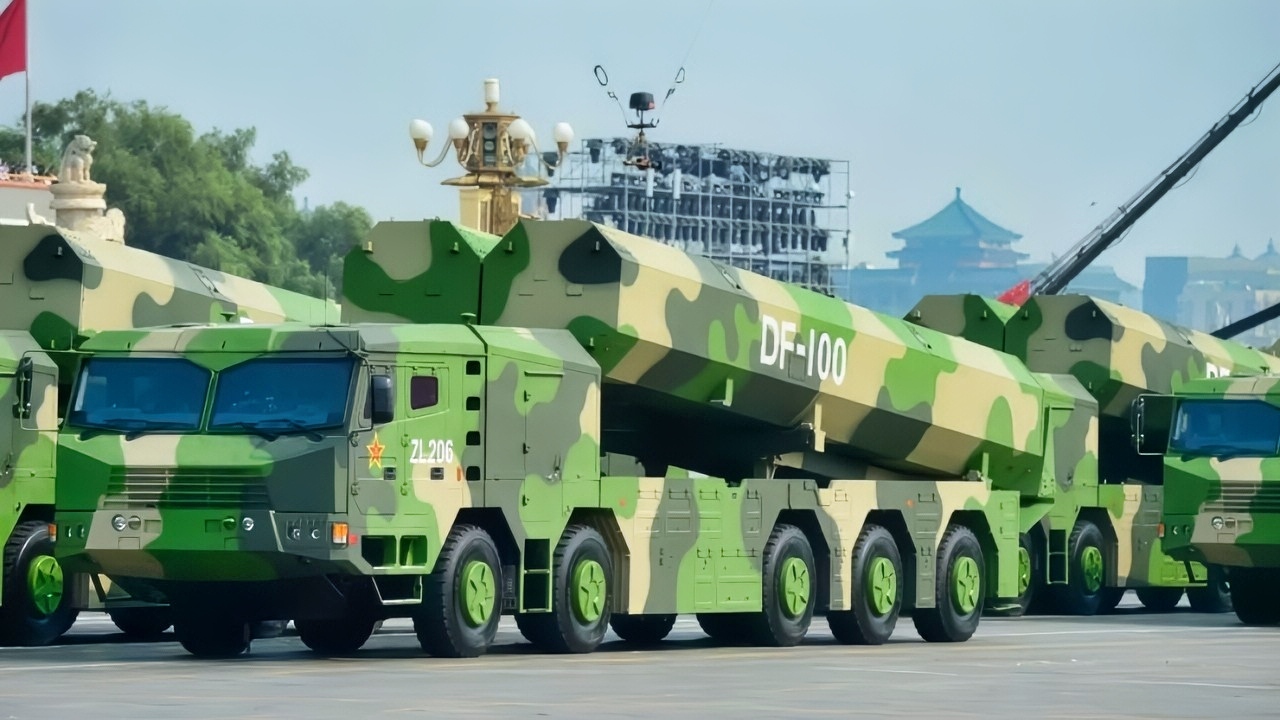
DF-100 Missiles: X Screengrab.
That doesn’t make carriers
helpless. It does mean that getting them into the fight—within useful range and with magazines intact—has become the central operational problem of a Western Pacific war.
Geography Is A Weapon, And China Owns The First Move
The maps tell the story. The first island chain bends like a scythe from Japan to the Philippines, bristling with airfields and ports the PLA can
saturate in the opening hours. From the Chinese mainland,
road-mobile launchers can fire deep into the Philippine Sea. Bombers can push missile range rings still further. Surface combatants and
diesel-electric submarines operating under land-based air cover can spread cruise missiles across multiple axes. Every mile a carrier must close to put its air wing in range is a mile deeper into overlapping threat envelopes.
And because time and distance favor the home team, the PLA can sequence its fires: reconnaissance drones probe; cruise missiles herd; ballistic or hypersonic shots exploit distraction; and follow-on waves aim at the leakers. The United States, by contrast, must flow forces across oceans, stage from bases under missile threat, and fight through the opening moves with what’s already afloat. None of that is impossible. All of it is harder than it was a
generation ago.
The Kill Chain That Makes Mass Matter
Missiles don’t matter if you can’t find, fix, track, and update a
moving carrier’s location. That is the PLA’s true “weapon system”: a kill chain that ties together space-based ISR (electro-optical, radar, signals), over-the-horizon radars, maritime patrol aircraft, UAVs, surface pickets, and submarines—plus data fusion on shore that can cue shooters fast enough to matter. Perfection isn’t required; volume and persistence can overcome gaps. As long as enough track quality makes it through to enough shooters, some salvos will arrive from enough angles to challenge even a well-handled CSG.
(Left to right) Australian ANZAC Class frigate HMAS Stuart (FFH 153) and USS Jack H. Lucas (DDG 125) wait off the coast of the Pacific Missile Range Facility in Kauai, Hawaii, as they prepare for Flight Test Aegis Weapon System-32 (FTM-32), held March 28, 2024.
The U.S. and allies can—and do—attack that chain: jamming, deception, cyber, and kinetic strikes against sensors, relays, and decision nodes. But on Day 0 to Day 3, before attrition takes its toll, the PLA gets first say. That early initiative is what creates the impression of inevitability around those missile salvos.
Magazine Math: Why Saturation Works (And Why It’s Not Automatic)
Think of a carrier group’s defense as a nested set of sieves. The outer layers—fighters, E-2D Hawkeyes, and long-range missiles—try to thin the raid. Middle layers—Aegis warships, multistatic sensors, and electronic warfare—strip more arrows from the quiver. Inner layers—point defense and close-in weapons—deal with what leaks through.
If a raid arrives coherent and concentrated, and if enough of it maneuvers unpredictably or arrives from multiple vectors, some leakers will survive. If the attacker can repeat that cycle, a defender will start to worry about missile depletion before the attacker does—especially if the defender is hundreds of miles from a reload port or underway rearm is still experimental. That’s the essence of
saturation.
But saturation is not automatic. It depends on the attacker generating the right geometry and synchronizing different missile types under electronic attack, while the defender denies cueing, spoofs tracks, and hunts archers (bombers, ships, and launchers) as aggressively as it intercepts arrows. The side that better manages complexity wins the exchange. China’s advantage is that it can mass more arrows at the start—close to home, under its own air defense
umbrella.
Hypersonics: Hype, Headaches, And Hard Problems
Hypersonic glide vehicles (like those mounted on the DF-17) complicate defenses because they maneuver and fly lower than ballistic arcs, compressing timelines and stressing radar coverage. They are not unstoppable bolts of Zeus—sensor fusion, updated interceptors, and layered soft-kill/hard-kill tactics are catching up—but they thicken an already thick raid. In the early stages of a fight, even a modest number of hypersonic shots, mixed with cruise and ballistic volleys, forces defensive tradeoffs and consumes high-end interceptors that are slow to replace.
For the attacker, that’s value: expensive defensive shots burned against relatively cheaper offensive ones. For the defender, it’s a reminder that range and deception are as important as raw intercept power. The war isn’t only about better arrows; it’s about making the other archer shoot first and
often.
How China’s Carriers Profit From The Missile Bubble
Here’s the irony: the headline says “China’s carriers have an advantage,” but the reason they do is that they can fight under a missile umbrella their opponent lacks. Inside the A2/AD bubble created by land-based fires, a Chinese carrier—particularly Fujian with catapults that can launch heavier fighters, electronic jammers, and fixed-wing airborne early warning—can project airpower with shorter logistics tails, under the cover of home-based SAMs and coastal aviation. That creates interior lines: the ability to refuel and rearm aircraft quickly ashore, cycle air wings faster, and keep pressure on a distant carrier that must guard every missile it shoots.