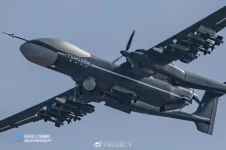
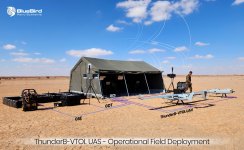
In a step that confirms the United States’ commitment to strengthening defense cooperation with the Kingdom of Morocco, the administration of US President Donald Trump approved a deal to sell four advanced
“MQ-9 Reaper” drones to Morocco.

The MQ-9 Reaper is one of the most efficient Drones in air operations, with its ability to fly for up to 40 hours under various weather conditions, making it an effective tool for reconnaissance and combat operations.
This development constitutes a qualitative shift in defense cooperation between Morocco and the United States, and is expected to contribute significantly to strengthening Moroccan military capabilities to confront the growing security challenges in the region.
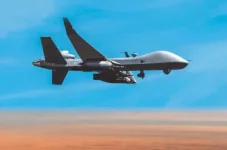
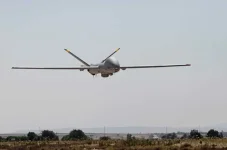
MQ-9A Reaper
The General Atomics MQ-9 Reaper (sometimes known as Predator B) is an unmanned aerial vehicle (UAV) that is a component of an unmanned aircraft system (UAS), capable of performing remotely controlled or autonomous flight operations. It was developed by General Atomics Aeronautical Systems (GA-ASI) primarily for the United States Air Force (USAF). The US Air Force calls the MQ-9 and other unmanned aircraft “remotely operated vehicles/aircraft” (RPV/RPA) to emphasize that control is by humans from the ground.
The MQ-9 is larger and more capable than its predecessor, the MQ-1 Predator, but relies on the same ground control systems. The aircraft features a 950 hp (712 kW) turboprop engine, compared to the MQ-1's 115 hp (86 kW) engine. This additional power allows the aircraft to carry 15 times more munitions and fly at speeds up to three times the speed of the MQ-1.
The aircraft is monitored and controlled, including the use of weapons, by an air crew at a ground control station (GCS). The MQ-9 is the first drone designed for combat and targeting roles as well as long-duration, high-altitude surveillance operations. In 2006, General Michael Moseley, then Chief of Staff of the US Air Force, stated: “We have transitioned from using unmanned aircraft primarily in intelligence, surveillance and reconnaissance roles prior to Operation Iraqi Freedom, to a true combat aircraft role with the MQ-9 Reaper.”
By May 2021, the USAF was operating more than 300 MQ-9 Reaper aircraft. Many of the aircraft have undergone equipment upgrades to improve their performance in “advanced combat scenarios,” and all new aircraft will include those updates. The MQ-9 fleet is expected to end its life by 2035. The average cost per unit of an MQ-9 is estimated at $32 million in 2023 prices.
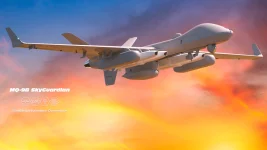
The Reaper aircraft is also used by US Customs and Border Protection, and the militaries of several other countries. The MQ-9A was also upgraded to the MQ-9B, called SkyGuardian or SeaGuardian depending on the mission and payload.
Data according to US Air Force (USAF) information:
General specifications:
Crew: 0 on board, 2 at ground control station
Length: 36 feet 1 inch (11 metres)
Wingspan: 65 ft 7 in (20 m)
Height: 12 feet 6 inches (3.81 m)
Curb Weight: 4,901 lb (2,223 kg)
Maximum takeoff weight: 10,494 lb (4,760 kg)
Fuel capacity: 4,000 lb (1,800 kg)
Payload: 3,800 lbs (1,700 kg)
Internal: 800 lbs (360 kg)
External: 3,000 lbs (1,400 kg)
Engine: 900 hp (671 kW) Honeywell TPE331-10 turboprop with DEEC.
Performance:
Maximum speed: 300 mph (482 km/h, 260 knots)
Normal airspeed: 194 mph (313 km/h, 169 kn)
Range: 1,200 miles (1,900 km, 1,000 nautical miles)
Operating time: 27 hours
Service altitude: 50,000 ft (15,420 m)
Operating altitude: 25,000 ft (7.5 km)
Armament:
7 suspension points:
Up to 1,500 lb (680 kg) at two internal weapons stations
Up to 750 lbs (340 kg) at the two middle stations
Up to 150 lbs (68 kg) on both outdoor stations
The middle point is not used
Can carry:
Up to 8 AGM-114 Hellfire air-to-surface missiles
Or 4 Hellfire missiles and two 500 lb (230 kg) GBU-12 Paveway II laser-guided bombs.
The GBU-38 JDAM guided bomb can also be carried.
Under testing: Support for the operation of Stinger air-to-air missiles.
In March 2014, the Brimstone dual-mode missile was successfully tested on a Reaper aircraft by the British Ministry of Defense and the Royal Air Force.
Depending on mission requirements, multiple AIM-9X Sidewinder Block 2 missiles can be carried.
Electronics:
AN/DAS-1 MTS-B Multispectral Targeting System
AN/APY-8 Lynx II radar
Raytheon SeaVue marine search radar (Guardian version).
MQ-9B SkyGuardian
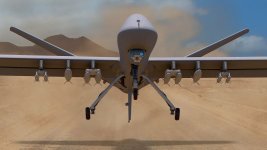
Data according to the General Atomics Handbook:
General specifications:
- Crew: 0 on board, 2 at ground control station
- Length: 38 ft 5 in (11.7 m)
- Wingspan: 78 ft 9 in (24 m)
- Maximum take-off weight: 12,500 lb (5,670 kg)
- Fuel capacity: 6,000 lb (2,721 kg)
- Payload: 5,550 lbs (2,520 kg)
- Internal: 800 lbs (360 kg)
- External: 4,750 lbs (2,150 kg)
- Engine: 900 hp (671 kW) Honeywell TPE331-10 turboprop with DEEC.
Performance:
Maximum speed: 240 mph (390 km/h, 210 knots)
Range: 6,900 miles (11,000 km, 6,000 nautical miles)
Operating time: more than 40 hours
Service altitude: 40,000 ft (12,200 m)
Armament:
- 9 suspension points:
- One central point
- 8 suspension points on the wings
- Can carry:
- Up to 10 Brimstone air-to-surface missiles
- Or 500 lb (230 kg) Paveway IV laser-guided bombs.
Electronics:
- AN/DAS-1 MTS-B Multispectral Targeting System
- AN/APY-8 Lynx II radar
- Optional equipment includes:
- 360° multi-pattern marine surface search radar
- Automatic Identification System (AIS)
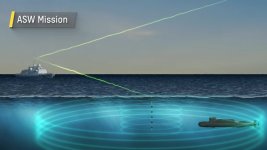
- Anti-submarine warfare (ASW) equipment
- Tactical and strategic signals intelligence (SIGINT) systems
- Tactical Data Link (Link-16)
- Airborne early warning (AEW)
- Communications gateway/transmission.