Navigation
Install the app
How to install the app on iOS
Follow along with the video below to see how to install our site as a web app on your home screen.
Note: This feature may not be available in some browsers.
More options
Style variation
You are using an out of date browser. It may not display this or other websites correctly.
You should upgrade or use an alternative browser.
You should upgrade or use an alternative browser.
General Economic Updates
- Thread starter Sainthood 2.0
- Start date
More options
Who Replied?


Owaiz
Registered Member

IMF talks stall over flood loss dispute | The Express Tribune
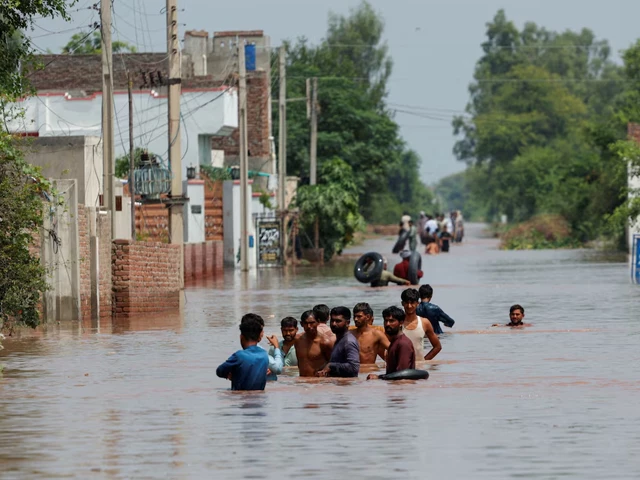
IMF talks stall over flood loss dispute
 tribune.com.pk
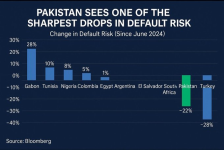
Always refreshing to see IMF puncturing fake narratives
Owaiz
Registered Member
Look at all the other countries in the list. Not a club you want to be part of. The reason for fall in CDS spread is very simple. Pakistan was at risk of sovereign default and the IMF bailed out Pakistan by lending money that staved off risk of default for the short term . If anyone is to be commenced for this, it is the IMF.

Mighty_Dragon_Strike
Trusted Member
there is a difference between mass and weight!Look at all the other countries in the list. Not a club you want to be part of. The reason for fall in CDS spread is very simple. Pakistan was at risk of sovereign default and the IMF bailed out Pakistan by lending money that staved off risk of default for the short term . If anyone is to be commenced for this, it is the IMF.

Fatman17
THINK TANK: CONSULTANT
Pakistan shunned by one multinational after another as P&G also exits
American consumer giant earlier announced it will quit Bangladesh in global restructuring
Consumer goods multinational Procter & Gamble will be leaving another South Asian country: Pakistan. (Source photos by Reuters)
ADNAN AAMIR
October 9, 2025 18:30 JST
SoulSpokesman
Trusted Member

$30b gap found in import records | The Express Tribune
Govt reportedly admits data was incomplete, with some import figures missing
tribune.com.pk
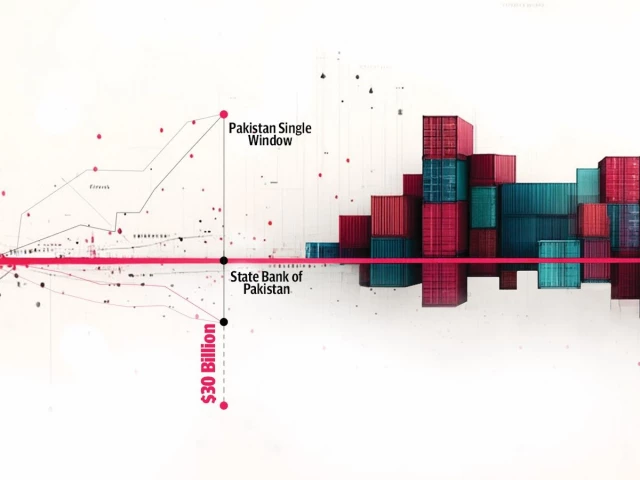
The federal government booked $321 billion in imports during the past five years, $30 billion more than import payments cleared by the central bank through banking channels in the same period, underscoring the urgent need to reconcile the huge discrepancy.
According to official records, Pakistan Single Window (PSW) booked imports worth $321 billion, while the State Bank of Pakistan (SBP) cleared $291 billion through banks from July 2020 to June 2025.
The PSW's figures have not been reported earlier, as the Pakistan Bureau of Statistics (PBS) had been issuing monthly trade bulletins based on data from the Pakistan Revenue Automation Limited (PRAL).
One reason for the large difference between SBP and PSW data is that the central bank records only the cost of goods, while freight and insurance costs are treated separately. However, the magnitude of the discrepancy suggests that even after accounting for freight, the import value gap remains abnormally high, according to government sources.
The Express Tribune reported last week that imports recorded by PRAL were $11 billion lower than those reported by PSW for fiscal years 2023-24 and 2024-25.
Following the report, the central bank clarified that "the SBP's trade data is computed mainly based on trade payments data received from banks; hence, there will be no significant revision in current account balance data already published by the SBP." The central bank, however, noted that minor revisions may continue as per established practice.
The article compared PSW-booked imports with SBP data.
Government stakeholders told The Express Tribune that every banking and import transaction over the past five years needs scrutiny to resolve the discrepancy and determine the true source of payments for imports recorded by PSW. PSW-sourced imports are significantly higher than those reported by PRAL and the SBP.
During the same period – July 2020 to June 2025 – PRAL reported $16.5 billion less in imports compared to PSW figures, official records show.
Last week, the International Monetary Fund (IMF) asked Pakistan to publicly disclose billions of dollars' worth of trade data discrepancies. During discussions, the IMF recommended adopting a clear communication policy to explain these discrepancies and methodological changes to prevent mistrust between the government and data users.
Pakistan reportedly admitted to the IMF that the trade data submitted to the Geneva-based International Trade Centre (ITC) by PBS was incomplete, with some import figures missing. However, officials maintained that the underreporting was not due to malafide intent but stemmed from transitioning the trade data source from PRAL to PSW.
PRAL operates under the Federal Board of Revenue (FBR), while PSW is an independent legal entity, though most of its officers come from the Customs Department. The FBR representative told the IMF that during internal scrutiny, the discrepancies initially appeared minor but have grown significantly in recent years.
The PBS had been reporting import figures based on PRAL data.
PBS informed the IMF that trade data analysis would be carried out with the support of all stakeholders and presented to relevant forums before inclusion in the statistical system. The IMF team stated that stakeholders should aim to correct and share previous years' data with the Fund, according to sources.
The PSW data is considered more comprehensive, covering all import entries, particularly those related to trade facilitation schemes.
Sources suggested one possibility could be that importers might have made payments outside the banking system and misused export finance facilities to evade taxes. They added that raw materials could have been used for producing goods later sold locally.
The underreporting surfaced during an exercise aimed at reconciling trade data discrepancies between Pakistani importers and Chinese exporters. Prime Minister Shehbaz Sharif had formed a committee to investigate the issue.
A joint team of FBR, PBS, PRAL, and PSW officials analysed five years of trade data. It found that PBS's trade data was retrieved using a programmed query that had not been updated since 2017, leading to persistent underreporting of imports, which worsened in recent years. In fiscal year 2024-25, PSW booked $64.1 billion in imports, while SBP reported $59.1 billion, showing a difference of $5 billion. In 2023-24, PSW showed $60 billion imports compared to SBP's $53.2 billion, a $6.7 billion difference.
The substantial variations between SBP and PSW data indicate the gap cannot be explained solely by freight payments, the sources said.
The highest single-year discrepancy occurred in 2021-22, when the SBP's import total was $10.8 billion lower than PSW's. That year, PSW recorded $82.3 billion in imports, PRAL $80.2 billion, and SBP only $71.5 billion.
In 2022-23, PSW booked $57 billion imports compared to $52.7 billion by the SBP, a $4.3 billion gap. In 2020-21, PSW showed $57.8 billion versus $54.3 billion by SBP, a $3.4 billion difference.
Regards
Fatman17
THINK TANK: CONSULTANT
Fatman17
THINK TANK: CONSULTANT
Fatman17
THINK TANK: CONSULTANT
Fatman17
THINK TANK: CONSULTANT

EDITORIAL: One silver lining for Pakistan’s economy as it transitions from stabilisation to modest growth without triggering an external account crisis is the bearish outlook on international oil prices. Brent is currently hovering around US$ 60 per barrel, and many global analysts expect it to fall into the US$ 50s in the coming months.
If oil remains below US$ 60, Pakistan could have enough breathing room to grow beyond 4 percent without sparking a balance of payments crisis. Crude oil and its products (petroleum) are the single largest component of Pakistan’s imports. A US$ 10 per barrel drop in oil prices translates into approximately US$ 2 billion in savings on crude oil, petroleum products, and RLNG.
Fatman17
THINK TANK: CONSULTANT

The IMF’s staff-level agreement has bought Pakistan another $1.2billion and a few more weeks of borrowed calm. That is what this government wanted before the next monetary policy meeting: a headline, a tranche, and a sense that the bleeding has stopped. It has not. It has only been delayed.
Technically, the country is at peace. In practice, it is running ceasefires on two borders, one with India since May, another with Afghanistan this week. Both are described as temporary. Both are expensive. Limited wars still cost unlimited money. The difference is only in what gets declared on paper.
Fiscal restraint is already fraying. The budget was never built for multiple fronts, not militarily and not economically. There is no evidence yet of supplementary grants or defense overshoots, but the pressure is visible. The only real austerity is monetary
SoulSpokesman
Trusted Member
Pakistan’s Second-Hand Clothing Prices Increase After New Import Tax
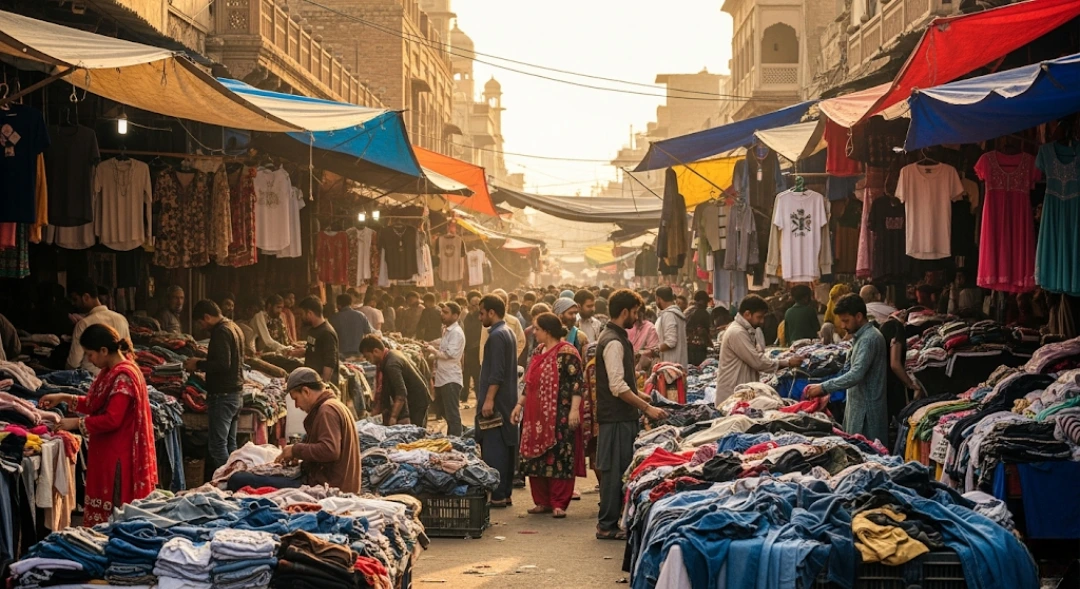
The government’s recent decision to impose a Rs. 200 per kilogram tax on second-hand clothing imports has sparked outrage among traders nationwide.
 bloompakistan.com
The government’s recent decision to impose a Rs. 200 per kilogram tax on second-hand clothing imports has sparked outrage among traders nationwide.
Sellers warn that the new duty has led to a steep rise in winter wear prices at Landa Bazaars, increasing costs by Rs. 500 to 1500 and putting affordable clothing out of reach for low-income families.
Traders say imported used garments were already costly this year due to higher freight charges and currency depreciation. With the new tax, shopkeepers are finding it difficult to keep prices within public reach.
“We are trying our best to sell at reasonable rates, but this tax has made everything more expensive,” said a vendor in Karachi’s Landa Bazaar.
Market representatives added that the import duty on second-hand clothes has raised container-level investment, making it hard for traders to manage profits without burdening buyers. Many fear that poor and middle-class families will struggle to buy warm clothes this winter.
Regards

hydrabadi_arab
Trusted Member
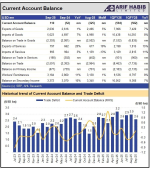
Pakistan’s current account (C/A) posted a significant surplus of $110 million in September, a sharp contrast against $52 million deficit recorded in the same month last fiscal, data released on Monday by the State Bank of Pakistan (SBP) showed.
The surplus came on the back of a significant increase in remittance inflows during the month, which clocked in at $3.18 billion, reflecting an increase of 11% on a yearly basis.
In September 2025, the country’s total export of goods and services amounted to $3.43 billion, up nearly 5% as compared to $3.28 billion in the same month of the previous year.
Meanwhile, total imports clocked in at $6.02 billion during September 2025, an increase of 6% on a yearly basis, according to SBP data.
Quarterly figures
During the first quarter of FY26, the current account recorded a cumulative deficit of $594 million, compared to a deficit of $502 million in the same period last year, an increase of 18%.
Low economic growth, along with high inflation, has helped curtail Pakistan’s current account deficit, with an increase in exports also helping the cause. A high interest rate, which has declined in recent months, and some restrictions on imports have also aided the policymakers’ objective of a narrower current account deficit.
Meanwhile, analysts attribute the monthly surplus to improved export performance and resilient remittance inflows, although the quarterly data still show external sector pressures amid high import demand.
The surplus came on the back of a significant increase in remittance inflows during the month, which clocked in at $3.18 billion, reflecting an increase of 11% on a yearly basis.
In September 2025, the country’s total export of goods and services amounted to $3.43 billion, up nearly 5% as compared to $3.28 billion in the same month of the previous year.
Meanwhile, total imports clocked in at $6.02 billion during September 2025, an increase of 6% on a yearly basis, according to SBP data.
Quarterly figures
During the first quarter of FY26, the current account recorded a cumulative deficit of $594 million, compared to a deficit of $502 million in the same period last year, an increase of 18%.
Low economic growth, along with high inflation, has helped curtail Pakistan’s current account deficit, with an increase in exports also helping the cause. A high interest rate, which has declined in recent months, and some restrictions on imports have also aided the policymakers’ objective of a narrower current account deficit.
Meanwhile, analysts attribute the monthly surplus to improved export performance and resilient remittance inflows, although the quarterly data still show external sector pressures amid high import demand.
hydrabadi_arab
Trusted Member
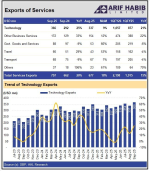
IT exports up 25% YOY

RescueRanger
Meme Lord

Users who are viewing this thread
Total: 4 (members: 0, guests: 4)


