General Economic Updates

Showing cautious optimism over Pakistan’s short-term economic outlook, the finance ministry on Tuesday warned that rising global oil prices due to the US-Israel war on Iran posed risks to the country’s import bill and macroeconomic conditions in the long-term.

“Rising global oil prices and potential supply chain disruptions may exert pressure on industrial input costs”, said the Ministry of Finance in its Monthly Economic Update and Outlook, with the estimated rate of inflation growing by up to 8.5 per cent for the month.

Read more: https://www.dawn.com/news/1987221
 

International Finance Corporation’s portfolio in Pakistan crosses $2.7b​


Talks focus on scaling private investment, building pipeline of bankable projects

Our Correspondent
April 01, 2026

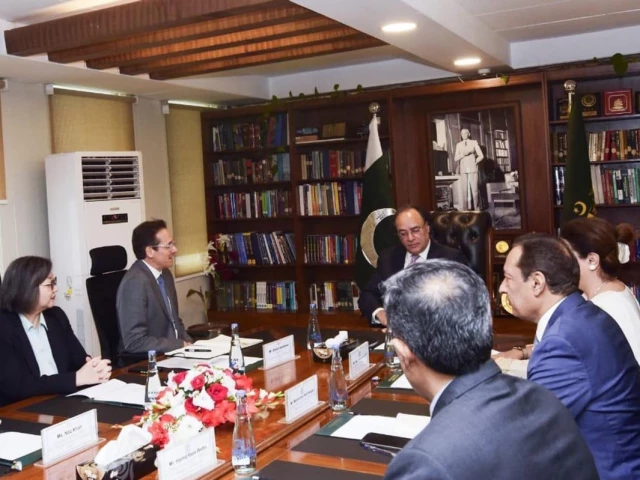
minister for finance and revenue senator muhammad aurangzeb meets with ifc and world bank officials in islamabad on april 1 to discuss investment expansion infrastructure development and job creation photo pid


Minister for Finance and Revenue Senator Muhammad Aurangzeb meets with IFC and World Bank officials in Islamabad on April 1 to discuss investment expansion, infrastructure development, and job creation. Photo: PID

The International Finance Corporation’s (IFC) portfolio in Pakistan has grown to over $2 billion annually, with commitments reaching approximately $2.7b this year, officials said during a meeting between Finance Minister Muhammad Aurangzeb and a visiting delegation.

According to a statement issued by the Ministry of Finance on Wednesday, IFC Divisional Director for Pakistan, Afghanistan and Central Asia Simon Andrews called on the minister at the Finance Division, accompanied by World Bank Country Director for Pakistan Bolormaa Amgaabazar and IFC Country Manager Naz Khan.

The finance minister welcomed Andrews on his recent appointment and acknowledged the IFC’s expanding engagement in Pakistan, particularly in investment, trade finance and advisory support. He noted that increased senior-level presence had strengthened collaboration and improved delivery.

The IFC delegation briefed the minister on its growing portfolio, highlighting financial sector support through risk-sharing and guarantee facilities aimed at promoting trade and small and medium enterprise financing. It also outlined expansion in local currency financing to reduce foreign exchange risks, along with upcoming initiatives, including a diversified payment rights facility and a green bond issuance with a local bank.
 
India’s media talking points about Pakistan being a ‘failed state’ doesn’t make them true, it only shows how low the bar for analysis has become. Pakistan’s economy is weak, yes, but weakness is not collapse. Countries with far worse indicators have rebuilt when they chose structural reform over political theatre.

The real issue isn’t what India or the GCC say, it’s that Pakistan’s own establishment has spent decades avoiding reforms, relying on bailouts, and treating IMF programs like seasonal band‑aids. When a state keeps borrowing instead of restructuring, of course outsiders will label it unstable. That’s not destiny, that’s mismanagement.

let’s be honest, the GCC calling Pakistan ‘unskilled’ is ironic when their own economies depend heavily on Pakistani labor. If Pakistanis are so unskilled, why do Gulf states keep issuing visas by the hundreds of thousands? Because the reality on the ground doesn’t match the rhetoric.

High unemployment and low productivity aren’t natural disasters, they’re the result of decades of political engineering, elite capture, and zero investment in human capital. Pakistan didn’t end up here because of fate; it ended up here because every government kicked reforms down the road.

Foreign policy sacrifices? That’s what happens when a country builds its entire economic survival on loans from ‘friendly’ nations instead of building a tax base, an export strategy, or a skilled workforce. Dependency always comes with strings. Pakistan tied those strings itself.

Pakistan is struggling but not because outsiders declared it a failure. It’s struggling because the people in charge refused to fix the system. And until Pakistan stops outsourcing its economy to lenders and its foreign policy to donors, the labels will keep coming.

Countries have come back from worse. The bad news? Pakistan won’t, unless it finally chooses reform over excuses.

Advocates of structural reform argue that the most effective way to fix Pakistan’s financial crisis is to dismantle the oversized provincial bureaucracy and replace it with 34 Economic Zones as the second tier of government. The logic is simple: Pakistan doesn’t have a revenue problem, it has a spending problem. Provinces consume billions in administrative costs, political patronage, and duplicated departments that deliver almost nothing to citizens.

By shifting to 34 lean, audit‑controlled Economic Zones, reformers claim Pakistan could cut government spending by up to 50% without touching essential services. No chief ministers, no bloated cabinets, no parallel bureaucracies, just zonal administrations focused on development, taxation, and service delivery.

Supporters of this model argue that it breaks elite capture, ends provincial political monopolies, and forces accountability down to smaller, manageable units. Instead of four massive power centers draining the budget, Pakistan would have 34 competitive zones, each judged by performance, transparency, and economic output.

In their view, this isn’t just administrative reform, it’s a survival strategy. A country drowning in debt cannot afford a 1970s‑style provincial structure in 2026. Cutting half the government’s overhead is not radical to them; it’s math.
 

Fitch affirms Pakistan’s credit rating at ‘B-’

Khaleeq Kiani
April 13, 2026

ISLAMABAD: Fitch Ratings, one of the world’s top three agencies, on Monday affirmed Pakistan’s long-term foreign currency issuer default rating (IDR) at ‘B-’ with a “stable outlook”.

“Pakistan’s rating affirmation reflects progress on fiscal consolidation and macro stability measures, broadly in line with its International Monetary Fund (IMF) programme and supporting its funding capacity,” the US-based rating agency said.

“Foreign exchange buffers rebuilt over the past year provide a cushion against the economic impact of the war in the Middle East, while Pakistan’s role as a ceasefire broker may provide tangible benefits and partly offset external pressures,” it said.

However, it highlighted that the country’s high exposure to the global energy price shock remained a key risk, particularly if it led to a sharp drop in foreign exchange reserves.

Talking about key rating drivers, Fitch said the authorities reached a staff-level agreement with the IMF on its loan programmes in March, unlocking a combined $1.2 billion.

“The programme will continue to provide a key policy anchor, particularly for the fiscal framework, and will help mobilise additional multilateral and bilateral support,” it said.

However, it pointed out that Pakistan’s vulnerability to energy shocks.

“Pakistan sources up to 90 per cent of oil from the Gulf and has limited storage capacity, creating high exposure to the Middle East conflict and constricted energy supply via the Strait of Hormuz,” it said, adding the fuel subsidies since early March had been funded by reallocating expenditure from other areas of the budget, while costs had been reduced by large pump-price hikes and the switch to a more targeted support scheme from April.
 
On the inflation side, the rating agency said higher global energy prices would raise inflation in the coming months, especially with the switch to more targeted subsidy support and base effects.

“We expect inflation to average 7.9pc in FY26 (ending June 30), above the FY25 level but well below the 23.4pc in FY24,” it said.

The State Bank of Pakistan (SBP) had cut the policy rate to 10.5pc by the end of 2025, from 22pc at the end of May 2024, and market interest rates fell in tandem. However, the term interbank rate had risen to about 100bp above the policy rate by early April, on inflation concerns tied to the tight energy supply.

“The shock will detract from gross domestic product (GDP) growth, but we still expect growth of 3.1pc in FY26, up slightly from 3pc in FY25, due to improved confidence from lower borrowing costs,” it said.
 
It anticipated external debt amortisations to rise to $12.8bn (2.9pc of GDP) in FY26, from almost $8bn in FY25.

A $3.5 billion deposit was repaid to the United Arab Emirates (UAE) in April, the agency said, even though repayments have yet to take place.

It said the amortisation projections exclude another $9.2bn in bilateral deposits and loans expected to be rolled over.
 
Fitch expected the primary surplus to narrow to 2.1pc of GDP in FY26, 0.3ppc below the official target.

“This will follow a rise in non-interest current expenditures and limits to sustained gains in tax revenue/GDP, due to capacity constraints and difficulties executing federal tax reforms at the provincial level,” it said.

“We expect the primary surplus to shrink further in FY27 as extraordinarily high SBP dividends are unlikely to continue in our view, while lower interest payments as a share of GDP will help keep fiscal deficits stable at about 5.3pc of GDP,” it said.

“A primary surplus and lower domestic borrowing costs should lower general government debt/GDP to 68.9pc in FY26 from 70.7pc in FY25, still well above the ‘B’ median of 51.3pc of GDP in 2026.

The ratio is expected to decline only gradually over the medium term as the primary surplus narrows. Pakistan’s general government interest/revenue ratio should remain very high at 46.5pc,” the rating agency said.
 
The current account was expected to return to a small deficit of 1.1pc in FY26 from a rare surplus of 0.5pc in FY25.

“Pakistan’s foreign exchange policy continues to exhibit rigidities despite a push towards currency liberalisation in 2023, and the rupee has appreciated by 30pc in real effective terms from its early 2023 trough, likely contributing to large merchandise trade deficits,” the agency said, adding that hydrocarbons typically comprised between a quarter and a third of goods imports.

It also noted that large and sustained net foreign exchange purchases by the SBP on the interbank market and a gold price rally led to foreign reserves of just under $28.4bn in February 2026, while non-gold reserves rose by about $5.1bn year-on-year to $17.5bn.

“We expect the current account deficit, and repayment of a $1.3bn Eurobond and the UAE deposits in April to bring foreign exchange reserves down to $21.3 billion by the end of FY26. This will cover 2.9 months of current external payments, from $22.6 billion at the end of FY25,” it said.
 
Net foreign exchange reserves remained negative, reflecting reserve deposits of domestic commercial banks, a Chinese central bank swap line and bilateral deposits at the SBP.

It also noted that tensions between Pakistan and Afghanistan had escalated since February 2026.

“Nevertheless, the potential impact on trade and the wider economy is likely to be limited. Our baseline does not include further escalation, given Pakistan’s financing constraints, but the conflict presents a considerable risk to its commitment to fiscal consolidation,” the agency said.


Users who are viewing this thread

Pakistan Defence Latest

Country Watch Latest

Latest Posts

Back
Top