Navigation
Install the app
How to install the app on iOS
Follow along with the video below to see how to install our site as a web app on your home screen.
Note: This feature may not be available in some browsers.
More options
Style variation
You are using an out of date browser. It may not display this or other websites correctly.
You should upgrade or use an alternative browser.
You should upgrade or use an alternative browser.
Gwadar Seaport and News Updates
- Thread starter ghazi52
- Start date
More options
Who Replied?


ghazi52
THINK TANK: CONSULTANT
- Thread starter
- #122
Gwadar roads’ solarization gets underway in phases
By Yasir Habib Khan | Gwadar ProSep 17, 2025
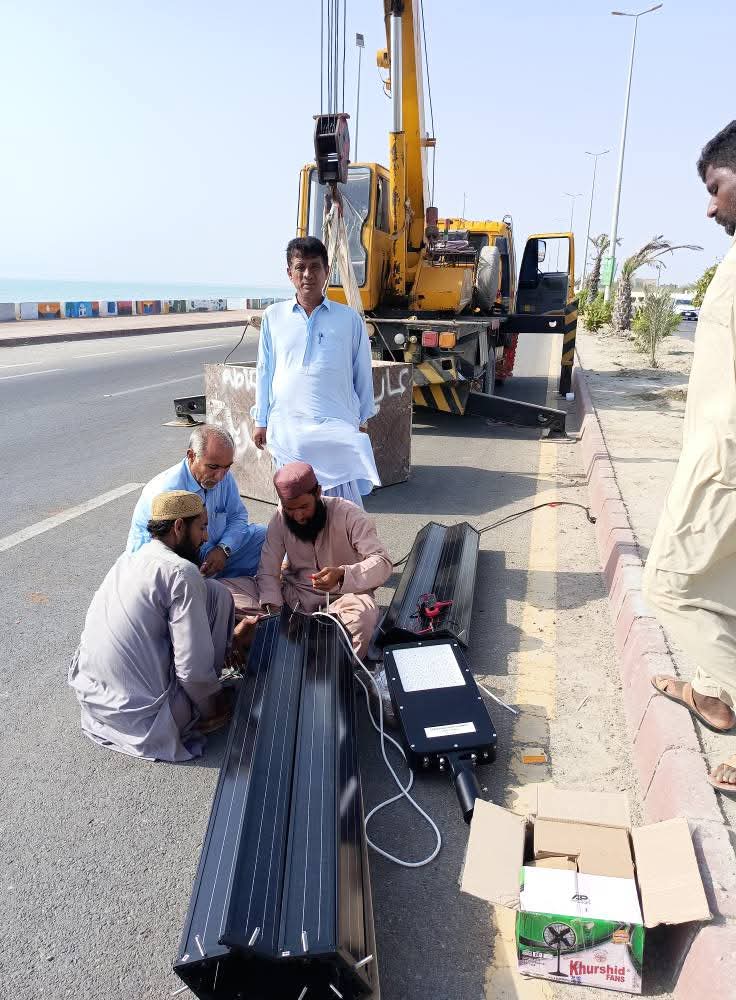
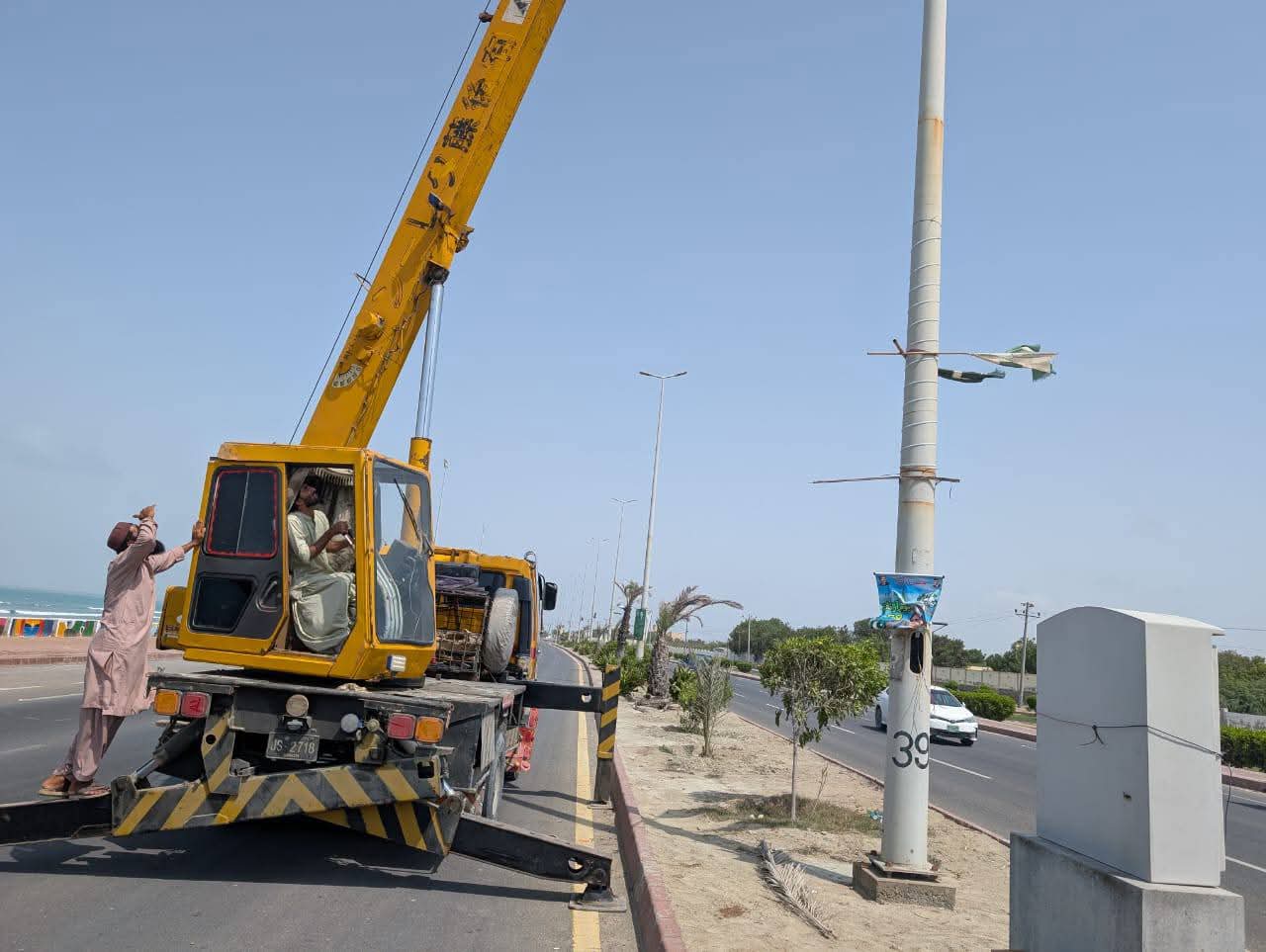
GWADAR - In a major step toward creating an eco-friendly urban environment, the Gwadar Development Authority (GDA) has launched a phased solarization project for the city’s streetlights. Beginning on September 16, the first phase covers the installation of solar-powered lights along Marine Drive, the city’s main artery.
In the second phase, other major roads—including Syed Zahoor Hashmi Road, Airport Road, Capt (R) Tariq Zehri Road, Gwadar Port Road, and Baba-e-Bizenjo Football Stadium Road—will also be illuminated with solar lights.
This initiative is expected to not only curb incidents of electricity cable theft but also ensure that streets remain lit during load-shedding hours, providing much-needed safety and convenience for commuters traveling at night.
Thanks to earlier efforts by Chinese companies, several streets and public spaces in Gwadar have already been lit by solar energy.
A total of 73 solar-powered streetlights were previously installed in busy public areas: 18 at the junction of the East Bay Expressway and the jetty, 19 at the fish landing area on West Bay along Marine Drive, 26 at the fish harbor jetty, and 10 at the District Headquarters Hospital (DHQ).
ghazi52
THINK TANK: CONSULTANT
- Thread starter
- #123
80 new transformers to relieve Gwadar people from loadshedding
By Yasir Habib Khan | Gwadar ProSep 17, 2025
GWADAR - In a bid to relieve the people of Gwadar from long-hour power loadshedding, Queata Electricity Supply Company (QESCO) has started purchasing new 80 power transformers for Gwadar, home of more than 400,000 people.
Talking to Gwadar Pro, a QESCO official said that around 20 power transformers will be kept in standby position. Meanwhile, he said that QESCO is also introducing new electricity infrastructure through which faulty power cables and fragile electricity poles are being replaced with newly purchased power paraphernalia.
QESCO, operating as a power distribution company and dealing with the power supply system along with National Transmission National Transmission and Dispatch Company (NTDC) will collaborate to complete the project.
ghazi52
THINK TANK: CONSULTANT
- Thread starter
- #124
Gwadar starts receiving 2 MGD water from Shadi Kaur Dam
By Tahir Ali | Gwadar ProSep 22, 2025
GWADAR- The Gwadar Development Authority (GDA) has started supplying water from Shadi Kor Dam to the city’s main transmission line, adding two million gallons per day (MGD) to the system after nearly three and a half years, officials said Saturday.
The 83-kilometer-long pipeline was reactivated on the directive of Balochistan Chief Minister Mir Sarfraz Bugti, following day-and-night efforts by GDA’s water division under the supervision of Director General Moin-ur-Rehman Khan. Chief Engineer Haji Syed Muhammad, Project Director Water Mir Jan Baloch and Site Engineer Kamran inspected the resumed flow.
The move follows Bugti’s September 17 meeting in Gwadar, where it was decided to transfer the city’s entire water distribution network to GDA. Since then, GDA has accelerated installation of new household connections, urging residents to promptly submit applications.
Gwadar has been facing an acute water crisis for more than a year and a half due to prolonged drought. Ankara Dam dried up four months ago, while Sawad Dam is on the verge of depletion. “One of the main dams has completely dried up, while the other is close to running out,” said GDA Director General Moin-ur-Rehman Khan.
To diversify supply, work is progressing on a 1.2 MGD desalination plant and a 0.5 MGD sensor boring project. These efforts complement the China-assisted 1.2 MGD desalination facility at the Gwadar Port Authority (GPA), a flagship initiative under the China-Pakistan Economic Corridor (CPEC), which is being pushed toward full capacity.
Gwadar’s daily requirement stands at 3.5 MGD. According to Khan, another 1.5 MGD will soon be added to the system, further reducing the shortfall. The combined inflows from Shadi Kor Dam, desalination, and expanded household connections will help meet Gwadar’s 3.5 MGD daily demand, offering long-awaited relief to residents.
ghazi52
THINK TANK: CONSULTANT
- Thread starter
- #127
Pakistan and China have agreed to operationalize the China -Gwadar -Africa shipping corridor under a new five-year maritime action plan for 2025-2029. The plan aims to expand trade routes and establish Gwadar as a leading regional trade hub, boosting connectivity with Central Asia, Afghanistan, and West Asia.
Federal Minister for Maritime Affairs, Muhammad Junaid Anwar Chaudhry, emphasized Pakistan’s commitment to strengthening maritime cooperation with China, particularly focusing on marine economy development, sustainable resource use, and environmental protection under the CPEC.
Key infrastructure projects include the expansion of Gwadar Port, completion of Free Zone Stage II, and the fast-tracking of the East Bay Expressway Phase II to improve accessibility. The integration of the New Gwadar International Airport with the port is also a priority, facilitating multi-transit connectivity.
As part of the plan, five feeder routes and bonded warehouses will be developed to increase trade flow. Gwadar will also be transformed into a “Green Port,” with feasibility studies and infrastructure development underway.
Efforts will also focus on enhancing connectivity between Gwadar and key rail and road corridors, including the Islamabad, Türkiye, Iran routes.
Federal Minister for Maritime Affairs, Muhammad Junaid Anwar Chaudhry, emphasized Pakistan’s commitment to strengthening maritime cooperation with China, particularly focusing on marine economy development, sustainable resource use, and environmental protection under the CPEC.
Key infrastructure projects include the expansion of Gwadar Port, completion of Free Zone Stage II, and the fast-tracking of the East Bay Expressway Phase II to improve accessibility. The integration of the New Gwadar International Airport with the port is also a priority, facilitating multi-transit connectivity.
As part of the plan, five feeder routes and bonded warehouses will be developed to increase trade flow. Gwadar will also be transformed into a “Green Port,” with feasibility studies and infrastructure development underway.
Efforts will also focus on enhancing connectivity between Gwadar and key rail and road corridors, including the Islamabad, Türkiye, Iran routes.
ghazi52
THINK TANK: CONSULTANT
- Thread starter
- #128
Donkey hides’ export to China permitted, all set for final inspection in Gwadar
By Yasir Habib Khan | Gwadar ProOct 4, 2025
GWADAR, Oct 4 (Gwadar Pro) - Amid the formal lifting of the ban on the export of donkey hides to China by the government of Pakistan, all is set for the final inspection of the Chinese pharmaceutical company Hengeng Trading Enterprise, in a bid to allow it to operate Pakistan’s first donkey slaughterhouse in Gwadar North Free Zone.
The General Administration of Customs of China has already conducted an online inspection of Hengeng to seal approval of its processes and procedures under prescribed laws.
A Balochistan government official told Gwadar Pro that the federal government has finally authorised the export of donkey hides to China as part of an amendment to the Ministry of Commerce’s Export Policy Order. “According to the Commerce Ministry’s notification, the export of donkey hides shall be allowed only to those firms and companies manufacturing in designated, approved and registered donkey slaughterhouses located in the Gwadar Free Zone North only,” he added
In July, 2024, protocols to export donkey skins and meat to China had been finalised, he revealed.
Meanwhile, certification from Pakistan Animal Quarantine (Import and Export of Animals and Animal Products) has also been received by the Chinese company Hengeng Trading Enterprise, a pharmaceutical company of China to run Pakistan’s first donkey slaughterhouse in Gwadar North Free Zone.
Pakistan’s first China-led top-notch construction of modern slaughterhouse for donkey meat and hides has been completed and is waiting for official approval to operate in Gwadar North Free Zone. At a cost of 50 million dollars, the slaughterhouse has been built by Hengeng.
An official from the Ministry for Maritime Affairs said that donkeys being reared at many farmhouses in various parts of Punjab will be slaughtered at the state-of-the-art Gwadar North Free Zone slaughterhouse. “Their meat and skins will be further processed keeping in view international standards and later exported to China,” he added
He said that the Gwadar North Free Zone donkey slaughterhouse will lay down the foundation of advanced slaughter technology in Pakistan to help secure the disease-free donkey meat with high-quality preservation through a cold chain.
The latest figures showed that the population of donkeys in Pakistan has jumped to 5.9 million during the fiscal year 2023-24.
ghazi52
THINK TANK: CONSULTANT
- Thread starter
- #129
Mirani Dam–Gwadar Pipeline Project Gets Green Light
By Tahir Ali | Gwadar ProOct 6, 2025
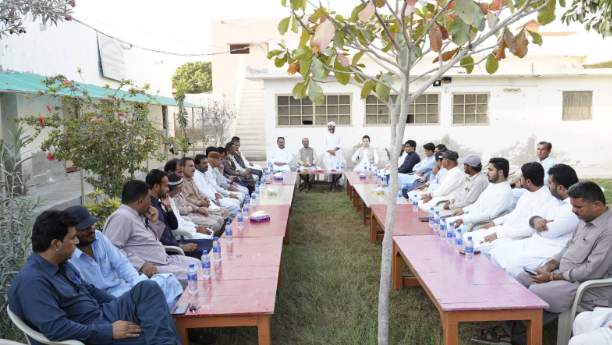
High-level meeting held at the RCD Council Hall in Gwadar. [Photo/DC Office]
GWADAR, Oct 6 (Gwadar Pro) - In a major step to end Gwadar’s prolonged water shortage, officials and community leaders have approved plans to build a direct pipeline from Mirani Dam and expand desalination facilities, while boosting tanker deliveries as an immediate relief measure.
The decision was made during a high-level meeting Sunday evening at the RCD Council Hall, chaired by MPA Maulana Hidayatur Rehman. Senior officials, including Gwadar Port Authority Chairman and Water Coordinator Noor-ul-Haq Baloch, Gwadar Development Authority Director General Moin-ur-Rehman Khan and Additional Deputy Commissioner Dr. Abdul Shakoor Khan, attended the meeting along with representatives from political parties and civic groups.
A statement from the Deputy Commissioner’s Office said participants unanimously backed a two-phase plan that aims to stabilize short-term supplies and secure long-term access. The first phase focuses on increasing water deliveries from Mirani Dam through tankers. The second involves building a dedicated pipeline to link Gwadar directly to the dam.
Gwadar is facing an acute water crisis as the region enters its second year without meaningful rainfall. Local reservoirs, including Ankara and Sawad Dams, have nearly dried up. The Shadi Kaur Dam pipeline, reactivated last month, has yet to reach full capacity and is supplying only limited water to the city.
ghazi52
THINK TANK: CONSULTANT
- Thread starter
- #131
CHEC Installs Weather and Tidal Monitoring Station at Gwadar Port
By Yasir Habib Khan | Gwadar ProOct 15, 2025
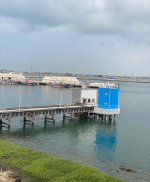
GWADAR- China Harbour Engineering Company (CHEC) has completed the installation of a weather and tidal monitoring station at Gwadar Port on October 16.
The team responsible for the installation included associate researcher Ding Ruibin, senior engineer Liu Yihu, engineer Yao Guipeng, assistant engineer Li Fangzhen, engineer Amir Nazeer, and engineer Sabir Hanif.
The primary objective of the newly established Gwadar Port Weather and Tidal Monitoring Station is to observe and record real-time environmental parameters of the Gwadar coastal region. The initiative supports port operations, navigation safety, maritime environmental management, and long-term climate and oceanographic studies.
A Gwadar Port official told Gwadar Pro that the maritime environment is highly dynamic and that weather shifts can alter operational plans in ways that may cause delays, increase risks, or even lead to catastrophic outcomes if not properly managed.
“Precise monitoring of tidal changes is equally critical, as tides influence docking procedures, berth allocations, and the overall safety of ships and port infrastructure. Comprehensive monitoring of weather and tidal conditions acts as a preemptive risk management tool, enabling harbor masters to prepare for inclement weather, modify schedules, and implement safeguards with agility,” he explained.
ghazi52
THINK TANK: CONSULTANT
- Thread starter
- #132
With the installation and commissioning of the new monitoring station, he said that Gwadar Port is now better prepared for severe weather events. “By analyzing incoming weather data alongside tidal data, port officials can proactively reorganize cargo operations, secure vulnerable infrastructure, and coordinate with emergency services. Such data-driven preparedness not only enhances overall safety but also reduces operational downtime and ensures smoother, faster recovery when conditions normalize,” he added.
When asked about the equipment, he said that a total of four specialized oceanographic instruments have been installed at the Gwadar Tidal Station, each serving a critical monitoring function essential for marine and port operations.
When asked about the equipment, he said that a total of four specialized oceanographic instruments have been installed at the Gwadar Tidal Station, each serving a critical monitoring function essential for marine and port operations.
ghazi52
THINK TANK: CONSULTANT
- Thread starter
- #133
“An anemometer measures wind speed and direction. Wind speed is determined by the rotational velocity of its propeller—the stronger the wind, the faster it spins. The Conductivity, Temperature, and Depth (CTD) Sensor measures underwater conductivity, temperature, and depth, allowing precise determination of salinity and profiling of the water column. This data is vital for assessing ocean water characteristics, supporting marine research, and ensuring navigation safety,” he explained.
He added that the water quality monitoring system continuously measures seawater quality parameters using high-sensitivity optical sensors. It detects key indicators such as turbidity, temperature, salinity, and potential contaminants, ensuring environmental compliance and early detection of anomalies.
“The submerged tide gauge records real-time sea-level variations using radar or pressure-based sensing. The data supports tidal predictions, storm surge assessments, and long-term sea-level rise studies essential for port planning and coastal infrastructure resilience,” he noted.
A COPHC official said that with rapidly changing weather conditions and tidal patterns affecting port activities, the importance of continuous weather and tidal monitoring has become indispensable. “In today’s data-centric environment, leveraging advanced business intelligence and data analytics solutions is essential for ensuring safe and efficient harbor operations,” he added.
He added that the water quality monitoring system continuously measures seawater quality parameters using high-sensitivity optical sensors. It detects key indicators such as turbidity, temperature, salinity, and potential contaminants, ensuring environmental compliance and early detection of anomalies.
“The submerged tide gauge records real-time sea-level variations using radar or pressure-based sensing. The data supports tidal predictions, storm surge assessments, and long-term sea-level rise studies essential for port planning and coastal infrastructure resilience,” he noted.
A COPHC official said that with rapidly changing weather conditions and tidal patterns affecting port activities, the importance of continuous weather and tidal monitoring has become indispensable. “In today’s data-centric environment, leveraging advanced business intelligence and data analytics solutions is essential for ensuring safe and efficient harbor operations,” he added.
ghazi52
THINK TANK: CONSULTANT
- Thread starter
- #134
GPA Invites Bids for Off-Dock Terminal to Support CPEC Trade
By Tahir Ali | Gwadar ProOct 21, 2025
GWADAR, The Gwadar Port Authority (GPA) has invited electronic bids for the development of an Off-Dock Terminal in Gwadar, a project aimed at expanding the port’s cargo handling capacity and supporting trade activities linked to the China-Pakistan Economic Corridor (CPEC).
According to a tender notice issued by the Ministry of Maritime Affairs, firms registered with the Pakistan Engineering Council (PEC) in Category C-3 are eligible to participate. The deadline for bid submission is November 7, 2025, with bids scheduled to open the same day. A pre-bid meeting will be held on October 30, 2025, at the GPA head office on Pak-China Friendship Avenue in Gwadar.
The Off-Dock Terminal will provide additional space for cargo handling and storage, helping to reduce congestion at the main port and improve logistics efficiency. The facility is part of GPA’s broader plan to strengthen port operations and facilitate growing cargo volumes associated with CPEC trade flows.
An Off-Dock Terminal is a cargo facility located away from the main seaport, used for the temporary storage, clearance, and transport of goods. Such terminals help streamline operations by managing containers and shipments outside the primary port area, allowing faster turnaround for vessels and trucks.
Bidding documents are available on the Public Procurement Regulatory Authority (PPRA) e-procurement portal. The GPA has stated it reserves the right to accept or reject any or all bids in accordance with PPRA rules.

hydrabadi_arab
Trusted Member
Pakistan charts new maritime vision: Gwadar set to lead regional trade by 2030
Maritime Affairs Minister Junaid Anwar outlines $1 trillion economy projection, port modernization, and expanded PNSC fleet as Pakistan positions itself as a regional connectivity hub.
By
Monitoring Desk
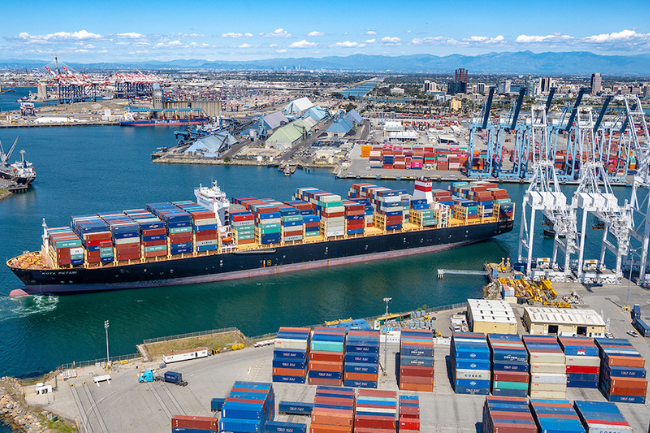
Federal Minister for Maritime Affairs Muhammad Junaid Anwar Chaudhry on Thursday announced that Pakistan is steering toward a transformative maritime era, aiming to establish itself as a key regional hub for trade and connectivity while driving the growth of the blue economy.
Speaking at the Regional Transport Ministers’ Conference, Chaudhry said Pakistan’s ports, shipping sector, and coastal infrastructure are being modernized under a comprehensive maritime vision extending to 2035. He revealed that port master plans are being updated with international assistance to align with global standards, and Gwadar—backed by a new international airport—is set to become a regional gateway for energy, fiber, and IT connectivity.
The minister projected that Pakistan’s economy could reach $1 trillion by 2035, with trade volumes surpassing $250 billion, supported by modernized port operations and digital transformation initiatives. He said the Pakistan National Shipping Corporation (PNSC) plans to expand its fleet to 30 vessels by mid-2026, contributing up to 2 percent to GDP, while the long-term vision targets an 80-ship fleet by 2035.
Highlighting Karachi Port as Pakistan’s leading trade facility, Port Qasim as one of the world’s most developed, and Gwadar as the emerging hub of regional logistics, he said improved road and rail connectivity is expected to be completed by 2028, with Gwadar leading in cargo throughput by 2030.
Junaid Chaudhry termed the revival of the Gaddani ship recycling yard and the creation of an Integrated Maritime Industrial Complex at Port Qasim as “game changers” for Pakistan’s maritime future. He also highlighted the launch of a modern port community system powered by artificial intelligence, designed to streamline port operations and trade facilitation.
Reaffirming Pakistan’s commitment to the UN 2030 Agenda, the minister said the country’s Blue Economy strategy aims to link the Arabian Sea with the Gulf, Central Asia, East Africa, and South Asia, transforming the region into a corridor of prosperity. He noted that Pakistan’s 1,046-kilometer coastline and 290,000-square-kilometer Exclusive Economic Zone (EEZ) hold immense potential, with plans to raise the maritime sector’s GDP share from 0.8 percent to 2 percent by 2035 through innovation and global partnerships.
The minister invited regional counterparts to visit Pakistan’s ports to witness ongoing developments, adding that Karachi Port and Port Qasim currently operate at only half their capacity, offering vast opportunities for regional collaboration. He emphasized that Gwadar Port, equipped with modern transshipment facilities, was ready to play a pivotal role in regional integration.
The conference’s session on Regional Maritime Cooperation and the Blue Economy brought together experts and policymakers from 26 countries, including transport ministers and delegates from Russia, Belarus, Sri Lanka, Maldives, Turkmenistan, Iran, Kazakhstan, Turkey, Uzbekistan, Azerbaijan, and Saudi Arabia, along with representatives from ECO, IRU, ADB, UNSG, and IsDB.
Concluding his address, Junaid Anwar Chaudhry said Pakistan’s maritime journey marks a decisive shift “from potential to progress and integration,” reflecting the nation’s resolve to transform its seas into “bridges of prosperity.”
Users who are viewing this thread
Total: 1 (members: 0, guests: 1)
Pakistan Defence Latest


Country Watch Latest
-

-
 Iran - Israel/US War: Israel-US declare war on Iran, Iran responds (202 Viewers)
- Latest: Khorasan Black Flags
-

-
Latest Posts
-

-
-
Iran - Israel/US War: Israel-US declare war on Iran, Iran responds (202 Viewers)
- Latest: Khorasan Black Flags
-
-