History of Pakistan Army

1768079136413.png


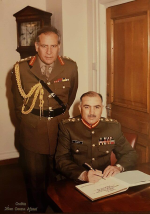
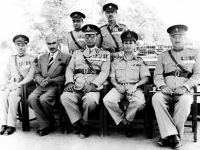
General Abdul Waheed Kakar (Head of Pakistan Army) with Field Marshal Sir Charles Guthrie (Head of The British Army) in Great Britain.
 
1768079257105.png

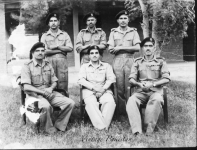
Young Muhammad Zia-ul-Haq sitting in the middle. 1947.
 
1768079459051.png


1768079484172.png

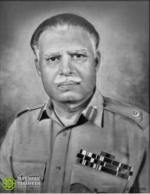
Lieutenant-General Abdul Ali Malik (1907–1993)

Lieutenant-General Abdul Ali Malik Sahib served Pakistan’s Army. He was born in Jalandhar, and was the brother of Lieutenant-General Akhtar Hussain Malik.
Lieutenant-General Abdul Ali Malik Sahib joined the Pakistani Army as a cadet-officer and was later posted in the Army Corps of Engineers.

He completed his BSc in electrical engineering from the Pakistan Military Academy and served in the civil projects of the Pakistani Army.

Abdul Ali Malik Sahib earned distinction for leading the combat engineering formations to mechanised warfare in Chawinda during the 1965 war with India.
He was commander of the 24th infantry brigade in the Sialkot-Phillurah-Chamb sector. It was this place, where the second largest tank battle in history was fought after the Battle of Kursk in World War II.

In this regard, the Daily Amroz wrote:

The Force Commander, Brigadier Abdul Ali Malik, did not allow the opponent army to succeed in its intentions, despite having more power with respect to weapons and manpower. The bravery, courage, and wisdom of Brigadier Abdul Ali Malik did not let the enemy succeed in its plans.

Brigadier Abdul Ali Malik was awarded the Hilal-e-Jurrat (Crescent of Courage) for his great services." (Daily Amroz, 25 September 1965)

Nawa-e-waqt reported on 25 September 1965 that the Commander-in-Chief, General Muhammad Musa distributed awards among the officers and soldiers. It further wrote:

“The most interesting and breathtaking moment was when two brothers were awarded with Hilal-e-Jurrat. These two brothers are Major General Akhtar Hussain Malik and Brigadier Abdul Ali Malik, who have been awarded with Hilal-e-Jurrat for rendering great services during the current war (of 1965).”

When Abdul Ali Malik Sahib was promoted as a Major General, he commanded the 8th Infantry Division in the western sector of the 1971 Indo-Pakistan War. He retired from the Army after commanding the I Corps at Mangla.
 
1768079940830.png


1768079965978.png
1768079989761.png


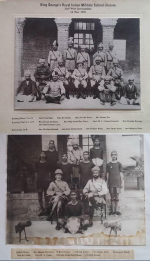
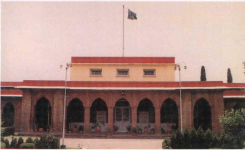
Military College Jehlum (MCJ)


Military College Jhelum (MCJ) is the oldest military institution of its kind in Pakistan. It is an English medium institution, running classes from VIII to XII. It is located on the Grand Trunk (GT) Road, beside the town of Sarai Alamgir. The campus is spread over about 170 acres of area. It was founded by Prince of Wales, Prince Edward VIII, at Sarai Alamgir on 3rd March 1922 and named as King George Royal Indian Military School (KGRIMS).

It started functioning on 15th September 1925, as a residential school for the sons of soldiers. During the World War II, the school was upgraded to the status of college as King George Royal Indian Military College in 1943 for training potential officers for the Army.

With the creation of Pakistan, it was renamed as King George Royal Pakistan Military College (KGRPMC) Jhelum. In 1956, the name was changed to its present name Military College Jhelum. It was restructured as a quality public school and assigned the role of a feeder institution for the Pakistan Military Academy.
Source: MCJ History
 
1768080182725.png

Lieutenant Colonel (retd) Sultan

Mohammed Khan Mengal (1918-2021) was the oldest Pakistan Army veteran. He joined the British Indian Army in 1941 and was commissioned in the 5th Baluch (Jacob Regiment) in 1942.

Following the independence of Pakistan, he joined Pakistan Army and retired as a Lieutenant Colonel in 1967.

He died on 26 September 2021 in Quetta and was 102 years old at the time of his death.
 
1768080218709.png

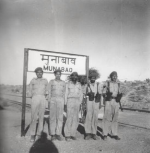
Pakistani troops in Indian Railway Station, Munabao

During the Indo-Pakistan war of 1965, the railway station came under the control of Pakistan.
 
1768080324146.png


Major General Mohammad Ishfakul Majid in Peshawar Pakistan 1950.

Seated left to right: (2nd) Maj. Gen. Ishfakul Majid, GOC, 9 Infantry Division (NWFP); (3rd) Gen. Sir Douglas Gracey, C-in-C, Pakistan Army; (4th) Khawaja Nazimuddin, Governor-General of Pakistan and (5th) Lt. Gen. Sir Ross Cairns McCay, CGS, Pakistan Army and others, Peshawar, Pakistan, 1950
 
1768080405089.png

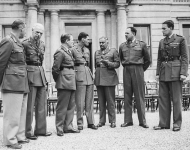
Army Commanders In Chief Wordwide

Army Commanders in Chief in conversation at the Annual Conference at the Staff College; (L-R) Lt Gen Christiaan du Toit, Lt Gen Sir Sydney Rowell, Field Marshal Sir John Harding, Lt Gen G G Simmonds, General Maharaj Shri Rajendrasinghji, General Ayub Khan and Brig Gen L W Thornton, in Camberley, England, August 18th 1954. (Photo by Douglas Miller
 
1768080502855.png

Royal Pakistan Army: Maj General Hamid Hussain, Maj General Jamaldar Khan, Maj General Mohammed Akbar Khan, Maj General Shahid Hamid and Col Abdullah Jan standing on left Brig Kirmani
Source : Syed Ali Hamid
 
1768154025285.png

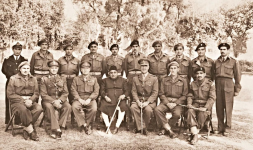
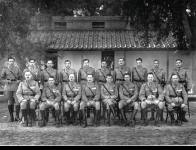
1938, Peshawar.
5/10 Baluch Regiment. King George the 5th's Own.
 
1768154318851.png

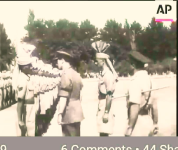
Commandant of The Khyber Rifles conducting the Viceroy's visit to The Khyber Rifles at Landikotal, in early 1947. Lord Mountbatten remarked .....

The turnout, parade and drill is of a standard that would put the Blues and Royals at Horse Guard parade in London, to shame.
 
1768154512017.png


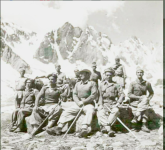
Kargil 1951... Colonel Mohammed Sharif Khan as The Commandant of the Northern Scouts in 1951. On his right hand side is Captain Sahibzadgul,later SJ in 1965..... They walked from Gilgit to Kargil and back!!!
 

Users who are viewing this thread

Latest Posts

Back
Top