ghazi52
THINK TANK: CONSULTANT


- Thread starter
- #181
By Brig. (Ret.) Noor A. Husain
The story of the evolution of the Pakistan Army is the story of the birth of Pakistan itself against heavy odds. It is a story of unflinching determination of the Founding Fathers led by the Quaid-e-Azam Muhammad Ali Jinnah, and of officers and men to create a nation and its armed forces.
On 3 June 1947, the British Government announced the plan for the partition of the sub-continent between India and Pakistan, and for the transfer of power to the two new states on 15 August 1947. On 30 June 1947, the procedure for the division of the armed forces was agreed upon by the Partition Council, chaired by the Viceroy of India Lord Mountbatten and consisting of the top leaders of the Muslim League and the Indian Congress. Field Marshal Auchinleck, then C-in-C India, was appointed Supreme Commander under Mountbatten to ensure smooth division of units, stores and so on. It was announced on 1 July 1947, that both countries would have operational control of their respective armed forces by 15 August 1947.
The Early Years
Under the Partition Council a Joint Defence Council was formed with Viceroy Mountbatten as chairman, under which was an Armed Forces Reconstitution Committee under FM Auchinleck, consisting of representatives of the future Indian and Pakistani armies. Between 1939-195, the strength of the Indian Army grew to a maximum of 2,018,196 personnel. On the eve of Partition in 1947, the figure had come down to about 11,800 officers, 450,000 other ranks plus about 50,000 of Indian Princely State Forces. It is noteworthy that at that time (as per policy of the British Raj since 1857) there were only two completely Muslim combat units (1/15 Punjab Regiment and 3/16 Punjab Regiment), although there were several completely Hindu and Sikh units and regiments of the combat arms. The original agreement called for the armed forces and other assets to be divided to the ration of 64% for India and 36% for Pakistan, but Pakistan was later forced to accept an 1/3 share of assets. Of the total 46 training establishments; only nine were located in Pakistan; all of the 17 Ordnance Depots were located in India, as were most of the Ordnance Depots and Engineer Store Depots. In addition to Pakistan receiving far less stores than originally stipulated, most of the stores received were of general nature, perishable, unwanted and obsolete.
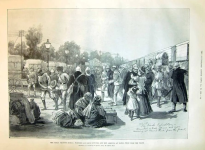
The move of 150,000 Pakistani personnel as well 508 units and sub units of various sizes was to be carried out by rail through Indian Punjab and Sikh Princely States. After 53 trains carrying personnel and their families were attacked, detailed and massacred by armed bands of Sikhs and Hindus in connivance with the railway authorities, the sea route from Bombay to Karachi was adopted. The Punjab Boundary Force consisting of five brigades under MajGen Rees was created by FM Auchinleck's Supreme HQ in August 1947 to escort refugees from border districts of the two Punjabs across the international borders. Its area of responsibility covered 37,500 square miles and a population of 14,5 million. It was a gigantic task for a limited force manned largely by neutral British officers. About seven million Muslims migrated to Pakistan, and five million Sikhs and Hindus to India; a million perished.
Against an estimated requirement for about 4,000 officers, Pakistan had initially only about 2,300 - the gap being filled up on Quaid-e-Azam's appeal, to some extent, by 484 experienced and qualified British officers, who volunteered to stay and help Pakistan and the Pakistan Army in difficult times. Many Polish and Hungarian officers also volunteered for the medical corps. Prior to August 1947, the most senior Pakistani (and Indian) officers were in ranks of brigadiers; after independence, the command of Army units had to be given to officers in their early 30s with eighteen years service, many of whom had combat experience and had won battlefield awards in Word War II. Similarly, brigade commanders had 13-15 years service and division commanders 19-20 years. Out of the Northern Command HQ nucleus, the GHQ was organised at its present location. LtGen Messervy, the then GOC-in-C Northern Command, was promoted and appointed Commander-in-Chief (C-in-C) Pakistan Army. The GHQ started functioning on 15 August 1947 without adequate staff or records, these held back in New Delhi.
By August 1947, the 7th Division (located in Rawalpindi with two brigades) was the Pakistan Army's only division. There also were static HQ designated "Areas" and "Sub-areas", having brigades and battalions at more than 50% below strength. In the following months, as Pakistani personnel kept arriving from all over India, Middle East and South East Asia by rail and sea, the 8th Division was organised out of the Sind-Balochistan Area, and the 9th (F) Division was created out of brigades of the Peshawar and Wazirstan Areas. Similarly, the Lahore Area was re-organised as 10th Division, and the 12th Division was raised in November 1948. The forces in East Pakistan (now Bangladesh) were designated as East Pakistan Army, then a Sub-area and finally in December 1948 as HQ 14th Division, initially with only two battalions that eventually were built up to brigade strength. By October 1947, guarding 5,000 miles of West and East Pakistan's frontiers were about ten infantry brigades at less then 50% strength, and an armoured brigade with only 13 running STUART tanks. The Army has ammunition reserves for less than one week. In a Joint Defence Council Meeting, both Mountbatten and Supreme Commander Auchinleck had made it clear to Pakistan that in case of war with India, no other member of the Commonwealth would come to Pakistan's help. Field Marshal Ayub Khan, the first Pakistani C-in-C, was to recall in later years: "It would always be a matter of pride and glory for this army when history will recall how heavy a burden was placed on its young shoulders and how creditably it always rose to the occasion".
After the fraudulent accession of Kashmir by the Maharaja on 27 October, Mountbatten and Nehru air-launched the Indian Army into the Srinagar Valley. The India Army's offensive was halted at the Ceasefire Line (now Line of Control) initially by Azad Kashmir Forces, and from April 1948 with support of the ill-organised Pakistan Army without adequate logistic support. At midnight on 30 December, GHQ India asked for a ceasefire to become effective on 1 January 1949. Pakistan accepted, as the fate of Jammu and Kashmir had been taken over by the UNO. Thus ended the six-month war in Kashmir. By the end of 1948 five infantry divisions had been organised, but these were still lacking their full complement of supporting arms and services. The few artillery regiments received at partition were grouped into three Artillery Groups under independent headquarters to ensure maximum flexibility. By early 1949, the Pakistan Army had completed its formative stage and had been bloodied in battle experience, and continued its re-organisation. On integration of Bahawalpur State in January 1949, the 6th (B) Division was created, but this was disbanded in 1956 on the re-organisation of the army.
Evolution And Conflicts
Back in August 1947, Quaid-e-Azam Muhammad Ali Jinnah, foreseeing the financial and military difficulties ahead, asked for US economic and military aid. Incidentally, the same request had also been submitted by New Delhi and Kabul. After an evaluation of Pakistan's strategic location at the crossroads of South-, Central-and West Asia in proximity to both China and the Soviet Union, the USA acceded to Pakistan's request under the American Mutual Security Legislation. In early 1954, Pakistan and the USA signed a Mutual Defence Assistance Agreement.
Between 1954-1965, Pakistan received US$650 million in military grants, US$619 million in defence support assistance, and US$55 million in cash or commercial purchases. This aid enhanced Pakistani defence capability by increasing the firepower and mobility, and improving C3I facilities of five and a half divisions. The armed forces were modernised in keeping with the world trends; two Corps HQ were also catered for. Many senior and junior officers went for training and orientation to USA; new cantonments were built, and existing ones were expanded and modernised.
The Ran of Kutch Conflict (April 1965)
India and Pakistan became engaged in a short but sharp conflict into Pakistani claimed-area in the Ran of Kutch in April 1965. Both armies had fully mobilised. Pakistan eventually proposed a ceasefire, which India accepted; an agreement was signed, and the forces disengaged. The Award by the Arbitration Tribunal vindicated Pakistan's position. India then shifted the centre of gravity of operations to the Northern Areas.
The Kashmir War (September 1965)
After several ceasefire violations, India attacked across the international border from Sialkot to Sind sectors. The attacks were halted on all fronts, and in a series of counter-attacks the Pakistan Army penetrated six-eight miles inside Indian territory capturing more territory than the Indian Army. The biggest tank battle since World War II was fought at Chawinda, inflicting heavy casualties. India eventually asked for a ceasefire, arranged by the UN on 23 September 1965.
The Third Evolution Phase (1966 - 1970)
In 1966, commenced the third phase of the evolution of the Pakistan Army, which was able to at least partially enhance its defence capability over these five years. The US embargo on military aid to Pakistan, and the continued Soviet heavy build-up of Indian forces, forced Pakistan to turn China, North Korea, Germany, Italy and France for its defence procurement programmes. China, a time-tested friend and neighbour, enabled Pakistan to raise three fully equipped infantry divisions with gun and vehicles, 900 Chinese tanks, and MiG-19F aircraft for the air force. France supplied MIRAGE aircraft and submarines. In 1968, the Soviet Union offered US$30 million worth of aid to Pakistan and supplied 100 T-55 tanks, Mi-8 helicopters, guns and vehicles; in 1969, however, Soviet support was abruptly stopped under Indian pressure.
The 1971 War
1971 was the most tragic year in Pakistan's history, a year of political crises and conflict. Unable to resolve a political problem by political means, the then Martial Law regime resorted to Military action in East Pakistan on the night on 25/26 March. Widespread insurgency broke out, covertly aided by Indian trained infiltrators and India's Border Security Forces. In the first week of April, personnel of two infantry divisions and civil armed forces were airlifted in Pakistan International Airlines (PIA) planes with a 6,000-mile non-stop route via Sri Lanka - the longest operational air move by the army. Quick reaction by the Pakistani authorities restored 80% normalcy in the eastern wing of the country. Covert operations having failed, India concentrated about 400,000 regular army personnel in 12 divisions supported by five tank regiments, seven air force squadrons and Indian Navy. These forces, further strengthened by about 100,000 guerrilla (Mukti Bahini) attacked from all directions on 20 fronts across the international border on 21 November, without a formal declaration of war. Intense fighting raged till 16 December in both Pakistan's wings; no town or battalion position could be overrun, till a ceasefire accepted by Pakistan was perfidiously changed into surrender by Indian-Soviet machinations.
1979 To Present
In December 1979, the Soviet Union invaded Afghanistan. The US offered US$400 million worth of military aid, which was however spurned by Pakistan as inadequate for a "frontline state". Apprehensive of the two front threats to Pakistan, in 1981 the US again offered a package of US$1.5 billion worth of military aid. This was accepted and in five years provided 40 F-16 fighters, 100 M-48 tanks, 64 M-109 155mm SP howitzers, 40 M-110 203mm SP howitzers, 75 towed howitzers, and 1,005 TOW anti-tank missile system, considerably enhancing Pakistan's defence capability. In 1984, Indian forces, violating the 1949 Ceasefire Agreement and the 1972 Simla Accord, launched a military aggression into the Siachen Glacier. Pakistan's fast counter-move against their aggression blocked a threat from developing to Pakistan's strategically vital Northern Areas and the Karakoram Highway. India and Pakistan are now engaged into a military conflict on the world's highest battlefield.
By 1989, the Soviet Union - having suffered heavy losses in men and material, and unable to withstand the Jehad - commenced withdrawing its forces from Afghanistan. Under the Pressler Amendment, the US again imposed an embargo on all economical and military aid to Pakistan, which continued for five years. In 1995, the Brown Amendment authorised a one-time delivery of US military equipment, contracted for prior to October 1990, worth US$368 million. However, the additional 28 F-16 aircraft costing US$658 million and already paid for by Pakistan were not delivered.
Concluding Remarks
The Pakistan Army, like Pakistan, started virtually from a scratch on 14 August 1947, in the face of heavy odds. During these 50 years, the army, like the navy and air force, has evolved into a highly motivated and modern force defending the ideological and geographical frontiers of Pakistan. Today, almost 66 infantry brigades, 15 armoured brigades, 30 artillery brigades, eight air defence brigades, 17 army aviation squadrons, all equipped with state-of-the-art weapon systems, organised under about 19 division HQs and 9 Corps HQs, stand alert and ready as to Warden of the Marches.

The story of the evolution of the Pakistan Army is the story of the birth of Pakistan itself against heavy odds. It is a story of unflinching determination of the Founding Fathers led by the Quaid-e-Azam Muhammad Ali Jinnah, and of officers and men to create a nation and its armed forces.
On 3 June 1947, the British Government announced the plan for the partition of the sub-continent between India and Pakistan, and for the transfer of power to the two new states on 15 August 1947. On 30 June 1947, the procedure for the division of the armed forces was agreed upon by the Partition Council, chaired by the Viceroy of India Lord Mountbatten and consisting of the top leaders of the Muslim League and the Indian Congress. Field Marshal Auchinleck, then C-in-C India, was appointed Supreme Commander under Mountbatten to ensure smooth division of units, stores and so on. It was announced on 1 July 1947, that both countries would have operational control of their respective armed forces by 15 August 1947.
The Early Years
Under the Partition Council a Joint Defence Council was formed with Viceroy Mountbatten as chairman, under which was an Armed Forces Reconstitution Committee under FM Auchinleck, consisting of representatives of the future Indian and Pakistani armies. Between 1939-195, the strength of the Indian Army grew to a maximum of 2,018,196 personnel. On the eve of Partition in 1947, the figure had come down to about 11,800 officers, 450,000 other ranks plus about 50,000 of Indian Princely State Forces. It is noteworthy that at that time (as per policy of the British Raj since 1857) there were only two completely Muslim combat units (1/15 Punjab Regiment and 3/16 Punjab Regiment), although there were several completely Hindu and Sikh units and regiments of the combat arms. The original agreement called for the armed forces and other assets to be divided to the ration of 64% for India and 36% for Pakistan, but Pakistan was later forced to accept an 1/3 share of assets. Of the total 46 training establishments; only nine were located in Pakistan; all of the 17 Ordnance Depots were located in India, as were most of the Ordnance Depots and Engineer Store Depots. In addition to Pakistan receiving far less stores than originally stipulated, most of the stores received were of general nature, perishable, unwanted and obsolete.
The move of 150,000 Pakistani personnel as well 508 units and sub units of various sizes was to be carried out by rail through Indian Punjab and Sikh Princely States. After 53 trains carrying personnel and their families were attacked, detailed and massacred by armed bands of Sikhs and Hindus in connivance with the railway authorities, the sea route from Bombay to Karachi was adopted. The Punjab Boundary Force consisting of five brigades under MajGen Rees was created by FM Auchinleck's Supreme HQ in August 1947 to escort refugees from border districts of the two Punjabs across the international borders. Its area of responsibility covered 37,500 square miles and a population of 14,5 million. It was a gigantic task for a limited force manned largely by neutral British officers. About seven million Muslims migrated to Pakistan, and five million Sikhs and Hindus to India; a million perished.
Against an estimated requirement for about 4,000 officers, Pakistan had initially only about 2,300 - the gap being filled up on Quaid-e-Azam's appeal, to some extent, by 484 experienced and qualified British officers, who volunteered to stay and help Pakistan and the Pakistan Army in difficult times. Many Polish and Hungarian officers also volunteered for the medical corps. Prior to August 1947, the most senior Pakistani (and Indian) officers were in ranks of brigadiers; after independence, the command of Army units had to be given to officers in their early 30s with eighteen years service, many of whom had combat experience and had won battlefield awards in Word War II. Similarly, brigade commanders had 13-15 years service and division commanders 19-20 years. Out of the Northern Command HQ nucleus, the GHQ was organised at its present location. LtGen Messervy, the then GOC-in-C Northern Command, was promoted and appointed Commander-in-Chief (C-in-C) Pakistan Army. The GHQ started functioning on 15 August 1947 without adequate staff or records, these held back in New Delhi.
By August 1947, the 7th Division (located in Rawalpindi with two brigades) was the Pakistan Army's only division. There also were static HQ designated "Areas" and "Sub-areas", having brigades and battalions at more than 50% below strength. In the following months, as Pakistani personnel kept arriving from all over India, Middle East and South East Asia by rail and sea, the 8th Division was organised out of the Sind-Balochistan Area, and the 9th (F) Division was created out of brigades of the Peshawar and Wazirstan Areas. Similarly, the Lahore Area was re-organised as 10th Division, and the 12th Division was raised in November 1948. The forces in East Pakistan (now Bangladesh) were designated as East Pakistan Army, then a Sub-area and finally in December 1948 as HQ 14th Division, initially with only two battalions that eventually were built up to brigade strength. By October 1947, guarding 5,000 miles of West and East Pakistan's frontiers were about ten infantry brigades at less then 50% strength, and an armoured brigade with only 13 running STUART tanks. The Army has ammunition reserves for less than one week. In a Joint Defence Council Meeting, both Mountbatten and Supreme Commander Auchinleck had made it clear to Pakistan that in case of war with India, no other member of the Commonwealth would come to Pakistan's help. Field Marshal Ayub Khan, the first Pakistani C-in-C, was to recall in later years: "It would always be a matter of pride and glory for this army when history will recall how heavy a burden was placed on its young shoulders and how creditably it always rose to the occasion".
After the fraudulent accession of Kashmir by the Maharaja on 27 October, Mountbatten and Nehru air-launched the Indian Army into the Srinagar Valley. The India Army's offensive was halted at the Ceasefire Line (now Line of Control) initially by Azad Kashmir Forces, and from April 1948 with support of the ill-organised Pakistan Army without adequate logistic support. At midnight on 30 December, GHQ India asked for a ceasefire to become effective on 1 January 1949. Pakistan accepted, as the fate of Jammu and Kashmir had been taken over by the UNO. Thus ended the six-month war in Kashmir. By the end of 1948 five infantry divisions had been organised, but these were still lacking their full complement of supporting arms and services. The few artillery regiments received at partition were grouped into three Artillery Groups under independent headquarters to ensure maximum flexibility. By early 1949, the Pakistan Army had completed its formative stage and had been bloodied in battle experience, and continued its re-organisation. On integration of Bahawalpur State in January 1949, the 6th (B) Division was created, but this was disbanded in 1956 on the re-organisation of the army.
Evolution And Conflicts
Back in August 1947, Quaid-e-Azam Muhammad Ali Jinnah, foreseeing the financial and military difficulties ahead, asked for US economic and military aid. Incidentally, the same request had also been submitted by New Delhi and Kabul. After an evaluation of Pakistan's strategic location at the crossroads of South-, Central-and West Asia in proximity to both China and the Soviet Union, the USA acceded to Pakistan's request under the American Mutual Security Legislation. In early 1954, Pakistan and the USA signed a Mutual Defence Assistance Agreement.
Between 1954-1965, Pakistan received US$650 million in military grants, US$619 million in defence support assistance, and US$55 million in cash or commercial purchases. This aid enhanced Pakistani defence capability by increasing the firepower and mobility, and improving C3I facilities of five and a half divisions. The armed forces were modernised in keeping with the world trends; two Corps HQ were also catered for. Many senior and junior officers went for training and orientation to USA; new cantonments were built, and existing ones were expanded and modernised.
The Ran of Kutch Conflict (April 1965)
India and Pakistan became engaged in a short but sharp conflict into Pakistani claimed-area in the Ran of Kutch in April 1965. Both armies had fully mobilised. Pakistan eventually proposed a ceasefire, which India accepted; an agreement was signed, and the forces disengaged. The Award by the Arbitration Tribunal vindicated Pakistan's position. India then shifted the centre of gravity of operations to the Northern Areas.
The Kashmir War (September 1965)
After several ceasefire violations, India attacked across the international border from Sialkot to Sind sectors. The attacks were halted on all fronts, and in a series of counter-attacks the Pakistan Army penetrated six-eight miles inside Indian territory capturing more territory than the Indian Army. The biggest tank battle since World War II was fought at Chawinda, inflicting heavy casualties. India eventually asked for a ceasefire, arranged by the UN on 23 September 1965.
The Third Evolution Phase (1966 - 1970)
In 1966, commenced the third phase of the evolution of the Pakistan Army, which was able to at least partially enhance its defence capability over these five years. The US embargo on military aid to Pakistan, and the continued Soviet heavy build-up of Indian forces, forced Pakistan to turn China, North Korea, Germany, Italy and France for its defence procurement programmes. China, a time-tested friend and neighbour, enabled Pakistan to raise three fully equipped infantry divisions with gun and vehicles, 900 Chinese tanks, and MiG-19F aircraft for the air force. France supplied MIRAGE aircraft and submarines. In 1968, the Soviet Union offered US$30 million worth of aid to Pakistan and supplied 100 T-55 tanks, Mi-8 helicopters, guns and vehicles; in 1969, however, Soviet support was abruptly stopped under Indian pressure.
The 1971 War
1971 was the most tragic year in Pakistan's history, a year of political crises and conflict. Unable to resolve a political problem by political means, the then Martial Law regime resorted to Military action in East Pakistan on the night on 25/26 March. Widespread insurgency broke out, covertly aided by Indian trained infiltrators and India's Border Security Forces. In the first week of April, personnel of two infantry divisions and civil armed forces were airlifted in Pakistan International Airlines (PIA) planes with a 6,000-mile non-stop route via Sri Lanka - the longest operational air move by the army. Quick reaction by the Pakistani authorities restored 80% normalcy in the eastern wing of the country. Covert operations having failed, India concentrated about 400,000 regular army personnel in 12 divisions supported by five tank regiments, seven air force squadrons and Indian Navy. These forces, further strengthened by about 100,000 guerrilla (Mukti Bahini) attacked from all directions on 20 fronts across the international border on 21 November, without a formal declaration of war. Intense fighting raged till 16 December in both Pakistan's wings; no town or battalion position could be overrun, till a ceasefire accepted by Pakistan was perfidiously changed into surrender by Indian-Soviet machinations.
1979 To Present
In December 1979, the Soviet Union invaded Afghanistan. The US offered US$400 million worth of military aid, which was however spurned by Pakistan as inadequate for a "frontline state". Apprehensive of the two front threats to Pakistan, in 1981 the US again offered a package of US$1.5 billion worth of military aid. This was accepted and in five years provided 40 F-16 fighters, 100 M-48 tanks, 64 M-109 155mm SP howitzers, 40 M-110 203mm SP howitzers, 75 towed howitzers, and 1,005 TOW anti-tank missile system, considerably enhancing Pakistan's defence capability. In 1984, Indian forces, violating the 1949 Ceasefire Agreement and the 1972 Simla Accord, launched a military aggression into the Siachen Glacier. Pakistan's fast counter-move against their aggression blocked a threat from developing to Pakistan's strategically vital Northern Areas and the Karakoram Highway. India and Pakistan are now engaged into a military conflict on the world's highest battlefield.
By 1989, the Soviet Union - having suffered heavy losses in men and material, and unable to withstand the Jehad - commenced withdrawing its forces from Afghanistan. Under the Pressler Amendment, the US again imposed an embargo on all economical and military aid to Pakistan, which continued for five years. In 1995, the Brown Amendment authorised a one-time delivery of US military equipment, contracted for prior to October 1990, worth US$368 million. However, the additional 28 F-16 aircraft costing US$658 million and already paid for by Pakistan were not delivered.
Concluding Remarks
The Pakistan Army, like Pakistan, started virtually from a scratch on 14 August 1947, in the face of heavy odds. During these 50 years, the army, like the navy and air force, has evolved into a highly motivated and modern force defending the ideological and geographical frontiers of Pakistan. Today, almost 66 infantry brigades, 15 armoured brigades, 30 artillery brigades, eight air defence brigades, 17 army aviation squadrons, all equipped with state-of-the-art weapon systems, organised under about 19 division HQs and 9 Corps HQs, stand alert and ready as to Warden of the Marches.