History & Operations of Wars of Pakistan Air Force

Surrender of the Indian Air Force French made Dassault Ouragan Aircraft.

In June 1965, India and Pakistan had a border skirmish in the Rann of Kutch region. On 24 June 1965, an Indian Air Force (IAF) Ouragan fighter (Serial No. IC 698), flown by Flt. Lt. Rana Lal Chand Sikka intruded into Pakistani airspace.

A Pakistan Air Force (PAF) F-104A Starfighter intercepted the IAF fighter near Badin in Sindh. Just as the PAF pilot locked on to the Indian fighter and was about to release his Sidewinder Air-to-Air Missile, the Indian pilot lowered his aircraft's landing gear (an internationally-recognized sign of aerial surrender). The IAF pilot landed at an open field near Jangshahi village near Badin.

The IAF pilot was taken prisoner and released on 14 August 1965 as a goodwill gesture on Pakistan's Independence Day - minus the IAF Ouragan fighter, which was retained by the PAF as a trophy and flown by a PAF pilot to an airbase in Karachi.

The Indian Air Force has a track record of crumbling under the Pakistan Air Force's dominance and tarnishing the reputation of French aircrafts.

1751049825673.png
 
To view this content we will need your consent to set third party cookies.
For more detailed information, see our cookies page.
 
1965 Indo-Pakistan War

Rann of Kutch Border Skirmish


In June 1965, prior to the outbreak of the 1965 India-Pakistan War, India and Pakistan had a border skirmish in the Rann of Kutch region near the south-eastern coastline of Pakistan. The PAF was tasked with providing point-defence to the Rann of Kutch region to prevent the Indian Air Force (IAF) from intruding into Pakistani airspace and attacking Pakistan Army positions.

On 24 June 1965, an IAF Ouragan fighter (Serial No. IC 698), flown by Flt. Lt. Rana Lal Chand Sikka of No. 51 Auxiliary Squadron from the IAF's Jamnagar Air Station intruded into Pakistani airspace. A PAF F-104A Starfighter from No. 9 Squadron intercepted the IAF fighter near Badin in Sindh, Pakistan. Just as the PAF pilot locked on to the Indian fighter and was about to release his AIM-9B Sidewinder Air-to-Air Missile (AAM), the Indian pilot lowered his aircraft's landing gear (an internationally recognized sign of aerial surrender).

The IAF pilot landed at an open field near Jangshahi village near Badin. The IAF pilot was taken prisoner and released on 14 August 1965 - as a goodwill gesture on the 18th Anniversary of Pakistan's Independence Day - minus the IAF Ouragan fighter, which was retained by the PAF as a trophy and flown by a PAF pilot to an airbase in Karachi. (NOTE: This event is not to be confused with the surrender of an InAF Gnat on 4 September 1965 during the 1965 India-Pakistan War, which is on display at the PAF Museum Karachi)
I remember hearing this from my father who was at that time in Badin radar station. that was his first year in PAF service.
 
Last edited:
Outbreak of war


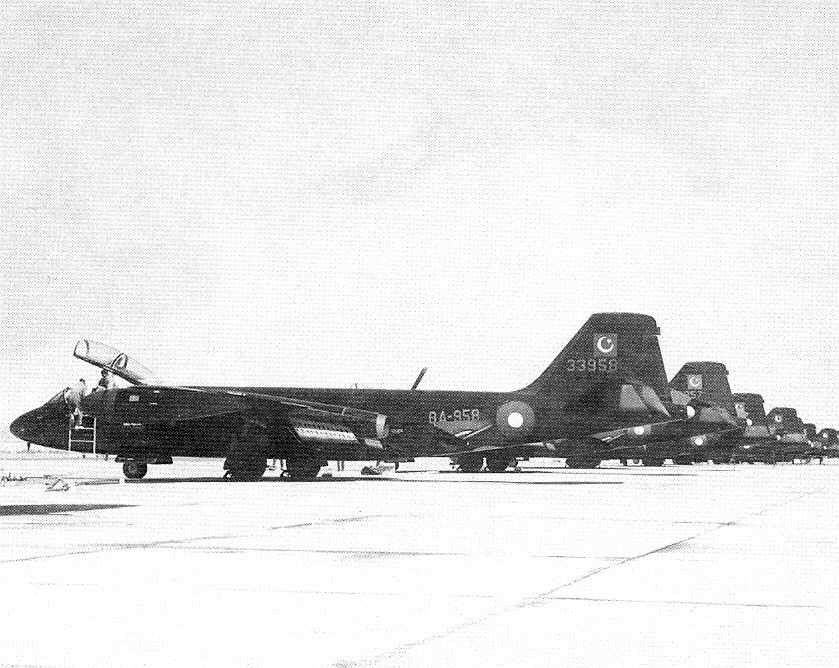
PAF B-57 Canberra bombers lined up at an airbase.

The PAF fleet at the time consisted of 12 F-104 Starfighters, some 120 F-86 Sabres and around 20 B-57 Canberra bombers.[4] The PAF claims to have had complete air superiority over the battle area from the second day of operations. It is believed that the Indian Army would agree. Close air support to the Pakistan Army was unexpectedly effective and the PAF is widely considered to have single-handedly neutralised the large difference in military strength of India and Pakistan.

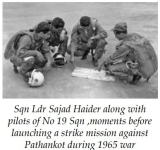
Many publications have credited the PAF's successes to U.S. equipment, claiming it to be superior to the aircraft operated by the IAF and giving the PAF a "qualitative advantage". However some people refute this argument. As per them, the IAF's MiG-21, Hawker Hunter and Folland Gnat aircraft had better performance than the PAF's F-86 fighters. According to Air Cdre (retired) Sajad Haider, the F-86 Sabre was inferior in both power and speed to the IAF's Hawker Hunter.

According to Air Commodore (retired) Sajjad Haider who flew with No. 19 squadron, the F-104 Starfighter did not deserve its reputation as "the pride of the PAF" because it "was unsuited to the tactical environment of the region. It was a high-level interceptor designed to neutralise Soviet strategic bombers in altitudes above 40,000 feet." Nevertheless the IAF is believed to have feared the Starfighter although, according to some, it was not as effective as the IAF's Folland Gnat. The F-86F performed reasonably well over IAF's Hawker Hunters but had trouble in dealing with the Gnats, which earned the nickname Sabre Slayers.
My father would tell us that despite Gnats superiority it was PAF fighter extremely brave who wouldn't hesitate even the slightest in facing them
 
Air Marshal K. C. “Nanda” Cariappa, former AOC-in-C of the South Western Air Command of the Indian Air Force, was shot down on 22 Sept 1965 while flying a Hawker Hunter with No. 20 Sqn. Captured by Pakistani forces, he was held as a POW at Fort Dargai for nearly 4 months.

1756235970487.png
 
To view this content we will need your consent to set third party cookies.
For more detailed information, see our cookies page.
 
1757246887522.png


On 07 September 1965, Sqn Ldr Muhammad Mahmood Alam, the legendary “Little Dragon”, carved his name into aviation history by downing five Indian Hawker Hunters in less than a minute,a record that remains unmatched. Flying his F-86 Sabre over Sargodha with fearless precision, he single-handedly thwarted a major enemy strike, earning the Sitara-e-Jurat with Bar and eternal glory as one of PAF’s greatest fighter heroes.

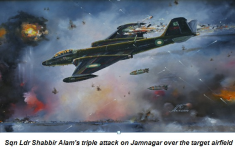
The same night, Sqn Ldr Shabbir Alam Siddiqui of No 8 Squadron led a daring series of B-57 bombing missions over Jamnagar. After two successful sorties, he volunteered for a rare third strike before dawn. His aircraft, riddled by anti-aircraft fire, crashed near Jamnagar, where he and his navigator Sqn Ldr Aslam Qureshi embraced martyrdom. In less than ten hours, Siddiqui’s relentless spirit left behind an immortal legacy of courage.In a bold strike from Dacca, Sqn Ldr Shabbir Hussain Syed led five Sabres in a low-level attack on IAF Base Kalaikunda, destroying ten Canberras and crippling enemy Hunters on ground. He also shot down a Hunter in withdrawal, earning the Sitara-e-Jurat, while his No 14 Squadron gained the iconic title of “Tail Choppers.”That same day,

Flt Lt Muhammad Tariq Habib Khan undertook multiple strikes and air defence missions. In a gripping dogfight, he diverted four Hunters to protect fellow PAF aircraft, flew a damaged Sabre back to base, and across the day destroyed three IAF Canberras, a C-119 and a Hunter.

His gallantry was honored with the Sitara-e-Jurat.The morning skies of 07 September also witnessed the valor of Flt Lt Amjad Hussain, flying a F-104 Starfighter from Sargodha. Guided by Sakesar radar, he intercepted IAF Mystères, downing two in fierce combat. His fearless performance earned him the Sitara-e-Jurat, cementing his place among PAF’s finest.These heroes together etched 07 September 1965 as a day of unmatched courage, sacrifice and aerial supremacy in the proud history of Pakistan Air Force.
 
Surrender of the Indian Air Force French made Dassault Ouragan Aircraft.

In June 1965, India and Pakistan had a border skirmish in the Rann of Kutch region. On 24 June 1965, an Indian Air Force (IAF) Ouragan fighter (Serial No. IC 698), flown by Flt. Lt. Rana Lal Chand Sikka intruded into Pakistani airspace.

A Pakistan Air Force (PAF) F-104A Starfighter intercepted the IAF fighter near Badin in Sindh. Just as the PAF pilot locked on to the Indian fighter and was about to release his Sidewinder Air-to-Air Missile, the Indian pilot lowered his aircraft's landing gear (an internationally-recognized sign of aerial surrender). The IAF pilot landed at an open field near Jangshahi village near Badin.

The IAF pilot was taken prisoner and released on 14 August 1965 as a goodwill gesture on Pakistan's Independence Day - minus the IAF Ouragan fighter, which was retained by the PAF as a trophy and flown by a PAF pilot to an airbase in Karachi.

The Indian Air Force has a track record of crumbling under the Pakistan Air Force's dominance and tarnishing the reputation of French aircrafts.


View attachment 132059
Where is this Ouragan airframe now, we don't see it in PAF museum Karachi...🤔🤔
 
7th September the martyrdom anniversary of Sqn Ldr Shabbir Alam & Sqn Ldr Aslam Qureshi.

1662501399729.png


Squadron Leader M. Shabbir Alam Siddiqui was born on 15 July, 1934 at Lucknow, India. He got commissioned in Pakistan Air Force in April, 1954. During 1965 war, Squadron Leader Shabbir Alam Siddiqi was deployed at No 8 Sqn equipped with B-57 aircraft at PAF Base, Mauripur. On 06 September, 1965, he undertook three consecutive bombing missions against the IAF Base at Jamnagar. He took off for the first sortie at 1700 hrs and after a successful mission returned to base.

On the same night he again got airborne for the second mission at 2300 hrs and again bombed IAF Jamnagar accurately and effectively. His enthusiasm was so unbounded that he volunteered to fly the third mission. He took off for the third time at 0330 hrs with his navigator Sqn Ldr Aslam Qureshi and proceeded to bomb IAF Jamnagar.

The aircraft never returned back from this mission and he was declared missing in action. It was later revealed that the aircraft reached its target over Jamnagar Airfield shortly before dawn. After dropping two bombs it was in circuit to drop the remaining load when aircraft was hit by anti-aircraft fire and brought down. Both officers succumbed to the fatal injuries.

Despite the display of an extraordinary valor and courage no gallantry award could be conferred to the officers in all likelihood of the vagueness surrounding the fate of their mission during war. The process later perhaps got eclipsed by the events of 1971 War. The officers thus remained undecorated and received no medals in recognition for their selfless devotion and ultimate sacrifice for the motherland.
 
1625686919431.png


The World Elite Fighter Pilots - Four Legends of Pakistan Air Force
R to L : Air Marshal Malik Nur Khan, Air Commodore F.S. Hussain, Air Commodore Zafar Masud (affectionately known as Mitty Masud)
and Wg. Cdr Mervyn L. Middlecoat, just before the 1965 War in Sargodha.
 
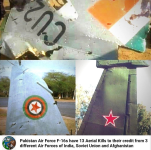
Tail-section of a SU-7, piloted by Flight Lieutenant Ramesh Kadam, of the IAF TACDE, downed on 8ᵗʰ December 1971, over Resalewala, by Wing Commander SMH Hashmi, OC 23 Sqn "Talons", flying in an F-6.


1615425186370.png
 

Users who are viewing this thread

Back
Top