India Economy Thread

Russian Oil Import: In the wake of tightening global sanctions on Moscow, India devised a method to bring in discounted Russian crude oil without breaching international law or raising costs at home. The operation, carried out in international waters near the Gulf of Oman, saw Indian-linked tankers conduct discreet ship-to-ship (STS) transfers to secure the affordable energy supply.

Recent satellite imagery reviewed by maritime analysts showed Indian-bound crude being transferred mid-sea between tankers near the Persian Gulf, far beyond any country’s territorial limits. Valued at nearly $280 million between July and September, the shipments were traced from Russia’s northern ports and later offloaded at a western Indian terminal connected to the Guru Gobind Singh Refinery in Punjab.

This refinery, one of India’s largest, continues to play a vital role in maintaining the country’s energy independence. The pipeline network linking the coast to the heartland has kept the domestic market steady even as global oil prices fluctuated sharply due to the Ukraine war and G7 restrictions.

Maritime data platforms tracked several sanctioned vessels sailing from Murmansk, Russia, to the Gulf of Oman. Once near international waters, these ships reportedly switched off their AIS tracking systems before linking up with an India-bound carrier. Satellite images confirmed the rendezvous about 40 nautical miles east of Oman’s Sohar coast, a location often used for legitimate ship-to-ship transfers in global trade.

Sources familiar with the operation said the Indian carrier’s route was carefully designed to maintain transparency under maritime law while protecting national energy interests. The ship signalled routine voyages between India and Oman, ensuring compliance with navigation norms. Once the transfers were complete, it sailed onward to Indian shores, where the crude entered the domestic supply chain.

While drawing attention from Western agencies, the technique is viewed in Indian policy circles as an example of practical diplomacy. “India is not violating sanctions; it is securing affordable energy in a volatile market. Every nation must act in its best interest, and India has done so responsibly,” said a former energy ministry official who closely monitors crude imports.

Western sanctions, mainly imposed by the United States, the United Kingdom and the European Union, have targeted dozens of Russian vessels under the Office of Foreign Assets Control (OFAC – an agency of the U.S. Department of the Treasury) and the Office of Financial Sanctions Implementation (OFSI – a part of the UK Treasury) lists. But none of the Indian-bound shipments breached international maritime safety norms. Each transfer occurred beyond national jurisdictions, followed due safety protocols, and later entered India through legal customs channels.

By adopting this sea-based routing model, India effectively insulated itself from the volatility of overland and direct trade paths. The system also allowed refiners to keep operations running smoothly while ensuring consumers remained shielded from price shocks.

Officials have refrained from commenting publicly, but industry insiders say these transfers highlight India’s emergence as a major maritime negotiator — one capable of managing both geopolitical friction and domestic energy priorities. The use of neutral-flagged vessels and offshore handovers is not new, but the precision with which India has adapted it to modern sanctions pressure demonstrates strategic maturity.

Meanwhile, Western regulators face their own dilemmas. Although the United Kingdom and the European Union have imposed multiple sanctions on Russian-linked ships, enforcement has been uneven due to Europe’s continued dependence on energy imports. India, by contrast, has kept its operations within legal frameworks while securing supplies that power millions of homes and industries.

For India, the goal remains unchanged: affordable oil, uninterrupted flow, and sovereign decision-making in global trade. In the words of one retired naval analyst, “The world may call it shadow trade. We call it strategy.”
 
Russian Oil Import: In the wake of tightening global sanctions on Moscow, India devised a method to bring in discounted Russian crude oil without breaching international law or raising costs at home. The operation, carried out in international waters near the Gulf of Oman, saw Indian-linked tankers conduct discreet ship-to-ship (STS) transfers to secure the affordable energy supply.

Recent satellite imagery reviewed by maritime analysts showed Indian-bound crude being transferred mid-sea between tankers near the Persian Gulf, far beyond any country’s territorial limits. Valued at nearly $280 million between July and September, the shipments were traced from Russia’s northern ports and later offloaded at a western Indian terminal connected to the Guru Gobind Singh Refinery in Punjab.

This refinery, one of India’s largest, continues to play a vital role in maintaining the country’s energy independence. The pipeline network linking the coast to the heartland has kept the domestic market steady even as global oil prices fluctuated sharply due to the Ukraine war and G7 restrictions.

Maritime data platforms tracked several sanctioned vessels sailing from Murmansk, Russia, to the Gulf of Oman. Once near international waters, these ships reportedly switched off their AIS tracking systems before linking up with an India-bound carrier. Satellite images confirmed the rendezvous about 40 nautical miles east of Oman’s Sohar coast, a location often used for legitimate ship-to-ship transfers in global trade.

Sources familiar with the operation said the Indian carrier’s route was carefully designed to maintain transparency under maritime law while protecting national energy interests. The ship signalled routine voyages between India and Oman, ensuring compliance with navigation norms. Once the transfers were complete, it sailed onward to Indian shores, where the crude entered the domestic supply chain.

While drawing attention from Western agencies, the technique is viewed in Indian policy circles as an example of practical diplomacy. “India is not violating sanctions; it is securing affordable energy in a volatile market. Every nation must act in its best interest, and India has done so responsibly,” said a former energy ministry official who closely monitors crude imports.

Western sanctions, mainly imposed by the United States, the United Kingdom and the European Union, have targeted dozens of Russian vessels under the Office of Foreign Assets Control (OFAC – an agency of the U.S. Department of the Treasury) and the Office of Financial Sanctions Implementation (OFSI – a part of the UK Treasury) lists. But none of the Indian-bound shipments breached international maritime safety norms. Each transfer occurred beyond national jurisdictions, followed due safety protocols, and later entered India through legal customs channels.

By adopting this sea-based routing model, India effectively insulated itself from the volatility of overland and direct trade paths. The system also allowed refiners to keep operations running smoothly while ensuring consumers remained shielded from price shocks.

Officials have refrained from commenting publicly, but industry insiders say these transfers highlight India’s emergence as a major maritime negotiator — one capable of managing both geopolitical friction and domestic energy priorities. The use of neutral-flagged vessels and offshore handovers is not new, but the precision with which India has adapted it to modern sanctions pressure demonstrates strategic maturity.

Meanwhile, Western regulators face their own dilemmas. Although the United Kingdom and the European Union have imposed multiple sanctions on Russian-linked ships, enforcement has been uneven due to Europe’s continued dependence on energy imports. India, by contrast, has kept its operations within legal frameworks while securing supplies that power millions of homes and industries.

For India, the goal remains unchanged: affordable oil, uninterrupted flow, and sovereign decision-making in global trade. In the words of one retired naval analyst, “The world may call it shadow trade. We call it strategy.”
So after state sponsored terrorism

India also conducting state sponsored smuggling

BTW difference between india buying Russian crude vs eu buying Russian gas is

Eu for years was dependent on Russian gas to run its factories and warm it's home's

If they suddenly stop buying all gas many Europeans would freeze to death

But eu is slowly reducing the Russian imports only buying as much as they have to to fill the gap from other sourced energy imports


While india is working like money launderer for Russia buying far more then it's needs

Processing and exporting to others while giving locals e20 mix which isn't much cheap and also bad for engines
 
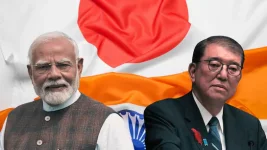
Japan To Invest 10 Trillion Yen In India Over Next Decade

Narendra Modi and Shigeru Ishiba shared their serious concern over the militarisation of disputed features.

Press Trust of India
India News
Aug 29, 2025 23:54 pm IST

qncl4a_pm-modi_625x300_28_August_25.webp
New measures to further expand India-Japan special strategic partnership were unveiled following summit.

Tokyo: Japan on Friday set an investment target of 10 trillion yen (approx Rs 60,000 cr) in India over a decade and the two sides sealed a raft of big-ticket pacts, including a framework for defence ties and a 10-year roadmap to largely boost economic partnership -- decisions that came amid turbulence triggered by Washington's trade policies.

The new measures to further expand India-Japan special strategic and global partnership were unveiled following summit talks between Prime Minister Narendra Modi and his Japanese counterpart, Shigeru Ishiba.

The two sides firmed up 13 key pacts and documents and announced the launch of several transformative initiatives, including an economic security architecture to promote supply chain resilience in strategic sectors such as semiconductors, clean energy, telecom, pharmaceuticals, critical minerals and new and emerging technologies.

"We both agree that as two major economies and vibrant democracies, our partnership is very important not only for our two countries, but also for global peace and stability. Strong democracies are natural partners in shaping a better world," Modi, flanked by Ishiba, said.

"Today, we have laid a strong foundation for a new and golden chapter in our Special Strategic and Global Partnership. We have set a roadmap for the next decade." "We have set a target of 10 trillion yen investment from Japan in India over the next ten years," Modi said.

Of the agreements, one relates to promoting mobility of 50,000 skilled and semi-skilled personnel from India to Japan in the next five years, while another agreement will advance collaboration in digital public infrastructure.

The 10-year roadmap features several key pillars such as economic security, mobility, ecological sustainability, technology and innovation, health, people-to-people exchanges and engagements between Indian states and Japanese prefectures.

Another key pact was to advance cooperation in supply chain resilience for critical minerals, including through the development of processing technologies, joint investments for exploration and mining and efforts for stockpiling critical minerals. A separate declaration was sealed for promoting projects on hydrogen and ammonia.

The pacts signed also featured one on a joint crediting mechanism and another on cooperation between the Indian Space Research Organisation and Japan Aerospace Exploration Agency for a joint lunar-polar exploration mission.

The document defines terms and conditions for cooperation between India and Japan on the Chandrayaan-5 mission, giving practical shape to a "landmark" collaboration.

 
So after state sponsored terrorism

India also conducting state sponsored smuggling

BTW difference between india buying Russian crude vs eu buying Russian gas is

Eu for years was dependent on Russian gas to run its factories and warm it's home's

If they suddenly stop buying all gas many Europeans would freeze to death

But eu is slowly reducing the Russian imports only buying as much as they have to to fill the gap from other sourced energy imports


While india is working like money launderer for Russia buying far more then it's needs

Processing and exporting to others while giving locals e20 mix which isn't much cheap and also bad for engines

There are wars all over the world in Africa, the Middle East, you name it but this one is 'special' because Europe is involved? Let’s not kid ourselves.

India will do what’s best for its people and economy. If the West has cards to play, they’re playing them. But don’t expect us to fall in line just because it suits someone else’s agenda.

If they want cooperation, let them come to the table and work out a win win if one exists. Otherwise, we’ll keep doing what works for us.

And it’s only called 'smuggling' or 'laundering' when smaller or less influential nations do it. Once a country crosses a certain power threshold, the same thing is suddenly called 'strategy' or 'realpolitik.' Let’s not be naive. And we’re not doing anything in secrecy like North Korea or Iran. We’re buying, processing, and exporting oil openly and publicly. Everyone knows what we’re doing, and we’re not hiding it because we have nothing to hide.
 
Last edited:
The problem for Hindustanis like the OP here remains a perennial one.

They simply cannot stay silent about whatever legal or illegal loophole they have or have not found.

If Israel did this, you can be assured they would shut up about it and quietly proceed until the day comes when they are exposed in an investigation and forced to stop.

For India, Indians themselves expose the fraud for 5 seconds of chest thumping sindoor worship.
 
The problem for Hindustanis like the OP here remains a perennial one.

They simply cannot stay silent about whatever legal or illegal loophole they have or have not found.

If Israel did this, you can be assured they would shut up about it and quietly proceed until the day comes when they are exposed in an investigation and forced to stop.

For India, Indians themselves expose the fraud for 5 seconds of chest thumping sindoor worship.
When banging pleasure is not in the cards , chest thumping is the only option left...
 
The problem for Hindustanis like the OP here remains a perennial one.

They simply cannot stay silent about whatever legal or illegal loophole they have or have not found.

If Israel did this, you can be assured they would shut up about it and quietly proceed until the day comes when they are exposed in an investigation and forced to stop.

For India, Indians themselves expose the fraud for 5 seconds of chest thumping sindoor worship.
that is true if done in secret, in our case it is not and there is a lot of back and forth happening with the west in this regard.. It's no state secret
 
But eu is slowly reducing the Russian imports only buying as much as they have to to fill the gap from other sourced energy imports
The other sourced energy imports is India. EU now imports Russian oil via India.
 
you cant fool every body every time!
Funny how the narrative changes depending on who's doing what.

When India does something openly and in its own interest, it's suddenly a betrayal or 'you can’t fool everyone forever.' But if it were done quietly, it’d be called shady or deceptive. So which is it, doing things openly is wrong, or doing them secretly is worse?

Pakistanis are always the first to say India blindly follows the West. But when India openly goes against the Western line, suddenly it’s 'how dare you,' 'you took trillions,' 'you owe them.' Make up your mind.

India will do what’s best for its people. If the West has cards to play, they’ll play them. And we’ll weigh our options and respond in our own interest.
 
Funny how the narrative changes depending on who's doing what.

When India does something openly and in its own interest, it's suddenly a betrayal or 'you can’t fool everyone forever.' But if it were done quietly, it’d be called shady or deceptive. So which is it, doing things openly is wrong, or doing them secretly is worse?

Pakistanis are always the first to say India blindly follows the West. But when India openly goes against the Western line, suddenly it’s 'how dare you,' 'you took trillions,' 'you owe them.' Make up your mind.

India will do what’s best for its people. If the West has cards to play, they’ll play them. And we’ll weigh our options and respond in our own interest.
no one is arguing your choice or right!

you wont have trustable friends now, like previous times.

you can buy Russian equipment (S400 or S500) to keep China away from Russia but, that aint going to happen any more

just watch
 
Pakistanis are always the first to say India blindly follows the West. But when India openly goes against the Western line, suddenly it’s 'how dare you,' 'you took trillions,' 'you owe them.'


You guys ....some of you sound like you are already writing chapters of the great Indian resistance to trump.

It has not even been one year of going through this ritualised mocking via trump.


Modi.... silent.

India will do what’s best for its people


That's the thing, you will reverse and justify as above, no principles. Buddies with the Taliban.

forever pragmatic.
 
no one is arguing your choice or right!

you wont have trustable friends now, like previous times.

you can buy Russian equipment (S400 or S500) to keep China away from Russia but, that aint going to happen any more

just watch
That’s exactly the difference in how India and Pakistan view the world.

We see global relations for what they are, driven by interests. Some are short term, some long term, but at the end of the day, it’s about alignment of interests, not emotions or loyalty.

The India Russia relationship might be one where both sides still see value long term, time will tell. But we’re under no illusion that 'trustable friends' exist in geopolitics. That idea sounds nice, but it doesn’t hold up when things get serious.

We don’t expect anyone to help us in a crisis unless it aligns with their own interests and that’s fine. That’s how the world works. So no, we don’t need to 'just watch.' We already know the playbook.
 
That’s exactly the difference in how India and Pakistan view the world.
You speak as if India is anything other than a relativist developing country, that happens to be enormous, invoking Pakistan is not really necessary


We don’t expect anyone to help us in a crisis unless it aligns with their own interests


What's this constant larping about trust.

Cannot trust USA, cannot trust china

Nation estates declaring they have trust issues is not a good look
 

Users who are viewing this thread

Pakistan Defence Latest

Country Watch Latest

Back
Top