
Navigation
Install the app
How to install the app on iOS
Follow along with the video below to see how to install our site as a web app on your home screen.
Note: This feature may not be available in some browsers.
More options
Style variation
You are using an out of date browser. It may not display this or other websites correctly.
You should upgrade or use an alternative browser.
You should upgrade or use an alternative browser.
India Economy Thread
- Thread starter indushek
- Start date
More options
Who Replied?

Vikramaditya1
Trusted Member
This is something I came upon recently. Didn't know we had such a thing called water metro in Kerala.
It's a replacement to boat service in those regions. The region Kochi is basically a bunch of islands and bridges connecting them so a boat service would make sense and one that looks modern improves the overall aesthetic. I hear they are adopting this to Mumbai or something. Not sure how it will go but let's see.

Remittance is NOT FDI. FDI is money invested into India. It is purchase of shares, bonds by corporate entities. Remittance is earnings and savings sent by diaspora back to their home country.
The amount and source country for remittance was enquired in parliament in 2023. It was compiled by RBI and presented by FinMin.
View attachment 90883
Source countries:
View attachment 90884
So, no, "Gulf" is really not the largest source of remittance to India any more.
US, UK, Singapore are bigger sources.
US + UK + Singapore = 23.4 + 6.8 + 5.7 = 35.9
UAE + SA+ Kuwait+Oman+Qatar = 18+5.1+2.4+1.6+1.5 = 28.6
Also, workers in Gulf countries are indeed called NRIs.
What would the today's statistics of 'outward' FDI by India in other countries?

We find we have invested more FDI 'Outward' in other countries than inward FDI. Check Google


lightoftruth
SpeedLimited
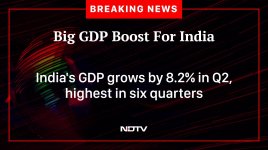
Exceeding expectations and marking a six-quarter high, India's gross domestic product (GDP) quickened to 8.2% in the second quarter of FY26, up from 5.6% in the same quarter last year. The expansion is underpinned by strong rural and government expenditure even as private capital spending remained subdued.
India's GDP in the last quarter follows a 7.8% growth in the April–June quarter.
Private consumer spending, which accounts for around 57% of GDP, rose 7.9% year-on-year in July-September, compared with a 7.0% rise a quarter ago. Apart from consumption, the strong economic performance was led primarily by the manufacturing sector, which grew 9.1 % year on year as against 2.2% in the same period last year.
Meanwhile, the country's nominal GDP grew at 8.7% during the previous quarter.
An Economic Times poll had forecast a 7.3% growth rate in the second quarter, higher than the Reserve Bank of India’s projection of 7%.
Economists had said pre-festive inventory buildup, coupled with GST rationalisation, would have bolstered activity.
Government spending decelerated, declining 2.7% year-on-year in the three months through September as compared to growth of 7.4% in the previous quarter, the data released on Friday showed.
India lowered Goods and Services Tax rates on most items from September 22, which is expected to bolster consumption in the world’s fifth-largest economy.
Demand for household products and groceries had revived in the second quarter even before the GST cuts on key staples took effect from September 22, ET had reported citing data by Numerator (formerly Kantar) and growth numbers of leading fast-moving consumer goods (FMCG) firms.
Finance Minister Nirmala Sitharaman had said that the GST rejig is set to bring to Rs 2 lakh crore in hands of the common people, signalling a possibility of higher discretionary spending.
"Growth has exceeded expectations dramatically to 8.2%, led by statistically favourable deflator effects, lagged effects of monetary and regulatory easing and a limited hit so far on India's exports,” Madhavi Arora, Chief Economist, Emkay Global Financial Services, told Reuters.
Agriculture grew 3.5% in the second quarter of FY26 on an annual basis. The sector had grown at 4.1% in Q2 FY25. The mining sector contracted 0.04% in Q2 FY26, against a contraction of 0.4% in FY25.
Further, the secondary sector consisting of manufacturing and electricity industries recorded a growth of 8.1% on an annual basis. The growth rate for India's secondary sector had stood at 4.0% in the same period of the last fiscal.
The tertiary sector growth stood at 9.2% annually. Growth for trade, hotels, transport, communications and services related to broadcasting grew 7.4% on an annual basis in Q2 FY26, up from 6.1% in FY25.
Meanwhile, financial, real estate and professional services witnessed a growth of 10.2% in September quarter as against 7.2% in Q2 of the previous fiscal.
Public administration and defence recorded a growth of 9.7% in Q2FY26 on an annual basis against 8.9% in FY25.
“A sustained recovery in economic momentum emerged in the second quarter, driven by agriculture, manufacturing, and construction, as evidenced by high-frequency data,” Rajani Sinha, chief economist at CareEdge Ratings, told ET before the print was released.
Industrial output strengthened, with the Index of Industrial Production rising 4.1% on average in the September quarter, compared with 2.7% a year earlier. Manufacturing output expanded 4.9% from 3.3% in the same period last year.
Government capital expenditure climbed 31% in the September quarter, slower than the 52% jump in the preceding quarter but stronger than the 10% growth recorded a year earlier. Merchandise exports rose 8.8%, reversing a 7% drop in the corresponding year-ago quarter, lifted by front-loaded shipments ahead of US tariffs.
Household consumption, which accounts for roughly 60% of the economy, strengthened in the July-September quarter as rural spending improved on better agricultural output. Urban demand and private investment continued to lag, Reuters reported.
India's GDP in the last quarter follows a 7.8% growth in the April–June quarter.
Private consumer spending, which accounts for around 57% of GDP, rose 7.9% year-on-year in July-September, compared with a 7.0% rise a quarter ago. Apart from consumption, the strong economic performance was led primarily by the manufacturing sector, which grew 9.1 % year on year as against 2.2% in the same period last year.
Meanwhile, the country's nominal GDP grew at 8.7% during the previous quarter.
An Economic Times poll had forecast a 7.3% growth rate in the second quarter, higher than the Reserve Bank of India’s projection of 7%.
Economists had said pre-festive inventory buildup, coupled with GST rationalisation, would have bolstered activity.
Government spending decelerated, declining 2.7% year-on-year in the three months through September as compared to growth of 7.4% in the previous quarter, the data released on Friday showed.
India lowered Goods and Services Tax rates on most items from September 22, which is expected to bolster consumption in the world’s fifth-largest economy.
Demand for household products and groceries had revived in the second quarter even before the GST cuts on key staples took effect from September 22, ET had reported citing data by Numerator (formerly Kantar) and growth numbers of leading fast-moving consumer goods (FMCG) firms.
Finance Minister Nirmala Sitharaman had said that the GST rejig is set to bring to Rs 2 lakh crore in hands of the common people, signalling a possibility of higher discretionary spending.
"Growth has exceeded expectations dramatically to 8.2%, led by statistically favourable deflator effects, lagged effects of monetary and regulatory easing and a limited hit so far on India's exports,” Madhavi Arora, Chief Economist, Emkay Global Financial Services, told Reuters.
Sectoral Classification
The primary sectors comprising agriculture and mining industries witnessed 3.1% growth on an annual basis as against 3.5% in the corresponding period of FY25.Agriculture grew 3.5% in the second quarter of FY26 on an annual basis. The sector had grown at 4.1% in Q2 FY25. The mining sector contracted 0.04% in Q2 FY26, against a contraction of 0.4% in FY25.
Further, the secondary sector consisting of manufacturing and electricity industries recorded a growth of 8.1% on an annual basis. The growth rate for India's secondary sector had stood at 4.0% in the same period of the last fiscal.
The tertiary sector growth stood at 9.2% annually. Growth for trade, hotels, transport, communications and services related to broadcasting grew 7.4% on an annual basis in Q2 FY26, up from 6.1% in FY25.
Meanwhile, financial, real estate and professional services witnessed a growth of 10.2% in September quarter as against 7.2% in Q2 of the previous fiscal.
Public administration and defence recorded a growth of 9.7% in Q2FY26 on an annual basis against 8.9% in FY25.
Key drivers behind India's GDP growth momentum
India’s economic growth is buoyed by a resilient rural economy, higher government spending and early export shipments.“A sustained recovery in economic momentum emerged in the second quarter, driven by agriculture, manufacturing, and construction, as evidenced by high-frequency data,” Rajani Sinha, chief economist at CareEdge Ratings, told ET before the print was released.
Industrial output strengthened, with the Index of Industrial Production rising 4.1% on average in the September quarter, compared with 2.7% a year earlier. Manufacturing output expanded 4.9% from 3.3% in the same period last year.
Government capital expenditure climbed 31% in the September quarter, slower than the 52% jump in the preceding quarter but stronger than the 10% growth recorded a year earlier. Merchandise exports rose 8.8%, reversing a 7% drop in the corresponding year-ago quarter, lifted by front-loaded shipments ahead of US tariffs.
Household consumption, which accounts for roughly 60% of the economy, strengthened in the July-September quarter as rural spending improved on better agricultural output. Urban demand and private investment continued to lag, Reuters reported.
kambhakt
Registered Member
yeah but.....Bangaloreans LOVE the Bangalore airport. I think we will use every excuse we get to go there. It's one of the VERY BEST airports in Asia.
How many hours does it take you to get there.
Guynextdoor
Banned
How many hours does it take you to get there.
1 hour .

onlinpunit
Trusted Member
1.5 hours on lucky days !!How many hours does it take you to get there.
onlinpunit
Trusted Member
GST rares recalibration + Holiday season !!
Guynextdoor
Banned
1.5 hours on lucky days !!
I think the new metro will fix it.
@Persian GulfServices will not keep bailing out India’s merchandise exports forever
It might sound ironic, but dependence on Chinese imports can be best reduced/eliminated by getting Chinese companies to make the products which India imports from China in India.
Subhash Chandra Garg
Last Updated : 22 October 2024, 14:01 IST
Indian exports recorded good growth of 4.86 per cent in the first half of 2024-2025, as per quick estimates released on October 16, with total exports (merchandise and services) rising from $375 billion in April-September 2023-2024 to $393.2 billion during the same period in 2024-2025.
Merchandise exports grew only 1.02 per cent from $211.08 billion to $213.22 billion. Services exports did exceedingly well, rising 9.66 per cent from $164.14 billion to $180 billion.
The World Trade Organization (WTO) released the world trade outlook earlier this month, projecting 2.7 per cent growth of merchandise trade during 2024. In January-June 2024, the WTO reported Indian merchandise export growth at 4 per cent, against our merchandise export growth of only about 1 per cent during April-September, as per our data.
Is India’s merchandise growth slipping? Will services keep bailing out exports?
China is our bugbear
Exports to China, our fourth largest export market in the first half of 2023-2024 with India exporting $7.63 billion of goods, recorded a degrowth of 9.35 per cent, downgrading China to fifth place, with exports declining to $6.91 billion.
Our largest export market, the United States, recorded a healthy growth of 5.6 per cent with the first half of 2023-2024 exports growing from $38.23 billion to $40.38 billion. Our next three largest export markets — the United Arab Emirates, the Netherlands, and the United Kingdom — also did very well, recording an impressive growth of 11.45 per cent, 36.73 per cent, and 12.40 per cent respectively.
Our inability to step up exports to China continues to stymie India’s overall export growth.
On the contrary, our import dependence on China has been growing unstoppably. India imported $56.29 billion worth of merchandise from China in the first half of 2024-2025, making 16 per cent of our total imports of $350.66 billion. Worryingly, imports from China recorded a growth of 11.52 per cent, much higher than overall import growth of 6.16 per cent.
This hurts. India’s merchandise trade deficit of $49.38 billion with China during April-September 2024 constituted 41 per cent of the total trade deficit of $119.24 billion.
Unable to capitalise on China+1 policy
Our principal export markets (the US and the European Union) desperately want to reduce dependence on Chinese imports and shift their imports to friendly countries like India. Policies of China+1 and the recent high import tariffs on Chinese electric vehicles (EVs) seek to achieve this objective.
India, unfortunately, has not been able to take advantage of these policies.
There have indeed been a few success stories like Apple contractors establishing a major production base in India resulting in India’s electronics exports growing handsomely ($15.64 billion in the first half of 2024-2025 against $13.06 billion in 2023-2024) recording growth of 19.74 per cent. There is, however, no widespread shift of manufacturing to India from China.
WTO data for January-June 2024 informs that against India’s merchandise export growth of 4 per cent, Vietnam recorded export growth of 16 per cent, Hong Kong, China 14 per cent, Chinese Taipei 11 per cent, Republic of Korea 10 per cent, and Singapore 6 per cent. China’s export growth of 4 per cent equalled India’s.
Most of ‘+1’ shift is in East Asia. India is missing out.
Services exports are bailing us out
India’s services exports at $204.76 billion in 2018-2019 made up 38.28 per cent of total exports of $534.84 billion. In 2023-2024, services exports of $341.25 billion rose to 43.93 per cent of the total exports of $776.89 billion.
In five years, services exports generated a decent CAGR of 10.76 per cent, gaining an additional 1 per cent share every year. In the first half of 2024-2025, the share of services exports rose further to 45.78 per cent. This trend is likely to continue.
Services exports would, most likely, exceed merchandise exports in 2029-2030 when Modi 3.0’s term comes to an end.
Services exports (IT services, GCCs, other commercial services and the likes) have been India’s saviour; but may not bail India out forever. It is time we capitalise on the promise of other services (sports, travel, entertainment, and personal services like education, health and personal care) besides strengthening other under-developed non-personal services (financial, software as service, and the likes).
Revamp export promotion framework
The government runs hundreds of schemes and spends billions of dollars promoting merchandise exports. Data tells you that it is unfortunately making no real difference.
Services exports, on the other hand, have been growing handsomely despite no promotional and financial support from the government. Let the government shift 25 per cent of the resources it spends on merchandise export promotion and invest it in building infrastructure for promoting services export and in providing services tax support.
It might sound ironic, but it is a fact. Dependence on Chinese imports can be best reduced/eliminated by getting Chinese companies to make the products which India imports from China (solar cells and modules, electronic goods, pharmaceutical APIs etc.) in India. Such a strategic shift will also give India a much better ‘control’ if Chinese companies were to invest in setting up manufacturing plants in India. We need to review our restrictive policies of discouraging Chinese investment.
US companies need to be offered a business case to invest in India to marry India’s talent and US technology. A good beginning has been made in semiconductors. Let many more flowers bloom.
The combination of high-technology product manufacturing investments from both China and the US and a very businesslike services promotion policy can turn India into an export powerhouse.
We find "Home Demand" based growth of India, since it refused to sign NPT by 1974 nuclear test, while focussing on those industries who won't produce the 'smoke' for export orders, as compared to other Asian tigers ,.
We aren't unhappy to have the current living standard of India without having Export based progress/on those manufacturing industries for export
onlinpunit
Trusted Member
Problem is not the actual path. (Hebbal to Airport) but the main city traffic.I think the new metro will fix it.
Guynextdoor
Banned
Problem is not the actual path. (Hebbal to Airport) but the main city traffic.
yeah but the number of cabs rolling out of Kempegowda is a key reason for traffic. So Until Hebbal they can reach via metro. And then there's that new ring highway which opened last year- it will take people directly to hope farm withot entering the city. There will be 'some' relief in Hebbal. I wonder if it will be enough.
Guynextdoor
Banned
Plus @onlinpunit an easy way to fix this is to grow rich 
There's a new helicopter serive you can take from Airport to places like whitefield
There's a new helicopter serive you can take from Airport to places like whitefield

Thinking_Hard
Banned
According to some, since india didn't "bend the knee" to Fuherer Trump, we are not going to see a deal anytime soon. According to IMF, we will lose 0.3% percent GDP growth. Also, inflation is record low. So nominal growth is not going to touch 10% this year. Good for PCI though. We are easily clocking 5.5% or more annual growth on that front.
Thinking_Hard
Banned
India's GDP to grow at 7% in 2025, says Moody's; country to lead growth among emerging markets
Moody's projects India's GDP to grow at 7% in 2025, leading emerging and advanced markets. The report highlights India's domestic growth drivers as key to its economic resilience amidst global uncertainty. While most rated companies manage currency risks, some in specific sectors face dollar...
So an upgrade from past verdict.. Ty Dolund Trumpf!
Users who are viewing this thread
Total: 4 (members: 0, guests: 4)
Pakistan Defence Latest
-
Federal cabinet gives nod to imposition of emergency in KP; summary sent to president (43 Viewers)
- Latest: Desprado123
-

-
-
-
PAF pilot highlights how chinese J10C fighters have left US F16's Obsolete (1 Viewer)
- Latest: Signalian
Country Watch Latest
-
-
 What the Indian Air Force ought to do if Narendra Modi had a Spine (19 Viewers)
- Latest: AZ_HighCountry
-
-

-
Latest Posts
-
Federal cabinet gives nod to imposition of emergency in KP; summary sent to president (43 Viewers)
- Latest: Desprado123
-
-
What the Indian Air Force ought to do if Narendra Modi had a Spine (19 Viewers)
- Latest: AZ_HighCountry
-
-
