
Navigation
Install the app
How to install the app on iOS
Follow along with the video below to see how to install our site as a web app on your home screen.
Note: This feature may not be available in some browsers.
More options
Style variation
You are using an out of date browser. It may not display this or other websites correctly.
You should upgrade or use an alternative browser.
You should upgrade or use an alternative browser.
India - Pakistan conflict analysis - aims, tactics, strategy, results
- Thread starter RescueRanger
- Start date
More options
Who Replied?
Panzerkiel
Professional
7TH DIVISION AND THE BATTLE OF BARKI
Having considered the entire history of the 15 Division, it is time to consider the efforts of 7 Division, deployed immediately to the south of 15 Division, in the centre of the broad attack by XI Corps on the Pakistani line of defence on the locus of the Ichhogil Canal.
A reminder: the broad plan of action for XI Corps was to attack through its constituent divisions, 15 Division, 7 Division and 4 Division, towards the bridges and crossings over the Ichhogil Canal. 7 Division was given the task of attacking the crossing over the Canal at the village of Barki, in a south-east to north-west direction, on the road to Lahore; this was the task of 48 Brigade, while 65 Brigade was to capture the crossing at Bedian, to secure the left flank of the 48 Brigade attack from counter-attack by the PA.
It is sad to see that this part of the offensive got bogged down fairly early, was forced back onto the front foot by firm pressure from divisional command, lost soldiers in frontal attacks, and finally ended in the Battle of Barki. This battle had a tragic aftermath, and that will come into the narrative when looking at the actions of 4 Mountain Division.
PRELIMINARY MOVEMENTS
Before the attack commenced on 6th September, 7 Division was arranged on a north-east to south-west axis, almost 90o to the line of advance planned; so, Divisional HQ was at Narla (north-west of Bhikhiwind), 48 Brigade was further forward on the road to Lahore, and 65 Brigade was further on that NE-SW line, south of the Lahore Road, in the Marimegha area. The plan was for 17 Rajput to detach itself from the 65 Brigade concentration point, and secure the Bedian bridge by 18:00 HRS that evening (6th September evening). In front of 65 Brigade, 48 Brigade would advance along the road, supported by Central India Horse and artillery, and take Barki, by the same time, 18:00 HRS that evening.
Like 15 Division, 7 Division also achieved early successes. Before dawn, the border outposts were cleared. By 05:30 HRS, the Brigade (48 Brigade) advanced down the road; in front was 6/8 Gorkhas, backed up by 19 Maratha LI and 5 Guards. When they came close to an intermediate water bearing body called the Hudiara Drain, the opposition opened fire. The Gorkhas were pinned down, but recovered, and cleared the village Hudiara, lying north of the Lahore Road, by 10:30, and landed up facing very strong enemy positions across the Drain and on the Drain (meaning, to its east), so they dug in South of the village.
Across the Road was the village of Nurpur; 5 Guards was asked to clear that, cross was promptly foiled by the PA sensing the intentions of 5 Guards moving into Nurpur; they pre-empted the move, retreated to the other side of the Drain and blew up the bridge. The Guards continued, cleared Nurpur, and by 17:00 HRS on the 6th, had crossed the Drain and swung right, northwards, to cut off the new Pakistani positions on the west bank. The Pakistanis retreated to their strong point at Barki, which was very well fortified. The target of 18:00 HRS was clearly not going to be achieved.
At this stage, the Divisional HQ decided that 65 Brigade was to pass through 48 Brigade, already astride the Drain, cross the Drain over a Bailey Bridge, to be built by the Engineers and clear Barki. However, the PAF had other ideas, and attacked the road and formations in and around the starting point of the planned attack. The Engineers were badly delayed, and finally the Bailey Bridge came up on the Drain only by PM on the 7th September.
Meanwhile, 17 Rajput had got bogged down, literally, in its attempt to capture Bedian. First, its armoured adjunct, the troop from CIH that was to help its advance, got stuck in the slushy ground; Alone, by itself, 17 Rajput failed to take the Pakistani positions, defending Bedian with exactly the opposite strength of one infantry battalion and armour, so they dug in east of the Bridge. The enemy counter-attacked at night, but was driven back, and decided to slow down any possible attack by flooding the area by cutting the Upper Bari Doab Canal. So that put paid to that, at least for the time being.
Back on the roadside and on the Drain, the Engineers had struggled through artillery and air attacks and put up the Bailey Bridge by the afternoon of the 7th. This left 65 Brigade free to deploy two component battalions, 9 Madras and 16 Punjab, to attack and capture a village on the west side of the drain, 3 kilometres west, named Barka Kalan that same evening.
On the 9th, Lt.Gen. Dhillon visited Divisional HQ and wanted relentless action, including the use of armour at night, that had been done so successfully at Dera Baba Nanak immediately before that. That night, Barka Khurd, another village north of the Lahore Road, was cleared and occupied.
On the 9th evening, therefore, elements of 65 Brigade – 9 Madras and 16 Punjab* – were sitting at Barka Kalan, 3 kms west of the Hudiara Drain, on the Ichhogil Canal due south of Barki; another element was in occupation of Barka Khurd, on the west of the Drain, East-South-East of Barki. That Brigade’s third battalion, 17 Rajput, was left at Bedian, watching against any sudden attack by the opposition.
48 Brigade was in echelon behind 65 Brigade, on the Lahore Road, occupying Nurpur south of the Road (5 Guards) and Hudiara to the north (6/8 Gorkhas). 19 Maratha LI were in reserve.
* In a twist of fate, the Pakistani 16 Punjab and the Indian 16 Punjab were both involved in the 1965 conflict. Sadly, the Pakistani 16 Punjab suffered the heaviest casualties of any Punjab Regiment during the conflict, as pointed out by Cuirassier earlier.
@Cuirassier
THE BATTLE
The Battle of Barki itself was remarkable from the Indian point of view for one formation’s excellent performance, and for the sad fact that this performance led to that unit getting decimated soon afterwards. But we are running ahead.
There was a great deal of anxious preparation for the actual attack on Barki, scheduled for the night of 10th/11th September. A new battalion had joined 7 Division, and this battalion, 4 Sikh, was assigned the task of attack along with Central India Horse. The attack was to have been in two phases – this, incidentally, seems to have been a particular favourite of the Brigade Commander, for a forward battalion to capture a point, and for a follow-up formation to ‘pass through’ and move towards the next objective. So 16 Punjab was the follow-up formation to 4 Sikh’s attack on Barki.
Barki proved to be a very tough nut to crack. Much on the lines of the house-by-house fighting last seen at Dograi, Barki was protected by pill-boxes, and entrenchments at each house. Even more, the PA 155 mm howitzers covered the Lahore-Wagah axis, and engaged the field artillery attached to 7 Division, just at 19:30 HRS, when the 4 Sikh commenced their attack, but the Sikhs pressed hard, in spite of losing nearly 150 men in their battalion, and in spite of the troubles that their armoured back-up, the CIH, went through, losing 4 tanks in very short order in a minefield. The regiment also lost its CO to injuries to which he succumbed later.
By 20:45 HRS, 16 Punjab were able to pass through to the Ichhogil Canal, along with surviving elements of the CIH, only to find that the PA had already prudently blown up the bridge.
This was indubitably success, but at a very high cost, a cost that was to be multiplied in the most stupid move that was made soon afterwards, affecting 4 Sikh.
Still on 7 Division’s front, however, 48 Brigade sought to make the most of the situation by attacking a village on the other side from Bedian, but failed the first time, on the 10th September.
There was a change of command then, and Brigadier Sahaney was posted out and Brigadier Pyara Singh took over.
The attack on the village, Jahman, was renewed, and it was taken a few days later, on the 15th.
At this stage, as part of the re-shuffling of forces that took place around 15th September, 48 Brigade was sent off in support of the beleaguered 4 Mountain Division, and that marked the end of 7 Division actions in the 65 conflict.
Panzerkiel
Professional
7 Div ops...
Firm base was established by 65 Brigade during night 5/6 Sep....this way 7 Div lost surprise....moreover it was a time consuming process of establishing a firm base...even though there was no requirement of making it in INDIAN territory which was already secured....
48 Bde took the lead, advanced and contacted PA defences on Hudiara Drain...later capturing Nurpur and Hudiara...however Hudiara bridge was partially blown by PA.
On 7 Sep, 65 Bde took over the advance from 48 Bde, with 4 Sikh in the lead....however, there was a communication failure within 48 Bde and its units....Barki was captured on 10 Sep, however, Barki bridge was destroyed by the defenders.....
7 Div offensive then stopped, with troops moving towards Khem Karan....
Firm base was established by 65 Brigade during night 5/6 Sep....this way 7 Div lost surprise....moreover it was a time consuming process of establishing a firm base...even though there was no requirement of making it in INDIAN territory which was already secured....
48 Bde took the lead, advanced and contacted PA defences on Hudiara Drain...later capturing Nurpur and Hudiara...however Hudiara bridge was partially blown by PA.
On 7 Sep, 65 Bde took over the advance from 48 Bde, with 4 Sikh in the lead....however, there was a communication failure within 48 Bde and its units....Barki was captured on 10 Sep, however, Barki bridge was destroyed by the defenders.....
7 Div offensive then stopped, with troops moving towards Khem Karan....
Panzerkiel
Professional
7 Div ops...
Firm base was established by 65 Brigade during night 5/6 Sep....this way 7 Div lost surprise....moreover it was a time consuming process of establishing a firm base...even though there was no requirement of making it in INDIAN territory which was already secured....
48 Bde took the lead, advanced and contacted PA defences on Hudiara Drain...later capturing Nurpur and Hudiara...however Hudiara bridge was partially blown by PA.
On 7 Sep, 65 Bde took over the advance from 48 Bde, with 4 Sikh in the lead....however, there was a communication failure within 48 Bde and its units....Barki was captured on 10 Sep, however, Barki bridge was destroyed by the defenders.....
7 Div offensive then stopped, with troops moving towards Khem Karan....
Many thanks.
It did seem redundant for 65 Brigade to create a firm base on a flank with so much activity giving away their intentions just to lunge for the bridge the next morning. The fierce fire received by 48 Brigade constituent battalions 6/8 Gorkhas and 19 Maratha LI the next morning was only to be expected. It is also a painful thing reading again and again of frontal attacks delivered without artillery support (or none mentioned) or tank fire as a substitute, some in broad daylight. Also, everyone seems to have marched to their targets all the way; not just the last mile, but all the way from their rail-head.
This has been covered, on the lines narrated; I started last night arranging the material segregating 47-48, 65 and 71, with your remarks on these as introductions to each chapter. The discussion on the individual actions is being presented as an afterword to each chapter. Once it looks fair and equitable and balanced on both sides, I will try - this in the medium time range after all the narrative is there in PDF - to put in citations; for which purpose, I have asked jbgt90 for the books he has to be sent to me urgently.
7 Div ops...
Firm base was established by 65 Brigade during night 5/6 Sep....this way 7 Div lost surprise....moreover it was a time consuming process of establishing a firm base...even though there was no requirement of making it in INDIAN territory which was already secured....
48 Bde took the lead, advanced and contacted PA defences on Hudiara Drain...later capturing Nurpur and Hudiara...however Hudiara bridge was partially blown by PA.
On 7 Sep, 65 Bde took over the advance from 48 Bde, with 4 Sikh in the lead....however, there was a communication failure within 48 Bde and its units....Barki was captured on 10 Sep, however, Barki bridge was destroyed by the defenders.....
7 Div offensive then stopped, with troops moving towards Khem Karan....
Click to expand...
Naturally my focus is on finishing the narrative; now 4 Mountain Division and I Corps at hand, all the rest described above to follow, once we have your critique of actions narrated.
OREWORD
At that time, Pakistan had its 12 Division in Kashmir, 7 Division in Chhamb, hastily raised 6 Armored Division and 9 Division as reserves located in the Sialkot sector, 15 Division at Sialkot, 10 Division at Lahore, 11 Division at Kasur along with crack 1 Armored Division nearby, 8 Division in Sind, and 14 Division in East Pakistan. The 11 Division, like the 6 Armored, had been hastily raised. The two armored divisions on strength belied the reality that Pakistan had actually converted its
Pakistan’s 7 Division had to be pulled back to the Sialkot-Lahore sector when Indian Xl corps crossed the international border. Its 6 Armored Division and 15 Infantry Division were opposing the advance of Indian 1 Corps from Kathua- Samba. Its 10 Division was opposing the advance of Indian 15 Division out of Amritsar. Its 8 Division was opposing Indian 11 Division in the desert, plus an independent brigade. That left its reconstituted 7 and previously uncommitted 9 Divisions as reserves, and the 1 Armored and an Infantry Division opposed by Indian 4 Division and 2 Independent Armored Brigade.
Because Pakistan had almost reached Akhnur and because it had made a shallow penetration at Khem -Karan, it could declare itself it was winning. Particularly since its Navy had just smacked the nose of the much more powerful Indian Navy by shelling Dwarka, and its compact, efficient air force had inflicted disproportionate casualties on the larger, more diffuse, and still under raising Indian Air Force.
But now lets look at the line-up from the Indian side.
In the north India had 3 Infantry Division out of Leh, which could spare two brigade to attack the Pakistan northern areas. In Kashmir India had bigger 19 and 25 Divisions compared to just one large 12 division for Pakistan.
In the stretch between Akhnur and Pathankot India had no less than five divisions, equal to half of Pakistan’ s entire army. These divisions were 10 Division (Akhnur), 26 Division (Jammu) and I Corps with 1 Armored, 6 Mountain and 14 Divisions. Plus Jammu held the 3 Independent Armored Brigade. In the Punjab India had three divisions and an independent armored brigade under Xl Corps. But another division, 23 Mountain, had moved up and was entering action. And Pakistan’s 1 Armored Division had been rendered almost ineffective at Khem Karan. India had nine divisions including one armored and two independent armored brigades between Akhnur and Ferozepur while Pakistan was left with almost six divisions including one armored.
India also had the equivalent of another division in loose brigades, one under formation, and seven mountain divisions in the east. Of these seven, at least one could have been spared without weakening the Northeast defenses.
This would have given India an effective one armored and ten infantry divisions, plus one armored brigade (leaving aside 2 (I) Armored Brigade which we deduct on account of casualties, as we have deducted Pakistan 1 Armored Division). On Pakistan’s side there were 1 armored and 5 infantry divisions.
If we assign an infantry division a value of 1, an armored division a value of 3, and the independent armored brigade a value of 2 (as being more than half as strong as an armored division) we get a total of 15 for India and 8 for Pakistan. Using Lanchester’s equation, we square each side’s combat power and get 225 for India and 64 for Pakistan, or a 3. 5 to 1 superiority.
Assume further that after another two weeks of fighting India loses the equivalent of three infantry divisions and an independent armored brigade, whereas Pakistan loses two infantry divisions and half its remaining armored division. (India’s losses would be greater because it was attacking.) Then India’s combat power reduces to 100 and Pakistan’s to 20; or a 5:1 superiority. In the next two weeks this could have meant defeat for Pakistan.
Yes, none of this was going to happen overnight. The two countries had been at war for a little over two weeks, and probably another two weeks would have been required for the state of attrition described above to come about on land and in the air. So give another two weeks after that, say six weeks in all, Lahore and Sialkot would surely have fallen.
But of course, when India barely managed to psychologically hold out in a two-week war, with an extra few days added for the initial defence of Chhamb-Akhnur, then there was no question of a six-week war.
THE THIRD PRONG – 4TH MOUNTAIN DIVISION
Having seen 15 Division and 7 Division in action, it remains to observe the action of the southern-most division, 4 Mountain Division, of XI Corps.
A mountain infantry division is not intended to fight armour or mechanised infantry in the plains. It is intended to defend mountain territory against an enemy similarly equipped, not against an enemy who might have armoured elements, or heavy artillery deployed against it in the open. Its organisation in battalions and companies is different; it has no anti-tank weaponry (at the time of the events we are discussing, normal plains infantry divisions had the 106 mm recoilless rifle, or the less effective 57 mm recoilless rifle.
It is a measure of the times that the 4 Mountain Division was alerted early in September; issued 4 instead of the regulation 6 recoilless rifles per battalion; entrained at 02:00 HRS on 5th of September in the Simla hills and detrained at 22:00 HRS near Valtoha, where 4 Mountain Division had set up its HQ. That was a 370 kms train journey. The troops then marched 10 to 12 kms to their forming-up places for the attack, which was to start at 05:30 HRS on the 6th September.
The division also got the Deccan Horse, which joined the division at Ambala, and travelled with it 320 kms by road.
The divisional line-up was:
- 4 Mountain Infantry Division
- Deccan Horse
- 7 Mountain Infantry Brigade – Brig. D. S. Sidhu
- 1/9 Gorkha Rifles
- 4 Grenadiers
- 7 Grenadiers
- 62 Mountain Infantry Brigade – Brig. H. C.Gehlaut
- 9 Jammu & Kashmir Rifles
- 13 Dogras
- 18 Rajputana Rifles
The layout of the actions that took place can be described simply, and concentrating on the Indian side, starts with the town of Valtoha, where 4 Mountain Division had set up HQ.
- About 22 kms away, in the West by South West direction, lay Kasur in Pakistan, one of the primary targets.
- Waigal, on the Rohi Nullah, was 14 kms away from Valtoha, in a West by North West direction;
- Bedian was 17.5 kms away, north west of Valtoha.
- Ballanwala, on the India-Pakistan border was 15 kms away, West by South West, more or less in the exact same compass bearing as Kasur, further behind within Pakistan.
62 Brigade was mustered 10 to 12 kms forward from Valtoha, so these intimidating distances from Valtoha need to be reduced by the radial distance between Valtoha and their locations; very approximately –
Waigal - 3 kms
Bedian - 6.5 kms
Ballanwala - 4 kms
Panzerkiel
Professional
THE TERRAIN
The layout of the actions that took place can be described simply, and concentrating on the Indian side, starts with the town of Valtoha, where 4 Mountain Division had set up HQ.
- About 22 kms away, in the West by South West direction, lay Kasur in Pakistan, one of the primary targets.
- Waigal, on the Rohi Nullah, was 14 kms away from Valtoha, in a West by North West direction;
- Bedian was 17.5 kms away, north west of Valtoha.
- Ballanwala, on the India-Pakistan border was 15 kms away, West by South West, more or less in the exact same compass bearing as Kasur, further behind within Pakistan.
62 Brigade was mustered 10 to 12 kms forward from Valtoha, so these intimidating distances from Valtoha need to be reduced by the radial distance between Valtoha and their locations; very approximately –
Waigal - 3 kms
Bedian - 6.5 kms
Ballanwala - 4 kms
When we looked at 7 Division, we were faced with an additional obstacle in front of the Ichhogil Canal, the Hudiara water obstacle. Here, too, we have the Rohi Nulla, or the Kasur Nalla. This Nulla came in from India into Pakistan, and flowed parallel to the Ichhogil Canal for some distance. It was aligned with a bund; a bund is a double wall aligning a water course, one wall on each side that holds in the waters of that water course. The water course flows between the parallel lines of the bund.
OBJECTIVES
In line with the general XI Corps objective to position the units under its command along the Ichhogil Canal and use it as a defensive barrier turned against the Pakistan Army, the plan for 4 Mountain Division, brought in to plug the gap between 7 Division and the 67 Infantry Brigade at Hussainiwala, was to use one brigade, 62 Brigade, to capture the crossing points over the Rohi Nulla at two locations and form a plug to prevent any Pakistani advance from those points.
In this first phase, 62 Brigade was to capture the bridge over the Nulla on the Khem Karan-Kasur Road and another crossing over the Nulla further south, on a road from Khem Karan to Ganda Singh Walla.
They also needed to form a ‘plug’.
Just to insure against any irruption from those two bridges, the brigade was under orders to form a firm base more or less between the two axes, from which any entry from either side could be contested. In addition to its constituent battalions, 9 J&K Rifles, 13 Dogra and 18 Rajrif, 62 Brigade was given the Deccan Horse and 1/9 Gorkha Rifles.
In the second phase, the other brigade, 7 Brigade, was to fan out and use its two battalions remaining (1/9 Gorkhas having gone to 62 Brigade) to attack the three points on the Rohi Nulla mentioned earlier, Bedian to the north, Waigal in the centre and Ballanwala to the south.
62 Brigade were to move forward from its positions on the Nulla, secure the east bank of the Canal, and destroy all bridges in their sector (the entire divisional sector).
Panzerkiel
Professional
Panzerkiel
Professional
Noted.There was and there will be no rules of engagement btw both..... Pakistan initiated wars to capture specific areas. Indians attack or responded or fight against us with this faith or ideology "let entirely remove Pakistan from the map". Both sides failed.... In the bigger picture, with a 1X4 ratio, the biggest failure of India despite large force, failed to completely destroy Pakistan.
In the bigger picture, never mind the details, it is always the biggest failure of India despite large force.
Not in 47-48. Indian troops fought to vacate aggression, and to recover those parts of the state of J&K that had been lost. Not enough a peanut shell fell outside these areas.Indians attack or responded or fight against us with this faith or ideology "let entirely remove Pakistan from the map"
Not in 65. Indian troops fought to resist a very large scale infiltration by regulars dressed as irregulars, and an attack with armour and artillery against her troops. Their counter-attack was specifically intended to achieve the Ichhogil Canal and convert it into a defensive line against Pakistan. Not much of entirely removing Pakistan from the map going on.
Not in 71. Indian troops fought to normalise conditions in East Pakistan, to enable the relief of 10 million refugees then living on Indian soil, and finally fought to neutralise the brutality and violence used by an army against its own people. Even Pakistani observers have commented in caustic terms about the lack of aggression in Indian operations on the western front; when they had opportunities, they failed to take them or drive home an advantage. Can't say this is indicative of the entirely removing Pakistan from the map mentality. One of the very inactive Army commanders became the next COAS, so government of India, and the redoubtable Mrs. Gandhi could not have been exactly displeased with his holding his hand.
Not in 99. Indian troops again fought to vacate aggression, and were bound by the rules of engagement not to cross to the Pakistani side. The IAF was similarly restricted.
THE INDIAN ATTACK: 62 BRIGADE
At 05:30 on 6th September, three units moved out.
To the north, on the Khem Karan-Kasur Road, 9 J&K Rifles advanced to the bund, captured the near-side embankment, but could not cross over to the far-side embankment.
To the south, on the Ganda Singh Wala side, 13 Dogra had also got to their objectives.
There is a piece of Pakistani territory sticking into India just south of Khem Karan, and 18 Rajputana Rifles squeezed out that bulge, and, along with some policemen, occupied it.
This state of satisfaction did not last very long. There was a strong counter-attack on the Ganda Singh Wala side, after heavy shelling; the attacking infantry came in armoured personnel carriers supported by tanks, very sophisticated methods for the times! The Dogras were unable to call for artillery support because the artillery officers were missing, one wounded, the other untraceable. After losing men, they withdrew.
At night, the situation worsened. Enemy shelling continued; the Dogra battalion retreated in disorder.
Meanwhile, further north, the Pakistani forces had broken out from a targeted location called Ballanwala, and outflanked the 9 J&K Rifles. The CO took 2 companies still in contact and retreated towards Div HQ at Valtoha. He had left behind two companies of the J&K Rifles; with the opposition swarming all around, there was no doubt that those two companies were in mortal danger.
There is an unexpected happy ending to report. The next day, as the division was regrouping around the village of Asal Uttar, Deccan Horse was asked to cover the movement of the infantry, and screen them. This they did to very great effect, and allowed the re-grouping to take place peacefully and efficiently. They also fished out the isolated two companies of the 9 J&K Rifles from the vicinity of the Rohi Nulla.
Before coming to this regrouping, one must continue the narrative where it had stopped.
By the evening of the 6th, all the victories of the morning had turned to ashes in the mouth of the CO 4 Mountain Division; not only was the Ganda Singh Walla position overrun, and the Dogras back at base, the Khem Karan- Kasur bridge capture had also had to be abandoned, as the position had been outflanked by a Pakistani break-out from Ballanwalla.
THE INDIAN ATTACK: TRIAL BY FIRE FOR 7 BRIGADE
But how did they break out? The Grenadiers had been assigned to capture and hold them; 7 Grenadiers were assigned to Ballanwala and got to within 50 m. of the target, but was driven back by very heavy artillery fire. Indian artillery could not mount counter-battery fire as the communications between the guns and the forward artillery officer was disrupted by the failure of the wireless set. For some unfathomable reason, the next target north, Theh Pannun, was assigned to 4 Grenadiers, but the one after that, the northernmost point, Waigal, was again to 7 Grenadiers.
Theh Pannun was reached, but the bridge could not be destroyed as the Engineer party had not come up in time. 4 Grenadier had to retreat under heavy fire.
Waigal again was reached by the tanks of a composite attack, but the infantry couldn’t get through, again, due to very heavy fire.
The picture was the same at the southern end, at Ballanwala, when by 21:00 HRS, 7 Grenadiers, backed by massive artillery fire, got to the Bund, but was shelled and machine-gunned very severely as they tried to cross the Nulla. They withdrew, and the badly shot-up detachment passed through other Indian Army lines and reached the Div HQ at Valtoha.
You are 110% right about the SSG raids. Indians had to move entire formations for search and mop-up/pacification efforts when the airborne attacks were carried out. Having actually spoken to some of the SSG officers who took part in these raids, this was the one common theme they all mentioned. I.e. the effect of their tactical operations (the purpose of which was to neutralize IAF assets on the ground) was more on the strategic side as Indians had to rebalance the employment of quite a few of their formations thus improving the situation for Pakistani defenses. So these attacks were well worth the immense sacrifice all these officers and ORs made in this Kamikazi mission.
Click to expand...
One of the lessons learnt from this discussion is that the Indian Army discounted the SSG raids. That should read - analysts of the Indian Army's reactions to events tend to discount the SSG raids. It dislocated the processes that had been envisaged for reacting to an attack by regular troops, unbalanced Western Command, and led to a lot of scrambling and ad hoc decision-making in the conflict that followed.
Panzerkiel
Professional
Panzerkiel
Professional
Many thanks.
It did seem redundant for 65 Brigade to create a firm base on a flank with so much activity giving away their intentions just to lunge for the bridge the next morning. The fierce fire received by 48 Brigade constituent battalions 6/8 Gorkhas and 19 Maratha LI the next morning was only to be expected. It is also a painful thing reading again and again of frontal attacks delivered without artillery support (or none mentioned) or tank fire as a substitute, some in broad daylight. Also, everyone seems to have marched to their targets all the way; not just the last mile, but all the way from their rail-head.
This has been covered, on the lines narrated; I started last night arranging the material segregating 47-48, 65 and 71, with your remarks on these as introductions to each chapter. The discussion on the individual actions is being presented as an afterword to each chapter. Once it looks fair and equitable and balanced on both sides, I will try - this in the medium time range after all the narrative is there in PDF - to put in citations; for which purpose, I have asked jbgt90 for the books he has to be sent to me urgently.
Naturally my focus is on finishing the narrative; now 4 Mountain Division and I Corps at hand, all the rest described above to follow, once we have your critique of actions narrated.
A few closing points regarding the Lahore front...sort of analysis....
First, lets solve the riddle of Op Riddle...it did live up to its name...
It conception was at fault.....being that to defend and improve the defensibility of Indian Punjab by an advance up til BRBL....it was a very limited objective which was set....not the best way.
Moreover, since Pakistan had the advantage of interior lines in Lahore sector....it could radiate threat towards Amritsar, Patti or Ferozepur...therefore, GOC of IA XI had three choices
first--deploy minimum forces on ground for defence, while holding the max in reserve for a massive counter attack at the right moment.
Second--launch a pre-emptive attack towards Lahore, cross BRBL and attempt to tie down max PA reserves.
Third--Capture area till eastern bank of BRB...which was the safest and cautious option. However, this option meant that the offensive elements would be stretched all along the front in order to reach BRBL...this force-stretch would automatically invite a PA penetration attack.
Therefore, it can be said that IA was everywhere, but they were not strong anywhere, they were unable to mass their superiority in any one sector in order to achieve the required dominance to help them achieve their desired aims.
GOC IA XI Corps also remained torn between PA threats to Amritsar and Khem Karan.
With regards to IA 6 Sep offensive...
-It achieved tactical surprise.
-However, it lacked finesse and boldness in its execution.
-Best option would have been to stagger the attacks of 15 and 7 Divisions...this way the divisional reserves of PA 10 Division would have been employed against one IA prong, leaving the other prong with a free run.
Undue caution remained the hallmark of Op Riddle. IA, since they did achieve surprise, had the potential to capture the important bridges over BRB / Ravi, but caution didnt help them.
There are couple of theories whether Lahore indeed was the intended objective for IA in 1965.
Couple of points which go in its favour are...
-the plan of the IA to cross BRB and make a bridgehead doesnt make sense unless it was planned to go further towards Lahore.
-PAF aircraft detected long convoys of engineer bridging vehicles east of Batapur. This indicates that IA wont stop at BRB but was planning to cross it for deeper objectives.
Some points which go against this theory....
-Both divisions (7 and 15) did not employ their full potential. They attacked with only two brigades each.
-Both these divisions were not having the required number of maps of this area, moreover, the maps which were available were outdated with old names.
-Their maps did not have any details of BRB.
-All attacking troops were employed from their line of march without rest or coordination which left them in no condition for operations across BRB.
-And then the formations employed were not the best which were available.
For IA, armor was the worst handled outfit. All attacks were led by infantry instead of armour. All the bridges could have been speedily captured by armor. Armor was also not employed as a punch but was distributed in packets.
Coming to PA 10 Division.
They overall mounted a good defence of their area. Their rehearsals and thorough briefing did pay off. Initial allocation of resources, initial dispositions and location was Divisional reserves were also sound.
The most outstanding feature of 10 Division battle was their sound perception of IA ops. For this Divisional staff should be lauded.
Launching of Divisional reserves (22 Brigade) within 48 hours from an unexpected direction not only reflects on the accurate reading of the battle but also GOC's boldness. Due to the aggressive posture of 10 Division, IA 15 Division was thrown off balance.
However, 10 Division made some mistake as well...like units were frequently broken and dished out. Dograi debacle could have been avoided if the integrity of 16 PR could have been ensured. Its depth company, which was from another unit, vacated the defences without informing 16 PR which had dire consequences later on.
PAF and PA artillery played their customary roles and were instrumental in all the engagements.
A few words about the defending PA 11 Division.THE TERRAIN
The layout of the actions that took place can be described simply, and concentrating on the Indian side, starts with the town of Valtoha, where 4 Mountain Division had set up HQ.
62 Brigade was mustered 10 to 12 kms forward from Valtoha, so these intimidating distances from Valtoha need to be reduced by the radial distance between Valtoha and their locations; very approximately –
- About 22 kms away, in the West by South West direction, lay Kasur in Pakistan, one of the primary targets.
- Waigal, on the Rohi Nullah, was 14 kms away from Valtoha, in a West by North West direction;
- Bedian was 17.5 kms away, north west of Valtoha.
- Ballanwala, on the India-Pakistan border was 15 kms away, West by South West, more or less in the exact same compass bearing as Kasur, further behind within Pakistan.
Waigal - 3 kms
Bedian - 6.5 kms
Ballanwala - 4 kms
When we looked at 7 Division, we were faced with an additional obstacle in front of the Ichhogil Canal, the Hudiara water obstacle. Here, too, we have the Rohi Nulla, or the Kasur Nalla. This Nulla came in from India into Pakistan, and flowed parallel to the Ichhogil Canal for some distance. It was aligned with a bund; a bund is a double wall aligning a water course, one wall on each side that holds in the waters of that water course. The water course flows between the parallel lines of the bund.
OBJECTIVES
In line with the general XI Corps objective to position the units under its command along the Ichhogil Canal and use it as a defensive barrier turned against the Pakistan Army, the plan for 4 Mountain Division, brought in to plug the gap between 7 Division and the 67 Infantry Brigade at Hussainiwala, was to use one brigade, 62 Brigade, to capture the crossing points over the Rohi Nulla at two locations and form a plug to prevent any Pakistani advance from those points.
In this first phase, 62 Brigade was to capture the bridge over the Nulla on the Khem Karan-Kasur Road and another crossing over the Nulla further south, on a road from Khem Karan to Ganda Singh Walla.
They also needed to form a ‘plug’.
Just to insure against any irruption from those two bridges, the brigade was under orders to form a firm base more or less between the two axes, from which any entry from either side could be contested. In addition to its constituent battalions, 9 J&K Rifles, 13 Dogra and 18 Rajrif, 62 Brigade was given the Deccan Horse and 1/9 Gorkha Rifles.
In the second phase, the other brigade, 7 Brigade, was to fan out and use its two battalions remaining (1/9 Gorkhas having gone to 62 Brigade) to attack the three points on the Rohi Nulla mentioned earlier, Bedian to the north, Waigal in the centre and Ballanwala to the south.
62 Brigade were to move forward from its positions on the Nulla, secure the east bank of the Canal, and destroy all bridges in their sector (the entire divisional sector).
Click to expand...
It was facing several problems of its own, since it had just been raised.
- It was NOT having its R&S unit.
-It Engineer unit was short of all sorts of equipment, including bridges.
-Signal unit was also short of communication sets.
-It had no S&T unit.
-6 Lancers, the divisional armor unit, was equipped with the older version of M47 tanks.
-Divisional artillery was having mix calibres.
FOREWORD
At that time, Pakistan had its 12 Division in Kashmir, 7 Division in Chhamb, hastily raised 6 Armored Division and 9 Division as reserves located in the Sialkot sector, 15 Division at Sialkot, 10 Division at Lahore, 11 Division at Kasur along with crack 1 Armored Division nearby, 8 Division in Sind, and 14 Division in East Pakistan. The 11 Division, like the 6 Armored, had been hastily raised. The two armored divisions on strength belied the reality that Pakistan had actually converted its106100 Independent Armored Brigade into a division by breaking out reserve tanks without US permission, by diluting tank crews in other regiments and by incorporating its self-propelled tank destroyers into new armored regiments. This hodge podge arrangement meant that Pakistan’s armor was much less effective than a seasoned armored division and an independent armored brigade.
Pakistan’s 7 Division had to be pulled back to the Sialkot-Lahore sector when Indian Xl corps crossed the international border. Its 6 Armored Division and 15 Infantry Division were opposing the advance of Indian 1 Corps from Kathua- Samba. Its 10 Division was opposing the advance of Indian 15 Division out of Amritsar. Its 8 Division was opposing Indian 11 Division in the desert, plus an independent brigade. That left its reconstituted 7 and previously uncommitted 9 Divisions as reserves, and the 1 Armored and an Infantry Division opposed by Indian 4 Division and 2 Independent Armored Brigade.
Because Pakistan had almost reached Akhnur and because it had made a shallow penetration at Khem -Karan, it could declare itself it was winning. Particularly since its Navy had just smacked the nose of the much more powerful Indian Navy by shelling Dwarka, and its compact, efficient air force had inflicted disproportionate casualties on the larger, more diffuse, and still under raising Indian Air Force.
But now lets look at the line-up from the Indian side.
In the north India had 3 Infantry Division out of Leh, which could spare two brigade to attack the Pakistan northern areas. In Kashmir India had bigger 19 and 25 Divisions compared to just one large 12 division for Pakistan.
In the stretch between Akhnur and Pathankot India had no less than five divisions, equal to half of Pakistan’ s entire army. These divisions were 10 Division (Akhnur), 26 Division (Jammu) and I Corps with 1 Armored, 6 Mountain and 14 Divisions. Plus Jammu held the 3 Independent Armored Brigade. In the Punjab India had three divisions and an independent armored brigade under Xl Corps. But another division, 23 Mountain, had moved up and was entering action. And Pakistan’s 1 Armored Division had been rendered almost ineffective at Khem Karan. India had nine divisions including one armored and two independent armored brigades between Akhnur and Ferozepur while Pakistan was left with almost six divisions including one armored.
India also had the equivalent of another division in loose brigades, one under formation, and seven mountain divisions in the east. Of these seven, at least one could have been spared without weakening the Northeast defenses.
This would have given India an effective one armored and ten infantry divisions, plus one armored brigade (leaving aside 2 (I) Armored Brigade which we deduct on account of casualties, as we have deducted Pakistan 1 Armored Division). On Pakistan’s side there were 1 armored and 5 infantry divisions.
If we assign an infantry division a value of 1, an armored division a value of 3, and the independent armored brigade a value of 2 (as being more than half as strong as an armored division) we get a total of 15 for India and 8 for Pakistan. Using Lanchester’s equation, we square each side’s combat power and get 225 for India and 64 for Pakistan, or a 3. 5 to 1 superiority.
Assume further that after another two weeks of fighting India loses the equivalent of three infantry divisions and an independent armored brigade, whereas Pakistan loses two infantry divisions and half its remaining armored division. (India’s losses would be greater because it was attacking.) Then India’s combat power reduces to 100 and Pakistan’s to 20; or a 5:1 superiority. In the next two weeks this could have meant defeat for Pakistan.
Yes, none of this was going to happen overnight. The two countries had been at war for a little over two weeks, and probably another two weeks would have been required for the state of attrition described above to come about on land and in the air. So give another two weeks after that, say six weeks in all, Lahore and Sialkot would surely have fallen.
But of course, when India barely managed to psychologically hold out in a two-week war, with an extra few days added for the initial defence of Chhamb-Akhnur, then there was no question of a six-week war.
THE THIRD PRONG – 4TH MOUNTAIN DIVISION
Having seen 15 Division and 7 Division in action, it remains to observe the action of the southern-most division, 4 Mountain Division, of XI Corps.
A mountain infantry division is not intended to fight armour or mechanised infantry in the plains. It is intended to defend mountain territory against an enemy similarly equipped, not against an enemy who might have armoured elements, or heavy artillery deployed against it in the open. Its organisation in battalions and companies is different; it has no anti-tank weaponry (at the time of the events we are discussing, normal plains infantry divisions had the 106 mm recoilless rifle, or the less effective 57 mm recoilless rifle.
It is a measure of the times that the 4 Mountain Division was alerted early in September; issued 4 instead of the regulation 6 recoilless rifles per battalion; entrained at 02:00 HRS on 5th of September in the Simla hills and detrained at 22:00 HRS near Valtoha, where 4 Mountain Division had set up its HQ. That was a 370 kms train journey. The troops then marched 10 to 12 kms to their forming-up places for the attack, which was to start at 05:30 HRS on the 6th September.
The division also got the Deccan Horse, which joined the division at Ambala, and travelled with it 320 kms by road.
The divisional line-up was:
THE TERRAIN
- 4 Mountain Infantry Division
- Deccan Horse
- 7 Mountain Infantry Brigade – Brig. D. S. Sidhu
- 1/9 Gorkha Rifles
- 4 Grenadiers
- 7 Grenadiers
- 62 Mountain Infantry Brigade – Brig. H. C.Gehlaut
- 9 Jammu & Kashmir Rifles
- 13 Dogras
- 18 Rajputana Rifles
The layout of the actions that took place can be described simply, and concentrating on the Indian side, starts with the town of Valtoha, where 4 Mountain Division had set up HQ.
62 Brigade was mustered 10 to 12 kms forward from Valtoha, so these intimidating distances from Valtoha need to be reduced by the radial distance between Valtoha and their locations; very approximately –
- About 22 kms away, in the West by South West direction, lay Kasur in Pakistan, one of the primary targets.
- Waigal, on the Rohi Nullah, was 14 kms away from Valtoha, in a West by North West direction;
- Bedian was 17.5 kms away, north west of Valtoha.
- Ballanwala, on the India-Pakistan border was 15 kms away, West by South West, more or less in the exact same compass bearing as Kasur, further behind within Pakistan.
Waigal - 3 kms
Bedian - 6.5 kms
Ballanwala - 4 kms
Click to expand...
A word about 4 Mountain Division...
Their orders were
-secure area east of BRB
-destroy bridge on Khem Karan-Kasur road.
-Contain any PA offensive.
4 Mountain Division had also its fair share of problems...
-It had only two brigades.
-It was a mountain division, not trained or organized to fight in the plains.
-They had 75 mm RRs instead of 105/106...moreover these they had only at the rate of 4/unit instead of normal 6/unit.
-9 H was placed under command at the last moment, once they started their move, therefore no coordination or marrying up could be done.
-Its artillery was ill-organized for giving fire support in plains.
KEEPING THE COUNTER-OFFENSIVE AT BAY:
RE-GROUPING
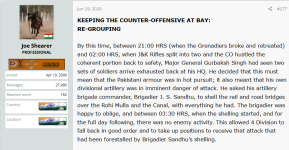
By this time, between 21:00 HRS (when the Grenadiers broke and retreated) and 02:00 HRS, when J&K Rifles split into two and the CO hustled the coherent portion back to safety, Major General Gurbaksh Singh had seen two sets of soldiers arrive exhausted back at his HQ. He decided that this must mean that the Pakistani armour was in hot pursuit; it also meant that his own divisional artillery was in imminent danger of attack. He asked his artillery brigade commander, Brigadier J. S. Sandhu, to shell the rail and road bridges over the Rohi Mulla and the Canal, with everything he had. The brigadier was happy to oblige, and between 03:30 HRS, when the shelling started, and for the full day following, there was no enemy activity. This allowed 4 Division to fall back in good order and to take up positions to receive that attack that had been forestalled by Brigadier Sandhu’s shelling.
Click to expand...
Some reasons of 4 Mountain Division rout....
-They were thrusted straight into battle after an almost 320 km journey.
-No recce of their new area.
-They were not given clear info about PA deployments.
-Both its brigades were launched on a broad front front without any depth in their attack.
-Both brigades had staggered H Hours.
-Armor was misused as usual.
-Artillery hardly intervened, was unable to silence PA artillery.
Panzerkiel
Professional
A few closing points regarding the Lahore front...sort of analysis....
First, lets solve the riddle of Op Riddle...it did live up to its name...
It conception was at fault.....being that to defend and improve the defensibility of Indian Punjab by an advance up til BRBL....it was a very limited objective which was set....not the best way.
Moreover, since Pakistan had the advantage of interior lines in Lahore sector....it could radiate threat towards Amritsar, Patti or Ferozepur...therefore, GOC of IA XI had three choices
first--deploy minimum forces on ground for defence, while holding the max in reserve for a massive counter attack at the right moment.
Second--launch a pre-emptive attack towards Lahore, cross BRBL and attempt to tie down max PA reserves.
Third--Capture area till eastern bank of BRB...which was the safest and cautious option. However, this option meant that the offensive elements would be stretched all along the front in order to reach BRBL...this force-stretch would automatically invite a PA penetration attack.
Therefore, it can be said that IA was everywhere, but they were not strong anywhere, they were unable to mass their superiority in any one sector in order to achieve the required dominance to help them achieve their desired aims.
Effectively, as you pointed out, IA radiated out from a point on diverging lines of advance, an open invitation for the opponent to pick gaps and counter-attack. With three divisions in hand, the battle was fought at company level, in a penny-packet kind of deployment. It sounds very well to turn the Pakistani defensive feature, the Ichholgil Canal, against them, but that so contradicts the principle of concentration of forces, or of keeping the opposition off balance, or of using superior numbers to overcome superior position.
GOC IA XI Corps also remained torn between PA threats to Amritsar and Khem Karan.
In fact, that is a kind summation. Dhillon Sahib was nowhere in the picture in the developments at Khem Karan; he was busy fire-fighting on behalf of 15 Division on the Lahore axis, and looking anxiously over his shoulder at the Battle of Barki. Finally, 41 Mountain Brigade (from poor, sad, battered 10 Division) and the Sikhs who had lost 150 men in the Battle of Barki, were moved in to reinforce 4 Mountain Division at Khem Karan when they were trying to win back the town, but it was too little too late, and even to deploy a tired, depleted 4 Sikh to spearhead an attack on an angry, aroused Pakistani redoubt around Khem Karan was an open invitation to trouble.
It is fair to say that the Khem Karan front was entirely managed by three officers; first, by Major General Gurbaksh Singh, notwithstanding his pessimism and his message to his Army Commander, as he carefully arranged his four surviving battalions to defend his fall-back position; second by Brigadier Theograj's inspiring leadership of the 1 Independent Armoured Brigade, and Salim Caleb's leadership of his Centurions in the 3 Cavalry.
With regards to IA 6 Sep offensive...
-It achieved tactical surprise.
-However, it lacked finesse and boldness in its execution.
-Best option would have been to stagger the attacks of 15 and 7 Divisions...this way the divisional reserves of PA 10 Division would have been employed against one IA prong, leaving the other prong with a free run.
Presumably 15 Div to go first, and focus all attention on themselves, and allow 7 Div to focus on the Barki axis, a battle that was hard-fought in the actual event, but that could have been easier to achieve for the Indian Army if part of the defenders had been diverted to the defence of Lahore.
Undue caution remained the hallmark of Op Riddle. IA, since they did achieve surprise, had the potential to capture the important bridges over BRB / Ravi, but caution didnt help them.
There are couple of theories whether Lahore indeed was the intended objective for IA in 1965.
Couple of points which go in its favour are...
-the plan of the IA to cross BRB and make a bridgehead doesnt make sense unless it was planned to go further towards Lahore.
Click to expand...
I believe that Defence Minister's Chavan's War Diary provides some useful inputs, albeit not directly, but in terms of a commentary by his Private Secretary, R.D. Pradhan:
1965 War: The Inside StoryAs soon as the conflict flared up, General Chaudhuri and the Directorate of Military Operations gave final touches to Operation Riddle planned as an offensive action to secure the eastern bank of the Ichhogil Canal. It was felt that the mere presence of the Indian troops on the canal opposite Lahore would draw Pakistani forces from Sialkot and other areas and thus reduce its offensive capabilities in other sectors. Moreover, if India could establish a bridgehead over the canal, the Pakistan Army would be forced to fight there and that would lead to the attrition of her smaller army. By basing the defence line along the canal India would confine the war to Pakistani territory. Operation Riddle was planned to meet an eventuality like the one the Indians were facing on 4 September. That was the next move as noted by Chavan in his diary.
Click to expand...
Defence Minister Y. B. Chavan's Diary of India-Pakistan War
Chapter 7: Operation Riddle: Counter Offensive
pp34 onwards
I submit that an Army with its back to the wall is more likely to be thinking in terms of a desperate defensive measure than of an attack that will win the day. This is not only supported by the demonstrated defensive mind-set of Indian commanders, including the very temperamental and moody COAS, General Chaudhuri, but also by a consideration of the dates and the plans that revolved around dates and timing. Thus:
The bold plan originally envisaged that I and XI Corps would launch simultaneous offensives in the Sialkot and Lahore Sectors respectively. While the XI Corps would establish a defence line along the Ichhogil Canal, I Corps would establish itself along with the MRL. The success of Operation Riddle was based on a surprise attack on two sectors simultaneously. However, by 4th September the Indian troops in the Chhamb-Akhnur area had come under unbearable pressure and a diversionary attack had become desperately essential as Pakistani forces were poised to launch attack towards Akhnur.
Click to expand...
Whatever aggressive spirit had permeated the plan in its original form was wholly dissipated by the firm grip on the throat of Western Command that Operation Grand Slam had given General Malik.
After the reverses in the battle for Jaurian, the situation was getting desperate and the Indian commanders had to advance the attack by XI Corps for the night of 5/6 September, I Corps were still on the move to their concentration areas and Operation Riddle could not be launched as originally planned. Realising urgency, Chavan approved Chaudhuri's decision to launch the XI Corps into attack across the international border in the Punjab. This was a desperate move and carried high risks. Chavan recorded on 4 September that: the step will change the complexion of the entire sitation. "If we fail - and I cannot even imagine of it - the Nation fails.
Click to expand...
Quite clearly, Operation Riddle had been transmuted by circumstances into a desperate move to relieve pressure, from being a dagger thrust into the key location of Lahore.
-PAF aircraft detected long convoys of engineer bridging vehicles east of Batapur. This indicates that IA wont stop at BRB but was planning to cross it for deeper objectives.
Considering that the bridge had been found collapsed only that morning, and considering that Hayde and his men had made their way across it, clearly if they had really seen such a sight, it would mean that a crossing had been pre-meditated, and it was not just a spur-of-the-moment opportunism by Brigadier Rikh.
Some points which go against this theory....
-Both divisions (7 and 15) did not employ their full potential. They attacked with only two brigades each.
-Both these divisions were not having the required number of maps of this area, moreover, the maps which were available were outdated with old names.
-Their maps did not have any details of BRB.
-All attacking troops were employed from their line of march without rest or coordination which left them in no condition for operations across BRB*.
-And then the formations employed were not the best which were available.**
Click to expand...
This part is too full of speculative element really to conclude one way or the other.
* We have already read about the advancing of the date of the attack. Quite clearly, those formations - 62 Brigade travelling for 20 hours from Simla to Valtoha, then marching 12 kms. to its jumping off point, Deccan Horse travelling with the Division 320 kms from Ambala - had been warned and moved in a manner timely from point of view of an attack two or three days later, and had to move straight into battle.
** Too many mountain troops were summoned for duties in the plains; worse, they had no anti-tank resource and, worse still, had to face attacks by armoured units. 41 Mountain Brigade being a prime example.
For IA, armor was the worst handled outfit. All attacks were led by infantry instead of armour. All the bridges could have been speedily captured by armor. Armor was also not employed as a punch but was distributed in packets.
Comment is superfluous.
The only good handling of armour was during the three-day battle of Asal Uttar.
Coming to PA 10 Division.
They overall mounted a good defence of their area. Their rehearsals and thorough briefing did pay off. Initial allocation of resources, initial dispositions and location was Divisional reserves were also sound.
The most outstanding feature of 10 Division battle was their sound perception of IA ops. For this Divisional staff should be lauded.
Launching of Divisional reserves (22 Brigade) within 48 hours from an unexpected direction not only reflects on the accurate reading of the battle but also GOC's boldness. Due to the aggressive posture of 10 Division, IA 15 Division was thrown off balance.
However, 10 Division made some mistake as well...like units were frequently broken and dished out. Dograi debacle could have been avoided if the integrity of 16 PR could have been ensured. Its depth company, which was from another unit, vacated the defences without informing 16 PR which had dire consequences later on.
PAF and PA artillery played their customary roles and were instrumental in all the engagements.
Click to expand...
A few words about the defending PA 11 Division.
It was facing several problems of its own, since it had just been raised.
- It was {ed.} not {end ed.}having its R&S unit.
-It Engineer unit was short of all sorts of equipment, including bridges.
-Signal unit was also short of communication sets.
-It had no S&T unit.
-6 Lancers, the divisional armor unit, was equipped with the older version of M47 tanks.
-Divisional artillery was having mix calibres.
Click to expand...
Comments by @Panzerkiel speak for themselves.
Some reasons of 4 Mountain Division rout....
-They were thrusted straight into battle after an almost 320 km journey.
-No recce of their new area.
-They were not given clear info about PA deployments.
-Both its brigades were launched on a broad front front without any depth in their attack.
-Both brigades had staggered H Hours.
-Armor was misused as usual.
-Artillery hardly intervened, was unable to silence PA artillery.
Click to expand...
Again, further comment is superfluous.
Amended in the quoted portion.I just corrected my post....11 Div was NOT having its integral R&S unit.
These are amendments to portions earlier posted. Please consider them instead of the earlier posts. An effort has been made to reflect the time lines.
THE INDIAN ATTACK: 62 BRIGADE
At 05:30 on 6th September, three units moved out.
To the north, on the Khem Karan-Kasur Road, 9 J&K Rifles advanced to the bund, captured the near-side embankment, but could not cross over to the far-side embankment.
To the south, on the Ganda Singh Wala side, 13 Dogra had also got to their objectives.
There is a piece of Pakistani territory sticking into India just south of Khem Karan, and 18 Rajputana Rifles squeezed out that bulge, and, along with some policemen, occupied it.
This state of satisfaction did not last very long. There was a strong counter-attack on the Ganda Singh Wala side, after heavy shelling; the attacking infantry came in armoured personnel carriers supported by tanks, very sophisticated methods for the times! The Dogras were unable to call for artillery support because the artillery officers were missing, one wounded, the other untraceable. After losing men, they withdrew.
At night, the night of the 6th September, the situation worsened. Enemy shelling continued; the Dogra battalion retreated in disorder.
Meanwhile, further north, the Pakistani forces had broken out from a targeted location called Ballanwala, and outflanked the 9 J&K Rifles. The CO took 2 companies still in contact and retreated towards Div HQ at Valtoha. He had left behind two companies of the J&K Rifles; with the opposition swarming all around, there was no doubt that those two companies were in mortal danger.
There is an unexpected happy ending to report. The next day, the 7th September, as the division was regrouping around the village of Asal Uttar, Deccan Horse was asked to cover the movement of the infantry, and screen them. This they did to very great effect, and allowed the re-grouping to take place peacefully and efficiently. They also fished out the isolated two companies of the 9 J&K Rifles from the vicinity of the Rohi Nulla.
Before coming to this regrouping, one must continue the narrative where it had stopped.
By the evening of the 6th, all the victories of the morning had turned to ashes in the mouth of the CO 4 Mountain Division; not only was the Ganda Singh Walla position overrun, and the Dogras back at base, the Khem Karan- Kasur bridge capture had also had to be abandoned, as the position had been outflanked by a Pakistani break-out from Ballanwalla.
THE INDIAN ATTACK: TRIAL BY FIRE FOR 7 BRIGADE
But how did they break out? The Grenadiers had been assigned to capture and hold them; 7 Grenadiers were assigned to Ballanwala and got to within 50 m. of the target, but was driven back by very heavy artillery fire. Indian artillery could not mount counter-battery fire as the communications between the guns and the forward artillery officer was disrupted by the failure of the wireless set. For some unfathomable reason, the next target north, Theh Pannun, was assigned to 4 Grenadiers, but the one after that, the northernmost point, Waigal, was again to 7 Grenadiers.
Theh Pannun was reached, but the bridge could not be destroyed as the Engineer party had not come up in time. 4 Grenadier had to retreat under heavy fire.
Waigal again was reached by the tanks of a composite attack by armour and infantry, but the infantry couldn’t get through, again, due to very heavy artillery fire.
The picture was the same at the southern end, at Ballanwala, when by 21:00 HRS on the 6th night, 7 Grenadiers, backed by massive artillery fire, got to the Bund, but was shelled and machine-gunned very severely as they tried to cross the Nulla. They withdrew, and the badly shot-up detachment passed through other Indian Army lines and reached the Div HQ at Valtoha.
KEEPING THE COUNTER-OFFENSIVE AT BAY:
RE-GROUPING
By this time, between 21:00 HRS (when the Grenadiers broke and retreated) and 02:00 HRS (on the 7th now, past midnight), when J&K Rifles split into two and their CO hustled the coherent portion back to safety, Major General Gurbaksh Singh had seen two sets of soldiers, the Dogras and 7 Grenadiers, arrive exhausted back at his HQ. He decided that this must mean that the Pakistani armour was in hot pursuit; it also meant that his own divisional artillery was in imminent danger of attack. He asked his artillery brigade commander, Brigadier J. S. Sandhu, to shell the rail and road bridges over the Rohi Nulla and the Canal, with everything he had. The brigadier was happy to oblige, and between 03:30 HRS, when the shelling started, and for the full day following, the 7th of September, there was no enemy activity. This allowed 4 Division to fall back in good order and to take up positions to receive that attack that had been forestalled by Brigadier Sandhu’s shelling.
The Divisional HQ shifted back 10 kms to the hamlet of Gharyala, and the remaining four battalions, 1/9 Gorkhas, 4 Grenadiers, who had come out of Theh Pannun under fire, two companies of 9 J&K Rifles, brought out in the nick of time from the mayhem on the Ruhi Nulla after being outflanked by the opposition breaking out of Ballanwala, and 18 Rajputana Rifles, vacating their position in the Pakistani enclave were arranged in defensive positions around the village of Asal Uttar.
THE BATTLE OF ASAL UTTAR: THE HORSESHOE
By 15:00 HRS, the Engineers had laid land mines all around the defensive positions of the infantry battalions. Before describing the battle that ensued in detail, over the three days of fighting that followed, some of the state of mind of the general officers involved on the Indian side needs to be depicted.
All the events described above took place on the 6th of September, and by the night, Major General Gurbaksh Singh felt the need for moral sustenance and sent a messenger to the Army Commander, stating, effectively, that 4 Mountain Division had cracked up. For Gurbaksh (gifted by the Guru) to seek help from Harbaksh (gifted by God) was quite appropriate, but the GOC-in-C, after having been woken up at 3 in the morning with this message, decided to check for himself before taking any action. In any case, it was not at all clear what he could call upon; at this time, the early hours of the 7th September, 15 Division was trying to keep its footing after the disastrous recall from Batapore, 7 Division had just been stopped short of its objectives, and would resume fighting only on the 10th, and 23 Mountain Division was still miles away, rushing along as best as it could. XV Corps could not help; it was just recovering from the tumultuous events of the previous four days of fighting, on the 1st, 3rd, 4th,and 6th, and needed time to recover. 41 Mountain Brigade, having been brushed aside by Pakistani armour during Grand Slam, needed time to recover its morale, and was useful only during the great re-shuffle that took place around the 15th of September.
On personal inspection, General Harbaksh Singh came to the conclusion that the situation could stand a little pressure even then, and no replacement of 4 Mountain Division was needed. [To be continued]
@meghdut
@Panzerkiel
@Blain2
@Hachiman
@TsAr
Please note #281 has been uploaded with minor modifications to #276 and #277. The modifications consist of including a lot more data about time lines, ie, when and at what time did something happen.
When I was reading it from my sickbed, it seemed to be confusing for a reader to keep track of events, so these amendments were made. Hope it makes the narrative clearer.
Panzerkiel
Professional

Panzerkiel
Professional
Panzerkiel
Professional
Panzerkiel
Professional
Panzerkiel
Professional
@meghdut
These showed up, as we see, in the narration itself, vividly.
A word about 4 Mountain Division...
Their orders were
-secure area east of BRB
-destroy bridge on Khem Karan-Kasur road.
-Contain any PA offensive.
4 Mountain Division had also its fair share of problems...
-It had only two brigades*.
-It was a mountain division, not trained or organized to fight in the plains**.
-They had 75 mm RRs instead of 105/106...moreover these they had only at the rate of 4/unit instead of normal 6/unit**.
-9 H was placed under command at the last moment, once they started their move, therefore no coordination or marrying up could be done^.
-Its artillery was ill-organized for giving fire support in plains***.
The reasons for the disastrous attacks by 4 Mountain Division are very clearly outlined by these points.
- (*)Lower than normal strength of infantry;
- (**) Not organised for plains fighting;
- (***)Artillery uncertain about plains conditions;
- (^) No coordination with Deccan Horse (General Vaidya's regiment), who fought very well on their own in the rescue of the isolated two companies of Dogras, and in shielding the defeated infantry formations digging in, but as isolates, not as a coordinated, integrated effort.
I followed this thread diligently till now. I read an interesting speculation by Sukhwant Singh. He speculates that both PA and IA were British trained , most of their Sr Officers were at that time KCIOs and so highly influenced by British style of warfare which favoured defensive approach, achieving overwhelming superiority in numbers and firepower and trade space for time till such conditions are met. Also whenever attacking use attrition rather than manoeuvre to achieve victory.
He moreover argues that such tactic was bound to fail in short wars fought in the subcontinent hence was ill suited for both armies. He concludes saying that the same attitude actually bolstered the defensive potential of both armies at the cost of their offensive capabilities. So both performed better in defence than while attacking which manifested itself Asal Uttar and Chawinda battles to the less than satisfactory performance of both countries premier armoured formations.
Reasonable, but please recall the comment - can't remember the exact location - about the PA being better in attack and the IA being better in defence. Or did I imagine that? It sounds so apt.
All the events described above took place on the 6th of September, and by the night, Major General Gurbaksh Singh felt the need for moral sustenance and sent a messenger to the Army Commander, stating, effectively, that 4 Mountain Division had cracked up. For Gurbaksh (gifted by the Guru) to seek help from Harbaksh (gifted by God) was quite appropriate, but the GOC-in-C, after having been woken up at 3 in the morning with this message, decided to check for himself before taking any action.
There is an error here. It was Lt. Gen. J. S. Dhillon, GOC, XI Corps, who concluded that 4 Mountain Infantry Division was beaten and needed replacement. Maj. Gen. Gurbaksh Singh of 4 Mountain Infantry Division, had NOT written off his own command, and was working hard to set up defences against the inevitable PA riposte. When Lt. Gen. Harbaksh Singh arrived on the scene, Maj. Gen. Gurbaksh Singh was busy repairing his defences.
RECAPITULATION: BEFORE THE BATTLE
To recapitulate:
On the 6th of September, the 62 Brigade of 4 Mountain Infantry Division attacked to the south-west, targeting the bund over the Ruhi Nulla on the main road, and another point on the road going off at an angle to the main road, going to Ganda Singh Wala.
It was also, as a second phase, to go beyond the bunds and reach the Ichhogil Canal from Ballanwala to Ganda Singh Wala, acting in concert with 7 Brigade, that was to reach the Canal further north, in the stretch between Ballanwala and Bedian.
For this, 62 Brigade had three battalions of its own, 9 J&K Rifles, 13 Dogras and 18 Rajputana Rifles, and one battalion from the other brigade, 7 Brigade,1/9 Gorkha Rifles, and also the armoured component, 9 Horse, the Deccan Horse, so, four infantry battalions and an armoured regiment. 9 J&K was to go for the bund on the Ruhi Nulla on the main road Khem Karan - Kasur, 13 Dogra were to take the southern section on the Ganda Singh Wala side. 18 Rajrif were assigned to squeeze out an enclave to the south of the firm ground around Khem Karan; 1/9 Gorkhas remained under the Divisional command for the time being.
62 Brigade won early gains, on the 6th September morning, and lost it all by the evening. 9 J&K Rifles got to the nearside embankment of the bund, but could not cross the Nulla or capture the far side emba/nkment against the heavy and concentrated artillery and tank fire. The Dogras, getting their objectives on the Nulla in the morning, lost it at 13:00 HRS to a mechanised infantry and tank push, preceded by an artillery barrage. We have seen, in the commentary on the action, the unfamiliarity of the artillery component to offering supporting fire in the plains, and to operating in the plains in general. The artillery officers with the battalion could not help; one was wounded, the other missing. By night, the battalion was defeated and retreated; even their firm base was abandoned, and the path was open for the Pakistani counter-attack.
9 J&K Rifles, sheltering around the near-side embankment of the Ruhi Nalla, were victims of the debacle further north. First, 7 Grenadiers, attacking Ballanwala, were repelled by heavy artillery fire. Again, there was no supporting fire from their own artillery, and this time, the problem was with the wireless. Later, in the afternoon, another attack did not come off. Second, 4 Grenadiers attacking Theh Pannun, reached the Canal, but could not blow up the bridge as the Engineering detachment did not turn up. Third, even further north, another team of 7 Grenadiers, supported by a troop of tanks, attacked Waigai; the tanks survived the shelling, the infantry could not brave it, the tanks alone could not hold it, so the party retreated. Fourth, a second attack by 7 Grenadiers on Ballanwala, supported by divisional artillery (mountain artillery fighting in the plains), got them to the eastern, near-side embankment of the Nulla, but heavy firing by Pakistani defenders, using machine guns and mortars, prevented them from going further; the intention was to cross the Nulla and the bund beyond, the western, far-side bund. Under heavy fire, they retreated right up to the Division HQ in Valtoha.
The path lay open for the PA to advance from Kasur or from any point on the Icchogil Canal that was bridged, and then after any bridge on the Nulla.
When the attack came, it was not a frontal attack. Pakistani armour burst out of the Ballanwala bridge at 02:00 HRS; the way ahead directly towards Khem Karan was clear, but the force made a sharp turn parallel to the Nulla it had just crossed, and outflanked the J&K Rifles formation guarding the eastern approach to the bridge across the Nulla on the Kasur-Khem Karan Road. Now this road, too, was open for PA armour to cross over.
The riflemen were split into two by the attack; the CO retreated with two companies, but they lost touch with each other in the darkness and reached Division HQ at Valtoha in bits and pieces. The other two companies, left behind in the confusion, were happily rescued during the course of the day by Deccan Horse.
Major General Gurbaksh Singh had the mortification of seeing two separate battalions, 7 Grenadiers and 9 J&K Rifles, scrambling to reach his HQ position searching for safety. He ordered his divisional artillery commander to target the bridges over the Nulla and, behind it to the West, over the Canal.
The Indian accounts believe that this stemmed the Pakistani advance just sufficiently long enough for 4 Mountain Division to re-group. The Pakistani account points to heavy damage to the Ichhogil Canal bridge due to a tank accident.
The pause enabled Maj. Gen. Gurbaksh Singh to arrange his battered and defeated infantry battalions into a defensive position around Asal Uttar, while he himself shifted his divisional headquarters from Valtoha to Gharyala. The formations were the 1/9 Gorkha Rifles, 4 Grenadiers, 9 J&K Rifles (2 companies at first, 2 more on rescue by Deccan Horse), 13 Dogras and 18 Rajputana Rifles. A minefield was laid around infantry positions by the Engineers, under cover of the tank regiment.
The Deccan Horse shielded these activities, and also rescued 2 companies of 9 J&K Rifles from their precarious position on the Ruhi Nulla, where they had been left behind during the precipitate withdrawal of the other half of the battalion.
With the infantry in place, with their artillery well located and with the integral armour in the shape of the Deccan Horse, 4 Mountain Infantry Division was as ready as it could be, to receive any assault at arms. However, as a matter of abundant precaution, 2 Independent Armoured Brigade was also assigned to keep a watching brief from an immediately rearward location.
THE PAKISTAN ARMY PLAN: BRIDGEHEAD, BREAKTHROUGH,
EXPLOITATION
In simple terms, the Pakistan Army plan was a classic:
- an Infantry Division reinforced by additional armour would break into Indian defences and form a bridgehead;
- a strong Armoured Division would then pass through and break out through the weakened Indian perimeter;
- in the final step, the Armoured Division would travel at speed through undefended Indian hinterland, reaching strategic objectives rapidly.
The break through by a strong Armoured Division was assigned to the crack 1 Armoured Division. Commanded by Major General Nasir Ahmed Khan, this division had five regiments, organised as three brigades.
In the exploitation phase, those three brigades would take their own individual routes forward, ensuring that the enemy was continuously under pressure on one or the other front. The routes were formed around initial objectives; the first, the Sutlej bridge over Harike, to be reached the first day (45 kms from Kasur, 35 kms from Khem Karan, as the crow flies); the second, Jandiala Guru, east of Amritsar (45 kms from Harike); the third, the bridge over the Beas (50 kms from Harike), both to be reached on the second day. In other words, in rough daily transit of 40 to 50 kms at a time, not particularly out of reach for M-47 or M-48s, representing perhaps two hours each of unopposed passage, the objectives would be reached, and the next stage of break-out could be decided.
Apart from completely outflanking XI Corps, and finding its way to within 20 kms of the sensitive Sikh centre of Amritsar, to defend which every Sikh in sight would have abandoned whatever he was doing and rushed back, this would find the column, on the second day, in a line with Ludhiana and Chandigarh, equidistant between Srinagar and Delhi, and on the lines of communications between the rest of India and her bases at Udhampur (200 kms) and Pathankot (140 kms).
At the time that the plan might have been made, there might not have been any concrete information available about the Indian I Corps; so this would have looked like an upsized Grand Slam, hooking around Amritsar instead of Jammu, and isolating not just XV Corps, but XI Corps as well.
A quick aside about the topography.
There were two roads out of Khem Karan, one leading to Bhikhiwind, one angled further right to Patti. Asal Uttar, on which village the 4 Mountain Infantry Division defences were based, lies about 5 kms out of Khem Karan on the road to Patti. It is important to know this because Indian deployment was on this crossbar, the Lakhna – Chima Kalan Road. The heavy fighting took place in the region between Asal Uttar and these two villages that are about 11 kms apart.
Interlude: Orientation and the roads around the battlefield The road from Khem Karan to Amritsar is 60 kms, running north by north-east. Five or six kms up the road is the turn to the village of Asal Uttar, as mentioned before; another twenty kms. up is the town of Bhikhiwind, hence the name the Bhikhiwind Road.
On turning right on the Bhikhiwind Road, Asal Uttar is two and a half kilometres away. That road then turns left and heads towards Patti, about twenty five to twenty six kms.away, angling away from the Bhikhiwind Road in the north-east direction. This is what is referred to in the literature as the Bhikhiwind axis, and the Patti axis. The Patti Road also contains, quite close to Asal Uttar, the earlier HQ of 4 Division, Valtoha, and further on the road, towards Patti, the shifted HQ, at Gharyala.
About 20 kms from Asal Uttar, to the right of the Patti Road, is the village of Chima (look for Chima Kalan on Google Maps; Cheema takes you far, far away). To the left of the Patti Road is the other village of Lakhna. Set in a little, it is 5 kms further away from Khem Karan than Chima Kalan. One can imagine the Khem Karan – Patti road as the upright of a ‘T’, and the road connecting Lakhna and Chima Kalan, at right angles to the Khem Karan – Patti Road, would be the crossbar of the ‘T’.
While 4 Mountain Infantry Division had arranged its forces around Asal Uttar, 2 Independent Armoured Brigade was further back, strung out in a north-westerly direction, originally facing towards Khem Karan, between the villages of Chima Kalan and Lakhna. These two are located on the south side and the north side of the road leading from Bhikhiwind to Harike, so effectively, we have a triangle: the base being this road, one side, ending in Asal Uttar, starting from Bhikhiwind; the other side, also ending in Asal Uttar, starting from the intersection of the Bhikhiwind-Harike Road with the Patti road.
THE BATTLE OF ASAL UTTAR - 8TH TO 10TH SEPTEMBER
On the 8th September A preliminary probing attack was launched by Chaffee tanks on the morning of the 8th; they advanced under artillery cover along the Khem Karan – Bhikhiwind axis, and kept advancing even against Indian artillery, and stopped only when brought under fire by the Sherman tanks of Deccan Horse. Since a frontal attack seemed to be likely to face strong opposition, the attacking force split into smaller groups to outflank the firmed up infantry positions. They were fairly successful, and at one stage had surrounded the 1/9 Gorkhas, the 9 J&K Rifles and 62 Brigade HQ. Deccan Horse, in their hyperactive style, came in and mounted a counter-attack, and managed to stall the Chaffee contingent.
But this was a probing attack; the main attack came in the afternoon of the 8th with Patton tanks that overran the 1/9 Gorkhas positions; 4 Grenadiers intervened and knocked out 4 tanks, but that did not stop the bulldozing charge of the MBTs, who broke through all obstacles and overran the trenches of the Grenadiers; they also got into the positions of 18 Rajasthan Rifles, and endangered 7 Brigade HQ.
At this stage, the first of several interventions by 2 Independent Armoured Brigade occurred. 3 Cavalry under Lt. Col. Salim Caleb, stepped in. They had been positioned in the Chima Kalan – Lakhna area, and their intervention cost the attacking force 4 Pattons and a Chaffee. The attack then probed the area to the west of this encounter.
By end of day on the 8th, the PA had successfully advanced from the line of the Ruhi Nulla into the former positions of the 4 Mountain Infantry Division, just before the village of Asal Uttar, and had been probing the prepared defensive positions of the Indians, frequently overrunning the Indian defences, but did not make a break-through; the Chaffees were thwarted by Deccan Horse with its Shermans, the Pattons were halted by 3 Cavalry, fighting Centurions.
On the 9th September The Pakistani attack started at 02:00 HRS. 2 Independent Armoured Brigade had moved its other components into place beside 3 Cavalry into two sickle-shaped formations between Chima Kalan and Lakhna, even before the formal assignment of his brigade to the command of 4 Mountain Infantry Division.
When the attack took place, in spite of heavy artillery, tank and infantry fire from all hands in 4 Div, the tanks kept moving forward, until they hit the minefield laid by the engineers. However, there was to be only minor respite; during the first half of the daylight hours, there were probing attacks, as well as aerial attack.
The heavy all-arms attack came in the afternoon.
First, the softening up. PA artillery opened fire, there was aerial attack as well, for an hour. Then the armour advanced, attacking 18 Rajrif from three directions in their outlying positions. A fierce battle broke out, and the tanks sought to come into redoubts of 18 Rajrif. Indian artillery and armour lay down very heavy defensive fire, but it could not stop the attack. This bitter, close quarters battle continued for some time until Pakistani armour came so deep into the defences of the infantry that relatively close-range weapons came into play. Recoilless rifles and, later, rocket launchers were fired. The attack finally let up at 22:00 HRS.
On the 10th September For a third day in succession, there was a determined effort to break through.
Brigadier Theograj had positioned his 2 Independent Armoured Brigade with the previous two days’ experiences in mind. 8 Cavalry with its AMX 13 light tanks was positioned on the flanks of the layout; it was hoped that this would funnel the Pakistani armour towards the Centurions lined up to meet their advance.
From their movements, it was apparent that the Pakistani armour was trying to outflank the defensive positions by moving north parallel to the Ruhi Nulla, to attack them from behind. However, this had been anticipated, as the main approach through the Bhikhiwind Road had already been reasonably well defended, and an attack on the Indian left flank was also difficult; there was no way to penetrate deep enough across the front of the line of Indian defences to take the attack to the right, to the Indian left flank, that was guarded by another Nulla. Only a deep penetration on the left, that is, on the Indian right flank, remained.
As an outcome of this deconstruction of the tactical alternatives left to the Pakistani forces, and in anticipation of a deep attack down the Indian right flank, along the Nulla, the Nulla had been breached and the water let out, making the fields soggy and muddy and very difficult to traverse for tank, for wheeled vehicle or foot soldiers. There was the additional handicap of the battlefield in general, a factor already mentioned, the high standing crops that took away the range advantage of the Pakistani tanks’ guns, and that allowed their own progress to be tracked by the visible movement of wireless masts on the tanks.
This prompted the Indians to adopt two tactics to address the Pakistani tanks: it was assumed that any infantry might accompany them would be fought off by the Indian infantry. The first was to fire upon the tanks from the Centurions, the moment they emerged from concealment in the cane; the second was to let loose hunter-killer teams with recoilless rifles mounted on 4 wheel drive vehicles, to search for targets of opportunity.
The 4 Grenadiers found themselves under attack first of all, by a battalion of infantry backed up by armour. The tanks managed to overrun some of the trenches, but by their very nature, could not find the main defences. When the 3 Cavalry realised how close the Pattons had got, they advanced, and a melee ensued. This was when Havildar Major Abdul Hamid destroyed three tanks in succession before being shot by the fourth.
It was at this point of the battle that Maj. Gen. Nasir Ahmed Khan, Divisional Commander, 1 Armoured Division (P), was injured by shellfire. He went forward with his reconnaissance team to a very advanced position on the Bhikhiwind Road. Having given his location on a clear message over the radio, he was attacked by a 4 Grenadier raiding party, and also by a very accurate salvo by 4 Division divisional artillery. He was injured, and his divisional artillery commander was killed.
With their thrust down the Bhikhiwind Road being unsuccessful, the next Pakistani effort came on the Patti Road that 10th evening. This push came close to 62 Brigade HQ, but was repelled by 7 Grenadiers, who stepped up in defence, but paid a heavy price, losing four officers in this counter-attack.
By 22:00 HRS, the Pakistani armour started retreating. For all purposes the Battle of Asal Uttar was over.
Afterword: Almost all the battalions of 4 Mountain Infantry Division had proved unable to overcome the impossible odds set them, to tackle fighting in the plains with inadequate artillery organisation or provision, with no anti-tank weapons, or ad hoc supplies almost on the field of battle, and in the teeth of heavy artillery fire and air attack.
13 Dogra was the first; 9 J&K Rifles, with its CO unable to take the strain, broke and ran; 1/9 Gorkha Rifles let down Gorkha tradition by simply melting away from the battlefield, later, once re-grouped, offering little or no resistance to enemy armour attacks; 4 Grenadier and 7 Grenadier both failed to press home attacks, albeit attacks in the teeth of determined opposition, but made up with their stout resistance once reformed and set to defend. The only battalion to emerge with self-esteem intact was the Rajputana Rifles.
The Deccan Horse, under Vaidya, managed to be in six different places at once, and was fortunate that these six places were neither contested hotly by the enemy, nor were subjected to sustained attack.
The unit that distinguished itself at all times in all ways was the 2 Independent Armoured Brigade. They were always ahead of the curve, anticipating both turns in the battle and higher command instructions – Brigadier Theograj had taken up defensive positions to protect the remainder of 4 Division even before receiving orders placing him under Gurbaksh Singh. 3 Cavalry, in particular, shone; its CO, Salim Caleb, went on to Major General rank when he retired.
I have not commented on the Pakistan Army units as this paper is about the Indian Army, and addresses the question of why it failed to win outright victories, given its significant advantages.
THE BATTLE OF KHEM KARAN
What followed this remarkable turn-around by a defeated Division was tragic. Until the ceasefire was declared, Indian forces tried to recapture Khem Karan, and Pakistani forces resisted them every inch of the way.
There were three phases of these events:
- An attack on Khem Karan by the Indian Army, with the 2 Mahars and 4 Sikhs on the 11th night/12th afternoon, that led to their being repulsed;
- Several minor actions against enemy positions north-west and south-east of Khem Karan around the 12th/13th, and actions against enemy pockets north-west of Chima (that shows how deep the PA had penetrated) on 15th September;
- A final attack on the night of the 21st /22nd September that was not pressed home with much determination, and gained little.
Immediately after the three-and-a-half days of terrible struggle of the Battle of Asal Uttar, the respective commanders’ thoughts must have turned to the next outlook. On the Pakistani side, the impact of the Indian I Corps threatening movements would be occupying their entire attention; in contrast to the units involved under XI Corps, or those under XV Corps, I Armoured Division under the reputed Rajinder Singh would have been a formidable psychological prospect. The Kasur-Khem Karan movement, in contrast, was a brilliant move, but it did not succeed. Nobody could have predicted the Lazarus-like revival of the Indian infantry battalions that were so brutally treated and dismissed during their own attempts at aggression against all reason; all but 13 Dogra made their appearance in the stout defence put up as Asal Uttar, all but 1/9 Gorkhas played their bit in the stormy three days that ensued. There were tragedies, there were comic interludes, to the extent that the grim task of war permits comedy, but from the Indian side, the outstanding images that remain are three – of Rajrif fighting it out toe to toe with formidable Pakistani attacking forces, favoured by the Pakistani brigadier’s repeated recalls to laager, of a promoted Havildar reverted to his platoon, taking on four tanks in a group single-handed, with no doubt in anyone’s mind that ultimately, he would have to pay the price, and a sharp and intelligent tactical decision by a regimental commander and his equally shrewd brigadier to convert the local conditions to suit them, and meeting their opponents’ technically superior equipment with plain, simple but well-rehearsed equipment use.
On the Pakistani side, there is a tragic story of outstanding valour and initiative at the regimental and battalion level, let down by the command failures of their general staff. That is a story for PanzerKiel to tell.
As the two forces faced each other, after the fighting on the 10th September, the uppermost thought in Indian minds was the recovery of Khem Karan. On the very next night after the climactic battle at Asal Uttar, the night of the 11th / 12th September, 7 Brigade was asked to take up the recovery of Khem Karan.
The order of battle had changed.
The ferociously effective 2 Independent Armoured Brigade had been shifted to the area of 15 Infantry Division to bolster the sagging fortunes of that division. In its place, in a manner of speaking, 4 Mountain Infantry Division had got two reinforcements – 2 Independent Armoured Brigade had left behind 2 Mahars, and 4 Sikhs were brought away from 7 Division’s battle at Barki. What people didn’t realise was the 4 Sikhs had made a mark at Barki against heavy odds, and had suffered serious casualties – some 150 dead, wounded or taken prisoner. They should have been rested but when the CO was asked by the Colonel of the Sikh Regiment, that outstanding Sikh chief of Western Command, if he and his men would celebrate the anniversary of Saragarhi by leading the attack, that man felt unable to demur. So they were to go ahead and to get to a point east of Khem Karan before dawn, and wait for the hammer to fall on them acting as anvil; that hammer was to be 2 Mahar, advancing to the right of the town, to the point where the Khem Karan distributary crossed the Bhikhiwind Road, to link up with the Sikhs. 9 J&K Infantry, in spite of its tribulations, overrun by Pakistani armour as it sheltered behind the east bank of the Ruhi Nulla, half of them fled with their CO to safer climes in the vicinity of the Brigade HQ, the abandoned half rescued by Deccan Horse and the enthusiastic Col. Vaidya, was to be in reserve.
4 Sikhs faced tragedy. They got to a suitable point east of Khem Karan, but found themselves next to a sleeping tank laager of Pakistani tanks. They deployed nearby, and the inevitable followed; the CO and more than half the battalion were captured, the rest were casualties.
2 Mahar fared no better. They attacked the outposts, supported by Deccan Horse tanks, and reached the canal distributary, but got no further; there, they were strafed by the PAF, shelled by the PA artillery, lost eight tanks and generally had a terrible morning, on the 12th.
The divisional commander persisted in his attack. The 9 J&K were brought out from reserve, and, together with two troops each of Deccan Horse and 3 Cavalry, attacked again; it didn’t work. They achieved the crossing of the distributary of the canal, and one tank troop reached the outskirts of Khem Karan, but under PAF attack and heavy artillery fire, the rest of the group retreated and the troop that had gone forward was taken prisoner.
- Several minor actions against enemy positions north-west and south-east of Khem Karan around the 12th/13th, and actions against enemy pockets north-west of Chima (that shows how deep the PA had penetrated) on 15th September;
Reorganised Order of Battle
4 Mountain Infantry Division –
+ 29 Brigade
+ 41 Mountain Infantry Brigade
+ 48 Brigade (from 7 Division)
- 7 Brigade
___________________________________________________________________
29 Brigade
1/5 Gorkha Rifles
2 Madras
+ 13 Dogras
41 Mountain Infantry Brigade
1/8 Gorkha Rifles
3/4 Gorkha Rifles
15 Kumaon
62 Brigade
9 J&K Rifles
18 Rajputana Rifles
- 13 Dogras
One point to observe is the composition of this mountain brigade; except for 2 Madras, all battalions were either hillmen or rifle regiments (18 Rajputana Rifles) – the Gorkhas were, of course, both hillmen and riflemen.
- A final attack on the night of the 21st /22nd September that was not pressed home with much determination, and gained little.
The plan was made for 41 Brigade to capture Khem Karan outright during the night of the 21st (revised date; the original could not be kept). With the core of the town in hand, the outskirts, east of the town and along the distributary, were to be cleaned up by 29 Brigade immediately thereafter.
The attack was not a success.
None of the battalions pressed home the attack with anything like determination; on the contrary, Pakistani counter-attacks were desperate affairs, mounted with fierce determination, and making no difference that losses were suffered.
CEASEFIRE
A ceasefire, effective from 03:30 HRS on 23rd September, was agreed by both sides.
@Panzerkiel @Cuirassier @jaibi @meghdut
Users who are viewing this thread
Total: 2 (members: 0, guests: 2)
Pakistan Defence Latest


Country Watch Latest
-
 Iran - Israel/US War: Israel-US declare war on Iran, Iran responds (197 Viewers)
- Latest: Khorasan Black Flags
-
-

-
-
TF-X / KAAN / Hürjet Turkish Fighter & Trainer Aircrafts News & Discussions (7 Viewers)
- Latest: hyperman
Latest Posts
-

-
Makkah Defence Alliance: Turkey, Saudi Arabia, and Pakistan, news & updates (25 Viewers)
- Latest: Hazard
-
Iran - Israel/US War: Israel-US declare war on Iran, Iran responds (197 Viewers)
- Latest: Khorasan Black Flags
-
 Who Created Harappan / Indus Valley Civilisation? | How Did It End? | Samvaad With Devdutt Pattanaik (5 Viewers)
- Latest: Distant_Observer