On October 7, 2024, the Indian Army
marked a key milestone in modernizing its defense capabilities with the rollout of its first fully upgraded
T-90 Bhishma Mk-3 tank. This development underscores significant progress in ensuring the operational readiness of its armored units and highlights the strengthening of local capabilities to maintain and upgrade essential defense equipment. The Chief of Army Staff, General Upendra Dwivedi, attended the tank’s unveiling, emphasizing the importance of this initiative within the ongoing transformation of India’s ground forces.
The
T-90 Bhishma Mk-3, recognized for its powerful armament and advanced armor protection, represents a substantial enhancement of the Indian Army’s combat readiness. This upgraded Mk-3 version integrates advanced targeting systems, improved survivability features, and enhanced mobility. Notably, the T-90 Bhishma Mk-3 features a high level of indigenous content, achieving 83% locally sourced components, with a fully indigenous engine. This effort reflects India’s commitment to reducing reliance on foreign defense imports and strengthening self-sufficiency in military technology.
The T-90 Bhishma Mk-3 is powered by a V12 diesel engine generating 1,130 horsepower, allowing a maximum speed of 60 km/h and a range of 550 km. Weighing 50.7 tons, the tank is designed to be both durable and agile on the battlefield. Its armament includes a 125 mm 2A46M-5 main gun with an automatic loader, a 7.62 mm coaxial machine gun, and an optional remotely controlled 7.62 mm anti-aircraft machine gun. It can carry 42 rounds of 125 mm ammunition and 3,000 rounds of 7.62 mm ammunition, and features 12 smoke grenade launchers on the turret for concealment.
Equipped with a thermal sighting system developed by DRDO and Bharat Electronics Limited, the tank can detect targets up to 8 km away, day or night. Its laser rangefinder has a range of up to 5 km. The fire control system includes a digital ballistic computer for enhanced accuracy under varying environmental conditions, while an automatic target tracking system allows faster and more precise target acquisition.
For protection and survivability, the T-90 Bhishma Mk-3 utilizes Kontakt-5 explosive reactive armor (ERA), providing reinforced defense against projectiles and anti-tank missiles. It also features the Saab LEDS-150 active protection system (APS), enhancing survivability against modern threats, as well as protective systems against chemical, biological, radiological, and nuclear (CBRN) threats.
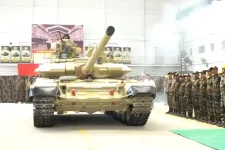
The upgrade process, carried out at the 505 Army Base Workshop in Delhi Cantonment, involved the complete dismantling of the tank, with each component meticulously examined, rebuilt, and tested.
Over 200 assemblies and sub-assemblies were disassembled and reassembled using precision techniques and specialized equipment from the original Russian manufacturer. This process leveraged the technical expertise of the Corps of Electronics and Mechanical Engineers (EME), ensuring the T-90’s operational readiness across diverse terrains.
The upgrade process, carried out at the 505 Army Base Workshop in Delhi Cantonment, involved the complete dismantling of the tank, with each component meticulously examined, rebuilt, and tested (Picture source: Indian Army)
India’s
T-90 modernization effort is part of a long-standing collaboration with Russia. Built under license and manufactured at the Heavy Vehicles Factory (HVF) in Avadi near Chennai, T-90 Bhishma tanks are a vital component of India’s armored forces. Since the initial acquisition of 1,657 units, about 1,300 T-90s are currently in active service. The overhaul program, starting with the initial batches, aims to extend the lifespan of these tanks while enhancing India’s operational independence in their maintenance.
During the ceremony, General Dwivedi commended the EME technicians and officers for their skill and dedication in revitalizing these tanks, highlighting the critical role of ongoing training and innovation. This overhaul effort aligns with the Army’s “Decade of Transformation” initiative, which seeks to reinforce operational capabilities using local solutions and expertise. This strategy underscores India’s intent to maintain technological superiority and secure the sustainability of its combat platforms without routinely relying on foreign support for maintenance and upgrades.
Alongside this significant upgrade, the Indian Army is also developing new equipment, including the Zorawar light tank. Designed for rapid deployment in mountainous regions, the Zorawar recently underwent testing at the Mahajan firing range near Bikaner. This 25-ton tank, developed in two years by the Defence Research and Development Organisation (DRDO) in collaboration with Larsen & Toubro under Project Zorawar, is intended to meet the Army’s requirements for high-mobility operations in high-altitude areas, with an initial series of 354 units planned. Trials, including missile firings, will continue until January 2025 before extensive army evaluation, with induction expected by 2027.
In summary, the successful upgrade of the T-90 Bhishma Mk-3 and the development of the Zorawar light tank highlight the Indian Army’s ongoing efforts to enhance and modernize its defense capabilities. These initiatives demonstrate a commitment to strengthening self-reliance in defense maintenance and technology, while preparing for diverse operational challenges.


 www.joint-forces.com