Indian Missiles and Guided Munitions

Pakistan is not worthy enough to call itself a rival of India. With its economy in the doldrums and foreign exchange reserves of only about $7 billion, Pakistan will not be able to hold its defensive front against the Indian military if a full-blown war breaks out today. We saw how you ran off the battlefield in 2019 when push came to shove, and your generals know it well. But arrogant Pakistanis like you live in a fantasy world, which is not only funny but also badly exposes your weaknesses.

We ran off in 2019? Utter clown
 
Yeah, some kit they will not sell to anyone, but Pakistan is firt in line for it's best available stuff it is willing to export and some things it is not willing to export to others. anything that helps Pakistan is a major win win for both China and Pak.

Everyone with even an ounce of knowledge of Geopolitics (this may well exclude you tragically), knows that US tild it in favour of India now and Mil to Mil relationship with Pak is minimal, but yeah, carry on convincing yourself whit is black and black is white.
The U.S. still has major influence over the Pakistani military, having provided substantial aid over the years. But after receiving all this support, you Pakistanis turned around and started badmouthing the Americans. Now, you've made the Chinese and Turks your new patrons, who are just using you as pawns. No wonder your borders are so unstable.
 
I read all that, it makes no sense absolutely no sense and based on so much wrong info it is time to put you on mute
It's better for you not to engage with me, as it will only lead to utter humiliation.
 

DRDO’s AD-1 Missile Interceptor Puts India In The Elite League​

1722002480462.png
DRDO’s development of the AD-1 interceptor will facilitate the fielding of a credible BMD (Ballistic Missile Defence) system and the deployment of a very capable IADS (Integrated Air Defence System).

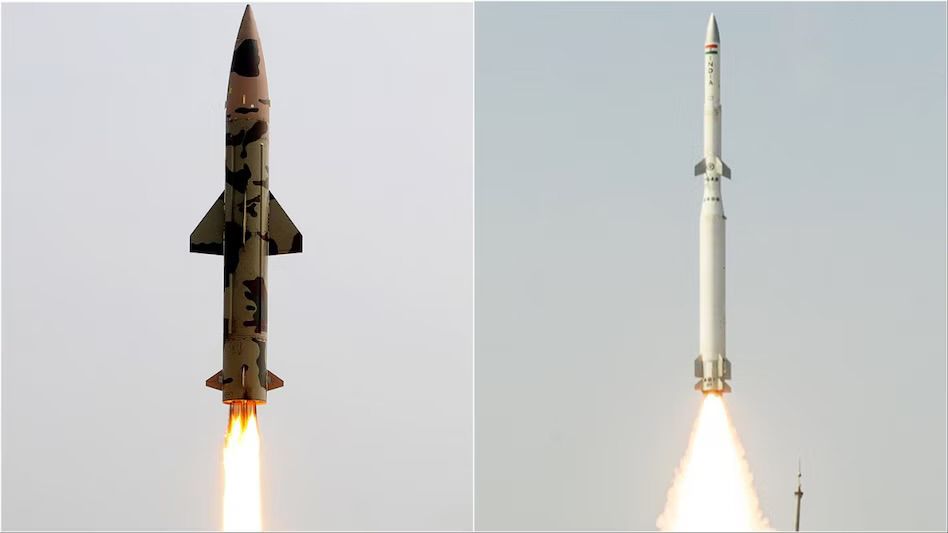
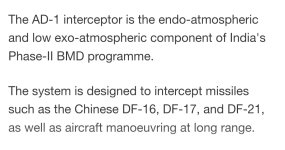
The AD-1 missile is a component of the DRDO’s BMD Phase-2 system.

DRDO has already completed the development of BMD Phase-1, which provides defense against missiles upto 2,000 km range, such as Pakistan’s Ghauri and Shaheen missiles and China’s solid-fuel Dongfeng-21 (NATO designation: CSS-5).

The Phase 2 system will provide defense against ballistic missiles with ranges of up to 5,000 km.

The Phase 2 system requires longer-range radars (Detection range of 1,500 km as opposed to 600 km for Phase 1 radars) and new hypersonic interceptor missiles flying at Mach 6-7 (As opposed to Mach 4-5 for Phase 1 missiles) with agility and the capability to discriminate against ballistic missile defense countermeasures.

Flight Tests

The second flight test of the BMD Phase-2 AD-1 interceptor on July 24 appears to have focused primarily on validating radar tracking, missile guidance, and the communication layer of BMD Phase-2.

The press release announcing the tests states that the test “fully met all the trial objectives validating complete network centric warfare weapon system consisting of Long Range Sensors, low latency communication system and MCC (Missile Control Centre) and Advance Interceptor missiles.”

Unlike the interceptor’s maiden test in November 2022, the second test also included the launch of a target missile. The maiden test validated the basic functionality of the system elements (radar, launcher, MCC) while deployed in their operational geographical locations.

Swordfish Radar

BMD Phase 2 uses the indigenously developed Swordfish Long Range Tracking Radar (LRTR) for target tracking. The L-band AESA radar is a derivative of the Israeli EL/M-2080 Green Pine long-range radar used while developing BMD Phase-I. The detection range for the latest variant of the Swordfish is reported to be 1500 km.

The press release’s reference to the validation of a low-latency communication layer during the test is significant. Low-latency communication, likely using an LEO (Low Earth Orbit, 200-600 km) satellite, facilitates more accurate guidance through tighter trajectory control.

The use of communication satellites placed in GEO (35,786 km) orbits leads to higher latency.

AD-1 Interceptor

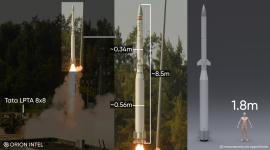
The AD-1 is a long-range interceptor missile designed for low exo-atmospheric and endo-atmospheric conditions. It is claimed to have a large kill altitude bracket, likely centered at 100 km. It is capable of intercepting long-range ballistic missiles and aircraft.

The missile is propelled by a two-stage solid motor and equipped with an indigenously developed advanced control system, navigation, and guidance algorithm to precisely guide it to the target.

The missile notably features fins on both stages.

Not much else is known about the AD-1 interceptor. A long-range interceptor missile should be capable of rapid acceleration and very high speeds. It needs a powerful rocket motor to contend with atmospheric drag. Because of the shorter engagement window, it needs to be capable of rapid maneuvering at high speeds (High g loads).

THAAD Analog
1722002531152.png
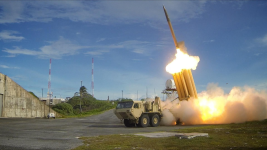
In many ways, AD-1 is analogous to the US THAAD (Terminal High Altitude Area Defence) system interceptor missile, which is designed to engage target missiles at higher altitudes within the atmosphere during their terminal phase descent. THAAD can intercept ballistic missiles over 200 km away and track targets at ranges in excess of 1,000 km.

However, unlike the AD-1, the THAAD interceptor is a single-stage missile.

A two-stage interceptor has several advantages over a single-stage interceptor, such as extended range, higher speed, better maneuverability, and greater altitude reach.

The THAAD interceptor uses a hit-to-kill warhead and an IR seeker.

An IR seeker can better discriminate warheads from decoys and other objects. Its high-resolution tracking capabilities facilitate more precise homing.

Hit-to-kill interception requires precise guidance and control to achieve successful intercepts.

Long-Range Interceptor For Aerodynamic Targets?

It is conceivable that a variant of the AD-1 interceptor would be adapted for use with an IADS like the S-400. In this case, the interceptor would need to feature an active radar-homing seeker. Unlike an IR seeker, a radar seeker is not affected by weather or other atmospheric conditions.

The S-400 uses the two-stage 40N6 interceptor, which has a range of 400 km and a target engagement altitude of up to 185 km. India is working on its own S-400 class air defense system, known as “Project Kusha.”

On October 3, 2023, speaking at the annual press conference to commemorate Air Force Day (October 8), Indian Air Force (IAF) Chief of Air Staff (CAS), Air Chief Marshal VR Chaudhari, announced that India would be developing its own long-range air defense system under Project Kusha.

Conclusion

The Ballistic Missile Defence test on July 24 proved the efficacy of the DRDO-developed Swordfish long-range tracking radar, low-latency communication layer, and MCC guidance capability.
 
Fair play to India if they can get this technology to anything like what the US has.

However, it will be pretty useless against a Pakistani mass attack that will come in the form of a variety of weapons to include cruise/ballistic missiles and drones.

It is an addition to your defences but not a "silver bullet".
 
Tragically for you, and what is hard for many Indians to comprehend is we dont need to master everything. We have the world's second largest economy and superpower to help us.

Maybe you are not seeing the irony in your own statement.
Not a while ago, you had world's largest economy and superpower to help you. In future, when your current supporter withdraws support, what'll you do?

Think about it and you'll realise the real tragedy. There are no free lunches in world.
 
However, it will be pretty useless against a Pakistani mass attack that will come in the form of a variety of weapons to include cruise/ballistic missiles and drones.
Listen, DRDO's BMD Phase 2 missiles are designed to take out 5,000 km class missiles. Whatever Pakistan's got doesn't even come close. FYI, we've mass inducted systems to easily take down enemy cruise missiles and tactical ballistic missiles. The Barak 8 is a proven ADS; it took down an Iskander missile in the Armenia-Azerbaijan war.
Screenshot_20240725-001342_Chrome.jpg
Against drone threats, our startups are delivering solutions that the Indian military is progressively inducting.

"Providing 360-degree protection, Indrajaal can defend areas of up to 4000 square kilometres against all classifications and levels of unmanned autonomous threats"
 
Listen, DRDO's BMD Phase 2 missiles are designed to take out 5,000 km class missiles. Whatever Pakistan's got doesn't even come close. FYI, we've mass inducted systems to easily take down enemy cruise missiles and tactical ballistic missiles. The Barak 8 is a proven ADS; it took down an Iskander missile in the Armenia-Azerbaijan war.
View attachment 56970
Against drone threats, our startups are delivering solutions that the Indian military is progressively inducting.

"Providing 360-degree protection, Indrajaal can defend areas of up to 4000 square kilometres against all classifications and levels of unmanned autonomous threats"


No you listen here....

As we saw what Iran did to the Zionist entity in April, the combined US/Zionist defence shield was sliced apart by Iran launching ballistic missiles with cluster bomblets.

HGV would be even more difficult to defend against.

You can spend the money in order to up your technology level but it will be pretty useless against a Pakistani missile attack using MIRV/HGV and cluster bomblets.
 
No you listen here....

As we saw what Iran did to the Zionist entity in April, the combined US/Zionist defence shield was sliced apart by Iran launching ballistic missiles with cluster bomblets.

Yeah totally, except 7 or 9 out of 300, all the other Iranian drones and missiles successfully impacted US/Israeli interceptors and destroyed them.
 
Yeah totally, except 7 or 9 out of 300, all the other Iranian drones and missiles successfully impacted US/Israeli interceptors and destroyed them.


Dude.

We already talked about it and it was explained away.

Pleas move on.
 
No you listen here....

As we saw what Iran did to the Zionist entity in April, the combined US/Zionist defence shield was sliced apart by Iran launching ballistic missiles with cluster bomblets.

HGV would be even more difficult to defend against.

You can spend the money in order to up your technology level but it will be pretty useless against a Pakistani missile attack using MIRV/HGV and cluster bomblets.
Your own countryman has debunked your propaganda, which says a lot about your credibility.
 
Your own countryman has debunked your propaganda, which says a lot about your credibility.
Ignore him his country pm got humiliated in China and still he licks Chinese feet....

Pakistani mass attack?? He talks the way as if only Pakistan will be delivering and India will be waiting for a blow..... as if there won't be any Indian mass attack in the beginning of the war..... seems for him India will wait for Pakistan mass attack to see if her system works or not....
 
Ignore him his country pm got humiliated in China and still he licks Chinese feet....

Pakistani mass attack?? He talks the way as if only Pakistan will be delivering and India will be waiting for a blow..... as if there won't be any Indian mass attack in the beginning of the war..... seems for him India will wait for Pakistan mass attack to see if her system works or not....
well all Bangladeshis and Pakistanies living in UK & USA are mocking Indian AAD/PAD/BMD or for that matter S400 or other Akaash or SPYDER type SAM systems when they themselfs think they can stop indian onslaught by placing MANPAD SAMs on top of HIlltops and with twenty year old short range SPADA or chinese HQ9 ... i say let them do it .... Kabar ka haal to murda hi jantta hai they can say that living in secure and cozzy rooms of UK & USA & Europe ask those Pakistani members living in Pakistan and facing 18-22 hours of powercuts but still getting power bills in 6 figures ;) :P

welcome-bolne-de.gif
 

Users who are viewing this thread

Latest Posts

Back
Top