Indian Missiles and Guided Munitions

Rudram 3 Brochure from Vigyan Vaibhav 2025
View attachment 147365

Rudram 3 Brochure from Defence Expo 2022
View attachment 147364
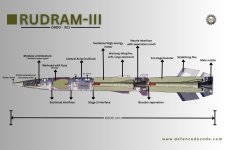
RudraM- 3 is an Air to Surface missile capable of neutralizing Radiating targets and ground targets including Bunkers, Buildings, Shelters at long ranges.

SALIENT FEATURES
Capable to be launched trom Su-30mki
Passive and Active dual mode seeker
Possible lock on before launch
Highly manoeuvrable missile
All weather Day and night capability
All thorough supersonic

CURRENT STATUS
Under Devlopment

LAB
Research Centre Imarat Hyderabad as Nodal Lab

A slide on Rudram 3 from Aero India 2025
View attachment 147361
Unknown Origin Schematics of Rudram 3 (possibly for a scale model)
View attachment 147363
View attachment 147362
Projected Specifications (My guestimates)
Range : 500- 550 km
Diameter : 560 mm
Length : 6000 mm
Mass : 1.5 ton
Propulsion : 2 Stage Solid Rocket Motor
Navigation : INS + SATNAV
Actuation : EMA
Launch Platform : Su 30MKI
Launch Mach : ?
Launch Alt : ?
Apogee : ?
Time of Flight : ?
Mach number : ?
WH Weight : 150 Kg class (125 kg PCB warhead)
Control : Aerodynamic
rudram.jpeg
 

India fears its ballistic missiles are outmatched by China’s

By Michael Peck
Oct 17, 2025, 10:42 PM

KOZWW7IS5JB4BG7WH2SKJHVJHE.jpg
A man waves India's national flag in front of a replica of the Indian Army's BrahMos missile system during Prime Minister Narendra Modi's roadshow in Ahmedabad on May 26, 2025. (Sam Panthaky/AFP via Getty Images)

Worried by China’s growing arsenal of ballistic missiles, India is responding with a plan to create a joint rocket force that would control and expand the country’s non-nuclear missiles.

But the proposed Integrated Rocket Force, or IRF, has been beset by delays and may be outgunned by Chinese missiles.

The mismatch could place India in a dilemma: either endure Chinese missile strikes deep inside India without the ability to retaliate, or escalate to nuclear weapons.

“The IRF is aimed at addressing a conventional war-fighting asymmetry that India has against China,” Debak Das, a professor of peace and security at the Univ. of Denver, told Defense News. “Using a rocket force dedicated to conventional military action will likely allow India space to militarily engage the PLA along the LAC [Line of Actual Control, or the Sino-Indian border] without escalation to the nuclear level.”

However, the IRF – first proposed in 2021 – has yet to materialize.

“The IRF, envisioned primarily as a conventional missile force geared mostly for tactical strike missions, is still theoretical,” wrote Kartik Bommakanti, a researcher for the Observer Research Foundation, an Indian think tank.

The IRF would be a joint army-navy-air force organization that in some ways mirrors the People’s Liberation Army Rocket Force, which is a branch of the Chinese military. But unlike the PLARF, the IRF would be responsible for conventional rockets, with India’s ICBMs and IRBMs remaining under the Strategic Forces Command.

The IRF would be armed with an array of missiles, including the Brahmos cruise missile, the ship-based Long-Range Land Attack Cruise Missile, the Pinaka multiple rocket launch system, and the Pralay tactical ballistic missile. But these weapon can’t reach more than 500 kilometers, or only enough to reach the Tibet plateau and other areas close to the border.

However, China’s ballistic missiles, such as the DF-26 and DF-100, have ranges up to 2,000 kilometers.

Chinese missiles “can strike across the great depth of the Indian land mass even when launched from deep within the Chinese mainland,” Bommakanti wrote. In contrast, “most of China’s economic and industrial hubs are located in central and eastern parts of the country, which need to be rendered vulnerable with Indian missiles that have an extended range.”

Indeed, China’s arsenal of 3,500 missiles – which has surged 50% over the past four years – has emerged as one of the potent factors in Asian security. Taiwan fears a deluge of rockets if China invades, while the U.S. worries that key bases such as Guam would be devastated by missile salvoes.

For India, the question is the impact of Chinese missiles if another conflict erupts along the 2,100-mile Sino-Indian border. Conflicting territorial claims led China and India to fight a brief war in 1962 – which China won – followed most recently by border clashes in 2020 and 2022.

Amid Himalayan mountains as high as 28,000 feet, large-scale ground combat operations would be a nightmare. But as in the Ukraine war, long-range munitions can hit supply depots, headquarters, bridges, and critical infrastructure such as the electrical grid.

Bommakanti suggests that India could use the Agni-5 – a 5,000-kilometer IRBM currently assigned to India’s nuclear forces – for conventional missions, as well as developing a long-range Indian hypersonic weapon. But he argues that there needs to be an organization to coordinate Indian non-strategic missiles.

“Without an IRF, clear priorities cannot be established, and all missile capabilities related to ballistic, cruise, and hypersonic projectiles with longer ranges cannot be integrated, deployed, or launched effectively in the event of military hostilities against the PRC [People’s Republic of China].”

Still, the IRF may face problems such as rivalry between services reluctant to give up control of their missiles.

“Many of IRF’s initial assets will come from the army and air force, and there appears to be concerns among Indian defense analysts about whether IRF will only control the missiles and rockets or the launching, communication, and intelligence systems that come with them as well,” noted an essay by the Center for Strategic and International Studies, a U.S. think tank.

Either way, the prospect of two nuclear-armed powers launching missiles – even without nuclear warheads – is almost apocalyptic.

“So far, there has been no public discussion about the conventional deep strike capability against Chinese strategic infrastructure,” Das said. “The problem with adopting such a doctrine is that China could do the same against India.”

There is also the question of India’s other strategic worry: a nuclear-armed Pakistan. Though the IRF is aimed at China, it has also rattled the Pakistanis, who recently announced the creation of the Army Rocket Force. “This is a response to India’s IRF announcement,” said Das. “Islamabad will likely try to minimize any asymmetry it has with India as its conventional rocket forces mature.”

In the end, a China-India missile competition may come to an existential question: Can two nuclear powers fire conventional missiles at each other’s homeland without escalation to thermonuclear war?

“While New Delhi might hope that this [the IRF] will decrease Beijing’s appetite for low level skirmishes along the Line of Actual Control, it is not clear if this will ultimately be the case,” said Das.

“India is still a ways away from being at parity with China along some of these vectors of conventional strength. So until we see ideas like the IRF mature, it is difficult to say if they will be effective in keeping peace.”
 
To view this content we will need your consent to set third party cookies.
For more detailed information, see our cookies page.
 
Damn!!! Better get the pl 17 or whatever the new Chinese bvr missile is called and also better make sure we get the latest amraam from the US. This presidency is the last time we will be able to get anything from the US and its allies. We better not screw this opportunity up!!! Engines for atak 1/2, zulus, v upgrade and new blk72, EW equipment, engines for subs etc. Other than that, start building up our defence industry to be 100% self sufficient. For that we need a very strong foundation that consists of US/EU & Chinese equipment. And then build up from there.

I had said this around a few years back:
Data data data..the one that manages to receive, process and implement it the fastest will win the next war. We succeeded but at the same time have helped the Indians work out what they are doing wrong. So we need to contionusly innovate and upgrade our systems to be always 3 steps ahead. We can not and should not take it easy. The way trump is mentioning this damn battle again and again the Indians will take their revenge. They will 100% do something to get even. That is a FACT!!! And it will happen soon. We better be prepared this time and better have an extremely robust and layered air defence system in place. God help us.
 
Damn!!! Better get the pl 17 or whatever the new Chinese bvr missile is called and also better make sure we get the latest amraam from the US. This presidency is the last time we will be able to get anything from the US and its allies. We better not screw this opportunity up!!! Engines for atak 1/2, zulus, v upgrade and new blk72, EW equipment, engines for subs etc. Other than that, start building up our defence industry to be 100% self sufficient. For that we need a very strong foundation that consists of US/EU & Chinese equipment. And then build up from there.

I had said this around a few years back:
Data data data..the one that manages to receive, process and implement it the fastest will win the next war. We succeeded but at the same time have helped the Indians work out what they are doing wrong. So we need to contionusly innovate and upgrade our systems to be always 3 steps ahead. We can not and should not take it easy. The way trump is mentioning this damn battle again and again the Indians will take their revenge. They will 100% do something to get even. That is a FACT!!! And it will happen soon. We better be prepared this time and better have an extremely robust and layered air defence system in place. God help us.
what is the panic, build up a healthy stable society and works on the economy first.
 
what is the panic, build up a healthy stable society and works on the economy first.

If the all the nations governments focused on free trade, allowed its citizens to build capital and compete, did not interfere in markets, did not follow fiat systems and fractional reserve bankings. Then eventually, all borders would break down, wars would finally stop, governments would have no role except in preventing crime and gangsters, defence would no longer be necessary because all people would be interconnected economically.

However, so long as government believes that it needs to intervene in people’s lives and in the market, then the concept of nations will continue to exist.

The only way humanity can truly unite is only through free market capitalism unhampered by governments, but the road to that is a long road.
 
Pakistan will need PL17 or whatever has succeeded the PL15
As well as more J10C and/or some J35 stealth
Time to prepare the special and strategic launchers as well
 
Damn!!! Better get the pl 17 or whatever the new Chinese bvr missile is called and also better make sure we get the latest amraam from the US. This presidency is the last time we will be able to get anything from the US and its allies. We better not screw this opportunity up!!! Engines for atak 1/2, zulus, v upgrade and new blk72, EW equipment, engines for subs etc. Other than that, start building up our defence industry to be 100% self sufficient. For that we need a very strong foundation that consists of US/EU & Chinese equipment. And then build up from there.

I had said this around a few years back:
Data data data..the one that manages to receive, process and implement it the fastest will win the next war. We succeeded but at the same time have helped the Indians work out what they are doing wrong. So we need to contionusly innovate and upgrade our systems to be always 3 steps ahead. We can not and should not take it easy. The way trump is mentioning this damn battle again and again the Indians will take their revenge. They will 100% do something to get even. That is a FACT!!! And it will happen soon. We better be prepared this time and better have an extremely robust and layered air defence system in place. God help us.
Trump administration is in risk I just saw news his admin decision could make lose 35trillion dollar value.

To view this content we will need your consent to set third party cookies.
For more detailed information, see our cookies page.
 
Weapons now economy later.
Just doesn't understand what is the panic for, Yes if you followed their defense account and ANI news, they are seems to make huge progress on daily basis like 120 Rafale, a few hundred Tejas mk1a, mk2 in the process, SU-57 with local input, super sukohi,skysting offered, etc etc etc,

In reality, not a single Tejas in the last four years, tenders after tenders, bids after bids, sometimes an engine arrived, a pair of wing beautifully made, you are not going to see anything substantial before 2030.
 
If the all the nations governments focused on free trade, allowed its citizens to build capital and compete, did not interfere in markets, did not follow fiat systems and fractional reserve bankings. Then eventually, all borders would break down, wars would finally stop, governments would have no role except in preventing crime and gangsters, defence would no longer be necessary because all people would be interconnected economically.

However, so long as government believes that it needs to intervene in people’s lives and in the market, then the concept of nations will continue to exist.

The only way humanity can truly unite is only through free market capitalism unhampered by governments, but the road to that is a long road.
yes dollar reserve system is destroying humanity and scientific progress
 

Users who are viewing this thread

Pakistan Defence Latest

Latest Posts

Back
Top