Indian Politics and Internal News

You need a map when there were trading companies called "East INDIA company" and "Dutch East INDIA company" and when a man called "Christopher columbus" was tasked and Paid by the Queen and King of Spain to find a "new sea passage" to the country of India and ended up "discovering" America in the 14th Century ?
Whoever you are, you seem not to know that the Dutch East India Company had nothing to do with India.

The new sea passage was to have been to the west of Europe, as the route by sailing around Africa was not considered feasible.
 

A map of all the developed, newly industrialized, developing, and least developed countries according to the IMF and the UN.​


v5pyl8ou1o281[1].png

To view this content we will need your consent to set third party cookies.
For more detailed information, see our cookies page.
 
Last edited:
Interesting Facts about India

India never invaded any country in her last 100000 years of history.

When many cultures were only nomadic forest dwellers over 5000 years ago, Indians established Harappan culture in Sindhu Valley (Indus Valley Civilization)

The name 'India' is derived from the River Indus, the valleys around which were the home of the early settlers. The Aryan worshippers referred to the river Indus as the Sindhu.


The Persian invaders converted it into Hindu. The name 'Hindustan' combines Sindhu and Hindu and thus refers to the land of the Hindus.

Chess was invented in India.

Algebra, Trigonometry and Calculus are studies, which originated in India.

The 'Place Value System' and the 'Decimal System' were developed in India in 100 B.C.

The World's First Granite Temple is the Brihadeswara Temple at Tanjavur, Tamil Nadu. The shikhara of the temple is made from a single 80-tonne piece of granite. This magnificent temple was built in just five years, (between 1004 AD and 1009 AD) during the reign of Rajaraja Chola.


India is the largest democracy in the world, the 7th largest Country in the world, and one of the most ancient civilizations.

The game of Snakes & Ladders was created by the 13th century poet saint Gyandev. It was originally called 'Mokshapat'. The ladders in the game represented virtues and the snakes indicated vices. The game was played with cowrie shells and dices. In time, the game underwent several modifications, but its meaning remained the same, i.e. good deeds take people to heaven and evil to a cycle of re-births.

The world's highest cricket ground is in Chail, Himachal Pradesh. Built in 1893 after leveling a hilltop, this cricket pitch is 2444 meters above sea level.

The world's first university was established in Takshila in 700 BC. More than 10,500 students from all over the world studied more than 60 subjects. The University of Nalanda built in the 4th century was one of the greatest achievements of ancient India in the field of education.

Ayurveda is the earliest school of medicine known to mankind. The Father of Medicine, Charaka, consolidated Ayurveda 2500 years ago.

India was one of the richest countries till the time of British rule in the early 17th Century. Christopher Columbus, attracted by India's wealth, had come looking for a sea route to India when he discovered America by mistake.

The Art of Navigation & Navigating was born in the river Sindh over 6000 years ago. The very word Navigation is derived from the Sanskrit word 'NAVGATIH'.
The word navy is also derived from the Sanskrit word 'Nou'.

Bhaskaracharya rightly calculated the time taken by the earth to orbit the Sun hundreds of years before the astronomer Smart. According to his calculation, the time taken by the Earth to orbit the Sun was 365.258756484 days.

The value of "pi" was first calculated by the Indian Mathematician Budhayana, and he explained the concept of what is known as the Pythagorean Theorem. He discovered this in the 6th century, long before the European mathematicians.

Algebra, Trigonometry and Calculus also originated in India.Quadratic Equations were used by Sridharacharya in the 11th century.
The largest numbers the Greeks and the Romans used were 106 whereas Hindus used numbers as big as 10*53 (i.e. 10 to the power of 53) with specific names as early as 5000 B.C.during the Vedic period.Even today, the largest used number is Terra: 10*12(10 to the power of 12).

Until 1896, India was the only source of diamonds in the world
(Source: Gemological Institute of America).

The Baily Bridge is the highest bridge in the world. It is located in the Ladakh valley between the Dras and Suru rivers in the Himalayan mountains. It was built by the Indian Army in August 1982.

Sushruta is regarded as the Father of Surgery. Over2600 years ago Sushrata & his team conducted complicated surgeries like cataract, artificial limbs, cesareans, fractures, urinary stones, plastic surgery and brain surgeries.

Usage of anaesthesia was well known in ancient Indian medicine. Detailed knowledge of anatomy, embryology, digestion, metabolism,physiology, etiology, genetics and immunity is also found in many ancient Indian texts.


India exports software to 90 countries.

The four religions born in India - Hinduism, Buddhism, Jainism, and Sikhism, are followed by 25% of the world's population.

Jainism and Buddhism were founded in India in 600 B.C. and 500 B.C. respectively.

Islam is India's and the world's second largest religion.

There are 300,000 active mosques in India, more than in any other country, including the Muslim world.

The oldest European church and synagogue in India are in the city of Cochin. They were built in 1503 and 1568 respectively.

Jews and Christians have lived continuously in India since 200 B.C. and 52 A.D. respectively

The largest religious building in the world is Angkor Wat, a Hindu Temple in Cambodia built at the end of the 11th century.

The Vishnu Temple in the city of Tirupathi built in the 10th century, is the world's largest religious pilgrimage destination. Larger than either Rome or Mecca, an average of 30,000 visitors donate $6 million (US) to the temple everyday.


Sikhism originated in the Holy city of Amritsar in Punjab. Famous for housing the Golden Temple, the city was founded in 1577.
Varanasi, also known as Benaras, was called "the Ancient City" when Lord Buddha visited it in 500 B.C., and is the oldest, continuously inhabited city in the world today.

India provides safety for more than 300,000 refugees originally from Sri Lanka, Tibet, Bhutan, Afghanistan and Bangladesh, who escaped to flee religious and political persecution.

His Holiness, the Dalai Lama, the exiled spiritual leader of Tibetan Buddhists, runs his government in exile from Dharmashala in northern India.

Martial Arts were first created in India, and later spread to Asia by Buddhist missionaries.

Yoga has its origins in India and has existed for over 5,000 years.

Interesting Facts about India - My India, My Pride - Know India: National Portal of India


Ayurveda is the earliest school of medicine known to mankind. The Father of Medicine, Charaka, consolidated Ayurveda 2500 years ago.


OFFER OF SCHOLARSHIPS TO STUDY IN INDIA UNDER ICCR AFRICA SCHOLARSHIPS SCHEME: 2023-24​

The Government of India offer Scholarships to Malagasy and Comorian students through Indian Council for Cultural Relations (ICCR) under Africa Scholarship Scheme to follow Undergraduate, Postgraduate, M. Phil. /Ph.D. course in various reputed Indian Universities/Institutes. The Scholarship is given for various courses: Agriculture, Commerce and Management, Engineering, Applied course (Journalism and Communication, Tourism Management, Pharmacy, Computer Application, etc…).

The applications from interested students for the academic year 2023-24 are invited online through ICCR’s A2A Scholarship Portal http://a2ascholarships.iccr.gov.in/ The last date of online application is on 31 May 2023.

Before applying for the scholarship programme, candidates are advised read the detailed policy guidelines and instructions at ICCR’s A2A Scholarship Portal.

ELIGIBILITY CRITERIA:

Candidates must achieve adequate level of English Proficiency as medium of instruction in India is English.

Candidates must be:

between 18 and 30 years old for Undergraduate/Postgraduate courses

between 18 and 45 years old for PhD Programmes

Candidates must be fully fit to be able to stay and complete his/her course in India and should not be suffering with any life-threatening ailment. :-)

Candidates must possess all required supporting documents.

REQUIRED DOCUMENTS:

All academic certificates and mark sheet from grade 10 with certified English translation attested by the Ministry of Foreign Affairs, if the original documents are not in English.

TOEFEL/IELTS and other standardized test scores, if available.

Recommendations/character certificates from existing school/University etc.

Certified copy of valid passport. (Passport should be valid for the duration of the course applied for.)

GMAT score for Commerce and Management course. (If required by the University)

A certificate of physical fitness dully filled by a sworn Doctor (Physical fitness format to be downloaded on ICCR’s A2A Scholarship Portal).

Synopsis details only for Ph.D. candidates.

GENERAL INFORMATION:

Online application should be complete in all respects, with all the required information and all necessary supporting documents. Any incomplete application will not be processed further.

The application will not be considered without English translation of documents if the original documents are not in English.

Applicants have the option to apply to 5 Universities/Institutes in the order of their preference of study. :-)

Students should submit a 500-word essay in English to ascertain English proficiency while applying online.

Embassy of India, Antananarivo, Madagascar : ICCR Africa Scholarship Scheme


www.eoiantananarivo.gov.in
.
=>
ICCR Scholarship

High Commission of India, Pretoria, South Africa : ICCR Scholarship


www.hcipretoria.gov.in

India 1000 ICCR Scholarships for Afghan Student for 2024-2025

 
India GDP per capita is similar to that of Pakistan or Bangladeshi. Not to that of China. India should be between an under developed country or a developing country. Also, Thailand and Vietnam are mistaken categorized as developing. There is no way India should be a newly developed country as India is behind Vietnam or Thailand.

Just noticed Russia is ranked as less than India at development. No Russians poop openly. Horrible ranking and totally untrustworthy. It’s either a CIA ranking or Indian ranking.

there is a ratio of "undocumented" part of GDP which would be included to see true picture of GDP per capita of India, i think :)

here on WIkipedia table, we find GDP on PPP per capita of India at $11,112 is close to that of other NICs like Philippines at $12,080 and to Indonesia at $16,542.
while the same is true in case of Philippines and Indonesia also that we would be having a large share of 'undocumented' part of GDP on PPP similar to India :coffee:

.

=> The table below presents the list of countries consistently considered NICs by different authors and experts. Turkey became a founding member of the OECD in 1961 and Mexico joined in 1994. The G8+5 group is composed of the original G8 members in addition to China, India, Mexico, South Africa and Brazil. :coffee: The members of the G20 include Brazil, China, India, Indonesia, Mexico, South Africa and Turkey.

 
Last edited:
.
The world's first university was established in Takshila in 700 BC. More than 10,500 students from all over the world studied more than 60 subjects. The University of Nalanda built in the 4th century was one of the greatest achievements of ancient India in the field of education. :coffee:

.
==>

Nalanda: The university that changed the world

More than 500 years before Oxford University was founded, India's Nalanda University was home to nine million books and attracted 10,000 students from around the world.
The winter morning was cloaked in thick fog. Our car swerved past horse-drawn carriages, a mode of transport still popular in the rural reaches of the eastern Indian state of Bihar, the trotting horses and turbaned coachmen looking like shadowy apparitions in the pearly-white mist.
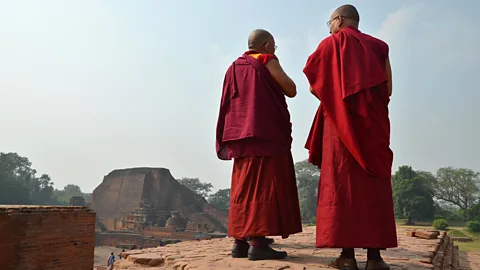
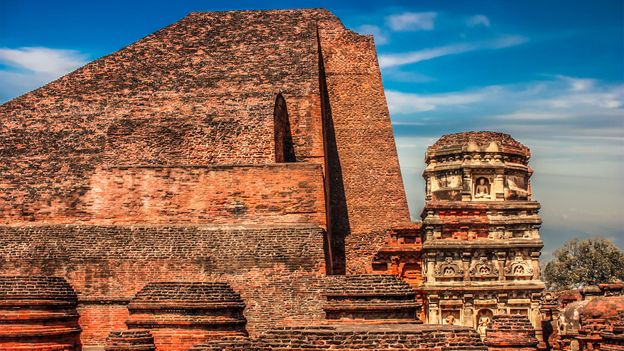
After spending a night in the town of Bodhgaya, the ancient settlement where Lord Buddha is said to have attained enlightenment, I set out that morning for Nalanda, whose red-brick ruins are all that remain of one of the greatest centres of learning in the ancient world.
Founded in 427 CE, Nalanda is considered the world's first residential university, a sort of medieval Ivy League institution home to nine million books that attracted 10,000 students from across Eastern and Central Asia. They gathered here to learn medicine, logic, mathematics and – above all – Buddhist principles from some of the era's most revered scholars. As the Dalai Lama once stated: "The source of all the [Buddhist] knowledge we have, has come from Nalanda."
imageBROKER/Alamy Ten thousand students from across Asia came to Nalanda to learn Buddhist principles from some of the era's most revered scholars (Credit: imageBROKER/Alamy)
imageBROKER/Alamy
Ten thousand students from across Asia came to Nalanda to learn Buddhist principles from some of the era's most revered scholars (Credit: imageBROKER/Alamy)
Advertisement


.
=> https://www.quora.com/Where-was-the-first-university-in-the-world-established
.
 
Last edited:
.
The world's first university was established in Takshila in 700 BC. More than 10,500 students from all over the world studied more than 60 subjects. :coffee:
.

=> 1733526286056.png

.


=> https://en.wikipedia.org/wiki/University_of_ancient_Taxila

.
=>

1733526386560.png

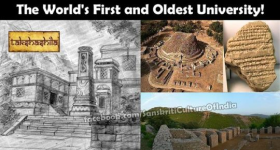
Takshashila - The World's First and Oldest University! :coffee:

India has a long and venerable history in the field of higher education. In ancient times, the country was known to have been home to the oldest formal universities in the world.

The world's first University was established in Takshila or Taxila or Takshashila (now in Pakistan) in 700BC. This centre of learning was situated about 50 km west of Rawalpindi in Pakistan. It was an important Vedic/Hindu and Buddhist center of learning but wasn`t as well organized as the University of Nalanda. :coffee:

The Vayu Purana traces the start of Takshila to Taksha, son of Bharata and is also mentioned in Mahabharata, citing Dhaumya as one of the Acharyas. There are several mentions of this University in the Buddhist Jataka Tales. Chinese travellers like Fa Hian (Faxain) and Huien Tsang (XuanZang) also speak of Takshila in their writings.
More than 10,500 students from all over the world studied here. The campus accommodated students who came from as far as Babylonia, Greece, Arabia and China and offered over sixty different courses in various field such as science, mathematics, medicine, politics, warfare , astrology, astronomy, music, religion, and philosophy. Generally, a student entered Takshashila at the age of sixteen. Students would come to Takshila and take up education in their chosen subject with their teacher directly. Entrance exam to Takshila was very difficult and only 3 out of every 10 students passed the admission test.

They were supposed to pay for their expenses. However, if a student was unable to pay then he could work for his teacher. The Vedas and the Eighteen Arts, which included skills such as archery, hunting, and elephant lore, were taught, in addition to its law school, medical school, and school of military science.

Takshila was specialized in the study of medicine.

Panini, the famous Sanskrit grammarian, Kautilya (Chanakya) and Charaka, the famous physician of ancient India, and Chandragupta Maurya were the products of this university. It gained its importance again during the reign of Kanishka. It was probably, the earliest of the ancient seats of higher education. Takshashila is perhaps best known because of its association with Chanakya. The famous treatise Arthashastra (Sanskrit for The knowledge of Economics) by Chanakya, is said to have been composed in Takshashila itself.

During the 800 years that Takshila was operational, it attained great fame. The University consisted of: - 300 lecture halls with stones benches for sitting - laboratories - Observatory called the Ambudharaavlehi for astronomical research - Massive Library called Dharma Gunj or Mountain of Knowledge, consisting of 3 buildings: Ratna Sagar, Ratnodavi and Ratnayanjak

Takshila`s prosperity resulted from its position at the junction of three great trade routes. In the second half of the 5th century, it was severely damaged by Hephthalite invasions; during the 7th century it was gradually abandoned by its inhabitants. Excavations begun in 1913 finally gave the world a peak into the best minds in Indian history.

Takshila was listed by the UNESCO as one of the World Heritage Sites in 1980. (y)

To view this content we will need your consent to set third party cookies.
For more detailed information, see our cookies page.
 

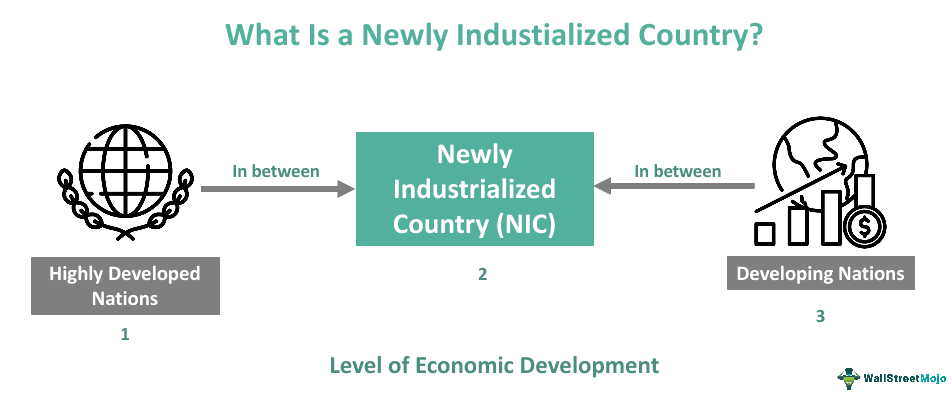
Newly Industrialized Country (NIC) Definition​

A Newly Industrialized Country (NIC) refers to a group of nations that fall between developing and advanced developed countries. The primary goal of NICs is to stimulate economic growth and advance the development of their economies. Therefore, these countries are often called "advanced developing" countries. :coffee:
Newly Industrialized Country

NICs gained prominence in the late 20th century as certain nations shifted from primarily agricultural economies to those driven by manufacturing or the service sector. This transition significantly influenced global economic growth patterns. In recent years, several Asian nations have emerged as prominent examples of NICs, showcasing rapid industrialization and economic advancement.

  • Newly Industrialized Country (NIC) consists of nations that have witnessed a shift from agricultural to manufacturing or service sector.
  • They aim to earn revenue through foreign investments and exports. The government also encourages development and schemes to boost economic growth.
  • The origin of this concept arose between the 1970s and 1980s. Initially, Asian Tigers consisting of South Korea, Hong Kong, Taiwan, and Singapore were a part of it.
  • The NICs include India, Brazil, Mexico, China, Thailand, South Africa, Taiwan, Singapore, Turkey, and Hong Kong.

Newly Industrialized Country Explained​

The newly industrialized country category consists of nations that have seen a vital transition from primary occupation to the tertiary sector. They aim to develop these nations into a more urbanized and industrialized economy. Since the 1970s, most nations have been a part of it. A few of them in the newly industrialized country list include Hong Kong, Singapore, South Korea, and Taiwan, collectively known as Asian Tigers. These nations predominantly excelled in industrialization and growth during the 1970-1980s.

As a result, these countries became highly competitive in technology and innovation, leading to a focus on boosting their GDP through exports. Additionally, workers were moved significantly from rural to urban areas to support industrial development. However, in the later stages, other nations also joined the cause.

Understanding the historical background is crucial to grasp the beginnings of this change. The roots of industrialization can be traced back to the Industrial Revolution, which many nations had already embraced. However, during the late 1700s and 1800s, British colonial rulers established colonies and exploited less developed countries, causing significant disparities. Consequently, resources were extracted from these nations, leaving them impoverished and hindering their overall growth.

Nonetheless, specific factors played a pivotal role in driving the growth of newly industrialized countries. Government intervention in the economy emerged as a crucial catalyst for economic development in NICs. Governments implemented policies encouraging business participation and amending existing regulations to facilitate growth and progress.

Characteristics​

Let us look at the characteristics of newly industrialized country growth to comprehend the concept better:

  1. NICs usually have a shift from agriculture to the manufacturing sector, which becomes a significant contributor to their GDP.
  2. These nations receive huge capital investments via FDI (Foreign Direct Investments).
  3. There is a tremendous boost in the exports sector.
  4. NICs often recover significantly, transitioning from negative GDP growth rates to positive values.
  5. Governments in NICs play an active role in promoting production and innovation.
  6. Better civic amenities like good transportation, water, and electricity are provided to the public.
  7. The laws and regulations within the economy are improvised for the betterment of society.

 
we share "Veto power" and other means of Russia together. here 'we' include Delhi-Tehran-Moscow :mps:


Russia is part of P5s of UN, with Veto, and Delhi-Moscow-Tehran share this together, with other means of Moscow having since SU's time, since Cold war :)

we find India-Russia-Iran combined power increased consistently since 1990. India-Russia combined are "self-sufficient" with themselves for a wide range of Industries since Cold War time.

Delhi-Moscow-Tehran dont have to trade with US-NATO...... :coffee:
 
Written By :

Last Updated:December
Written By :
Abhijit Majumder
News18.com
Last Updated:

December 06, 2024, 09:04 IST

Maharashtra and to an extent Haryana elections have proved that Yogi Adityanath’s slogan has the power to bring Hindus back under one umbrella when reminded of a common threat


The slogan coined by Uttar Pradesh Chief Minister Yogi Adityanath has the potential to outlive this century. (PTI/File)


The slogan coined by Uttar Pradesh Chief Minister Yogi Adityanath has the potential to outlive this century. (PTI/File)

Slogans, especially the more powerful ones, are the pulse throbs of politics. They reveal a lot about the heart of the polity, the rush of blood, and the past, present and future of a nation.

When the American economy was booming in the late 1920s, candidate Herbert Hoover sprung the slogan: “A chicken in every pot and a car in every garage" for his 1928 presidential campaign (it is another matter that the Great Depression of 1929 left the pots and garages empty).
 
Barack Obama’s Nike-esque slogan “Yes we can" in 2008 brought hope after the Bush years, and Brexit’s “Take back control" took Britain out of the European Union in 2016.
India has had its own mouthful of political magic. Lal Bahadur Shastri’s “Jai jawan, jai kisan" (long live the soldier and the farmer) captured the two most transformative achievements of his short tenure as PM: the 1965 India-Pakistan war which India won and the Green Revolution in farming which Shastri kicked off. Its sheer simplicity, and its ability to compress the optimism about food and defence security, makes it one of the most impactful and enduring Indian political slogans ever.
 
Narendra Modi’s campaign slogan in 2014 “ Achhey Din aane wale hain"
convinced the nation that good days are indeed round the bend — even if one concedes that UPA2 had set the bar really low — and he stormed to power.
But a slogan coined by Uttar Pradesh chief minister Yogi Adityanath right now in 2024 has the potential to outlive this century.
Batenge to Katenge
Ek Rahenge to Safe Rahenge "
 

Users who are viewing this thread

Pakistan Defence Latest

Country Watch Latest

Latest Posts

Back
Top