Indian Politics and Internal News

A waqf property is not just any property that is lying around; it is property in trust placed under a board of trust, that is called the Waqf Board. The documentation, the deed of trust, is precise but comprehensive.

Record-keeping has not been. As a result, Waqf property, that is among the most advantageously located, has been targeted by the greedy, the bigoted and the greedy and bigoted.

The Taj Mahal was commissioned - paid for - by Shah Jahan, but the architect was Ustad Ahmed Lahori. It may have been - probably was - built by workmen coming from various social and professional classes, and religions, but its style and genre, including its domes, have nothing to do with classical, pre-Sultanate architecture.

I do not hold with giving architecture religious classifications, like Hindu, Sikh or Muslim - or Christian - architecture, but the complex, not just the central tomb, is typical of Mughal architecture. Its immediate predecessor is Humayun's Tomb, and the derivation can be clearly seen.

i have less information about the Skilled workers who might have worked on Taj Mahal, but i personally guess that it might include Muslim and Hindus both. but then Mughal Rulers and others does it mean that Taj Mahal is a Islamic Building..... :coffee:

the Waqf Board is a nationalist organization. they proud to list Taj Mahal as their property along with Jama Masjid, and Charminar etc, as mentioned on google search also, i posted....

Islam has a good place in Indian society and Waqf Board, we hear who mainly claim for the Islamic building, lands, like Taj Mahal in India. about remaining Islamic organisation of India, i heard less .....
 
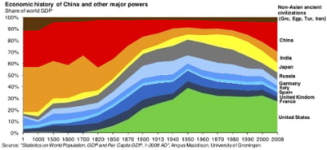
China's 5000years old Economic history is reported as below also.

it mainly states economic history of World since information of 'Jesus', for last more than 2000 years :coffee:

.
=>

More 2,000 years in a single graphic​


1736126963036.png

The Economist has developed its own infographics of 2,000 years of economic history with Mr Maddison's data. :coffee: One in 2010, nicknamed "GDP since Jesus" charts just that (below, with commentary here). We encountered the same layout difficulties as Mr Cembalest, so chose a bar chart to distinguish specific years, and fiddled with the spacing of increments on the x-axis to designate missing chunks of time. The result is imperfect, but we did as much as possible to disclose, not camouflage, the imperfections. (In retrospect, we should have done more on the right-hand side of the chart, such as perhaps making the bar widths proportionately thinner….)

22-201034nac119[1].jpg


:)

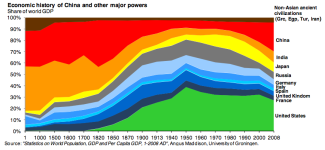
A second chart from last year (below, and with a commentary here) is both simple and startling. Among the points it presents is that in the first decade of the 21st century, the population of the world produced more economic output than in the first 19 centuries of the common era combined.

More 2,000 years in a single graphic

Did JP Morgan's striking chart on 2,000 years of economic history bungle the x-axis? Why yes, it did.
www.economist.com
www.economist.com

further, here is the above's map of 'The Economist' in large view, as below

here, China at least have their history of last 2000 years upto now as below, since Time of 'Jesus Christ', as discussed in the article of the Economist in post#28 :coffee:

1736126910851.png

.
=>
1736126928324.png

To view this content we will need your consent to set third party cookies.
For more detailed information, see our cookies page.
 
Last edited:

Advisory/Information for ICCR applicants.​

Advisory / Information for ICCR applicants

  1. Indian Council for Cultural Relations (ICCR) organizes fully paid scholarship programs for Bangladeshi students each year, the full process of which is handled by the High Commission of India, Dhaka, and offices of Assistant High Commission of India in Rajshahi, Sylhet, Khulna and Chittagong, only. Govt. of India has not appointed any agent for processing and/or selection of ICCR applications in Bangladesh. :coffee:
  2. It has come to notice that an organization called “GEE Bangladesh”, with its offices in Dhaka, Khulna, Chittagong, Mymensingh, Kishoreganj and Rajshahi, is acting as an agent for ICCR applicants, collecting cash payment from each ICCR aspirant.
  3. While condemning such actions, which are totally illegal, it is clarified that Govt. of India and its offices in Bangladesh, viz. High Commission of India, Dhaka, and the offices of Assistant High Commission of India in Rajshahi, Sylhet, Khulna and Chittagong, do not, repeat, do not have any sort of relationship with the organization mentioned above, or, such sort of organizations which claim themselves to be agents.
  4. ICCR applicants are being alerted that any association with such sort of organization(s) would not only result in cancellation of his/her ICCR application/admission/scholarship, but also black listing of his/her name for any type of visit to India in future.
Dhaka

March 20, 2023

 
@UKBengali
@Afif

good day sir. how you see news of last post#31?

what would be number of Bangladeshi students in this scholarship, i guess it would nearly to that of Afghanistan and Nepal, i think ☕
 
i have less information about the Skilled workers who might have worked on Taj Mahal, but i personally guess that it might include Muslim and Hindus both. but then Mughal Rulers and others does it mean that Taj Mahal is a Islamic Building.....
No, it doesn't.
It does make it Mughal architecture.


the Waqf Board is a nationalist organization. they proud to list Taj Mahal as their property along with Jama Masjid, and Charminar etc, as mentioned on google search also, i posted....
It is a board of trustees.
Please read up on things before commenting.
 

ICCR Scholarship​

ICCR Scholarship Indian Council for Cultural Relations (ICCR)

ICCR offers 36 scholarships annually to Myanmar in UG, PG and PhD in a range of subjects. Myanmar students are mostly availing PG/PhD courses in B-Tech, MBA, Agriculture, Buddhist Studies etc. :coffee:

Various scholarships schemes offered to Myanmar under ICCR:

(i) Atal Bihari Vajpayee General Scholarship Scheme: For Under Graduate & Post Graduate studies in Science, Humanities and also Research work.

(ii) Mekong Ganga Co-operation Scholarship Scheme (MGCSS):For Under Graduate & Post Graduate studies in Science, Humanities and also Research work.

(iii) Lata Mangeshkar Dance & Music Scholarship Scheme: For pursuing study of Indian Culture such as dance, music, theatre, performing art, sculpture, Indian language, Indian cuisine, etc.

(iv) Dr. S. Radhakrishnan Cultural Exchange Scholarship (without Airfare)

Under the Cultural Exchange Programme/Educational Exchange Programme signed between India and other foreign countries, the ICCR offers slots as indicated in the CEP/EEPs slots for pursuing undergraduate, postgraduate and doctoral courses.

(iv) Ayush Scholarship to BIMSTEC member countries:

The ICCR offers scholarships slots to meritorious nationals of BIMSTEC member countries every year to pursue Under Graduate/Post Graduate/Ph.D course in Indian Traditional Systems of Medicine, i.e. Ayurveda, Unani, Siddha and Homoepathy under this scheme.

100+ subjects studies by foreign students that include Agriculture, Artificial Intelligence, Biotechnology, Business Studies, Classical Indian Dance, Music, Commerce, Economics, Engineering/IT: Indian languages, Liberal arts, Management, Philosophy, Political Science, Yoga etc. (Medical Science and Integrated courses like for law are not included)

Age limit:

For Undergraduate / Postgraduate courses - between 18 to 30 years and

For PhD Programmes - between 18 to 45 years.

Applicants have the option to apply to 5 universities / institutes in the order of their preference of study. The admission, as far as possible, shall be given as per applicant's preference. However, there may be a scenario when students do not get admission in their preferred Universities / institutes due to limited number of seats on offer. Students should therefore be prepared to receive admission from any of their five preferences

The admissions in Medical/ paramedical (Nursing / physiotherapy / anesthesia etc.) / fashion / law courses / integrated courses such as BALLB (5 years)/ B Sc & M Sc (5 years) etc. are not admissible.

It may be noted that for BE / B. Tech courses, Physics, Chemistry and Mathematics (PCM) are compulsory in 11 and 12 Grades and it is a mandatory requirement for Engineering courses. Mark sheets for each i.e., level 10 and 10+2 equivalent level of school should be uploaded along with the transcripts in English.

For admission in UG level courses, it is compulsory to have 10+2 i.e; (12 years) of schooling. lt is, therefore, necessary that the student applying for UG level courses must complete 12 years of schooling.

lt is reiterated that the admission remains provisional till the time Universities verify the authenticity of original documents. lf original documents are not found in order on which provisional admission has been granted by university, the admission offer will be revoked and the student(s) will have to return to their country at their own cost. In case Association of Indian Universities (AIU) Equivalence Certificate is required the offer letter for allotment of scholarship should be processed only after the AIU Equivalence Certificate has been obtained by the student.

These scholarship slots include return economy class airfares nearest airport to the and 3rd AC Train fare to the place of study, if so required. Mission is requested to provide one way air-ticket to the selected scholars. Mission may please ensure booking the air ticket so that no student claims reimbursement of airfares in India.

Detailed guidelines on the process of applying for ICCR Scholarships are available on the A2A Portal (https://a2ascholarships.iccr.gov.in/home)
bullet


Know India Programme (KIP)

40 candidates were sent to India under Know India Programme (KIP) since September 2018 till date.The participants get the opportunity to familiarize with India's Cultural heritage, art and also with various aspects of contemporary India. Till date 72nd KIP has been held.

  • Applicant should be of Indian origin, holding OCI/PIO/NRC card and Passport issued by Myanmar Government.
  • Detailed guidelines and application form for this program may be accessed on KIP portal kip.gov.in
 
Interesting Facts about India

India never invaded any country in her last 100000 years of history.

When many cultures were only nomadic forest dwellers over 5000 years ago, Indians established Harappan culture in Sindhu Valley (Indus Valley Civilization)

The name 'India' is derived from the River Indus, the valleys around which were the home of the early settlers. The Aryan worshippers referred to the river Indus as the Sindhu.


The Persian invaders converted it into Hindu. The name 'Hindustan' combines Sindhu and Hindu and thus refers to the land of the Hindus.

Chess was invented in India.

Algebra, Trigonometry and Calculus are studies, which originated in India.

The 'Place Value System' and the 'Decimal System' were developed in India in 100 B.C.

The World's First Granite Temple is the Brihadeswara Temple at Tanjavur, Tamil Nadu. The shikhara of the temple is made from a single 80-tonne piece of granite. This magnificent temple was built in just five years, (between 1004 AD and 1009 AD) during the reign of Rajaraja Chola.


India is the largest democracy in the world, the 7th largest Country in the world, and one of the most ancient civilizations.

The game of Snakes & Ladders was created by the 13th century poet saint Gyandev. It was originally called 'Mokshapat'. The ladders in the game represented virtues and the snakes indicated vices. The game was played with cowrie shells and dices. In time, the game underwent several modifications, but its meaning remained the same, i.e. good deeds take people to heaven and evil to a cycle of re-births.

The world's highest cricket ground is in Chail, Himachal Pradesh. Built in 1893 after leveling a hilltop, this cricket pitch is 2444 meters above sea level.

The world's first university was established in Takshila in 700 BC. More than 10,500 students from all over the world studied more than 60 subjects. The University of Nalanda built in the 4th century was one of the greatest achievements of ancient India in the field of education.

Ayurveda is the earliest school of medicine known to mankind. The Father of Medicine, Charaka, consolidated Ayurveda 2500 years ago.

India was one of the richest countries till the time of British rule in the early 17th Century. Christopher Columbus, attracted by India's wealth, had come looking for a sea route to India when he discovered America by mistake.

The Art of Navigation & Navigating was born in the river Sindh over 6000 years ago. The very word Navigation is derived from the Sanskrit word 'NAVGATIH'.
The word navy is also derived from the Sanskrit word 'Nou'.

Bhaskaracharya rightly calculated the time taken by the earth to orbit the Sun hundreds of years before the astronomer Smart. According to his calculation, the time taken by the Earth to orbit the Sun was 365.258756484 days.

The value of "pi" was first calculated by the Indian Mathematician Budhayana, and he explained the concept of what is known as the Pythagorean Theorem. He discovered this in the 6th century, long before the European mathematicians.

Algebra, Trigonometry and Calculus also originated in India.Quadratic Equations were used by Sridharacharya in the 11th century.
The largest numbers the Greeks and the Romans used were 106 whereas Hindus used numbers as big as 10*53 (i.e. 10 to the power of 53) with specific names as early as 5000 B.C.during the Vedic period.Even today, the largest used number is Terra: 10*12(10 to the power of 12).

Until 1896, India was the only source of diamonds in the world
(Source: Gemological Institute of America).

The Baily Bridge is the highest bridge in the world. It is located in the Ladakh valley between the Dras and Suru rivers in the Himalayan mountains. It was built by the Indian Army in August 1982.

Sushruta is regarded as the Father of Surgery. Over2600 years ago Sushrata & his team conducted complicated surgeries like cataract, artificial limbs, cesareans, fractures, urinary stones, plastic surgery and brain surgeries.

Usage of anaesthesia was well known in ancient Indian medicine. Detailed knowledge of anatomy, embryology, digestion, metabolism,physiology, etiology, genetics and immunity is also found in many ancient Indian texts.


India exports software to 90 countries.

The four religions born in India - Hinduism, Buddhism, Jainism, and Sikhism, are followed by 25% of the world's population.

Jainism and Buddhism were founded in India in 600 B.C. and 500 B.C. respectively.

Islam is India's and the world's second largest religion.

There are 300,000 active mosques in India, more than in any other country, including the Muslim world.

The oldest European church and synagogue in India are in the city of Cochin. They were built in 1503 and 1568 respectively.

Jews and Christians have lived continuously in India since 200 B.C. and 52 A.D. respectively

The largest religious building in the world is Angkor Wat, a Hindu Temple in Cambodia built at the end of the 11th century.

The Vishnu Temple in the city of Tirupathi built in the 10th century, is the world's largest religious pilgrimage destination. Larger than either Rome or Mecca, an average of 30,000 visitors donate $6 million (US) to the temple everyday.


Sikhism originated in the Holy city of Amritsar in Punjab. Famous for housing the Golden Temple, the city was founded in 1577.
Varanasi, also known as Benaras, was called "the Ancient City" when Lord Buddha visited it in 500 B.C., and is the oldest, continuously inhabited city in the world today.

India provides safety for more than 300,000 refugees originally from Sri Lanka, Tibet, Bhutan, Afghanistan and Bangladesh, who escaped to flee religious and political persecution.

His Holiness, the Dalai Lama, the exiled spiritual leader of Tibetan Buddhists, runs his government in exile from Dharmashala in northern India.

Martial Arts were first created in India, and later spread to Asia by Buddhist missionaries.

Yoga has its origins in India and has existed for over 5,000 years.

Interesting Facts about India - My India, My Pride - Know India: National Portal of India

Some issues with these claims,

1) Algebra's first use is traced back to Babylon and Egypt, 1900-1600 BCE. The Plimpton 322 tablet displays Pythagorean triples and other forms of mathematics.
2) Trigonometry was invented by the Greek. Hipparchus is the first person of whose systematic use of trigonometry we have documentary evidence of.
3) The credit of inventing Calculus through the discovery of infinite sums in India is at best tenuous.
4) The Chinese came up with the decimal system back in 1400 BCE.
5) The Babylonians came up with the first Place Value System. This is an Indian source for it.
6) The word navigation is derived from Latin.
7) What navigation technique are we talking about here? The first boats were invented by Homo Erectus. Pretty sure this makes them the first navigators.
8) Did Bhaskaracharya calculate Earth's orbital period before he knew that the solar system was Heliocentric?
9) Budhayana gave an approximation of PI and did not calculate it. He gave it as 3.00444, which is not very accurate. Furthermore, his approximation was worse than what the Babylonians had been using since 4000 BCE.
10) The Egyptian Berlin Papyrus, dating back to the Middle Kingdom (2050 BC to 1650 BC), contains the solution to a two-term quadratic equation. Babylonian mathematicians from circa 400 BC and Chinese mathematicians from circa 200 BC used geometric methods of dissection to solve quadratic equations with positive roots.
11) The earliest human surgeries can be traced back to 12000 years ago, as opposed to Sushruta 2600 years ago.
12) Please provide source, details, and the extent of the knowledge on anesthesia, anatomy, embryology, digestion, metabolism, physiology, etiology, genetics and immunity.
13) Earliest recorded evidence of martial arts are the 3400 BCE murals at Beni Hasan showing Egyptian wrestling techniques in detail.

People need to move on from claiming "facts" which only serve to provide them with useless false pride. The pride would be useless even if the facts were true.


No, it doesn't.
It does make it Mughal architecture.

Wouldn't Mughal architecture fall under the broader Islamic Architecture category? While Andalusian, Arabian Peninsular, Iranian, Central Asian, Mughal, Moroccan, Turkic, and Ottoman architectures are clearly not the same, they do all encompass overarching themes seen predominantly across and ascribed to Muslim architecture, e.g. Domes, minarets, columned halls, Muqarnas vaulting, geometric and vegetal mosaics and repeated patterns, Arabic/Quranic calligraphy, Mashrabiya, etc. Not an expert in the field.
 
Last edited:
Wouldn't Mughal architecture fall under the broader Islamic Architecture category? While Andalusian, Arabian Peninsular, Iranian, Central Asian, Mughal, Moroccan, Turkic, and Ottoman architectures are clearly not the same, they do all encompass overarching themes seen predominantly across and ascribed to Muslim architecture, e.g. Domes, minarets, columned halls, Muqarnas vaulting, geometric and vegetal mosaics and repeated patterns, Arabic/Quranic calligraphy, Mashrabiya, etc. Not an expert in the field.
I'm sorry to contradict one part of an otherwise excellent post, that put in its place the most fanciful and grossly exaggerated, or utterly shallow assertions about Indian science and culture, but your proposition is flawed to say the least. Consider it, please, logically and not emotionally, along two lines of thought.

If we find common points in the regional styles that you have named, the very fact that you have distinguished these as distinct styles should remind us that they were similar, and not identical. That being the case, we need to see that Mughal architecture was distinct from earlier architecture sponsored by Muslim kings and dynasties (notice that I carefully observe my own boundaries, and do not refer to any architecture, or a collection of regional styles, by a religious name
I do not hold with giving architecture religious classifications, like Hindu, Sikh or Muslim - or Christian - architecture,
There is a great deal of similarity between the styles of the earlier dynasties of Muslim rulers of Delhi and Mughal architecture, and this no more than supports the division of styles into segments. If we look at the details of the monuments and structures, we cannot help noticing the obsession with fine detail that was a feature of sub-continental practice from greater antiquity (I continue to observe those self-imposed boundaries).

The second matter concerns architectural and structural features.

First, it is extremely unlikely that there were stipulations about, for instance, some of the features you have yourself mentioned, or that architects formed a distinct profession that undertook the comparative study of building and construction styles across the entire vast sweep that was ruled by Muslim rulers.

Second, one of the most common fight points of the mindless low-life who lead certain socio-political movements in India is the incorporation of earlier structures, down to fragments of earlier structures, in the buildings of the Sultanate, at least, leaving aside the Mughal dynasty for the moment. Should we then define those as non-Islamic? I hope you see the contradictions inherent in assuming a religious cast to structures and building styles.

On a general principle, apart from my two lines of thought above, I would strongly urge the balanced and thoughtful minds on this forum to leave behind parochial descriptions and intellectual structures. A good reason for doing that might be the pitiable passages that you spent the first portion of your own message tearing into tiny fragments. Do you want to encourage thinking on those lines?
 
Last edited:
Domes, minarets, columned halls, Muqarnas vaulting, geometric and vegetal mosaics and repeated patterns, Arabic/Quranic calligraphy, Mashrabiya, etc. Not an expert in the field.
An afterthought:

Domes and columned halls are certainly not central to the pattern that you have described. They are to be found both in the West (for domes) and in the East (the sub-continent, specifically; there is no need to go to the gigantic enterprises that represent state-sponsored architecture in south-East Asia for that). Nor are geometric and vegetal mosaics and repeated patterns; if anything, there are countless examples of prior buildings that display such mosaics and repeated patterns on the sub-continent.

I have insufficient evidence about minarets, and do not want to cite the pseudo-minarets or tall towers as evidence. Regarding vaulting, I have my doubts, but need to be sure after some at least preliminary research about that. The point about Arabic/Quranic calligraphy I readily concede; there is the slightly facetious point that the absence of this feature should not immediately transfer that building to the school of Kaffir architecture, but I am sure that serious opinion will hold that as a feature of a common style that spanned continents.

Two last points: my primary degree required, in three papers out of eight, some elementary knowledge of architectural styles; I hated it at that time, but it was useful in later life.

This discussion excites a desire to look at western architecture, from the Greek, Roman and Hellenistic styles, through the numerous styles that followed, not to contradict or support any of the arguments that we have seen put forward, but to illustrate with emphasis the need to eschew parochial nomenclature about architecture.
 
i have less information about the Skilled workers who might have worked on Taj Mahal, but i personally guess that it might include Muslim and Hindus both. but then Mughal Rulers and others does it mean that Taj Mahal is a Islamic Building..... :coffee:
It is indeed an "Islamic building". Out of curiousity why does it matter what religion is associated with it?

No, it doesn't.
It does make it Mughal architecture.
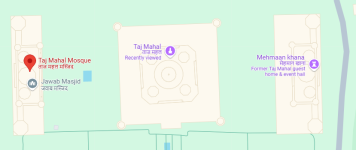
But it does make it Islamic architecture:
- There is a mosque at the Taj Mahal, an Islamic place of worship completed 5 years after the mausoleum.
1736360569564.png
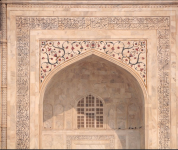
- Verses of the holy Quran are etched into the Taj Mahal.
1736361270863.png
- Builders, carvers, painters, calligraphers from Central Asia and Iran were brought to complete the construction of the Taj Mahal

All these things make it more than Mughal architecture. There is no doubt it is Mughal but Mughal is a subset of Muslim.
 
It is indeed an "Islamic building". Out of curiousity why does it matter what religion is associated with it?


But it does make it Islamic architecture:
- There is a mosque at the Taj Mahal, an Islamic place of worship completed 5 years after the mausoleum.
View attachment 93898
- Verses of the holy Quran are etched into the Taj Mahal.
View attachment 93902
- Builders, carvers, painters, calligraphers from Central Asia and Iran were brought to complete the construction of the Taj Mahal

All these things make it more than Mughal architecture. There is no doubt it is Mughal but Mughal is a subset of Muslim.
You are not wrong, and you are not right.

Do read my detailed response to that brilliant post by Krash a couple of posts before - #74 being the post by Krash, #75 and #76 my reflections on that.
 
It is indeed an "Islamic building". Out of curiousity why does it matter what religion is associated with it?
To answer briefly - architecture is a theatre of war in a social conflict going on in my country, and I therefore endeavoured to point out the irrelevance of any religious classification.
 
Builders, carvers, painters, calligraphers from Central Asia and Iran were brought to complete the construction of the Taj Mahal
The bulk, considering logistics, and some of the details of the decorations, seem to have been locals, natives. This is at best a point that cannot be proved one way or the other.
 
India never invaded any country in her last 100000 years of history.

Sounds amazing, because India never existed

When many cultures were only nomadic forest dwellers over 5000 years ago, Indians established Harappan culture in Sindhu Valley (Indus Valley Civilization)

The name 'India' is derived from the River Indus, the valleys around which were the home of the early settlers. The Aryan worshippers referred to the river Indus as the Sindhu


Thats in Pakistan
 

Users who are viewing this thread

Pakistan Defence Latest

Country Watch Latest

Back
Top