Indian Politics and Internal News

Remember infrastructure is not just pouring concrete on ground. That is fairly easy to do. You should also consider education, healthcare, quality of the polity and all things that make creation of wealth possible.
 
In fact, this is incorrect on two counts.

First, there were portions of history when India, hypothetically, according to the reconstruction of World GDP that we are all referring to, was even better off.

Second, after Aurangzeb, the national economy declined, not in a catastrophic manner, but visibly; with the coming to power of the British, with the defeat of the Maratha Confederacy piece-meal, and the reduction of Shivaji's descendants to two minor Maharajas, and the abject surrender of the Nizam, and the Nawab of Oudh, the economy began to decline very rapidly, running from the periodical peak under Aurangzeb to a meagre 2% of the world figure by 1947.

India's progress from 1947 is flawed only by a horribly bad GINI coefficient, but apart from this heart-breaking figure, to be potentially the world's fourth largest economy by 2026 is not a trivial thing.
Here, Hindu forum fighters consider Maratha Rule as reestablishing of Hindu Rule by 1700 to 1818, when they lost to Western forces....
Mughal Rule is also regarded as favouring rule. Hindus became richer during that Mughal period 🕳️
 
I visited South Asia last year. I visited Pakistan, Nepal, Bangladesh and India ending with Maldives. Then 6 months later I visited China, far east Russia, Uzbekistan, Turkmenistan, Kazakhstan, Azeribaijan, Iran and Tajikistan.

I noticed one thing India´s infrastructure is beyond poor perhaps worst infrastructure and worse then mountainous Nepal. I was surprised by Bangladesh as having the best infrastructure in South Asia by a landslide most people have no idea how well Bangladesh is build.

Pakistan is second it has great roads and especially Islamabad is beautiful perhaps one of the most beautiful cities I have visited with the way nature and infrastructure is mixed.

But overall as soon as you enter from Indian border Pakistan surprises you it has good infrastructure in comparison. I was kind of surprised by even the tiny details such as the gas stations, motels, restuarants, large clean roads etc etc the Infrastructure is much better and everything was clean and people were extremely chill which adds to the beautiful nature and good infrastructure people arent in your face but they keep distance and just chill overall.

I was just like this guy when I entered Pakistan from India and the place I loved most was Baltistan it has many beautiful district and valley´s with gardens each one better then the other.
To view this content we will need your consent to set third party cookies.
For more detailed information, see our cookies page.


At this point, I think this NZ guy from the YT video, goes to India at the days end to be with his Indian wife and comes back to Pakistan early morning. He seems to be traveling to Pakistan from India quite a lot.
 
1737224516853.png
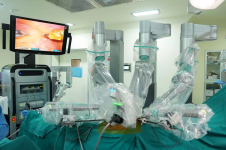
Combining cutting-edge technology with medical innovation, doctors used India’s first indigenous surgical tele-robotic system to successfully conduct two complex heart surgeries over a distance of 286 kilometres – the longest, physical separation so far achieved in India between a patient and the operating surgeon.

The surgical-robotic system, called the SSI Mantra, and developed by medical technology company, SSI Ltd, is the first-of-its-kind system in India. It conducted two surgeries on January 9 and 10 on two men, aged 59 and 56 respectively, with a team stationed at the SSI’s robotics control in Gurugram and another at the Manipal Hospital in Jaipur.

The first procedure was an internal mammary artery harvesting, which involves removing the artery for a coronary artery bypass grafting. The second was a total endoscopic coronary artery bypass, which is considered a complex cardiac surgery as the surgeon has to work on the artery while the heart is still beating.

Speaking to The Hindu about the surgeries, Dr. Lalitaditya Malik, cardiothoracic vascular surgery consultant at the Manipal Hospital in Jaipur, said his team of 10 medical staff and five from an Information Technology support team did mock drills for these operations for nearly a week every day before the actual procedures.

Less time, better precision​

“Latency time, ensuring good connectivity, anticipating and being prepared for medical and technical problems are the challenges associated with the procedure. The advantages include reduced time of operation, better precision, minimal operation trauma to the body in terms of incision, blood loss, recovery time and chances of infection,’’ he said.

The surgeries were successful because the underlying technology enabled a latency of 35-40 milliseconds (1/20th of a second), meaning that actions executed in Gurugram were almost instantaneously transmitted to the robotic surgical instruments in Jaipur. The patients have been discharged.

The surgeon involved, Sudhir Srivastava, founder of SS Innovations, and who specialises in robotic cardiac surgery, told The Hindu that MantraSync was a proprietary tele-surgical network module specifically designed to work seamlessly with the SSI Mantra surgical-robot system.

A research article published in the Journal of Robotic Surgery last November, describes the robotic system employed: “The dual console SSI Mantra Surgical Robotic System has two consoles: a master surgeon console situated at a remote location and a slave surgeon console located in an operation theatre. Both the surgeon consoles have a system controller, a pair of hand controllers, and various other control pedals/toggle switches etc. In an operation theatre, multiple patient-side arm carts are arranged around an operating table. Multiple robotic arms (each having a robotic surgical instrument) are mounted on the patient-side arm carts. One of the patient-side arm carts is equipped with an endoscopic camera. The dual consoles are connected via a transmission network. During the telesurgery, the system control is with the master surgeon console. The remote expert surgeon manoeuvres the hand controllers to perform specific surgical actions, and these action/control signals are transmitted to a network router via a network switch locally present near the master surgeon console. Then the control signals are sent over the chosen transmission network to the system controller of the slave surgeon console via a local network router. These action/control signals are then transmitted to the patient-side arm carts, present at the location of surgical site of the patient.”

Technology approved​

Based on these trials, the SSI technology had got regulatory approvals. “The technology has been approved by the Central Drugs Standard Control Organisation (CDSCO) in India under Class B and Class C surgical devices. These approvals affirm the safety, efficacy, and regulatory compliance of the system for use in hospitals across India,’’ said Dr. Srivastava.

He added that the development cost of MantraSync primarily involved software development for secure data transfer using Airtel’s existing fibre-optic network infrastructure. The implementation costs were limited to installing the SSI Mantra robotic system in a hospital and Airtel’s network infrastructure fees. Currently, three institutions are connected to the SSI’s headquarters in Gurugram via the MantraSync setup, allowing them to perform tele-surgeries under controlled conditions.

Stating that while the aim was to bridge geographical and infrastructural gaps in surgical care and make tele-surgery accessible on a global scale, Dr. Srivastava added that for the effective implementation of the technology in India, there should be good network with high-speed, low latency, robust training of medical staff and scalability for greater distances.


Expensive option​

Another challenge was that robotic surgeries were still expensive. “While technology is now well- developed and availability of trained surgeons too have improved considerably, it will seem that the adaption has been skewed to metros and tier-1 locations,” said Dilip Jose, Managing Director and CEO, Manipal Hospitals, “Higher costs – both capital as well as operating – would be a major factor in this, and it might still be a while before the option of robotic surgeries become commonly available in all parts of the country,’’ he said.

He added that once insurance covered more robotic procedures, it would be more affordable. Mr. Jose also noted that the training infrastructure had improved following an increase in installation of the robotic system.
 
I visited South Asia last year. I visited Pakistan, Nepal, Bangladesh and India ending with Maldives. Then 6 months later I visited China, far east Russia, Uzbekistan, Turkmenistan, Kazakhstan, Azeribaijan, Iran and Tajikistan.

I noticed one thing India´s infrastructure is beyond poor perhaps worst infrastructure and worse then mountainous Nepal. I was surprised by Bangladesh as having the best infrastructure in South Asia by a landslide most people have no idea how well Bangladesh is build.

Pakistan is second it has great roads and especially Islamabad is beautiful perhaps one of the most beautiful cities I have visited with the way nature and infrastructure is mixed.

But overall as soon as you enter from Indian border Pakistan surprises you it has good infrastructure in comparison. I was kind of surprised by even the tiny details such as the gas stations, motels, restuarants, large clean roads etc etc the Infrastructure is much better and everything was clean and people were extremely chill which adds to the beautiful nature and good infrastructure people arent in your face but they keep distance and just chill overall.

I was just like this guy when I entered Pakistan from India and the place I loved most was Baltistan it has many beautiful district and valley´s with gardens each one better then the other.

To view this content we will need your consent to set third party cookies.
For more detailed information, see our cookies page.


The difference between the best and worst is fairly small in BD.

Whereas the difference between best and worst is quite horrendous in India.

Outside the tech hubs and tier-2 cities - things are pretty grim.
 
@Afif ,Looks like the Begum gave you the best infrastructure in South Asia by a landslide.

Hasina transformed BD from a crap hole into something that even first world foreigner can admire.

Only the utter nutcase partisans deny it.

But YouTube videos are there for reference!

Start with that bus terminal that was called “Zia International Airport”.

That airport was aptly named!

The new airport is also aptly named - progress and plurality.

24/7 load shedding replaced with 24/7 air conditioning!
 
BD had worst infrastructure in 2009 out of the large 3(India,Pakistan and BD) and may now be the best.

All credit to Hasina who will go down in history as the architect of modern BD.

She has left a fantastic legacy behind and although she had her faults, I will always be grateful to her for what she did for BD.
 
@UKBengali

UKB Dada,

Do you have any numbers, rankings etc to show that BD is best among the 3 South Asian countries in infra? Or is it just your personal opinion?

Regards
 
Install robotic surgical units in mobile healthcare vans powered by satellite internet. These vans could be deployed to remote regions during natural disasters or emergencies.
 
Yes, and Compton when our distribution center was located there. The area surrounding LAX proper is equally bad.

I've been to 3rd world countries that weren't nearly as bad as sections of Los Angeles, San Francisco, Seattle, and , surprisingly, Atlanta.
But is it fair to compare a relatively small part of America with large parts of developing countries.

The tenderloin in SF or Skid row in LA are sacrifice zones and the problem seems more politically mismanaged. Reopening mental hospital, spending more on drug and alcohol rehab, and building cheaper starter homes could solve much of the problem. California politicians don’t want to solve the problem.

As far as Indian infrastructure lagging, has to be looked at from a funding and priorities point of view. India is probably spending more to distribute better services across the board then Pakistan or Bangladesh, so spending on sanitation is not as high a priority.
 
Due to size, India’s and Pakistan’s spending is spread very thinly.

Bangladesh’s spending is most optimal for coverage.

Another 200 billion over this decade - it should look like east European level at least.
 
@UKBengali

UKB Dada,

Do you have any numbers, rankings etc to show that BD is best among the 3 South Asian countries in infra? Or is it just your personal opinion?

Regards


Look at connectivity by road/rail, bridges and power supply.

BD is small and so building a single piece of infrastructure like Padma Bridge can impact 20-25% of the population in a major way.

By 2030-2035 BD is likely to have truly world-class infrastructure as there are still a few large scale projects that need completing such as high speed railway from Dhaka to Chittagong.

Only bad infrastructure left in BD is railways but that should be upgraded in next 5-10 years to world class levels.
 
But is it fair to compare a relatively small part of America with large parts of developing countries.

The tenderloin in SF or Skid row in LA are sacrifice zones and the problem seems more politically mismanaged. Reopening mental hospital, spending more on drug and alcohol rehab, and building cheaper starter homes could solve much of the problem. California politicians don’t want to solve the problem.

As far as Indian infrastructure lagging, has to be looked at from a funding and priorities point of view. India is probably spending more to distribute better services across the board then Pakistan or Bangladesh, so spending on sanitation is not as high a priority.
It depends. I've been witnessing the degradation of any number of US cities for quite awhile now and frankly, they are not only getting worse, the proposed solutions will solve no problems.

Concerning your comments about California politicians not wanting to solve problems, I couldn't agree more. If anything, they are creating more problems than solving. Some of the latest "mandates" by the state will only achieve the goal of driving investment out of the state and making it even more unaffordable for those who live there.
 
It depends. I've been witnessing the degradation of any number of US cities for quite awhile now and frankly, they are not only getting worse, the proposed solutions will solve no problems.

Concerning your comments about California politicians not wanting to solve problems, I couldn't agree more. If anything, they are creating more problems than solving. Some of the latest "mandates" by the state will only achieve the goal of driving investment out of the state and making it even more unaffordable for those who live there.
I suspect it’s harder to upkeep things in the US because, a lot of the maintenance budgets are being used to either patch up other problems, then there is more grifters taking a higher cut, and finally not enough tax revenue in the areas that need upkeep.

Yes as a whole the country ain’t what it use to be, but the culture of not revering our third places, less attachment to our cities, is causing a decline in people giving a hoot to upkeep them
 

Users who are viewing this thread

Pakistan Defence Latest

Back
Top