SoulSpokesman
Trusted Member

MHTMH. Congratulations to ISRO.
Regards
Regards
Follow along with the video below to see how to install our site as a web app on your home screen.
Note: This feature may not be available in some browsers.


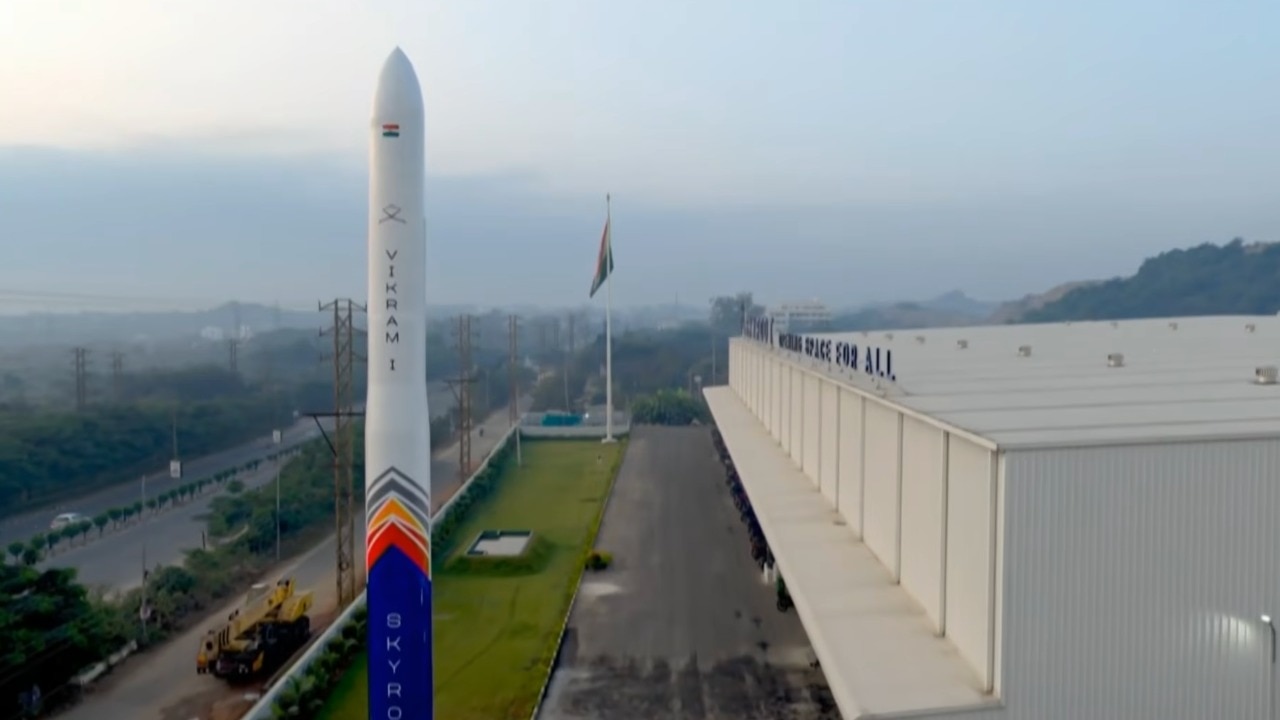
They are making good progress.PM Modi unveils Skyroot-built India's first private rocket Vikram-I in Hyderabad
Prime Minister Narendra Modi on Thursday inaugurated Skyroot Aerospace's Infinity Campus in Hyderabad, unveiling Vikram-I, India's first privately developed orbital launch vehicle capable of placing satellites into orbit.
The state-of-the-art facility spans 200,000 square feet, designed for end-to-end development, integration, and testing of multiple launch vehicles, with a capacity to produce one orbital rocket monthly.
Addressing the event virtually, PM Modi praised ISRO for powering India's space journey over decades, crediting its credibility, capacity, and value for carving a distinct global identity. He highlighted the youth's innovation, risk-taking, and entrepreneurship reaching new heights, noting unprecedented opportunities in the space sector where the private sector is advancing rapidly.
WHAT IS VIKRAM-I?
Vikram-I is a technological marvel, designed to carry payloads of around 300 kg to Low Earth Orbit (LEO). It boasts an all-carbon-fiber body, a feature that sets it apart from other rockets in its class.
The Vikrams series is named for Dr. Vikram Sarabhai, founder of the Indian Space Program, and is in development to capture the multi-million-dollar small satellite launch market. The rockets are developed with the aim of providing multi-orbit insertion and interplanetary mission capability to not just India but also foreign customers.
One of the most notable features of Vikram-I is its ability to place multiple satellites into orbit simultaneously. This capability is a first for India's space sector and places the country among the global leaders in satellite deployment technology.
The company claims that it can be assembled and launched within 24 hours from any launch site.
Skyroot's Infinity Campus embodies India's new thinking and youth power, positioning the nation as a future leader in the global satellite launch ecosystem.
Founded by former ISRO scientists and IIT alumni Pawan Chandana and Bharath Dhaka, Skyroot made history in 2022 with Vikram-S, India's first private sub-orbital rocket launch.
The event highlighted policy reforms liberalising India's space sector since 2023, fostering startups across launch, satellite, and analytics chains. Vikram-I targets the small-satellite market, enhancing onshore launch capacity amid projections of a $77 billion opportunity by 2030.
Skyroot has raised over $95 million, partnering with entities like Axiom Space to expand low-Earth orbit access.
PM Modi unveils Skyroot-built India's first private rocket Vikram-I in Hyderabad
The Vikrams series is named for Dr. Vikram Sarabhai, founder of the Indian Space Program, and is in development to capture the multi-million-dollar small satellite launch market.www.indiatoday.in
Good, if it's helping you in improving your social credit!India is truly skilled at creating "PPT" presentations!
View attachment 221406
View attachment 221407

First, you would send Hindunaught in space than will dream space station, which won't come 2040 as early as India can, I afraid to say that dude, China is way ahead in space exploration from youGood, if it's helping you in improving your social credit!
...and the race has ended or India is only warming up??. For a country as poor as India is advised to be, Indians are OK with the progress.First, you would send Hindunaught in space than will dream space station, which won't come 2040 as early as India can, I afraid to say that dude, China is way ahead in space exploration from you

ChatGPT suggests similar....and the race has ended or India is only warming up??. For a country as poor as India is advised to be, Indians are OK with the progress.
I remember, 20 years back, People where laughing on China vs US. Now they don't. Be it sports or space or defence, everything is a function of money. 4 trillion...and so far...8 trillion with lower population than current and infra far developed, the matrix changes. ...and do you know how many years India needs to reach 8 Trillion . Let's check this. Using WhatsApp AI. "
Searching for current estimates
Looking into the latest estimates in nominal USD, focusing on sources like the IMF World Economic Outlook and government data.
Short answer
Factually, India is likely to become an US$8 trillion economy around 2034–2036, approximately 8–10 years from 2026, assuming the question refers to nominal GDP measured in current US dollars, not purchasing-power parity.
What credible projections indicate
- Morgan Stanley’s India economic outlook projects the economy at US$8.8 trillion by 2035 under its base-case scenario. Its pessimistic scenario projects US$6.6 trillion, while its optimistic scenario reaches US$10.3 trillion by 2035. 1
- KKR’s October 2026 outlook says India has crossed US$4 trillion and could double to more than US$8 trillion over the next ten years, implying approximately 2036. KKR assumes nominal GDP growth of around 10–11% annually, although the dollar value will also depend heavily on the rupee-dollar exchange rate. 2
- Morgan Stanley separately projected India’s GDP at US$4.7 trillion in 2026 and US$5.7 trillion in 2028. 1
Mathematical cross-check
Starting from US$4.7 trillion in 2026:
- At 7% annual dollar-GDP growth: approximately 2034
- At 8%: approximately 2033
- At 9%: approximately 2032
- At 10%: approximately 2032
However, this calculation is only illustrative. India’s real economic growth, domestic inflation and the rupee-dollar exchange rate collectively determine nominal GDP expressed in US dollars.
Bottom line
Claims that India will reach US$8 trillion much earlier than 2032 would require unusually strong nominal growth in dollar terms and a relatively stable rupee. Conversely, significant rupee depreciation could push the milestone beyond 2035 even if India continues recording strong real GDP growth.Considering projections and sources
Looking into various projections, including Morgan's and KKR's, for growth from 4.7 to 8 trillion USD. The timeline seems to vary, with estimates ranging from 9 to 10 years from 2026."