Indonesian Democracy and Islamic Ethics

Status
Not open for further replies.
To view this content we will need your consent to set third party cookies.
For more detailed information, see our cookies page.


Secrets & Lessons From Thailand's Almost Prime Minister - Pita Limjaroenrat (Tim)​

 
Poltracking Indonesia Survey: 78.1% Satisfaction with 1 Year of the Prabowo Subianto–Gibran Rakabuming Raka Administration

By Firda Cynthia Anggrainy
19 October 2025


To view this content we will need your consent to set third party cookies.
For more detailed information, see our cookies page.

Prabowo during Armed Force Event, 5 October 2025


Jakarta
– The polling institute Poltracking Indonesia conducted a survey to evaluate the one-year performance of President Prabowo Subianto and Vice President Gibran Rakabuming Raka. The results show that public satisfaction with their first year in office stands at 78.1%.


  • The survey was held 3–10 October 2025, involving 1,220 respondents via face-to-face interviews.
  • The sample method used was multistage random sampling, with a reported margin of error of ±2.9 percent at a 95% confidence level.
  • Among the respondents:
    • 78.1% indicated they were satisfied with the combined performance of President Prabowo and Vice-President Gibran.
    • 19.3% said they were not satisfied.
    • 2.6% answered “don’t know / no answer”.

Reasons for satisfaction​


According to the survey’s executive director, Hanta Yuda Rasyid, respondents cited several reasons for being satisfied, including:


  • Firm and authoritative leadership;
  • Targeted government aid;
  • The “Free Nutritious Meals” (Makan Bergizi Gratis) program;
  • Efforts in preventing/countering corruption;
  • Tangible performance;
  • Assurance of healthcare services.

Reasons for dissatisfaction​


On the other side, among those who said they were not satisfied, cited reasons included:


  • Unstable economy;
  • Aid not properly targeted;
  • Corruption cases;
  • High prices of staple goods;
  • Insufficient job opportunities.


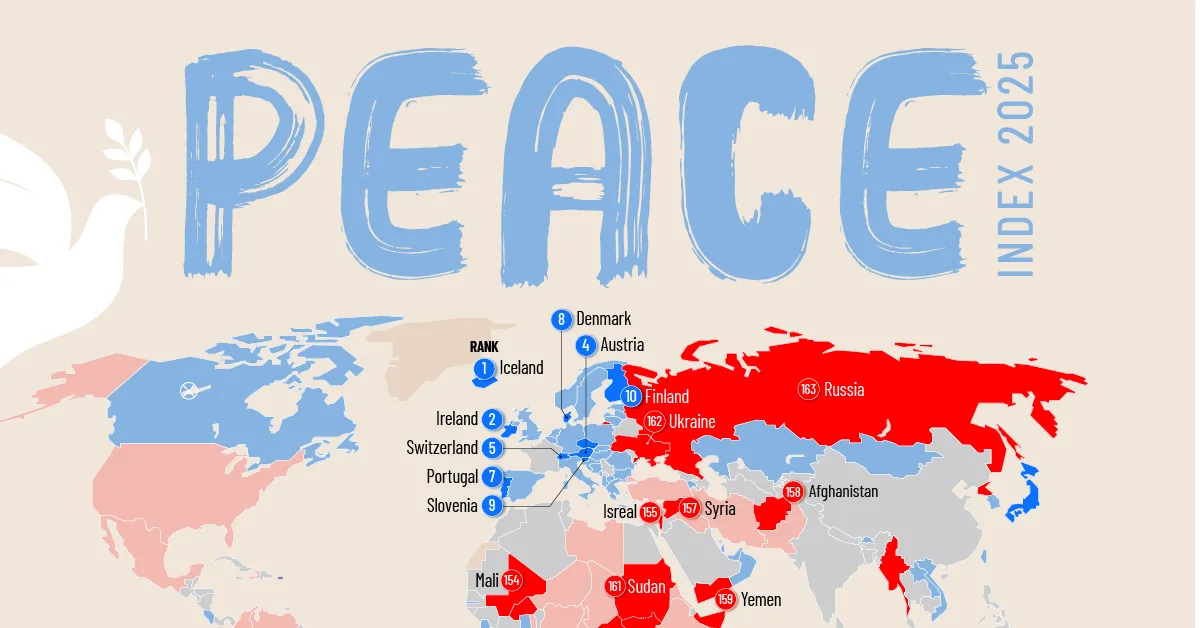
Mapped: The 2025 Global Peace Index​


Published on October 26, 2025

1761878839088.webp

Methodology​


For the analysis, the IEP used 23 equal-weighted indicators to assess the stability countries, including:


  • Deaths from internal conflict
  • Violent demonstrations
  • Perceptions of criminality
  • Terrorism impact
  • Safety and security

Overall, 99.7% of the global population was covered across 163 countries and territories.

 
1762101590179.jpeg
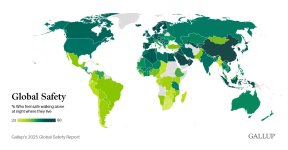
Do you feel safe walking alone at night?

That is the question Gallup posed to the world. You might expect the answer to be grim. After all, global conflict is at its highest level since the Second World War.

But this year’s Global Safety Report reveals a remarkable paradox: despite wars, extremism, and unrest, 73% of adults worldwide now say they feel safe walking alone at night. It's the highest level in nearly two decades of tracking.

This question is not just a data point. It is the United Nations’ benchmark for progress on peace and justice (SDG indicator 16.1.4). And rightly so. If people do not feel safe in their own communities, what in society can work?

Explore Gallup’s 2025 Global Safety Report, produced with NYU Center on International Cooperation (CIC): https://lnkd.in/erbfAK7a

 
1762101927665.jpeg
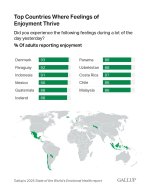
The next global crisis may not begin in markets or politics, but in how people feel.

Gallup’s new State of the World’s Emotional Health 2025 finds that nearly four in ten adults worldwide live with high levels of worry and stress. These are not passing moods but early signs of pressure building inside societies and the institutions meant to hold them together.

Even with all that strain, humanity has not lost its spirit. Anger and sadness remain high, yet most people still find reasons to smile. Eighty-eight percent say they are treated with respect, one of the highest figures Gallup has ever recorded.

Economic data show how nations perform. Emotional data show how people live. One measures progress; the other may decide whether it lasts.


Global study finds people in Indonesia flourish the most. Here’s why​


Alexa Mikhail
May 2, 2025 at 2:29 PM EDT


To view this content we will need your consent to set third party cookies.
For more detailed information, see our cookies page.

A village in rural areas of Java Island


An expansive new Global Flourishing Study found that you don’t need to live in the richest countries to “flourish,” with that concept defined as “the relative attainment of a state in which all aspects of a person’s life are good, including the contexts in which that person lives.”

To determine where people are flourishing, researchers at Harvard and Baylor universities analyzed data collected by Gallup and survey responses from more than 200,000 people in 22 countries over five years. The flourishing index takes into account residents’ happiness and life satisfaction, mental and physical health, meaning and purpose, character and virtue, and close social relationships.

Indonesia, a middle-income country, topped the list with the highest composite flourishing score, followed by Israel, the Philippines, and Mexico.

“While many developed nations report comparatively higher levels of financial security and life evaluation, these same nations are not flourishing in other ways, often reporting lower meaning, pro-sociality, and relationship quality,” the researchers write.

Three-fourths of the participants in Indonesia reported going to religious services at least once a week, for example, providing context for why their social connectedness ranks higher than in other countries.

“Indonesia is often contrasted unfavorably with Japan in discussions of international development, cited as an example of the so-called middle-income trap, in which economic growth stalls before reaching high-income levels,” the researchers wrote in a New York Times opinion piece. “This is true, so far as it goes, but our study suggests that the focus on economic growth tells only part of the story.”

While the annual World Happiness Report considers whether people are living the best possible life they can imagine, the flourishing study looks beyond individual happiness to consider the well-being of someone’s environment.

“While the terms ‘flourishing’ and ‘well-being’ are often used interchangeably, flourishing arguably has a connotation of also having the environment itself being conducive to growth and being a part of one’s flourishing,” the authors explain. They found that a country’s wealth factors less into residents’ perception of flourishing.

“The claim being made here is not a causal assertion about gross domestic product lowering meaning,” the authors write. “Rather, the desired outcome of a society is presumably one with both high levels of economic development and high levels of meaning, and the question is then how to attain this.”

The study also found that the U-shaped curve of happiness—illustrating how life satisfaction peaks when you’re young, then dips, and peaks again when you’re older—is becoming less pronounced. In fact, people aged 18 to 29 were flourishing less than previously thought. Past research has pointed to contributors such as social isolation, financial worries, social and political unrest, and a lack of meaning and direction, among others.


Muslim piety in Southeast Asia mirrors increased religious traditionalism in the Middle East​


To view this content we will need your consent to set third party cookies.
For more detailed information, see our cookies page.

Masjid in Bojonegoro, East Java


Published
on
September 29, 2022
By
Dr. James M. Dorsey

Eighty-four per cent of the respondents in Malaysia and Indonesia said they prayed five times daily. Thirty-three per cent described themselves as more observant than their parents, 45 per cent said they were just as observant as their parents, and 21 per cent stated that they were less observant.

Religion’s increasing importance stroked with the polling in the Middle East where 41 per cent of 3,400 young Arabs in 17 Arab countries aged 18 to 24 said religion was the most important element of their identity, with nationality, family and/or tribe, Arab heritage, and gender lagging far behind. That is 7 per cent more than those surveyed a year earlier.

 
To view this content we will need your consent to set third party cookies.
For more detailed information, see our cookies page.


Another credible survey company shows similar result about Prabowo latest popularity (20 - 27 October 2025). His latest popularity is pretty high with 77.7 % Indonesian satisfied with him and his leadership, pretty similar with previous survey at Poltracking at 78 %.

Indikator is one of the most reputable survey company in Indonesia, lead by Prof Burhand Muhtadi Phd

The suvey is quite complete, just need to dig on the company survey thread to see more detail survey

---------------

PERFORMANCE OF PRESIDENT PRABOWO SUBIANTO Currently, around 77.7% of citizens feel satisfied with the performance of President Prabowo Subianto, while around 20.8% feel somewhat/dissatisfied at all, and around 1.5% did not respond.

To view this content we will need your consent to set third party cookies.
For more detailed information, see our cookies page.
 
Soeharto becomes national hero. Just need to inform folks in here that Soeharto is part of military commanders who fought Dutch and its allies ( British Armed Force and British Indian Army) during War of Revolution 1945-1949.

To view this content we will need your consent to set third party cookies.
For more detailed information, see our cookies page.


Soeharto families appreciate it, Soeharto son and daugther spoke

To view this content we will need your consent to set third party cookies.
For more detailed information, see our cookies page.
 
One thing that is different from previous President, Prabowo usually meet with Cabinet Ministers inside his house during weekend whether in Kertanegara, South Jakarta or in Bogor, Greater Jakarta.

What is told inside the elite circle is that Prabowo is pretty difficult to be reached, this frequent/usual weekend meeting I think is a good thing does by him to improve communication between him and his cabinet minister and also with other Democracy stake holders like Islamic leaders during recent protest and also with news editors

His house in Kertanegara, South Jakarta where he meet with his ministers

To view this content we will need your consent to set third party cookies.
For more detailed information, see our cookies page.


This is his house in Bogor, Greater Jakarta, where he met big media editors

To view this content we will need your consent to set third party cookies.
For more detailed information, see our cookies page.
 
To view this content we will need your consent to set third party cookies.
For more detailed information, see our cookies page.


To view this content we will need your consent to set third party cookies.
For more detailed information, see our cookies page.
 

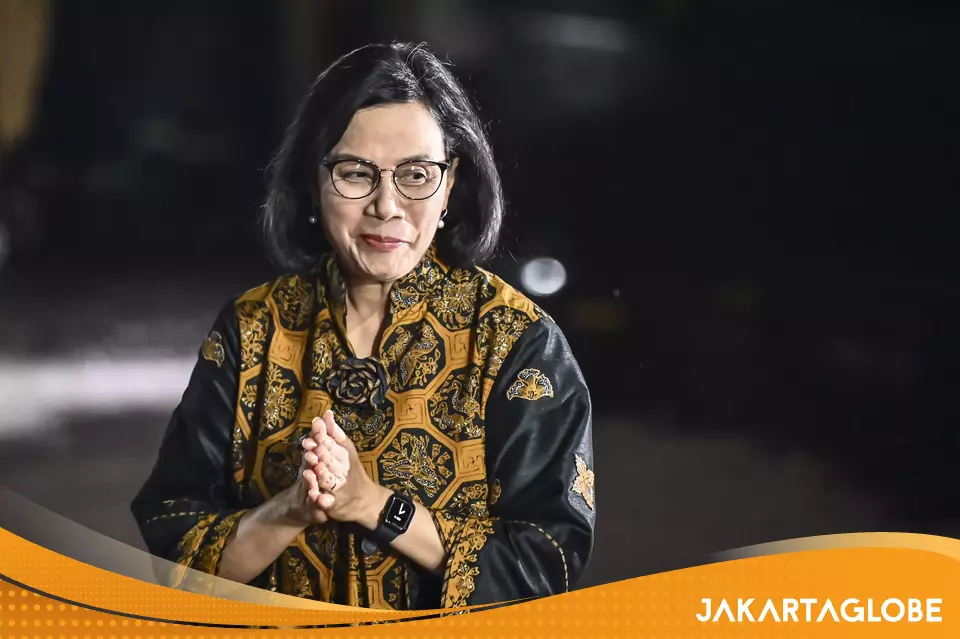
Sri Mulyani Joins Oxford to Mentor Future World Leaders​


Johnny Johan Sompotan

December 11, 2025 | 3:37 pm


1765464532464.png
Finance Minister Sri Mulyani Indrawati arrives at the private residence of President-elect Prabowo Subianto on Kertanegara IV Street, South Jakarta, Monday, Oct. 14, 2024. (Antara Photo/Aprillio Akbar)


Jakarta. Former Finance Minister Sri Mulyani Indrawati has revealed her next chapter: she is now teaching at the University of Oxford in the United Kingdom while joining the 2026 World Leaders Fellowship at the Blavatnik School of Government.


The fellowship is designed for global leaders transitioning from top public roles, providing a platform to share insights, mentor future policymakers, and engage in high-level discussions on governance and innovation.


During her one-year fellowship, Sri Mulyani will mentor students and alumni, participate in global leadership forums, and explore new approaches to public-sector management.

“It is an honor for me to join the World Leaders Fellowship at the University of Oxford. I hope to contribute wisely, share experiences while continuing to learn, and support the next generation of policymakers,” she said in a statement published on Oxford’s Blavatnik School website on Tuesday.


Founding Dean Ngaire Woods welcomed her appointment, saying students from more than 60 countries would benefit from Sri Mulyani’s deep experience in global economic policymaking.


Sri Mulyani is the first Indonesian finance minister to serve under three consecutive presidents. She was named the world’s best minister in 2018. Before returning to government, she served as Managing Director and Chief Operating Officer of the World Bank, overseeing global operations and supporting developing countries in tackling development challenges.


Her fellowship marks a new milestone in her long career in public policy and global leadership.


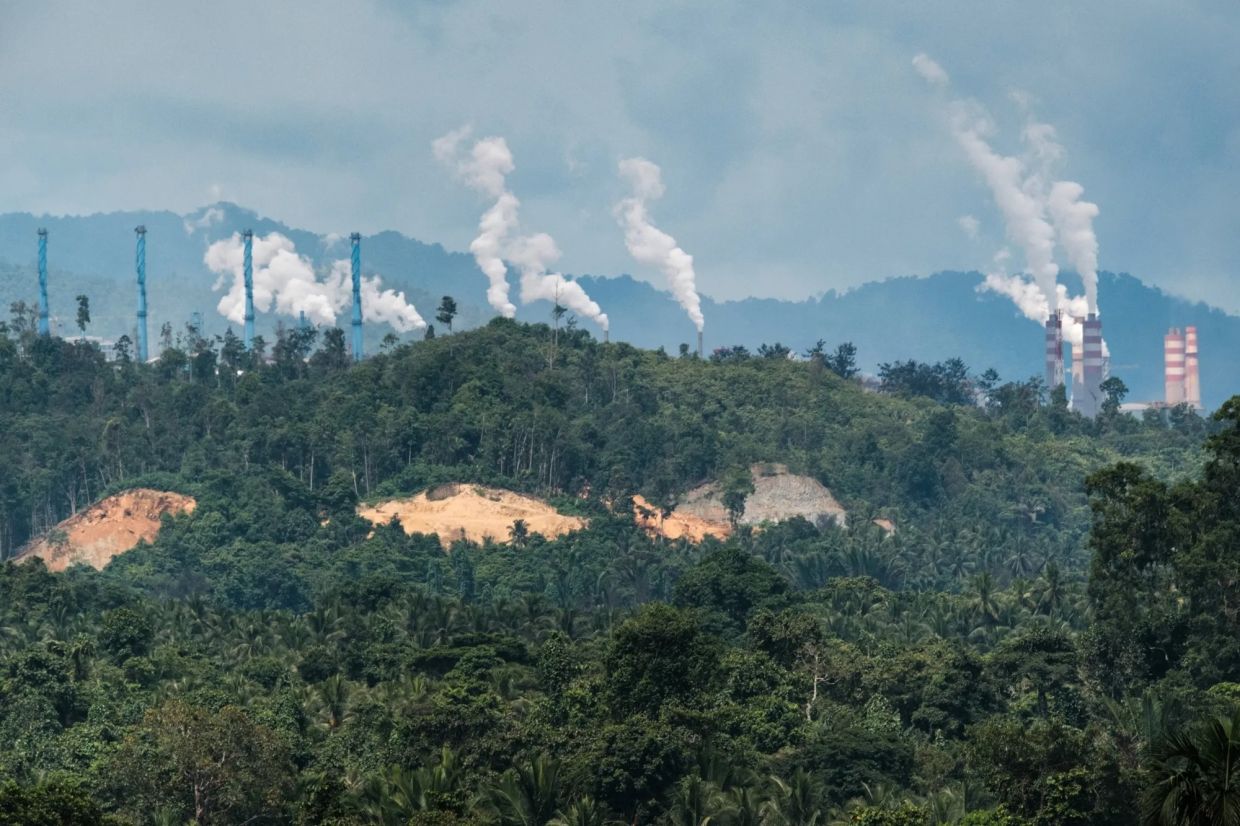
Indonesia meets its goal to seize four million hectares of illegal land, used for mining, palm oil and forestry activities​


Wednesday, 24 Dec 2025


JAKARTA (Bloomberg): Indonesia has seized more than four million hectares of land it says was used illegally for mining, palm oil, and forestry activities, meeting a target issued earlier this month as the government cracks down on illegal resource extraction.

The figures were announced by Attorney General ST Burhanuddin at a land handover ceremony in Jakarta on Wednesday. The plantations taken are valued at more than 150 trillion rupiah ($8.9 billion), according to data provided by the government.


The seizures are a result of President Prabowo Subianto’s push to tighten oversight of the country’s natural-resource industries, thereby boosting profits to the state from lucrative industries like mining and plantations.

The moves are also part of Indonesia’s broader efforts to strengthen governance in sectors that play a key role in the economy, including addressing environmental and legal risks.

"I’m happy today,” Prabowo said at the event. "Despite the workload still being heavy, I have a strong instinct that in 2026 we’ll take much bolder steps.”

The government has transferred control of more than 2.4 million hectares to relevant ministries and state entities, including 1.7 million hectares of palm oil plantations to state-owned firm PT Agrinas Palma Nusantara.

More than 700,000 hectares are also slated for ecosystem restoration and reforestation, Burhanuddin said.

Authorities have collected 2.3 trillion rupiah in land-use fines, while the Attorney General’s Office has secured an additional 4.3 trillion rupiah in recovered state funds linked to corruption cases in the natural-resources sector.

-- ©2025 Bloomberg L.P.


New penal code takes effect, marking historic break with colonial law​


Sunday, 04 Jan 2026


To view this content we will need your consent to set third party cookies.
For more detailed information, see our cookies page.


The country began enforcing its newly ratified penal code, replacing a Dutch-era criminal law that had governed the country for more than 80 years and marking a major shift in its legal landscape.

Since proclaiming independence in 1945, the South-East Asian country had continued to operate under a colonial framework widely criticised as outdated and misaligned with Indonesia’s social values.


Efforts to revise the code stalled for decades as lawmakers debated how to balance human rights, religious norms and local traditions in the world’s most populous Muslim-majority nation.

The 345-page Indonesian Penal Code was passed in 2022. At the time, then-US State Department spokesperson Ned Price said the United States was “closely monitoring the revised criminal code” of its democratic partner.

To view this content we will need your consent to set third party cookies.
For more detailed information, see our cookies page.


It criminalises sex outside marriage and reintroduces penalties for insulting the president and state institutions. It comes into force following a three-year transition period.

A previously revised code was poised for passage in 2019, but then-president Joko Widodo urged lawmakers to delay a vote amid mounting public criticism that led to nationwide protests involving tens of thousands of people.

Opponents said it contained articles that discriminated against minorities and that the legislative process lacked transparency.

A parliamentary task force finalised the Bill in November 2022 and lawmakers unanimously approved it a month later in what the government called a “historic step”.

The enforcement of the new penal code marks “the end of the colonial criminal law era and the beginning of a more humane, modern, and just legal system rooted in Indonesian culture,” said Coordinating Minister for Law, Human Rights, Immigration, and Corrections Yusril Ihza Mahendra.

“This is a historic moment for the Indonesian nation,” Yusril said. — AP


Indonesia to Begin Construction of Hajj Complex in Mecca in 2026​


Jayanty Nada Shofa

January 7, 2026 | 7:52 pm

1767932757999.png
President Prabowo Subianto performs Umrah in Mecca on July 3, 2025. (Photo Courtesy of Presidential Press Bureau)


Jakarta. Sovereign wealth fund Danantara announced on Wednesday that Indonesia would break ground on its Hajj Complex megaproject in Mecca later this year.


Indonesia wants to build a “village” dedicated to its pilgrims near Islam’s most significant mosque, the Masjid al-Haram, in Mecca.


Danantara recently struck a $500 million deal to acquire Novotel Makkah Thakher, an already operational hotel that is around 2.5 kilometers away from the mosque. The agreement includes 14 land plots spanning 4.4 hectares, on which Indonesia will build more towers and a shopping center. According to Danantara, construction over this land will begin this year, although the fund did not say the exact month. The agency has also prepared an undisclosed amount of capital to get the work started.


“Our focus is to make sure that every step is prudent, measured, and provides long-term benefits. We are building this Hajj Complex as a cross-generation, strategic project,” Danantara’s chief investment officer Pandu Sjahrir said.

This further development will bring the total lodging capacity in the Thakher area from around 4,383 pilgrims to around 22,000 individuals, about 10% of Indonesia’s annual Hajj contingent. The additional hotel towers will enter operations by 2029, which the fund said would depend on the permit and the project’s readiness.


Danantara is awaiting the results of a bid for a land that is also close to Masjid al-Haram, but lies in the Western Hindawiyyah area. Indonesia claimed to be among the top two contenders out of the 90 bidders vying for this spot. Saudi authorities will pick the investor deemed capable of developing the area according to the Mecca master plan.


Shortly after bringing home the Novotel deal last month, Danantara’s boss Rosan Roeslani told reporters that the further developments of the Thakher land would cost up to $800 million. The land put on bid has a fixed price tag of $750 million. This, alongside the $500 million Novotel deal, brings the total known investment for this Hajj Village to around $2 billion. Rosan at the time said that the construction on the Thakher area would begin in Q4 2026.


“We are not renting this land. It now belongs to the Indonesian government through Danantara. This is the first land in Mecca acquired by a non-Saudi entity,” Rosan said on Dec. 17.


The Saudi government has allowed foreign property ownership, starting January 2026. The oil-rich kingdom let Indonesia — the world’s largest Muslim-majority country — send 221,000 pilgrims in the last Hajj season. Hajj is the major pilgrimage that capable Muslims must perform at least once in their lifetime. Beyond Hajj, approximately 2 million Indonesians go on the minor pilgrimage of Umrah annually.


Status
Not open for further replies.

Users who are viewing this thread

Latest Posts

Back
Top