Indonesian Energy sector

Middle East giant to invest $1.5 billion to exploit Indonesia gas asset​

Kufpec gets approval of its Plan of Development for the Anambas field

1747807512872.webp
Indonesian waters of the Natuna Sea.Photo: AFP/SCANPIX

Published 16 May 2025, 15:01


Indonesian upstream regulator SKK Migas has approved the Plan of Development (POD) for Kuwait Foreign Petroleum Exploration Company’s (Kufpec) $1.54 billion Anambas gas field development in the Natuna Sea, upstream regulator SKK Migas confirmed on Thursday.

Exploiting Anambas will include drilling production wells from the wellhead platform, installing subsea pipeline infrastructure to channel the field’s gas to existing facilities in the West Natuna Transportation System.

After coming on stream, Anambas is expected to be able to deliver gas to both the domestic market and Singapore (via the existing WNTS) to support Indonesia's energy security and drive economic growth.


Chevron Eyes Re-Entry into Indonesian Oil and Gas Sector​

By Editorial Dept - May 20, 2025, 8:48 AM CDT


1747833209990.jpeg


U.S. energy giant Chevron is exploring a return to Indonesia's upstream oil and gas sector, following its 2023 exit from the Indonesia Deepwater Development (IDD) project. According to SKK Migas chairman Djoko Siswanto, Chevron is currently evaluating assets with potential reserves of around 15 trillion cubic feet of gas, primarily in Bali and eastern Indonesia. Chevron has confirmed ongoing engagement with SKK Migas but declined to provide details.

Indonesia is actively marketing its underexplored oil and gas blocks to attract global investment. The Ministry of Energy and Mineral Resources (ESDM) has identified 60 potential blocks, which it plans to auction simultaneously. These include unexplored wells with promising reserves.

At the recent 49th IPA Convention & Exhibition in Tangerang, SKK Migas confirmed that 25 international oil companies have shown interest in Indonesia’s upstream sector. Major players include Shell, TotalEnergies, and Chevron. Some companies are already involved in joint studies, while others are close to making investment decisions.


The renewed interest comes amid Indonesia’s efforts to boost exploration and production, following past setbacks such as Chevron’s withdrawal from IDD and Shell’s exit from the Masela Block. By re-engaging energy majors and offering sizable new acreage, Indonesia aims to revitalize its oil and gas sector and attract billions in foreign direct investment.


Indonesia Spends $40 Billion Annually on Energy Imports, Prabowo Pushes for Energy Independence​


Addin Anugrah Siwi, Celvin Moniaga Sipahutar

May 22, 2025 | 4:44 am

1748147344711.jpeg
FILE - Pertamina workers inspect fuel production facilities at the Balongan Refinery in Indramayu, West Java, Thursday, Jan. 14, 2016. (Antara Photo/Rivan Awal Lingga)


Jakarta. President Prabowo Subianto on Wednesday reaffirmed his administration’s commitment to achieving national energy self-sufficiency, warning that Indonesia’s heavy reliance on imported oil and gas costs the country a staggering $40 billion a year.


Speaking at the Indonesian Petroleum Association (IPA) Convention and Exhibition in Jakarta, Prabowo described the current energy import bill as a significant drain on the national budget -- funds that he argued could be better used to uplift public welfare.


“This money should be redirected toward education, healthcare, and eradicating poverty,” Prabowo said, underlining the urgency of transitioning toward domestic energy production.


He stressed that energy and food security form the bedrock of a nation’s sovereignty. Without the ability to meet its basic needs independently, Indonesia remains vulnerable to external shocks.

“The sovereignty of a nation is guaranteed by its ability to feed its people and supply its entire energy needs,” he said.


Targeting 1 Million Barrels a Day by 2029
The Prabowo administration is targeting a boost in domestic oil production to 1 million barrels per day (bpd) by 2029, up from the current output of around 600,000 bpd. The initiative is part of a broader push to reduce energy imports and regain Indonesia’s former status as a major energy producer.

Read More:​

Pertamina to Phase Out Fuel Imports from Singapore Following Government Order

Minister of Energy and Mineral Resources Bahlil Lahadalia noted that Indonesia once produced 1.5 million bpd in the 1990s, with domestic consumption accounting for only a third of that volume. During that era, oil and gas contributed up to 40 percent of state revenue, he said.


Bahlil expressed optimism that Indonesia can reclaim similar levels of output, thanks to strong performance from multinational energy firms operating in the country, including ExxonMobil and ENI.


“ExxonMobil currently produces between 155,000 and 160,000 bpd, and by July or August, that’s expected to rise to 185,000-190,000 bpd,” said Bahlil.


He added that ENI is projected to contribute an additional 90,000 bpd by 2027-2028, not including a recent production increase of 20,000 bpd.


State-owned energy giant Pertamina remains the backbone of the country’s oil output, accounting for 60 percent of national production.


Energy Ministry Eyes $35 Billion Investment to Expand Electricity Network​


Bambang Ismoyo
May 30, 2025 | 6:00 pm

1748770035632.jpeg
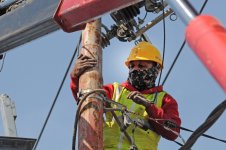
A PLN technician from Gorontalo repairs a damaged power line on a street in Palu, Central Sulawesi. (Antara Photo/Basri Marzuki)

Jakarta. The Energy and Mineral Resources Ministry (ESDM) announced a major initiative to develop electricity infrastructure reaching even the most remote areas of Indonesia. Over the next decade, the government plans to build a transmission network totaling 47,758 kilometers of circuit.


Minister Bahlil Lahadalia explained that this transmission network will connect renewable energy power plants to substations owned by the state electricity company, Perusahaan Listrik Negara (PLN), which will then distribute power to customers.


This “Green Enabling Supergrid” plan is detailed in PLN’s 2025–2034 Electricity Supply Business Plan (RUPTL), aiming to facilitate the interconnection of renewable energy sources directly to households across the archipelago. Under the plan, PLN aims to construct about 63,000 kilometers of transmission lines by 2040, with 48,000 kilometers targeted for completion by 2034.


The ministry targets renewable energy to make up 23 percent of the national electricity mix, up from the current 15 percent.

“To connect renewable energy, we must have a network. Our target for renewables is 23 percent, but currently, it is only 15-16 percent. We have programs for renewable energy, but the network has been lacking,” Bahlil said on Friday.


Among the planned transmission developments, the Java, Madura, and Bali regions will see the longest stretches of network expansion.


Bahlil also stressed the significant investment opportunities from the project, estimating a total of Rp565.3 trillion ($34.67 billion). The project is expected to create 881,132 jobs across manufacturing, construction, operations, maintenance, and distribution sectors.


To boost the economy and create jobs, the minister emphasized maximizing the use of domestic content (Tingkat Kandungan Dalam Negeri, TKDN) in the development of transmission lines and substations, aiming to minimize imports.


“I hope there will be no imports. All domestic industries should be maximized,” Bahlil concluded.


Bukaka stock will likely be skyrocketing I guess

To view this content we will need your consent to set third party cookies.
For more detailed information, see our cookies page.
 
RI Needs Rp 2,967 Trillion (88 Billion USD) to Increase Electricity Supply Up to 2034, This is the Source of Funds


Kompas.com - 02/06/2025, 20:40 WIB


JAKARTA, KOMPAS.com - Indonesia needs funds of about 88 billion US dollars or Rp 2,967.4 trillion to increase electricity supply up to 2034.


The plan is that the power plant capacity will increase by 69.5 gigawatts (GW).


This addition is listed in the Electricity Supply Business Plan (RUPTL) of PT Perusahaan Listrik Negara or PLN (Persero) 2025-2034.

PLN President Director Darmawan Prasodjo explained that the large funding includes a project investment of 171 billion US dollars or Rp 2.699 trillion, as well as PLN capex maintenance and interest during construction (IDC) of 17 billion US dollars.


"This is the investment requirement of almost Rp 3,000 trillion. PLN cannot possibly carry out this task in a solitude atmosphere," he said in the event of the RUKN Dissemination and RUPTL in the Directorate General of Electricity, Jakarta, Monday (2/6/2025).


Therefore, the funding for the addition of the 69.5 GW generation capacity is not only from PLN but also from the private or Independent Power Producer (IPP).

In detail, PLN will invest Rp 568 trillion for 20.4 GW, while the investment from IPP amounted to Rp 1,566 trillion for 49.1 GW. “The only way to move forward is through collaboration. It’s indeed a challenge, but it’s also an opportunity for all of us to come forward together,” Darmawan said.


Also read: Pertamina Record Brilliant Performance Throughout 2024, Net Profit Penetrated Rp 49.54 Trillion


The composition of 69.5 GW includes new renewable energy generation (EBT) 42.6 GW, 10.3 GW storage, and 16.6 GW fossil energy.


In detail, the addition of EBT generating capacity includes solar energy of 17.1 GW, 11.7 GW water, wind 7.2 GW, geothermal 5.2 GW, bioenergy 0.9 GW, and 0.5 GW nuclear.


While for storage includes a water power plant (PLTA) pumped storage of 6 GW and a battery of 4.3 GW.


As for fossil fuels include gas of 10.3 GW and coal of 6.3 GW.


Indonesia’s Bumi Resources to Acquire Australian Gold and Copper Miner Wolfram Limited​


Jauhari Mahardhika

June 19, 2025 | 11:59 pm


1750390038191.webp
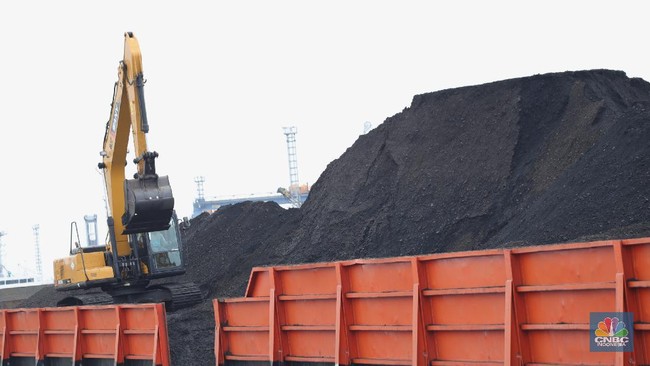
This undated photo shows activities to load coal into a tugboat at a Bumi Resources mine. (Photo courtesy of Bumi Resources)


Jakarta. Indonesia’s coal giant Bumi Resources has signed a term sheet agreement to acquire Australia-based Wolfram Limited, a company engaged in gold and copper mining, as part of its broader push to diversify beyond thermal coal.


The acquisition marks a strategic move by Bumi Resources (BUMI), the world’s largest exporter of thermal coal and one of the largest coal producers globally, to expand into critical minerals amid growing global demand for green energy transition metals.


The Bakrie- and Salim-owned company said the deal aligns with its long-term transformation plans, highlighting the potential of Wolfram’s gold and copper assets to deliver added value for shareholders.


“The transaction is still subject to approval from Australia’s Foreign Investment Review Board,” BUMI management said in a statement on Thursday.

Bumi Resources noted that it has conducted in-depth assessments over recent years to support its diversification strategy. The company is currently targeting assets that are either in production or close to entering production.


In addition to gold and copper, BUMI is also reportedly eyeing the acquisition of a bauxite mine and alumina refinery in West Kalimantan.


Coal Price Record Highs 3 Months High, Caused by U.S.-China Strategy​


mae, CNBC Indonesia

18 June 2025 07:27


Jakarta, CNBC Indonesia - Coal prices are increasingly burning and touching the three-month high.


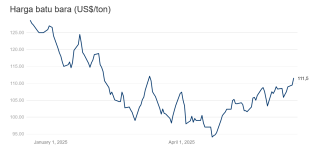
Refinitive Refinitiv, the price of coal in Tuesday (17/06/2025) closed at US$115 per ton. It cost 1.83%. The increase extends the "black sand" rally to five days with a 5.4% increase.


Yesterday's strengthening also brought the price of coal to its highest position since March 11, 2025 (US$112) or more than the last three months.

1750391447329.png

The price of coal soared because it was supported by a number of factors, ranging from policies in the United States (US), Germany, to China. The Israeli and Iranian wars also boosted prices.

As a result of the "low" wind rate in the first quarter of 2025, power generation from renewable energy in Germany fell 17% for the first time in two years. In contrast, the generation from fossil fuel sources increased significantly.

Despite an overall decline in renewable energy, wind power remains the largest source of electricity generation, with a share of nearly 28%. This figure is only slightly above the coal that is in 27%.

Electricity from gas accounts for nearly 21% while power generation from solar power increased "more than a third", reaching a share of 9.2% of the total electrical mix, the media explained.

China's coal-fired power plant approval rises after 2024 decline

According to Reuters, China approved 11 gigawatts (GW) of new coal-fired power plants in the first quarter of 2025, exceeding 10 GWs approved in the first half of last year.

Last year, the approval of new coal-fired power plant capacity in China fell 41.5% on an annual basis to 62.24 GW, the first annual decline since 2021. The latest data shows approval this year follows a higher trend. While not all approved projects will be built, the longer the project list signals a continued dependency on coal.
China said it would begin reducing coal use during the Five-Year Plan 2026-2030 period, but Beijing has not set specific targets.

This year is the last year of the Five-Year Plan 2021-2025, where China has approved 289 GW of new coal capacity, about double that of 145 GW approved in the period 2016-2020.

U.S. stays away from net energy

U.S. President Donald Trump's administration as well as Wyoming legislators appear to be losing enthusiasm to encourage research and instill commercial-scale carbon capture technology in coal-fired power plants. This is an important component of the energy strategy of an inclusive "decarbonization" against coal belonging to Governor Mark Gordon.

The U.S. Energy Department in May cancelled an estimated $3.7 billion federal grants to support "net energy" demonstration projects across the country, including $49 million for a "large-scale" carbon capture pilot project at the Dry Fork Station bar coal power plant located north of Gillette.

Also in May, Wyoming's Joint Committee of Minerals, Business and Economic Development Legislatives decided to consider the repeal of the state's carbon coal capture mandate, House Bill 200, "Reliable and Submitted Low-Grand Carbon Energy Standard," which was passed in 2020.

However, according to Wyoming legislators, the state's law does not appear to be producing a retrofit of carbon capture in the near future, although electricity consumers in the state have paid millions of dollars to support the technical feasibility studies required by the mandate.

CNBC INDONESIA RESEARCH
 

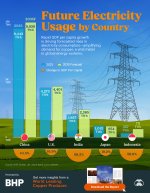
Charted: Future Electricity Usage by Country​

Published 1 day ago
on June 18, 2025

1750401781251.jpeg

Charted: Future Electricity Usage by Country​


As global electrification accelerates, electricity demand in major economies is set to surge, driving a parallel rise in demand for copper, the metal that powers the modern energy grid.


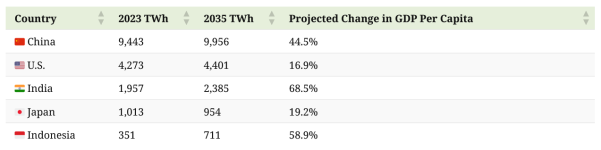
This graphic, sponsored by BHP, utilizes data from Ember, the World Bank, and the Lowy Institute to visualize the projected growth in electricity consumption and GDP per capita across five major economies between 2023 and 2035.


Powering the Future​


Together, these five economies are projected to increase their electricity consumption by nearly 2 trillion kilowatt-hours (kWh) by 2035.

1750401850181.png

  • China, already the world’s largest electricity consumer, is expected to grow from 9,443 TWh to 9,956 TWh.
  • The U.S. will see demand rise from 4,273 TWh to 4,401 TWh—an increase of 128 TWh, enough to charge more than 2 billion Tesla Model 3s.
  • India’s consumption will jump from 1,957 TWh to 2,385 TWh, narrowing the gap with advanced economies.

  • Indonesia’s electricity use will double, climbing from 351 TWh to 711 TWh.

Growth in GDP per capita is one of the most significant contributors to the projected increase in electricity consumption. As economies grow, inhabitants gain the ability to purchase technologies that consume more electricity.

The Copper Connection​


Copper’s unmatched electrical conductivity makes it the metal of choice for virtually every part of the power system. From high-voltage transmission lines to the wiring in homes and electric vehicles, copper is essential for transporting electricity.

As countries expand their grids and invest in clean energy, demand for copper is expected to climb sharply.


Renewable technologies like wind and solar require up to five times more copper than traditional power sources, while electric vehicles use up to four times more copper than internal combustion engines.


Medco Energi (MEDC) Acquires Repsol’s Participating Interest Worth US$ 425 Million


To view this content we will need your consent to set third party cookies.
For more detailed information, see our cookies page.


Thursday, 26 Juni 2025

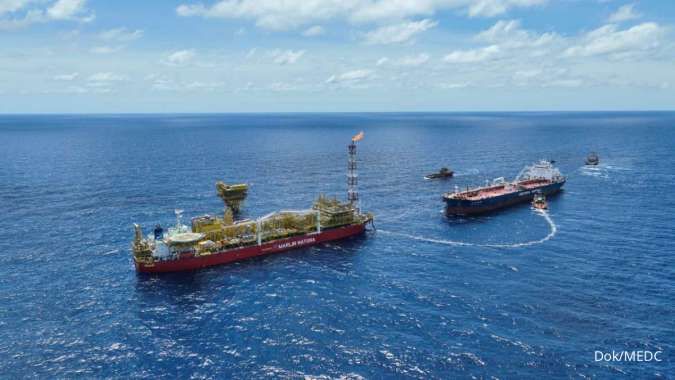
KONTAN.CO.ID - JAKARTA. PT Medco Energi Internasional Tbk (MEDC) announced that it has signed an agreement with Repsol E&P, S.à.r.l. to acquire Fortuna International (Barbados), Inc, which holds an indirect 24% ownership stake in the PSC Corridor.

Acquisition is valued at a transaction price of US$ 425 million, subject to customary adjustments. The transaction is expected to be completed in the third quarter of 2025.

For information, the PSC Corridor has seven gas production fields and one oil production field, all located onshore in South Sumatra, Indonesia. Gas sales are conducted through long-term contracts with reliable buyers in Indonesia and Singapore.

Hilmi Panigoro, President Director of MEDC, said that this acquisition is in line with the company’s strategy to own and develop high-quality assets that generate strong cash flow. “This acquisition also strengthens our commitment to national development, where natural gas is an important step in the journey toward a low-carbon future,” he said in an information disclosure to the Indonesia Stock Exchange (IDX) on Thursday (June 26).

For the record, Repsol is a global multi-energy company operating in more than 20 countries, employing 25,000 people, and serving 24 million consumers. Repsol’s upstream business covers the entire oil and gas value chain—from exploration to commercial development—conducted with the highest safety standards.

Next: Rupiah Spot Closes Up 0.56% at Rp 16,209 per US Dollar, Thursday (June 26)

 
Bukit Asam (PTBA) Absorbs Nearly IDR 1 Trillion in Capex in Q1-2025


To view this content we will need your consent to set third party cookies.
For more detailed information, see our cookies page.


25 Juni 2025 / 08:05 WIB

KONTAN.CO.ID - JAKARTA. PT Bukit Asam Tbk (PTBA), a member of Indonesia’s state mining holding group MIND ID, revealed that it has absorbed nearly IDR 1 trillion in capital expenditure (capex) during the first quarter of this year.

According to PTBA Corporate Secretary Niko Chandra, the majority of this capex was used by the company for the development of the TE-Keramasan transportation project.

For your information, TE Keramasan, or the Keramasan Export Terminal, is a coal terminal developed by Bukit Asam in cooperation with PT Kereta Api Indonesia (KAI) to increase coal transportation capacity from Tanjung Enim to Palembang.

Read Also: Bukit Asam (PTBA) Continues to Boost Non-Coal Business

“As of the first quarter of 2025, investment realization has reached almost IDR 1 trillion, with most of the absorption being investment for the development of the TE-Keramasan transportation, while the rest is for routine investment,” Niko said when contacted on Tuesday (June 24).

Niko also explained that throughout this year, PTBA has allocated capex of IDR 7.2 trillion, with the largest portion intended for business development.

“For the development of TE-Keramasan transportation to increase capacity to 20 million tons, as well as other investments to support achieving the production target of 50 million tons in 2025,” he explained.

In line with this, PTBA is also continuing to develop its coal downstream projects this year. Primarily, the development of Artificial Graphite and Anode Sheet, a humic acid project, and Synthetic Natural Gas (SNG).


“For the coal to Artificial Graphite and Anode Sheet project, we are collaborating with BRIN, and the project is currently in the basic engineering design update stage,” Niko said.

In addition, the development of a prototype for extracting humic acid from low-calorie coal is being carried out in collaboration with Gadjah Mada University (UGM).

“PTBA is also continuing to develop various other project studies, such as the development of Synthetic Natural Gas (SNG) from coal, which in the future will be carried out in cooperation with Perusahaan Gas Negara (PGN),” he explained.


Pertamina refinery production 250 million barrels of fuel in 2024​


Verda Nano Setiawan, CNBC Indonesia

26 June 2025 12:25

1751090558391.jpeg

Jakarta, CNBC Indonesia - PT Kilang Pertamina Internasional (KPI) recorded a significant achievement in the production of Fuel Oil (BBM). Throughout 2024, the company managed to produce about 250 million barrels of fuel, consisting of gasoline series (gasoline products), gasoil series (dipelling products), to aircraft fuel (avtur).

Corporate Secretary KPI Hermansyah Y. Nasroen said, during 2024 the company managed to process raw materials as much as more than 320 million barrels and managed to produce 250 million barrels of fuel products.

In addition to producing fuel products, KPIs are also able to produce Non-BBM products of about 31 million barrels, including Smooth Fluid, Propylene, LPG, Polytam, Breezon MC-32 and a variety of Green Refinery products. In addition, KPIs also produce other products as many as 28 million barrels, such as asphalt, sulfur, and petroleum coke.


Indonesia says Exxon boosts production in Cepu block​

By Reuters
June 26, 20254:22 PM GMT+7
Updated June 26, 2025

JAKARTA, June 26 (Reuters) - Indonesia energy minister on Thursday said an additional 30,000 barrels oil per day (bpd) have been produced at the Exxon Mobil-operated Cepu block, as the country strives to counter declining national oil output.

Indonesia targeted oil lifting stands at 605,000 bpd this year, but figures for January-May showed production at 567,900 bpd, with 2024 levels slightly higher at 579,700 bpd.

"Previously Cepu's lifting was at 150,000 bpd, so our total lifting from Cepu will be 180,000 bpd or in other words 25% of total national lifting," energy minister Bahlil Lahadalia said during a livestreamed ceremony marking the production increase.

The Banyu Urip project, operated by Exxon in partnership with state energy company Pertamina, has the potential to produce 1 billion barrels of oil, the energy ministry previously said.

The Indonesian government is keen to reverse the declining production trend and is targeting an increase in lifting to one million barrels of oil and 12 billion standard cubic feet per day of gas by 2030.

Reporting by Bernadette Christina, Editing by Louise Heavens


11 of the Biggest Oil & Gas Producers of the Republic of Indonesia, Here's the Latest List​


Firda Dwi Muliawati, CNBC Indonesia

01 July 2025 17:25

1751432015578.jpeg
Photo: The atmosphere of the Tangguh LNG Factory operated by BP Berau Ltd, in Bintuni Bay, West Papua, Tuesday (10/6/2025). (Doc. Ministry of Energy and Mineral Resources)

Jakarta, CNBC Indonesia - Special Working Unit for Upstream Oil and Gas Business Activities (SKK Migas) revealed the realization of the average production of national oil and gas (oil and gas) as of May 2025 reached 1.55 million barrels equivalent to oil per day (BOEPD).

Head of SKK Migas Djoko Siswanto said, the realization of oil and gas lifting is still below the target set in the State Budget (APBN) 2025 of 1.61 million BOEPD.

The realization of the oil and gas lifting consists of the daily average oil production of 567.9 thousand barrels per day (bpd), 94% of the target of 605,000 barrels per day (bpd). For lifting or gas salur recorded at 5,530 million standard cubic feet per day (MMSCFD), 98% of the target of 5,628 MMSCFD.

"Then for oil lifting, until May we have reached 94%. It is expected that the outlook will be 2025 605 (thousand bpd) or 100%, 605 thousand barrels per day or 100%. For 2026, the range is 600-610 (thousand bpd). For gas, we've reached 90-85%, until May at the end of the year the estimated 98.5% year. For oil and gas, we have reached 97%, to reach May estimated the end of the year on average 99%, "he explained in the Hearing Meeting of Commission XII of the House of Representatives, Jakarta, Tuesday (1/7/2025).


Here are the largest contributors to the national oil and gas production as of May 2025:


1. BP (British Petroleum) Berau Ltd: 304 thousand barrels of oil equivalent per day (MBOEPD), 103.5% of the target of 294 MBOEPD.


2 PT Pertamina EP: 178 MBOEPD, 96.6% of the target of 184 MBOEPD.


3. ExxonMobil Cepu Ltd: 152 MBOEPD, 112% of the target of 136 MBOEPD.


4. PT Pertamina Hulu Rokan: 152 MBOEPD, 94.5% of the target of 165 MBOEPD.


5. Medco E&P Grissik Ltd: 101 MBOEPD, 101% of the target of 100 MBOEPD.


6 PT Pertamina Hulu Mahakam: 95 MBOEPD, 109.5% of the target of 87 MBOEPD.


7. Eni East Singgan Ltd: 72 MBOEPD, 101.1% of the target of 72 MBOEPD.


8 Husky-CNOOC Madura Ltd: 40 MBOWPD, 91.6% of the target of 44 MBOEPD.


9. Petrochina International Jabung Ltd: 42 MBOEPD, 102% of the target of 41 MBOEPD.


10. Medco E&P Natuna Ltd: 29 MBOEPD, 71.9% of the target of 40 MBOEPD.


11. PC (Petronas) Ketapang II Ltd: 9 MBOEPD, 94.5% of the target of 11 MBOEPD.


Another KKKS: 379 MBOEPD, 87.1% of the target of 435 MBOEPD.


Inpex starts tender for key contract for Asia gas megaproject​

Abadi LNG has touted nameplate capacity of 9.5 million tonnes per annum

1751967039127.webp
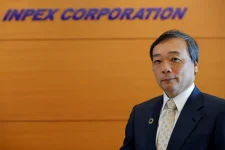
Inpex chief executive, Takayuki Ueda, poses in front of his company's logo.Photo: REUTERS/SCANPIX


Published 6 July 2025, 14:25


Inpex has launched the tender process for a key contract to support its planned multibillion-dollar Abadi liquefied natural gas megaproject in Indonesia.

The Japanese operator is seeking to award a contract for independent project management consultancy (PMC) services to support the Abadi front-end engineering and design (FEED) study work.

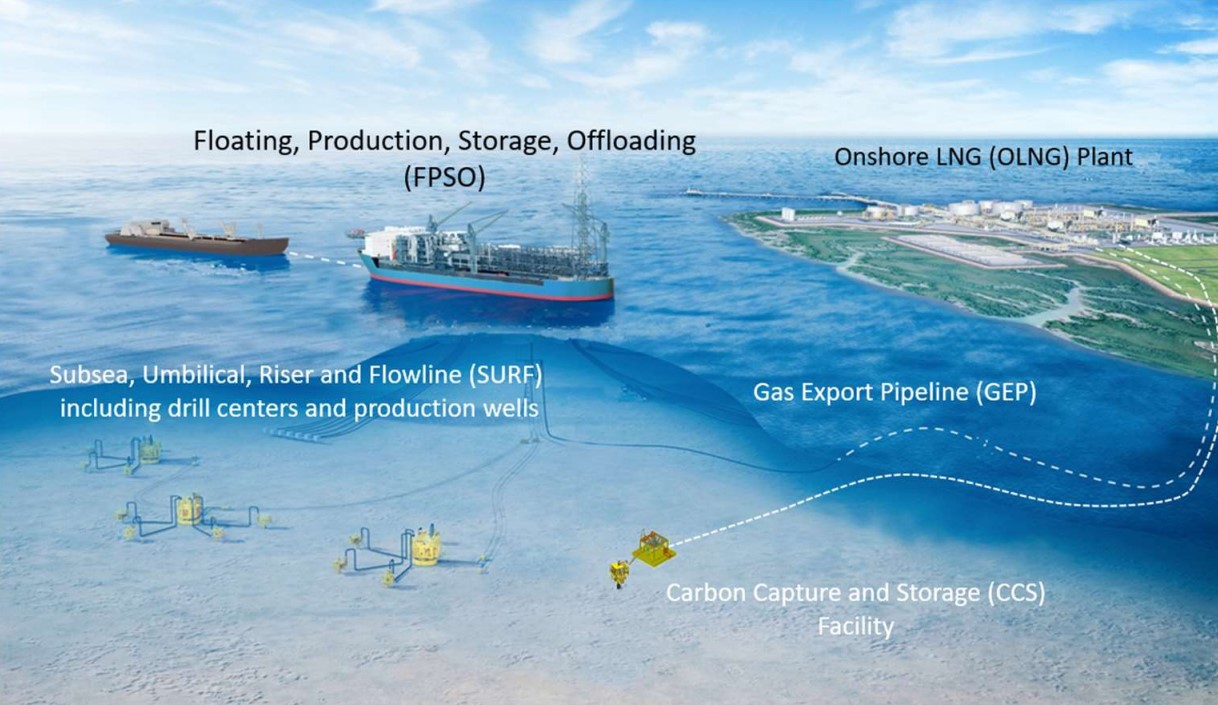
The giant Abadi offshore field on the Masela production sharing contract will be exploited via a 9.5 million tonnes per annum onshore liquefied natural gas (OLNG) facility, and will also provide 150 million cubic feet per day of pipeline gas for the domestic market.


Japan's Inpex weighs Indonesia hiring spree for $20bn LNG project​

Energy group prepares for final investment decision on Abadi gas field
1752029230566.jpeg
The Abadi project involves drilling for gas offshore and sending it to onshore facilities via pipeline. (Inpex)

KOKI IZUMI
July 9, 2025 02:26 JST

JAKARTA -- Japanese energy group Inpex is looking to hire thousands of workers in Indonesia as it moves closer to building the estimated $20 billion Abadi liquefied natural gas project.

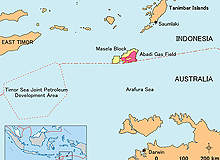
The project, being pushed forward by a consortium led by Inpex, is centered on a gas field off the coast of Yamdena island in Maluku province, about 2,700 kilometers east of the capital Jakarta.


----------------------------


May 8 2011

Abadi Gas Field​


The Abadi gas field is situated in the 3,221km² Masela block in the Arafura Sea, Indonesia. The field lies in water

Water Depth​

984-3,281ft

Project Type​

Liquefied natural gas and condensate field

Reserves​

10 trillion cubic feet of natural gas

Discovery​

2000

1-abadi-field.jpg
The Abadi gas field lies in the Masela block in the Arafura Sea, Indonesia.

2-abadi-field.jpg
The Abadi field will be developed using a subsea production system and a floating LNG facility.

3-abadi-field.jpg
The Ramform Challenger marine vessel was used to carry out the 3D seismic survey at the field.

The Abadi gas field is situated in the 3,221km² Masela block in the Arafura Sea, Indonesia. The field lies in water depths ranging 984ft-3,281ft.

Inpex Masela, a subsidiary of Japan-based oil and gas company Inpex, operates the field. Inpex earlier owned a 90% interest in the field but in July 2011 transferred 30% to Shell. Abadi is a large-scale project and Inpex invited Shell Upstream Overseas Services as a strategic partner to use its expertise in floating LNG technology. PT EMP Energi Indonesia owns the remaining 10%.

A production sharing agreement for the field was signed in November 1998, covering 30 years. The plan for development of the field was submitted in September 2008 to BPMigas, the Indonesian Government authority responsible for oil and gas upstream business, and the same was approved in December 2010. First production of gas is expected in 2018 with an initial output of 2.5 million tonnes of LNG a year and 8,400 barrels per day of condensate.


In November 2012, the Indonesian subsidiary of Wood Group was commissioned to conduct front end engineering and design (FEED) of subsea production facilities for the development of the LNG project. The FEED study is expected to be completed in one year. The scope of the FEED contract includes detailed engineering for subsea, umbilical, riser and flowline (SURF) works.

Discovery​

A 2D seismic survey was carried out in the block using marine vessel Geco Rho between February and March 1999.

The field was discovered by the Abadi-1 exploration well, which was drilled between October and December 2000.
The Abadi field was discovered by the Abadi-1 exploration well, which was drilled between October and December 2000 by the Energy Searcher rig. The confirmed presence of gas and condensate was the first discovery of crude oil and natural gas in the Arafura Sea.

Between July and September 2001, a 3D seismic survey was carried out using the PGS Ramform Challenger marine vessel. In 2002, two appraisal wells, Abadi-2 and Abadi-3, were drilled to examine the extent of reserves of the field. Abadi-2 was drilled by the Energy Searcher rig and Abadi-3 was drilled by the Ocean General rig.

Four more wells drilled between May 2007 and June 2008 confirmed the presence of significant gas reserves.


Abadi geology and reserves​

The Abadi field reservoir is of the Middle Jurassic Plover Formation and located at depths ranging between 3,700m and 3,900m. The reservoir contains shallow-marine, highly mature, quartzose sandstones.

The field is estimated to contain ten trillion cubic feet of natural gas reserves.

Field development​

The field will be developed in phases using a subsea production system and a floating LNG facility (FLNG). About 18 directional production wells are expected to be drilled from five subsea drilling centres. Initial development will be carried out in the northern part of the field, where most of the reserves are concentrated.

The exploration well is expected to be drilled in 2013.

TIn January 2013, Inpex awarded the FEED contract for the floating LNG (FLNG) of Abadi gas field to JGC and PT Saipem Indonesia Group.

The two groups will separately conduct FEED studies on the FLNG. The company which will provide the winning FEED design will be awarded the engineering, procurement and construction (EPC) contract for the FLNG.

The FEED studies are scheduled for completion in 2013. The engineering, procurement and construction contracts are expected to be awarded between 2014 and 2018.

Floating LNG facility​

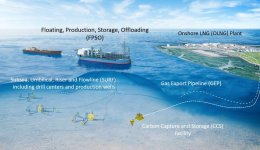
The floating LNG facility will feature the integration of proven technologies such as FPSO, baseload onshore LNG plants and LNG carriers. It will include an LNG loading plant, an LNG storage tank and a loading facility similar to that available on a conventional FPSO.

"Abadi project partners will invest $19.6bn in the FLNG facility."
The floating LNG concept was chosen for the field because it reduces the environmental impact of constructing an onshore facility in terms of the land, harbour and infrastructure facilities required.

The MetOcean conditions at the field also favoured the design and operation of the floating LNG facility. In addition, the concept is expected to reduce the costs incurred and the project lead time.

The project partners are expected to invest $19.6bn in the facility, which will be installed about 170km south-west of the city of Saumiaki.

Production​

The feed gas produced will be collected through the subsea drilling centres and transported to the floating LNG through flexible production risers. The gas will be processed and liquefied on the floating LNG. The LNG and condensate will be stored in the floating LNG, and offloaded at regular intervals through LNG carriers.


=======================

Inpex gets approval for Abadi LNG project in Indonesia​


By LNG Prime Staff
December 6, 2023

1752029341879.jpeg

Japan’s Inpex said it has received written approval for the revised plan of development for the Abadi LNG project in Indonesia.
Earlier this year, Inpex Masela on behalf of the joint venture with LNG giant Shell submitted the revised plan to the Indonesian government, adding a carbon capture and storage (CCS) component.

“This marks the official approval of the authorities for the revised POD,” Inpex said in a statement.

In October, Shell completed the sale of its 35 percent stake in Indonesia’s Masela PSC, which includes the planned Abadi LNG project, to Pertamina Hulu Energi and Petronas Masela.

Indonesia’s Pertamina now owns a 20 percent stake and Malaysia’s Petronas has a 15 percent stake in the PSC.

Inpex holds 65 percent operating interest in Masela PSC and is the operator of the Abadi LNG project.

The Japanese company said in the statement that the project is the first in which CCS-related costs are eligible for recovery based on the PSC scheme that governs crude oil and natural gas upstream operations in Indonesia.

Inpex said the approval of the revised POD paves the way for the firm and its partners to “fully mobilize the project as a clean project in support of the energy transition.”

Resuming activities​

The Inpex-operated project has seen many changes over the years and initially, the development of the Masela offshore block involved a floating LNG plant, while it now includes a 9.5 mtpa onshore LNG plant with an estimated cost of about $20 billion.

Going forward, Inpex and its partners will pursue the revision of the PSC to incorporate CCS into the contractual scope of work and resume project operations including on-site activities and prepare for FEED work, the firm said.

“Thereafter, the JV will implement the project with the aim of reaching a final investment decision (FID) and production startup at an early stage after completing the necessary preparations including marketing and financing activities,” Inpex said.

Inpex previously said it aims to reach FID in the “latter half of the 2020s and commence production in the early 2030s.”

The project would become Inpex’s second self-operated, large-scale natural gas development project following the Ichthys LNG project in Australia.


Users who are viewing this thread

Country Watch Latest

Latest Posts

Back
Top