Indonesian Energy sector

Indonesia Puts 75 Oil and Gas Blocks Up for Auction to Boost Domestic Output​


July 8, 2025 | 11:35 pm

1752058992497.jpeg
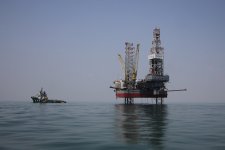
FILE - An offshore oil platform is seen in Gresik, East Java, on Aug. 31, 2018. (Antara Photo/Moch Asim)


Jakarta. The Indonesian government is offering 75 oil and gas blocks for exploration and development, the majority of which are located in the eastern regions of the archipelago, as part of its drive to increase domestic energy production.


Deputy Energy and Mineral Resources Minister Yuliot Tanjung said on Tuesday that 20 of the blocks are situated in the Maluku-Papua region, including areas such as Seram-Aru and Cendrawasih Bay II and III.


“These blocks have been identified and are ready to be offered to business entities through auctions,” Yuliot said. He explained that some of the blocks already have winning bidders, others are currently in the open bidding stage, while the rest are still being prepared for auction.


The 75 blocks are available through production sharing contracts (PSC), a scheme aimed at attracting investment and boosting national oil and gas output.

Of the total, 61 blocks are currently being auctioned by the government. These include:


Central Andaman, Amanah, Melati, Panai, Pesut Mahakam, Serpang, Kojo, Binaiya, Gaea 1, Gaea 2, Air Komering, Meuseuraya, Jalu, Gagah, Natuna D-Alpha, Kisaran Baru, Barong, Perkasa, Mabelo, Lavender, Muara Tembesi, Southwest Andaman, Areca, Bruni, Carera, West Andaman I, West Andaman II, Abar, Anggursi, West Rapak, Bintuni, Drawa, Seram-Aru, Namori, Talu-Sapukala, Bengkulu Mentawai, Marva-Talawang-Balakbalakang, Masakka, Nawasena, South Tanimbar, Rupat, Puri, Ampuh, North Andaman, Maratua II, Bengara II, Mamberamo, Tomini Bay, AOI-K1, SE Natuna, Karapan Baru, Patin, South East Java, Taliabu, South Matindok, Rangkas, Boka, Enrekang, Northeast Tanjung, Palmerah Baru, and Tungka Baru.


In addition to these, the government has identified 14 potential open areas for future auctions:


Bukit Barat, Kasongan Sampit, Palangkaraya, West Sangatta, South Sageri, South East Mandar, Halmahera Kofiau, Semai IV, North Arguni, Cendrawasih Bay II, Cendrawasih Bay III, Akimeugah I, Akimeugah II, and East Tanimbar.


Read More:​

Indonesia’s Palm Oil Exports Surge 27.89% with Pakistan, India as Top Buyers


President Prabowo Subianto has set an ambitious goal of raising Indonesia’s crude oil production to 1 million barrels per day (bpd) within the next few years, up from the current level of approximately 630,000 bpd.


In parallel, the government is also working to increase natural gas output to achieve national energy self-sufficiency while simultaneously accelerating the transition to renewable energy sources.


Italy’s Eni Eyes $10 Billion Gas Investment in East Kalimantan​


Antara

July 21, 2025 | 5:45 pm


Jakarta. Rome-based energy giant Eni has expressed interest in investing $10 billion in two offshore natural gas blocks in East Kalimantan, Indonesian Energy and Mineral Resources Minister Bahlil Lahadalia said on Sunday.


Eni, one of Europe’s largest oil and gas companies with operations in over 70 countries, plans to begin new gas production in the region by 2027. The company has been operating in the area for around a decade to process natural gas in its floating production unit.


“The proposed investment in East Kalimantan will focus on offshore natural gas development, specifically in the Jangkrik and Merakes blocks,” Bahlil said, as quoted by Antara news agency. Both blocks are located in the Makassar Strait.


According to the minister, Eni’s investment interest comes at a time of global economic uncertainty caused by geopolitical tensions and disrupted supply chains.

“This is good news for Indonesia, especially for the economic growth of East Kalimantan,” Bahlil noted.


He added that Eni’s investment is expected to generate significant employment opportunities, both locally and nationally.


Under the proposed plan, the provincial government of East Kalimantan will hold a participating interest in the gas projects, which would increase the region’s share of revenue from the development, Bahlil said.

According to Eni Indonesia's website, the company started gas production at the Jangkrik field on 15 May 2017. Gas produced is processed onboard the floating production unit and then flows to the onshore receiving facility. It then finally reaches the Bontang gas liquefaction plant, and the LNG produced is sold under long-term contracts, partly to Pertamina and partly to Eni itself.


The company said it chose the name Jangkrik (cricket) for the field with the aim of "making the project fast like the insect that, despite being small, is able to take large leaps that allow it to move quickly."

 
Indonesia Reduces Part of Gas Exports to Meet Domestic Industrial Needs


By Verda Nano Setiawan
4–5 minutes
22 August 2025 13:55


To view this content we will need your consent to set third party cookies.
For more detailed information, see our cookies page.

Medco Energy


Jakarta, CNBC Indonesia – Minister of Energy and Mineral Resources (ESDM) Bahlil Lahadalia reaffirmed his commitment to making natural gas a top priority for domestic needs. This means that meeting domestic gas demand will take precedence over exports.


To address a recent gas supply deficit caused by a pipeline fire, part of the gas that was previously allocated for export has now been redirected to the domestic market.


"We held back a portion of gas that was intended for export. We are channeling new supplies as well. Then we distribute it to meet domestic needs, particularly those affected by the pipeline fire," Bahlil said at the Ministry of Energy and Mineral Resources building on Friday (Aug 22, 2025).


Previously, the Upstream Oil and Gas Regulatory Task Force (SKK Migas) had ensured that domestic gas supply would be maintained through a multi-party gas swap mechanism.


The multi-party swap scheme started flowing on August 22, 2025. This step was taken to maintain stability in domestic gas supplies, including for the industrial sector, with distribution carried out by PGN (Perusahaan Gas Negara).


The multi-party gas swap agreement involves several upstream oil and gas contractors and buyers, including West Natuna Supply Group (Medco E&P Natuna Ltd., Premier Oil Natuna Sea B.V., Star Energy (Kakap) Ltd.), South Sumatra Sellers (Medco E&P Grissik Ltd., PetroChina International Jabung Ltd.), PT Pertamina (Persero), PGN, Sembcorp Gas Pte Ltd., and Gas Supply Pte Ltd. The agreement was drafted through close coordination among all parties to ensure that everyone’s interests are protected.


Under this agreement, a volume of 27 BBTUD from the West Natuna Gas Supply Group will be supplied to PGN. The gas will be delivered by Medco E&P Grissik Ltd. and PetroChina International Jabung Ltd. to PGN. The swap-based implementation is aimed at safeguarding domestic demand while also honoring other contractual commitments.


SKK Migas head Djoko Siswanto said the multi-party swap ensures that additional supply for domestic industry needs can be maintained properly.


"This scheme is only possible through close cooperation between upstream contractors, gas buyers, and the government. With this step, domestic supply stability remains secure while other ongoing contracts are still fulfilled," Djoko said in a written statement, Friday (Aug 22, 2025).


He emphasized that this additional gas does not mean all industries or new industries will receive supply. The allocation is intended to ensure existing industries continue receiving gas. He stressed that everyone must understand oil and gas are non-renewable resources that will eventually run out if no new discoveries are made.


Although Indonesia’s exploration success ratio has improved from 10:1 to 10:3, the risk of unsuccessful drilling remains as high as 70 percent. Moreover, most discoveries—especially gas—are typically in remote or offshore areas. “Exploration costs are very high, with a 70 percent risk of dry holes,” he said.


MedcoEnergi’s Director & Chief Operating Officer, Ronald Gunawan, expressed appreciation for the coordination led by SKK Migas and the cooperation of all parties in this initiative.


"In addition, MedcoEnergi is also participating by adding gas supply from the South Sumatra Block to continue actively contributing to national energy security," he stated.


Asia Turns to Ammonia for Power Generation​

By Rystad Energy - Aug 19, 2025, 1:00 PM CDT

  • Coal made up 54% of Asia’s power mix in 2024, driving countries to explore ammonia co-firing as a decarbonization strategy.
  • Rystad Energy projects a ninefold increase in ammonia demand by 2030, but warns of an 8.8 Mtpa supply gap and high production costs.
  • China, Japan, South Korea, and Indonesia are leading efforts, though success depends on foreign partnerships, infrastructure, and supportive policies.
1756087126547.jpeg


With coal accounting for 54% of Asia’s power mix last year, the region faces a significant challenge in meeting its net-zero ambitions. In a bid to cut emissions, several Asian countries are turning to ammonia for power generation, particularly through co-firing, blending low-carbon ammonia with coal or natural gas. Rystad Energy expects China, Indonesia, Japan and South Korea to emerge as key hubs for this transition. However, a sizeable supply gap remains, with about 8.8 million tonnes per annum (Mtpa) of ammonia needed to meet 2030 targets.

Having relied on coal for decades, Asia lacks both the policy frameworks and the market demand needed to justify investment in infrastructure for ammonia as an energy source. Countries such as Japan and South Korea also face resource constraints, whether limited natural gas or insufficient renewable capacity, that hinder domestic production of clean ammonia. To meet net-zero goals, they will need to import clean ammonia from overseas, enabling coal replacement as a baseload power source while safeguarding energy security and affordability.

Ammonia co-firing is currently expensive, mainly due to the high costs associated with low-carbon hydrogen production, ammonia conversion and transportation. However, countries in Asia appear willing to tackle this challenge and advance their co-firing plans. Assuming a low-carbon hydrogen price of $5 per kilogram, which corresponds to an ammonia price of $1,000 per tonne, Rystad Energy estimates that the levelized cost of electricity for a 10% ammonia blend will be about 50% higher than coal-only generation. This indicates that costs must be tackled through innovation, economies of scale, or the implementation of a meaningful carbon price to make ammonia co-firing competitive.

While hydrogen and ammonia are set to play a growing role in decarbonizing Asia’s power sector, much of the progress hinges on foreign partnerships and long-term offtake agreements. Even with high costs associated with hydrogen, our data shows that ammonia demand from power generation is expected to grow ninefold by 2030. However, without firm offtake commitments and accelerated development of critical import infrastructure, this growth could stall. While several key Asian players are already in discussions with international partners to secure ammonia supply, progress on import terminals and co-firing capabilities must speed up,

Minh Khoi Le, Head of Hydrogen Research, Rystad Energy


Indonesia Targets 2029 Production Start for $21 Billion Masela Gas Project​


Heru Andriyanto

August 28, 2025 | 8:05 pm

Jakarta. Indonesia announced on Thursday that the long-delayed Masela offshore gas block in Maluku is now expected to begin production in 2029, following the launch of the front-end engineering and design (FEED) phase.


Deputy Energy and Mineral Resources Minister Yuliot Tanjung said the Masela project, first discovered in the Arafura Sea in 1998, will require an investment of $20.94 billion. Once operational, it is projected to produce 9.5 million tons of liquefied natural gas (LNG) annually and around 35,000 barrels of condensate per day, supplying both domestic needs and exports.


“With this $20.94 billion investment, the project will create around 12,600 jobs during development and 850 jobs during operations. We expect significant multiplier effects that directly benefit local communities,” Yuliot said in a statement.

The government pledged to streamline procurement rules and accelerate permitting to keep the project on schedule. “Licensing is now handled by an integrated team, and we expect approvals to be issued without major delays,” Yuliot added.

The Masela Block is operated by Japan’s Inpex Masela Ltd, which holds a 65 percent stake. The remaining 35 percent is owned jointly by Indonesia’s Pertamina and Malaysia’s Petronas, which acquired Shell’s share in July 2023.


The block, originally awarded in 1998 with a concession set to expire in 2028, received a 20-year extension. However, progress has been repeatedly delayed, drawing criticism from government officials. In May, Energy Minister Bahlil Lahadalia warned that Indonesia spends about Rp 500 trillion ($30.75 billion) annually on energy imports despite its abundant reserves. He criticized the 26-year delay at Masela, insisting that “the nation should guide corporations, not the other way around.”


With the FEED phase now underway, production is still at least four years away.


Medco Raises Corridor Gas Block Stake to 70% With $425m Repsol Deal​


Muhammad Ghafur Fadillah

September 10, 2025 | 1:33 pm

To view this content we will need your consent to set third party cookies.
For more detailed information, see our cookies page.


Jakarta. Indonesian energy firm Medco Energi Internasional (IDX: MEDC) completed a $425 million ($7 trillion) acquisition of Spanish company Repsol’s indirect 24 percent stake in Indonesia’s Corridor gas block, lifting its ownership to 70 percent and tightening its grip on one of the country’s largest producing assets. State-owned Pertamina Hulu Energi holds the remaining 30 percent.


The deal marks a significant portfolio expansion for Indonesia’s largest listed energy company and positions it for stronger cash flow in the coming years, Medco Director Amri Siahaan said Wednesday during a public expose.


“This acquisition fits squarely within Medco’s investment criteria,” Amri said. “As operator of the Corridor block, increasing our ownership to 70 percent gives us greater control over asset management.”

Medco expects the additional stake to boost earnings before interest, taxes, depreciation, and amortization by about $145 million in 2026, assuming mid-cycle oil prices. Corridor’s gas output is underpinned by seven long-term sales contracts to domestic buyers and Singapore, providing stable revenue visibility.

The company also projects the acquisition will add roughly 25,000 barrels of oil equivalent per day to its production, helping Medco stay on track to hit its 2025 output target of 155,000 to 160,000 barrels of oil equivalent per day.


The Corridor block in South Sumatra is one of Indonesia’s largest gas-producing areas, spanning seven active gas fields and one oil field. Its production is critical for domestic supply and exports to Singapore under long-term agreements.


Amri said the deal not only strengthens Medco’s profitability in the near term but also supports Indonesia’s broader energy transition agenda. “Natural gas is a key transition fuel. Securing assets like Corridor allows Medco to sustain national development while maintaining strong cash flows,” he said.


Beyond oil and gas, Medco is expanding its renewable portfolio with a target of 4,300 GWh of power generation by 2025, focusing on geothermal, solar, and gas-fired transitional projects.

 
Government Accelerates Gas Pipeline Projects, Hundreds of Kilometers Now Connected


By Ferry Sandi | 4–5 minutes
07 October 2025 19:50


To view this content we will need your consent to set third party cookies.
For more detailed information, see our cookies page.

Batang Industrial Complex, Central Java


Jakarta, CNBC Indonesia — The Ministry of Energy and Mineral Resources (ESDM) continues to accelerate the development of the national natural gas infrastructure to ensure equal distribution and supply efficiency between regions. One of the strategic projects that has been completed is the Cirebon–Semarang (Cisem) natural gas transmission pipeline, phase one, which extends to Batang, Central Java.


This pipeline now delivers gas from East Java to the Batang industrial area. The effort does not stop there — the government is currently finishing the second phase of the Cisem gas transmission pipeline, stretching 245 kilometers (km) from Batang to Kandanghaur, West Java.


“We are now completing 245 kilometers from Batang to Kandanghaur, and construction will be finished by April 2026. This way, the abundant gas in East Java can be distributed to the western part of Java,” said Laode Sulaeman, Director General of Oil and Gas (Migas) at the Ministry of ESDM, during an event at Menara Kadin, Jakarta, on Tuesday (October 7, 2025).

The government is also expanding the gas pipeline network to Sumatra. The Ministry of ESDM has prepared the tender process for the Dumai–Sei Mangkei (Dusem) gas pipeline project, which spans 541 km. This pipeline will connect Riau and North Sumatra, channeling gas supplies from the Andaman Block, expected to begin production by late 2028 or early 2029.


If the entire gas pipeline network — including Dusem and Cisem Phase II — is fully integrated from Aceh to East Java, the efficiency of natural gas distribution will significantly improve, supporting the implementation of the Specific Natural Gas Price (HGBT) policy evenly across Indonesia.


In Eastern Indonesia, a different approach is being adopted. The government is preparing a Small-Scale LNG distribution system — transporting liquefied natural gas (LNG) via small vessels. This solution is designed to reach smaller islands and support the gas needs of small-scale industries.


“This adjustment ensures that the gas business remains balanced from upstream to downstream while still providing benefits to all parties,” explained Laode.

This strategic move is part of the government’s broader effort to boost domestic gas utilization and create a competitive energy ecosystem.


Meanwhile, the Special Task Force for Upstream Oil and Gas Business Activities (SKK Migas) confirmed that the domestic gas supply will remain well secured through the end of 2025.


Kurnia Chairi, SKK Migas Deputy for Finance and Commercialization, stated that the majority of the supply comes from the West Natuna Gas Supply Group, with a volume of 27 billion British thermal units per day (BBTUD).


“So, God willing, domestic gas demand for 2025 can be met — partly through accelerated production in several existing fields,” said Kurnia.

(wia)

 
Indonesia’s Bauxite and Coal Reserves Sufficient for 192 Years, Non-Tax Revenue Remains Secure


By Arrijal Rachman | 4–5 minutes
13 October 2025 09:05

To view this content we will need your consent to set third party cookies.
For more detailed information, see our cookies page.

Alumina Plant in Kalimantan


Jakarta, CNBC Indonesia
— Indonesia’s natural resource (NR) reserves remain vast and largely untapped. Nevertheless, the government has identified their potential as a major component supporting non-tax state revenue (PNBP) in the long run.


“Our potential is huge. Many resources remain unexplored,” said Mochamad Agus Rofiudin, Expert Staff to the Minister of Finance for Non-Tax State Revenue, during a media briefing in Bogor, West Java, as quoted on Monday (October 13, 2025).

In addition to the significant potential from natural resources, the government also sees strong prospects in non-NR-based PNBP sources. Altogether, these components are expected to compensate for the transfer of PNBP derived from state-owned enterprise (SOE) dividends — officially moved to BPI Danantara as Separated State Assets (KND).


Since the establishment of Danantara earlier this year, a total of Rp 80 trillion in dividends or KND has been redirected from the state treasury. For comparison, SOE dividends paid to the state in 2024 amounted to Rp 86.4 trillion, with a target of Rp 90 trillion projected for inclusion in the 2025 state budget (APBN).


“This year, we’ll still receive around Rp 10–11 trillion in dividends, but next year there won’t be any. Or if there is, it will come from the government’s 1% minority shares — which is a very small amount,” said Rofiudin.

Even so, the government remains confident that many other PNBP sources, both natural and non-natural, can still be optimized to offset the loss of SOE dividend contributions.


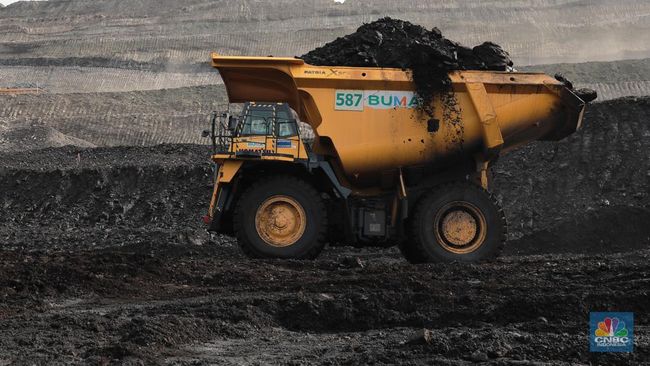
From the natural resources side, Indonesia’s coal reserves alone are estimated at 27.16 billion tons, sufficient for 56–192 years of production. Similarly, bauxite reserves, totaling 9.11 billion tons, can also sustain operations for 56–192 years.


Meanwhile, oil and gas reserves are estimated to last 17–25 years, with oil reserves of 0.5 billion tons and natural gas reserves of 1.5 billion tons. Geothermal energy potential is estimated at 23.7 gigawatts (GW).


Other major mineral reserves include:


  • Tin: 8.28 billion tons, manageable for about 40 years.
  • Copper: 18.41 billion tons, sufficient for 27–66 years.
  • Nickel and cobalt: 19.35 billion tons, for approximately 35 years.
  • Gold and silver: 18.87 billion tons and 12.81 billion tons respectively, estimated to last 33–60 years.

“Tin has been mined since the Dutch colonial era, yet that’s only the surface. We still have a lot of untapped tin potential. The same goes for nickel and cobalt,” Rofiudin explained.

“Copper, bauxite, gold, silver, geothermal — we have all these resources, and they’re still far from being fully utilized,” he emphasized.

According to the 2026 State Budget (APBN 2026), the government’s PNBP target is set at Rp 459.2 trillion, lower than the Rp 584.4 trillion realized in 2024 due to commodity price adjustments and the loss of SOE dividend contributions.


The 2026 PNBP target consists of:


  • Oil and gas NR revenue: Rp 113.1 trillion
  • Non-oil and gas NR revenue: Rp 123.5 trillion
  • Other PNBP sources: Rp 122.5 trillion
  • Public Service Agency (BLU) income: Rp 98.3 trillion

(arj/haa)


Indonesia’s $7.4 Billion Balikpapan Refinery to Start Full Operations in December 2025​


Heru Andriyanto
November 19, 2025 | 10:39 pm

1763607405689.webp
Deputy Energy and Mineral Resources Minister Yuliot Tanjung, center, speaks to the media during a visit to the Balikpapan oil refinery in East Kalimantan, Wednesday, Nov.19, 2025. Photo courtesy of the Energy and Mineral Resources Ministry)

Balikpapan. Indonesia’s largest oil refinery project in Balikpapan, East Kalimantan -- a $7.4 billion investment -- is targeted to be completed and fully operational by mid-December 2025, a senior official said on Wednesday. Once in operation, the refinery is expected to supply 22 to 25 percent of Indonesia’s national fuel demand.


“We conducted inspections this morning through this afternoon on the Balikpapan refinery facilities, including production units and supporting facilities such as oil-storage infrastructure that will add 2 million kiloliters of capacity. This is the largest refinery we have,” Deputy Energy and Mineral Resources Minister Yuliot Tanjung said in a press statement after visiting the project.


Yuliot said the visit was aimed at reviewing the remaining work before full operation. The refinery is planned to be inaugurated by President Prabowo Subianto in December.


“We came today to check production readiness. The inauguration by the President will be proposed based on actual readiness in the field,” he said.

According to Yuliot, only minor final touches remain. “There are still refinements of around 1 to 2 percent, which we expect can be completed within the next few days. The remaining 1.5 percent consists only of detailed work,” he said.


The Balikpapan Refinery, managed by Kilang Pertamina Internasional, is classified as a National Strategic Project and represents one of the largest investments by a state-owned company as part of a long-term strategy to reduce dependence on imported fuel.


Kilang Pertamina President Director Taufik Aditiyawarman said several key milestones have been reached, including the initial operation of the Residual Fluid Catalytic Cracking (RFCC) unit on November 10.


The RFCC is the refinery’s core unit designed to produce Euro V-standard fuel, enhancing both efficiency and economic value.


Euro V is an international fuel-emission standard that significantly reduces harmful exhaust pollutants. Globally, Euro V fuel is typically slightly more expensive to produce due to additional refining processes. However, long-term benefits -- including reduced engine maintenance and improved fuel efficiency -- can offset higher prices.


“RFCC not only increases efficiency and product quality, but also boosts the added value of our domestic natural resources,” Taufik said.

Once fully operational, the Balikpapan refinery will not only supply environmentally friendly fuel but also process remaining residues into high-value petrochemical products, including propylene and ethylene.


Both products are critical feedstocks for Indonesia’s petrochemical industry, which has long faced shortages and has relied heavily on imports.

 
Indonesia oil and gas industry is now getting into untapped shale oil reserve. Its first attempt made by Pertamina is successful to get around 724 million barrel of oil potential, Alhamdulillah.

It uses different technology compared to conventional oil drilling

Source


Oki said that the discovery of 724 million barrels of oil equivalent only comes from one geological structure. According to him, Indonesia’s non-conventional oil and gas potential is much larger than that.


This “treasure” was previously revealed by PT Pertamina Hulu Rokan (PHR) in November 2024. They stated that the discovery came from the Gulamo DET-1 Well, which is Indonesia’s first non-conventional oil and gas (MNK) well to successfully prove the existence of hydrocarbon flow to the surface.


MNK refers to oil and gas that are formed and trapped in fine-grained reservoir rocks with very low permeability within a particular maturity zone.


MNK becomes economically viable when produced through horizontal drilling combined with hydraulic fracturing stimulation techniques, including: shale oil, shale gas, tight sand oil, tight sand gas, coal-bed methane, and methane hydrate.
 

Indonesia Offers 108 Untapped Oil and Gas Basins to Global Investors​


Heru Andriyanto

November 25, 2025 | 6:06 pm

1764180108796.webp
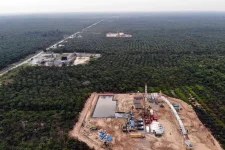
An aerial photo taken on Wednesday, September 24, 2025, shows the oil drilling area operated by Pertamina Hulu Rokan at the Rangau 30 Field in Bengkalis Regency, Riau Province. (Antara Photo/Yulius Satria Wijaya)


Jakarta. Indonesia is opening 108 untapped oil and gas basins to domestic and foreign investors as part of its plan to dramatically increase national energy production by 2029, Deputy Energy and Mineral Resources Minister Yuliot Tanjung said on Tuesday.


Indonesia has identified 128 hydrocarbon basins across the archipelago, but only 20 have been developed so far. The government aims to accelerate exploration to help the country reach its long-standing targets of 1 million barrels of oil per day and 12 billion standard cubic feet per day of natural gas (BSCFD) by 2029, Yuliot said in a statement.


To support the push, the government is channeling significant funding to the Geological Agency this year to conduct advanced subsurface surveys and provide the technical foundation for new exploration initiatives.

“Our shared vision is clear: by 2029, Indonesia will achieve 1 million barrels of oil per day, strengthen national energy security, and drive sustainable development,” Yuliot said.

The policy drive is accompanied by updates to Indonesia’s investment regulatory framework. The government has issued Government Regulation No. 28/2025 on Risk-Based Business Licensing and Energy Ministry Regulation No. 14/2025 on Joint Management of Working Areas, designed to promote transparent and efficient partnerships with investors.


Alongside the 108 basins being offered, the Energy Ministry has also prepared 75 oil and gas blocks in Sumatra, Kalimantan, Sulawesi, Papua, and various offshore sites. Nine blocks have already received designations for development, with more expected to follow, Yuliot said.


Expansion of production capacity is being supported by major infrastructure projects, including the development of transmission pipelines, distribution networks to industrial zones, refinery upgrades, an expansion of domestic storage facilities, and increased capacity for oil and gas cargo shipments.


Indonesia Tenders Eight New Oil and Gas Blocks to Boost Reserves​

By Tsvetana Paraskova - Dec 22, 2025, 6:00 AM CST

1766730121294.png

Oil and gas producer Indonesia has put up for tender eight new blocks to award to companies as Southeast Asia’s biggest economy looks to boost domestic hydrocarbon reserves and production.

Interested parties can submit bids by February 5, 2026, for the onshore and offshore blocks Tapah, Nawasena, Mabelo, Arwana III, Tuah Tanah, Rangkas, Akimeugah I, and Akimeugah II, according to a document of the Indonesian Energy and Mineral Resources Ministry published on Monday and seen by Reuters.

These blocks are estimated to hold billions of barrels of crude oil and billions of cubic feet of gas as Indonesia looks to reduce its import dependence and reverse a years-long decline in its oil production.


Indonesia looks to unlock its upstream potential by offering more than 100 previously untapped oil and gas basins to global investors for exploration.
The country targets to nearly double its oil production to 1 million barrels per day (bpd) of crude oil. Currently, Indonesia pumps about 600,000 bpd of crude.

Indonesia has developed only 20 out of 128 identified oil and gas basins across its archipelago, Deputy Minister of Energy and Mineral Resource, Yuliot Tanjung, said in November at the launch event to attract investments in Indonesia’s energy future.

The government is allocating resources to its Geological Agency to conduct advanced 2D and 3D surveys, paving the way for exploration to unlock the potential of these resources, the official said.

“Our shared vision is clear: by 2029, Indonesia will achieve its production target of 1 million barrels of oil per day, boost energy security, and advance sustainable development,” Yuliot said at the event.

Indonesia has also prepared 75 oil and gas blocks across Sumatra, Kalimantan, Sulawesi, Papua, and offshore areas for auctions and concessions. Nine of these oil and gas blocks have been awarded to business entities, with several more blocks to follow, the deputy energy minister said at the end of November.

By Tsvetana Paraskova for Oilprice.com


Indonesia to End Diesel Imports in 2026 as Balikpapan Refinery Comes Online​


Fuad Iqbal Abdullah, Celvin Moniaga Sipahutar

January 12, 2026 | 9:30 pm


To view this content we will need your consent to set third party cookies.
For more detailed information, see our cookies page.

One of Pertamina refineries, Balikpapan, East Kalimantan


Balikpapan, E. Kalimantan. Indonesia will stop importing diesel fuel in 2026 as output from the newly upgraded Balikpapan refinery pushes domestic supply into surplus, Energy and Mineral Resources Minister Bahlil Lahadalia said during the refinery inauguration on Monday.


Bahlil said state oil and gas company Pertamina's Balikpapan Refinery in East Kalimantan will generate a diesel surplus of 3 million to 4 million kiloliters a year, allowing the country to fully rely on domestic production.


“We will no longer import diesel,” Bahlil said during a visit to Pertamina’s Refinery Unit V in Balikpapan.


He added that the government will no longer issue permits to import diesel starting this year, including for private fuel retailers, such as Shell and BP. Any diesel cargoes that still arrive in January or February 2026, he said, will be part of import contracts approved in 2025.

“Starting this year, I will no longer issue diesel import permits. There will be no new diesel import licenses,” Bahlil said. “If there are still shipments early next year, those are simply the realization of permits issued last year.”


The Balikpapan project, valued at $7.4 billion or around Rp 123 trillion, is the largest refinery revitalization project in Indonesia’s history. Covering more than 80 hectares, it is a cornerstone of the government’s strategy to modernize downstream energy infrastructure and reduce dependence on fuel imports.

The upgrade lifts the refinery’s processing capacity from about 260,000 barrels per day to 360,000 barrels per day — equivalent to roughly a quarter of Indonesia’s total fuel demand. The increase is expected to sharply reduce imports, particularly diesel, which has been a major drag on the country’s trade balance.


According to the Energy Ministry, the Balikpapan refinery could save Indonesia up to Rp 68 trillion annually in fuel import costs. Its broader economic impact is projected to reach Rp 514 trillion in cumulative contributions to gross domestic product.


Beyond higher volumes, the refinery will also produce higher-quality fuels. The upgraded facility is capable of producing diesel, gasoline, jet fuel, and liquefied petroleum gas (LPG), with specifications improved from Euro II to Euro V standards, making the fuels cleaner and more environmentally friendly.

“With this refinery, we are not just increasing capacity,” Bahlil said. “We are strengthening Indonesia’s energy independence.”


Energi Mega Persada Strikes Oil in Malacca Strait Block​


Erta Darwati
January 26, 2026 | 6:19 pm

1769473862647.png
A gas field belonging to Energi Mega Persada in Sungai Gelam, Jambi province. The company is controlled by tycoon-politician Aburizal Bakrie.(SP Photo/Alex Suban)


Jakarta. Bakrie Group's oil and gas company Energi Mega Persada (IDX: ENRG) has announced a new oil discovery by its subsidiary, Imbang Tata Alam (ITA), from a recently drilled exploration well in the Malacca Strait working area.


The discovery was confirmed on Monday following initial evaluations that identified a productive oil-bearing layer in the Upper Sihapas Formation.


Flow testing showed the well produced around 350 barrels of oil per day, indicating good reservoir quality and stable flow potential, ENRG said in a statement. Geologically, the discovery is interpreted as a stratigraphic trap, opening up opportunities for further exploration and resource expansion in the surrounding area.


Based on preliminary assessments, the discovery is estimated to contain around 31 million barrels of original oil in place, according to ENRG Vice President Director and Chief Financial Officer Edoardus Ardianto. The company also sees potential to lift output by an additional 1,000 to 1,500 barrels per day through the planned development of the MSTB-NW structure, which would involve drilling six development wells.

“Similar seismic response evaluations indicate that the area around the discovery may still hold more than 76 million barrels of oil in potential resources, making it a key target for our next exploration campaign,” Edoardus said.


Read More:​

Bakrie Group's Energi Mega Persada Eyes $12 Million Buyback Program


ENRG Director and Chief Operation Asset A Kelik R. Suharya said ITA will work closely with upstream regulator SKK Migas to continue technical studies aimed at finalizing the development concept for the MSTB-NW structure, while also identifying additional exploration prospects near the discovery area.


President Director and Chief Executive Officer Syailendra S. Bakrie said the oil find is expected to support Indonesia’s energy security while delivering benefits to stakeholders around the Malacca Strait working area.


“ENRG reaffirms its commitment to conducting sustainable exploration and development activities to create long-term value for all stakeholders,” he said.


The oil discovery adds to a series of upstream milestones for ENRG. In December 2025, the company announced a new gas discovery from the East Walanga structure (EWL-1 exploration well) in the Sengkang Production Sharing Contract in South Sulawesi. Testing showed the well could produce gas at rates of 25 million to 36 million cubic feet per day, with an absolute open flow potential of 120 million cubic feet per day.


To support its growth strategy, ENRG has set capital expenditure of $200 million (Rp 3.35 trillion) for 2026, part of a $1.4 billion investment plan covering the 2025–2035 period.


The company has also consolidated its position in the Kangean block in East Java, becoming the sole operator after acquiring the remaining 25% participating interest previously held by Japan Petroleum Exploration Co. Ltd. (Japex). The transaction marked the end of Japex’s long-standing involvement in the gas-rich block.


Kangean is one of ENRG’s core producing assets. As of the third quarter of 2024, the block recorded production of 11,537 barrels of oil equivalent per day, accounting for about 25% of ENRG’s total output of 46,118 boepd between January and September 2024.


New Natuna Project Lifts Medco’s Oil & Gas Production to 156,000 Barrels per Day

By Firda Dwi Muliawati – CNBC Indonesia
28 January 2026 20:45


To view this content we will need your consent to set third party cookies.
For more detailed information, see our cookies page.


JAKARTAPT Medco Energi Internasional Tbk (MEDC) recorded oil and gas (O&G) production of 156,000 barrels of oil equivalent per day (BOEPD) in 2025.

This production achievement was primarily supported by new projects in Block B Natuna and an increase in Medco’s operating interest in the PSC Corridor to 70%.

“Production in 2025 was recorded at 156 MBOEPD, within guidance, supported by new projects in Block B Natuna and the increase of operating interest in the PSC Corridor to 70%,” Medco stated in its 2025 performance report, released on Wednesday (January 28, 2026).
The report also noted that in Q4 2025, oil and gas production peaked at 178 MBOEPD, with an average of 176 MBOEPD during the quarter.

For 2026, the company targets production of 165,000–170,000 BOEPD, which is projected to become the highest production level in Medco’s history.

Medco Energi CEO Roberto Lorato stated:

“Entering 2026, we remain focused on continuously creating sustainable value for stakeholders through growth, operational excellence, and disciplined capital management.”
In terms of shareholder returns, Medco recorded a total shareholder return (TSR) of 27% in 2025, with US$110 million returned to shareholders, comprising US$80 million in dividends and US$30 million in share buybacks.

Regarding reserves, Medco’s proved and probable (2P) oil and gas reserves increased to 564 million barrels of oil equivalent (MMBOE) in 2025, up from 493 MMBOE in 2024.

As a result, the company’s reserve life rose to 11.4 years, compared to 10.4 years previously.

Meanwhile, contingent resources (2C) at the end of 2025 also increased to approximately 1 billion BOE, up from 896 MMBOE in 2024.


Users who are viewing this thread

Country Watch Latest

Latest Posts

Back
Top