Indonesian EV Battery Development

Polytron to Enter Electric Car Market with Foreign Partner​


Wahyu Sahala Tua

January 21, 2025 | 11:34 pm

1737554043608.webp
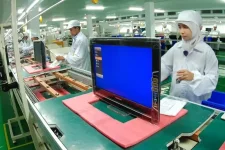
Workers assemble televisions at a Polytron plant in Kudus, Central Java. (Antara Photo)

Jakarta. Indonesia’s homegrown electronics company Polytron is venturing into the electric car market following its success in the electric scooter industry. The company announced on Tuesday that it will collaborate with a foreign partner experienced in the electric vehicle (EV) sector.


“We are working with a foreign partner to develop platforms for electric cars, aiming to establish Polytron as a key player in Indonesia’s EV market,” said Tekno Wibowo, Polytron’s Commercial Director.


Although Tekno did not disclose the partner's name, sources suggest the collaboration may involve Chinese EV manufacturer Skyworth Automobile. Last August, Polytron and Skyworth signed a preliminary agreement for future partnerships.


Polytron also plans to release new electric scooter models, building on the success of its current offerings, such as the Fox S and Fox 500.


To accommodate growing demand, the company
will relocate its electric scooter assembly plant from Kudus, Central Java, to a larger facility. The move, expected in the third quarter of 2025, is aimed at significantly increasing production capacity.


“We are constructing a larger, state-of-the-art assembly plant equipped with modern technology to scale up production and meet rising market demand,” Tekno said, though he did not specify the new plant's location.


The current assembly facility overlaps with Polytron’s production lines for household appliances, prompting the need for a dedicated and expanded manufacturing space.


Polytron to Enter Electric Car Market with Foreign Partner​


Wahyu Sahala Tua

January 21, 2025 | 11:34 pm

View attachment 96371
Workers assemble televisions at a Polytron plant in Kudus, Central Java. (Antara Photo)

Jakarta. Indonesia’s homegrown electronics company Polytron is venturing into the electric car market following its success in the electric scooter industry. The company announced on Tuesday that it will collaborate with a foreign partner experienced in the electric vehicle (EV) sector.


“We are working with a foreign partner to develop platforms for electric cars, aiming to establish Polytron as a key player in Indonesia’s EV market,” said Tekno Wibowo, Polytron’s Commercial Director.


Although Tekno did not disclose the partner's name, sources suggest the collaboration may involve Chinese EV manufacturer Skyworth Automobile. Last August, Polytron and Skyworth signed a preliminary agreement for future partnerships.


Polytron also plans to release new electric scooter models, building on the success of its current offerings, such as the Fox S and Fox 500.


To accommodate growing demand, the company
will relocate its electric scooter assembly plant from Kudus, Central Java, to a larger facility. The move, expected in the third quarter of 2025, is aimed at significantly increasing production capacity.


“We are constructing a larger, state-of-the-art assembly plant equipped with modern technology to scale up production and meet rising market demand,” Tekno said, though he did not specify the new plant's location.


The current assembly facility overlaps with Polytron’s production lines for household appliances, prompting the need for a dedicated and expanded manufacturing space.

To view this content we will need your consent to set third party cookies.
For more detailed information, see our cookies page.


To view this content we will need your consent to set third party cookies.
For more detailed information, see our cookies page.
 

Indonesia’s EV battery firm expands partnerships with Japan, Korea​


To view this content we will need your consent to set third party cookies.
For more detailed information, see our cookies page.

Indonesia Battery Corporation on EV Battery Production Outlook​


Author: Lin Bo-yu
Market
January 24, 2025


Indonesia, rich in nickel reserves, is striving to become a key player in the global electric vehicle (EV) supply chain. However, in response to U.S. President Trump’s threat of higher tariffs on Chinese companies, Indonesian battery manufacturers with close ties to Chinese firms are expanding their partnerships with other countries.


For example, Indonesia Battery Corporation (IBC) is targeting Japanese and South Korean companies, while also seeking new raw material suppliers in Australia and South America.


IBC to mitigate risks from U.S. tariffs​


Toto Nugroho, CEO of IBC, recently told Nikkei Asia that the company is negotiating with Japanese and South Korean firms, stating, “because that will be key to supplying the U.S. market,” though he did not specify which companies.


Under the previous administration of President Joko Widodo, Chinese companies had dominated Indonesia’s EV battery industry, making it difficult for local businesses to cooperate with European and American companies. As a result, Indonesian firms are now looking to East Asia to avoid the risks posed by the U.S.-China trade and technology conflict.


Toto believes that “The U.S. imposing high tariffs on China puts Indonesia in a very favorable position because Indonesia’s tariffs are relatively lower.”


IBC執行長托圖近日受訪表示,公司正與日本及南韓企業洽談合作,因為那將是供應美國市場的關鍵。

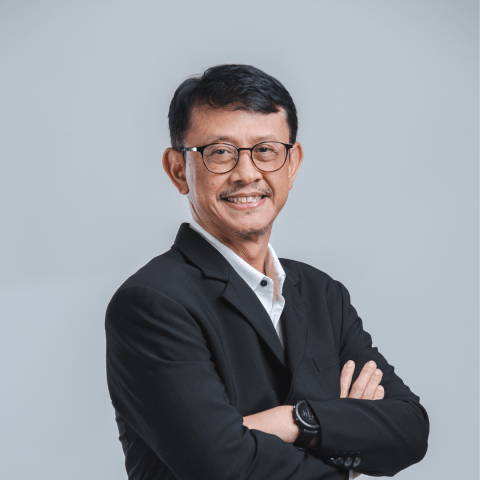
Toto Nugroho, CEO of IBC, recently stated in an interview that the company is in talks with Japanese and South Korean companies, as these partnerships “will be key to supplying the U.S. market.” (Image source: IBC website)


Founded in 2021, IBC is a joint venture between Indonesia’s state-owned oil company Pertamina, mining giant MIND ID, Aneka Tambang, and the state electricity company PLN.


Its main goal is to build a comprehensive EV battery supply chain, actively seeking foreign investment. In 2022, IBC collaborated with Foxconn and Gogoro to develop the Indonesian battery market.


IBC strengthens non-chinese partnerships​


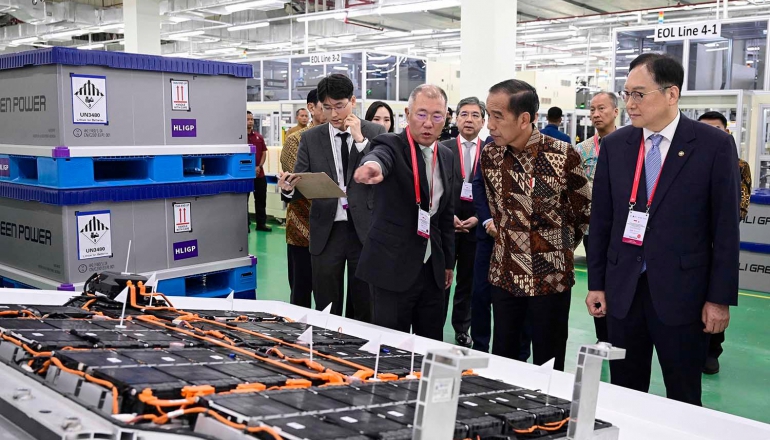
IBC has already completed Southeast Asia's largest EV battery plant in collaboration with South Korea’s Hyundai and LG Energy Solution with annual capacity up to 10 GWh. The plant began operations in June 2024, with President Widodo personally attending the inauguration.


Regarding partnerships with Japanese companies, Toto noted that while Japanese automakers are currently focused on hybrid vehicles, battery raw materials still heavily rely on nickel, which makes Indonesian products appealing to Japanese carmakers.


Additionally, in response to the growing demand for lithium iron phosphate (LFP) batteries driven by Chinese electric vehicles, IBC is developing its manufacturing capabilities for LFP batteries, leveraging Indonesia’s iron ore resources. The company is also continuing its search for partners in Australia and South America to ensure a stable lithium supply.


However, Toto emphasized that IBC will maintain its partnership with China’s CATL. Both companies are expected to develop a factory that can handle the entire lifecycle of batteries. While progress has slowed, the goal remains to start operations by 2027.


French Mining Giant Eramet Eyes Investing in South Sulawesi, Papua​


Jayanty Nada Shofa

February 5, 2025 | 9:51 am

1738738007202.webp
Investment Minister Rosan Roeslani meets with Eramet's chief executive officer Christel Bories in Jakarta on Feb. 3, 2025. (Photo Courtesy of Investment Ministry)

Jakarta. Investment Minister Rosan Roeslani recently said that the French mining giant Eramet was looking to invest in South Sulawesi and Papua.


In Indonesia, Eramet is a minority shareholder in the Weda Bay Nickel joint venture which it operates alongside Chinese nickel firm Tsingshan Holding Group and state gold miner Antam. This entity develops an open-pit mining operation in Halmahera Island, North Maluku.


Earlier this week, Eramet Group’s chief executive officer Christel Bories visited Rosan in his office to discuss the French company’s operation plans in Southeast Asia’s largest economy. In a social media post, Rosan revealed that Eramet sought to help Indonesia process its critical minerals at home and develop the country’s electric vehicle (EV) development ecosystem.


“Eramet also laid out its investment plans to explore new areas in South Sulawesi and Papua. They also talked of [investment plans] for a responsible green electric vehicles project that will involve several strategic partners,” Rosan wrote Tuesday.


“This collaboration is also expected to create jobs and boost technology transfer,” he said.


Later that day, Rosan told reporters that Eramet was “not only looking to be a contractor, but also develop some sort of production in Indonesia in partnership with a state-owned company.”

He also gave his word that his ministry would help facilitate Eramet’s investment plans in Indonesia.


Eramet data shows that the Weda Bay is the world’s largest nickel mine, representing 17 percent of the global production.


Last year, Indonesia amassed around Rp 1,714.2 trillion or approximately $105 billion in combined investments throughout 2024. About 52.5 percent of that money came from foreign investors. France ranked 16th place in terms of Indonesia's largest source of foreign direct investment (FDI) that year. The European country invested approximately $328.1 million in Indonesia over the said period. The French investment went to 6,437 projects.


Nickel is a mainstay ingredient in EV battery production. Indonesia posted Rp 153.2 trillion (9.6 billion USD) investments in the nickel smelting industry for the entirety of 2024. The Indonesian EV battery ecosystem also booked Rp 8.4 trillion in investments.


In 2022, Eramet and German chemical producer BASF unveiled plans to jointly invest in Sonic Bay, a hydrometallurgical plant project in Halmahera. The project was set to process nickel and cobalt for EV battery production. However, Eramet-BASF announced last year that they would withdraw from the $2.6 billion project.


BNBR boss Anindya Bakrie Talks Battery Factory Joint Venture with Envision & Glencore in Sulawesi

Anindya Bakrie said the consortium will open a nickel-derived export route in markets in the European Union, the United Kingdom and the United States.

1740034703046.jpeg
President Prabowo Subianto summoned Arsjad Rasjid and Anindya Bakrie to the State Palace, Jakarta on Friday (6/12/2024)/Business-Akbar Evandio


February 19, 2025


Bisnis.com, JAKARTA - President Director of PT Bakrie & Brothers Tbk. (BNBR) Anindya Novyan Bakrie insists the cooperation of the Bakrie group with Envision Group and Glencore remains on the way. The cooperation refers to the Indo-Pacific Net Zero Battery Materials Consortium (INBC).

The Joint Venture business of the Bakrie Group together with Envision & Glencore is planning to build an integrated nickel industrial area in Sulawesi with an estimated investment value of US $ 9 billion."[Consortium] the road continues to be even now the opportunity, because there is already a special ministry downstream," Anin told Bisnis, Wednesday (19/2/2025).

His vision, according to Anin, the consortium will accelerate the construction of jumbo-scale battery plants or gigafactories in several countries in the world. INBC will be an alternative to nickel-based battery raw materials.

Anin said the consortium would open the export line of stun batteries in the market in the European Union, the United Kingdom and the United States."This will send the product the result can be to the west other than to the east," Anin said.

Recently, BNBR along with Envision Energy International Ltd. signed a memorandum of understanding or MoU for the construction of a floating solar power plant (PLTS) Bayu Power Plant with a capacity of 200 megawatts.The memorandum of understanding was signed by BNBR along with Envision during the Indonesia-China Business Forum 2024 event in Beijing, China in 2024.

The plan is that both sides will use hybrid power to supply clean and sustainable electricity to support the power grid, especially in the eastern region of Indonesia.As is known, BNBR is the parent business of the Bakrie Group that houses the business line of automotive components, the building materials industry, infrastructure, and metal construction services.

BNBR also has an extension in the electric bus development sector through PT Vektor Mobiliti Indonesia which is a subsidiary of Bakrie Autoparts.Bakrie & Brothers Tbk - TradingViewMeanwhile, Envision Group and Glencore plc. are two leading global companies.

Envision Group is the world's leading eco-friendly technology company and net-zero technology partner.On the other hand, Glencore plc. is a Swiss mining commodity company that focuses on copper, zinc, aluminum, nickel, and cobalt commodities.

Previously, BNBR posted a net profit of Rp636.27 billion until the third quarter of 24, darting 416.76% or five times on an annual basis compared to net income in the same period the previous year Rp123.12 billion.

Based on the financial statements as of September 30, 2024, BNBR recorded a decrease in net income of 11.58% year-on-year (YoY) to Rp2.72 trillion in 9 months 2024.

The most dominant BNBR revenue came from infrastructure and manufacturing of Rp2.6 trillion in the third quarter of 24, a shrinkage of 12.79% YoY. Even so, the profits of BNBR are driven by corporate actions in the form of divestment of corporate subsidiaries.

"The increase in net income is significantly as a result of the release of one of the company's assets used for debt settlement," Anin said in a written statement on Friday (25/10/2024).

 
To view this content we will need your consent to set third party cookies.
For more detailed information, see our cookies page.


Talkshow With Raditya Wibowo - Maka Motors Founder & CEO​


Indonesia's Maka Motors will start producing electric motorcycles next year, CEO Raditya Wibowo told Nikkei Asia, aiming to capture a share of a growing domestic market currently dominated by Chinese makers.

Maka Motors, founded in 2021 by Wibowo and Arief Fadillah -- previously executives at Indonesian ride-hailing company Gojek -- has focused on developing electric motorcycles for the local market. Fadillah is chief technology officer. The company has recruited experienced engineers from Japanese and German motorbike manufacturers to kick-start operations.
 

GoTo, Toba Break Ground on Electric Motorcycle Factory in Cikarang with $1B Investment​


Zsazya Senorita

June 23, 2023 | 3:07 pm

1741697243092.webp
Executives of Electrum, a joint venture of GoTo Gojek Tokopedia (GOTO) and energy company TBS Energi Utama (TOBA), break ground on an electric motorcycle assembly plant in Cikarang, West Java, Friday, June 23, 2023. (Zsazya Senorita)


Jakarta. Tech company GoTo Gojek Tokopedia (GOTO) in collaboration with energy company TBS Energi Utama (TOBA) broke ground on an electric motorcycle assembly plant in Cikarang, West Java, on Friday.


The two companies have established a joint venture called Electrum to initiate the project.


The factory occupies an area at Greenland International Industrial Center on Jakarta-Cikampek Toll Road KM 37 just east of Jakarta.


“We begin with the construction of an assembly line with a capacity of 250,000 motorcycles a year. The entire lines will have a capacity of up to 1 million when completed,” Electrum Managing Director Patrick Adhiatmadja told reporters in Cikarang.

The project is estimated to cost $1 billion for the first four years with an equal cost-sharing agreement between GoTo and Toba, Electrum CEO Pandu Sjahrir added.


The assembly plant construction will take a portion of the total investment, but Pandu declined to go into detail.


“As one of the initiators for the most thorough, integrated electric vehicle ecosystem in Indonesia, Electrum announces that we commence building our first electric motorcycle factory in Indonesia,” the joint venture company said in a statement.


Ride-hailing company Gojek will supply its entire two-wheeler fleet with Electrum motorcycles by 2030, ensuring a captive market of thousands of electric bikes.


It will also oblige all partnering drivers to use electric cars only by the end of this decade.


“Since the large majority of the Gojek ecosystem is two-wheelers, we are focused on electric motorbikes first,” GoTo Head of Sustainability Department Tanah Sullivan said recently.


Vinfast plans EV factory worth Rp4 trillion in Subang: minister​


March 11, 2025 18:56 GMT+700

1741847208015.webp
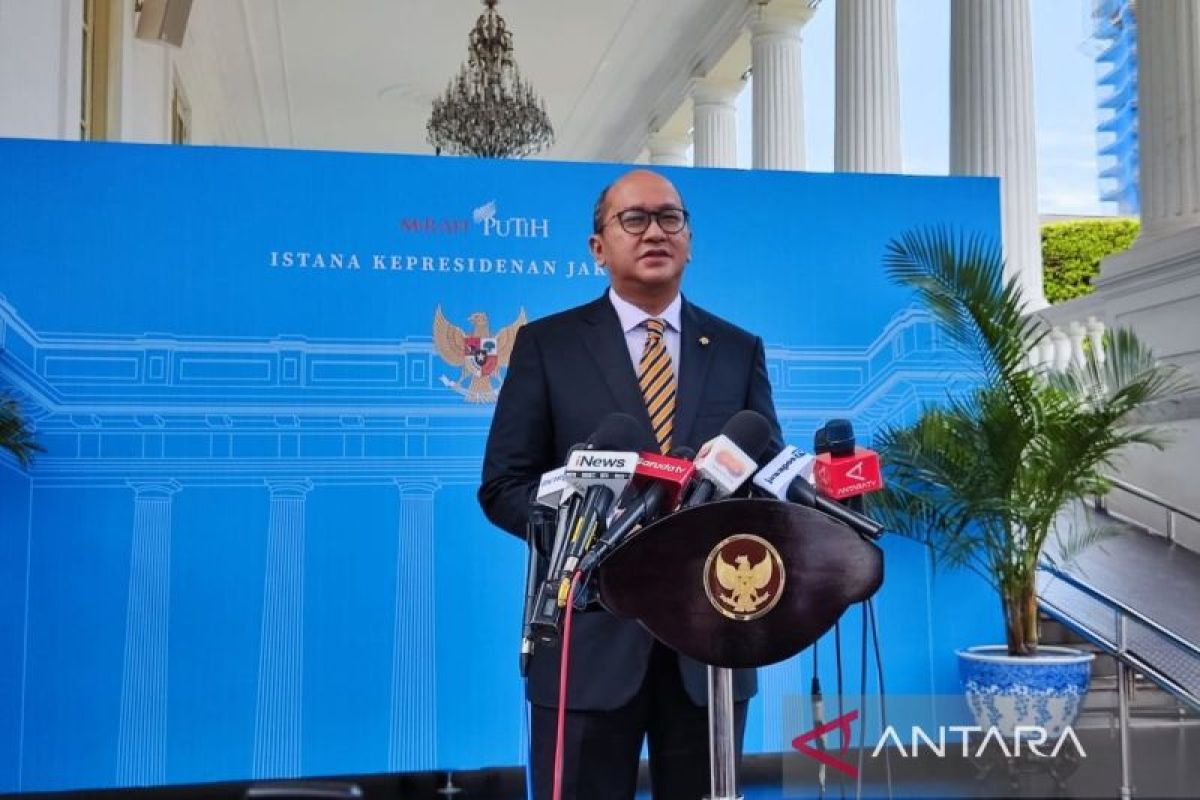
Minister of Investment and Downstreaming, Rosan Roeslani, issuing a press statement at the Presidential Palace Complex in Jakarta on Tuesday (March 11, 2025). (ANTARA/Mentari Dwi/rst)


Jakarta (ANTARA) - Vietnamese automotive company Vinfast has expressed its commitment to building an electric vehicle (EV) factory in Subang, West Java, with an investment of Rp4 trillion (US$237 million), Minister of Investment and Downstreaming, Rosan Roeslani, said.

"The factory is spread over 120 hectares of land. The company plans to produce 50 thousand vehicles per year, with the investment reaching Rp4 trillion," he informed at the Presidential Palace Complex in Jakarta on Tuesday.

According to the minister, the investment commitment was conveyed directly by Vinfast during a meeting with President Prabowo Subianto.

Vinfast plans to start constructing the factory shortly after Ramadan, Roeslani said.

The construction work is expected to be completed this year, and will be followed by vehicle production in September. He informed that the factory will produce several types of vehicles.

"There will be several types, with prices ranging from Rp200 million (US$12 thousand) to Rp 600 million (US$35 thousand)," he said.

So far, preparations for the factory's construction have run smoothly. Roeslani said that the government will support and accelerate the construction process so that the investment made can immediately have an impact on the surrounding community.

Earlier on Monday, he informed that Indonesia is one of two countries targeted by VinFast for manufacturing cars, with the products intended for export.

Besides the initial investment commitment, which will be realized through the construction of the electric car factory, the company has also expressed interest in several other investment opportunities in Indonesia's energy sector, the minister added.

Vinfast has conveyed its desire to invest in solar power plants (PLTS) in West Nusa Tenggara and wind power plants (PLTB) in Sulawesi.

It also plans to gradually build 30 thousand–100 thousand public electric vehicle charging stations (SPKLUs) in several parts of Indonesia, especially in Java.

Roeslani said that the investment for building 100 thousand SPKLUs is likely to touch US$1 billion.


China’s Huayou to Join Indonesia EV Battery Project Following LG’s Exit​


Ichsan Ali

April 24, 2025 | 7:59 am

1745471130167.webp
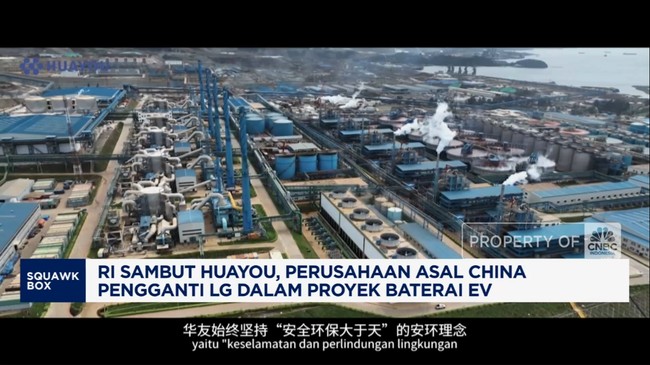
This undated photo taken from the Huayou Indonesia website shows the company's nickel processing facility at the Weda Bay Industrial Park in Halmahera, North Maluku.


Jakarta. Chinese nickel processing giant Huayou is set to join an Indonesian electric vehicle (EV) battery consortium, replacing South Korea’s LG Energy Solution, a senior official confirmed on Wednesday.


Huayou, which has been operating in Indonesia through its local subsidiary Huayou Indonesia, is already involved in key nickel processing projects, including operations in Weda Bay, Halmahera, North Maluku.


“Huayou has invested in similar industries and understands the business well,” Investment Minister Rosan Roeslani said in Jakarta.


The move comes after LG Energy Solution announced its withdrawal from the consortium -- originally formed with Indonesia Battery Corporation (IBC) and state miner Aneka Tambang (Antam) -- in a $9.8 billion joint investment project. The investment spans upstream mining ($850 million), smelter construction ($4 billion), a cathode processing plant ($1.8 billion), and a battery cell factory ($3.2 billion).

Rosan noted that LG and its partners had already disbursed part of the initial $1.1 billion investment.


He also revealed that in January, Energy and Mineral Resources Minister Bahlil Lahadalia formally notified LG Chem and LG Energy Solution of the consortium’s termination due to prolonged delays and stalled negotiations.


Huayou had already expressed interest in joining the consortium as early as last year, Rosan said, adding that the overall investment target of $9.8 billion remains unchanged with the company’s entry.


“Why Huayou? Because they’ve already made a significant investment in Weda Bay. They understand the industry and have the capacity to execute this project,” Rosan explained.


The EV battery consortium is a critical part of Indonesia’s strategy to develop a fully integrated domestic EV supply chain and accelerate the establishment of its first EV ecosystem.


Vietnam's VinFast Secures Rp 1.8 Trillion Loan to Build EV Plant in Indonesia​


April 25, 2025 | 2:53 pm

1745750306588.webp
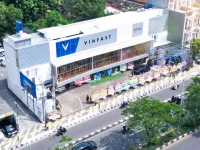
This aerial photo shows a dealership of VinFast electric vehicles in Depok, West Java. (Photo Courtesy of VinFast)


Jakarta. Vietnamese electric vehicle (EV) manufacturer VinFast has secured a syndicated loan worth Rp 1.84 trillion ($109 million) to fund the construction of an EV assembly plant in Indonesia.


State-owned Bank Negara Indonesia (BNI) contributed Rp 1.51 trillion to the loan, while the remainder was provided by Bank Maybank Indonesia. The financing was extended to VinFast's local subsidiary, VinFast Automobile Indonesia.


The credit agreement was signed in Jakarta on Thursday, in a ceremony attended by BNI’s Head of International and Financial Institutions Division Rima Cahyani, VinFast Global Deputy CEO Pham Thuy Linhbank, BNI Corporate Banking Director Agung Prabowo, and representatives from Maybank.


“The plant is expected to become VinFast’s production hub for both domestic and export markets, while also strengthening the national automotive supply chain,” Agung said in a statement.

VinFast began construction of its first factory in Indonesia last July. The facility, located in Subang, West Java, underscores the company's long-term commitment to the country.


The Subang plant is scheduled to begin production by late 2025 and will manufacture four electric car models: the VF5, VF6, VF7, and VF3. The project’s initial investment is $200 million (Rp 3.2 trillion), forming part of a broader $1.2 billion commitment to Indonesia. The plant will exclusively produce electric cars, with no plans to manufacture conventional vehicles or motorcycles.


In a separate development last month, VinFast announced plans to build up to 100,000 EV charging stations across Indonesia, with a focus on Java Island.

 
Building Battery Factory in Karawang, CATL Targets IDR 16 Trillion Loan - Energy


Kari Lindberg -- Bloomberg News

06 May 2025 12:00​


To view this content we will need your consent to set third party cookies.
For more detailed information, see our cookies page.

Karawang Industrial Park, West Java


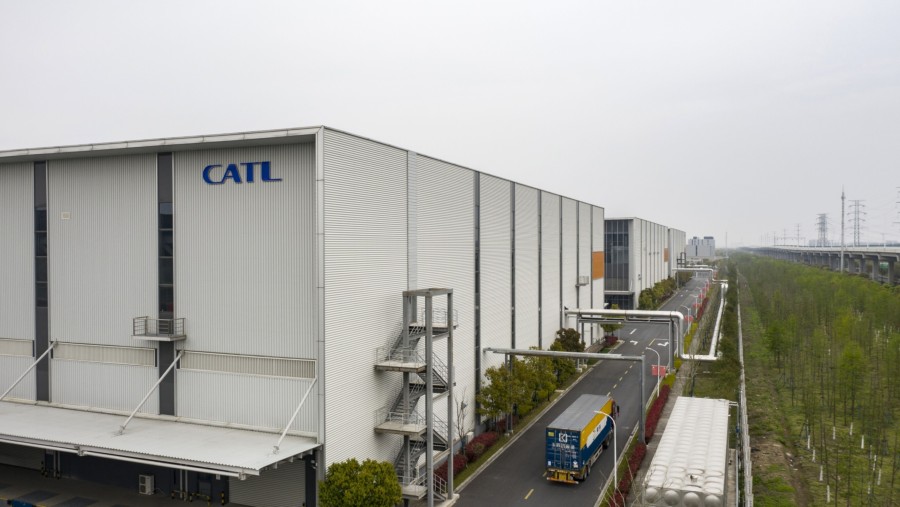
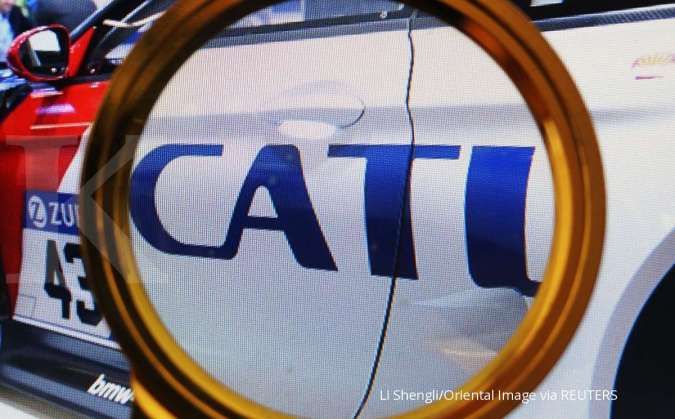
Contemporary Amperex Technology Co. Ltd. (CATL) is seeking a US$1 billion loan to fund a battery cell factory in Karawang, according to sources familiar with the plan.

The loan facility is expected to have a term of between five and seven years, according to sources who spoke on condition of anonymity because the discussions are private.

The plan is to use the proceeds from the loan to finance a joint venture with the Indonesia Battery Corporation (IBC) consortium related to an investment in a battery cell factory in Karawang, West Java.

Talks with potential lenders are ongoing and details of the loan could change, the sources added. CATL has not responded to requests for comment.

CATL’s move to expand its battery production in Indonesia comes as the Chinese electric vehicle battery giant seeks investor interest in a potential US$5 billion IPO — which could be one of the largest listings in Hong Kong in years.

In October, CATL, through its subsidiary CBL International Development, formed a joint venture with IBC. The joint venture plans to invest US$1.2 billion in Indonesia to increase the Fujian-based company’s battery production capacity to 15 gigawatts (GW) per year.

On the other hand, CATL previously confirmed that the impact of US tariffs on the company would be relatively minimal. The reason is that CATL’s business exposure to the United States is relatively small.


A critical mineral match for Australia and Indonesia​

Robert Walker
Hilman Palaon


Downstreaming diplomacy and shared interests to secure the global supply of nickel and lithium should be the focus for Anthony Albanese’s trip to Jakarta.
1747654390503.jpeg


Published 14 May 2025


The freshly re-elected Australian Prime Minister Anthony Albanese is wasting no time, making the customary first overseas visit to Indonesia on Wednesday only one day after swearing in a new cabinet. There will be much to talk about, but critical minerals will likely be a priority for the Indonesian side.

On a call with President Prabowo Subianto, Albanese proudly stated the relationship between “Australia and Indonesia is an unbreakable bond” and on Australian television declared “We have no more important relationship than Indonesia just to our north”.

Critical mineral cooperation is fast becoming central to how Indonesia imagines future economic engagement between the two countries.

Indonesia wishes to explore critical mineral collaboration with Australia – an ambition Australia needs to take seriously

Indonesia has rapidly become the world’s largest supplier of nickel after adopting a surprisingly successful mix of industrial and trade policies to expand processing capacity and battery manufacturing, dubbed “downstreaming”. This downstreaming is now envisaged for other critical minerals and non-mineral commodities and seen as a pathway for Indonesia to reach high income status by 2045.

This is why Indonesia wishes to explore critical mineral collaboration with Australia – and an ambition Australia needs to take seriously.

A receptive Albanese government established a collaboration mechanism in 2023 with the aim of “mapping EV supply chains, joint scientific and research studies, as well as fostering new business-to-business links”. The focus is primarily on critical mineral processing and battery manufacturing.

Australia already devoted A$2 million to funding joint research activities into transport decarbonisation and battery recycling. Indonesia, meantime, signed similar cooperation agreements with the Western Australian and Northern Territory state governments.


Nickel sulfate (SeongJoon Cho/Bloomberg via Getty Images)

Nickel sulfate (SeongJoon Cho/Bloomberg via Getty Images)


The Indonesian Ministry of Foreign Affairs recently hosted a closed-door seminar, inviting speakers from the National Economic Council, a nickel company, Indonesian academia, and the Lowy Institute, to explore further critical mineral collaboration with Australia. Indonesia is serious about building opportunities with Australia and recognises that a “greener” Indonesian nickel industry will be a necessary step. This is welcome given growing concerns about the industry’s environmental, social and governance standards.

Indonesia sees Australia’s status as the largest producer of lithium and Indonesia as the largest producer of nickel as a collaboration opportunity. Both minerals are crucial inputs for certain EV batteries.

There is merit in this assessment. Several ideas have already been explored, such as a division of production between the two countries, where certain stages of mineral processing and battery manufacturing take place in each country.

But our research into Indonesia’s nickel downstreaming suggests cooperation may be harder than it first appears, although progress is possible in some narrow areas.

Indonesian firms could acquire stakes in Australian lithium projects alongside lithium refining firms, much like the joint venture model in Indonesia’s nickel industry.

Several essential factors led to Indonesia’s success in nickel processing: Technology, financing, skilled labour, large mineral reserves, the right policy environment, and abundant energy. Each pillar must be present if a critical mineral processing industry is to develop. In the case of Indonesian nickel, China provided the first three while Indonesia provided the latter three.

Australia has a similar comparative advantage to Indonesia, able to provide mineral reserves, favourable policy, and abundant energy. But Australia lacks some skilled labour. It also does not have cost-effective technology to compete with China, with projects reliant on state support because Australia only received US$2 billion in foreign investment for new critical mineral projects in 2023–24. Indonesia received between US$2–$10 billion in seven out of the last ten years of downstreaming. So Australia will not be able to play the role of China in further Indonesian downstreaming efforts.

Indonesia also cannot provide processing technology or skilled labour. But Indonesia has finance potential. Indonesian acquisitions of Australian coal and copper mines are an example. Indonesian firms have spent A$3 billion acquiring coal mining projects in Australia since 2016. Indonesian firms could acquire stakes in Australian lithium projects alongside lithium refining firms, much like the joint venture model in Indonesia’s nickel industry.

One stumbling block is low commodity prices. A major lithium refiner in Australia already announced production declines last year. Investments look risky but could be cheaper given this outlook.

Australia would also need to consider the risk of foreign investments from Indonesian firms involved in Chinese critical mineral supply chains.

As Albanese travels to Indonesia, critical mineral collaboration will be high on the Indonesian economic agenda. Australia needs to temper expectations where necessary but lithium ambitions may be a path forward.


Investment in EV Batteries in Indonesia, CATL Will Use IPO Funds​


Sunday, May 18, 2025 / 06:33 WIB

1747655420261.jpeg
ILLUSTRATION.

China Contemporary Amperex Technology Co. Ltd. (CATL) will work on an electric vehicle battery (EV) exosystem project in Indonesia to cooperate with Indonesia Battery Corporation (IBC).


Reporter: Sabrina Rhamalat | Editor: Khomarul Hidayat


KONTAN.CO.ID - JAKARTA. China Contemporary Amperex Technology Co. Ltd. (CATL) will work on an electric vehicle battery (EV) exosystem project in Indonesia to cooperate with Indonesia Battery Corporation (IBC).


CATL is also preparing to conduct Initial Public Offering (IPO) or initial stock offering on the Hong Kong exchange as one way the Chinese company is to get additional funding.


According to Deputy Minister of Energy and Mineral Resources (ESDM) Yuliot Tanjung, funds obtained from the IPO will be one of the schemes used by CATL to finance the funding of electric vehicle battery (EV) project in Indonesia in collaboration with IBC.


More details, Yuliot said, the CATL investment scheme in Indonesia must go through the Outward Direct Investment (ODI) process approved by the Government of China.


The production capacity based on the approved ODI is 7.5 gigawatt hour (GWh) per year or half of the initial capacity of 15 GWh.


"The investment mechanism they do is not only that comes from funding (alone) but they also get a farm from the IPO. So for the capacity of 15 GWh it can be done, "said Yuliot at the ESDM Office, Friday (16/05).


READ MORE: CATL giant investment in Indonesia continues, buyers of EV batteries from the US and Europe


Even so, Yuliot emphasized that the battery production figures and also the initial investment figures of the CATL did not change, which amounted to US $ 1.18 billion or equivalent to Rp 19.13 trillion (assuming the exchange rate of Rp 16,213 per US dollar) along with a production capacity of 15 gigawatt hours (GWh) per year.


But for the first phase, the production targeted in March 2026 will aim for a production capacity of 7.5 GWh first. "So this (initial production) is 7.5 GWh," he added.


To note, CATL has set the IPO stock price on the Hong Kong Stock Exchange amounting to HK$ 263 equivalent to US$33.7 per share.


According to two sources, CATL will enlarge the IPO with a fundraising of about $4.6 billion about HK $ 35.66 billion.


If realized, this record will be the largest globally by 2025, based on data from LSEG.


More than 20 major investors (cornerstone investors) have committed to buying CATL shares worth around $2.6 billion in this IPO, according to the documents submitted by the company.


About 90% of the funds obtained, or about HK$27.6 billion, will be used for the construction of the CATL battery plant in Hungary. The facility is part of the company's expansion plans to produce batteries in Europe for automotive manufacturers such as BMW, Stellantis, and Volkswagen.


Huauyou continued, EV RI Battery Project Ready Groundbreaking August 2025​


Yanwardhana Emir, CNBC Indonesia

22 May 2025 21:40

1747992169614.jpeg


Jakarta, CNBC Indonesia - ESDM Minister Bahlil Lahadalia revealed that the electric vehicle battery ecosystem project immediately entered the development stage. The groundbreaking plan will be carried out before August 2025.

"We plan before August," Bahlil said, at the President's Office on Thursday (5/22/2024).

Previously the project of the battery ecosystem of the vehicles initiated since 2022, was slow. Until finally the government decided to no longer continue to cooperate with LG Energy Solution.

Although in July 2024, the 7th President of the Republic of Indonesia Joko Widodo has inaugurated one of the investment parts in Karawang, worth US $ 1.2 billion. But that’s only part of the project run from the car’s battery ecosystem worth US $ 9.8 billion or equivalent to Rp 165.3 trillion.

“US$1.2 billion has actually been in the era of LG that has been inaugurated by the previous president’s administration. Now there is about $8 billion left from a portion of the headwaters to the Cell Battery, 20 gigawatts," Bahlil said.

Bahlil insists that he decided to no longer cooperate with LG, because the negotiations that continue to run hard. Until it was decided that Huayou became a substitute.

“I as the head of the Task Force at that time then decided to cancel what LG did, because it was too long. Then I was with Mr. Rosan (Investment Minister) and met Mr. Erick (Minister of SOE) to find a replacement that is Huayou," he said.

On that occasion, Bahlil also revealed that in the composition of the consortium with Huayou the portion of Indonesia remains still the largest. But he said the Investment Management Agency (BPI) Danantara will later participate in the development of the next project.

"The one that's been firm now is at 51% upstream, then in the next JV about 30%," he said.

"The next JV is now 30%, but we are trying again to be an increase because Danantara will also participate," Bahlil said.


(pgr/pgr)


China Wants to Invest Rp 130 T (8 Billion USD) in North Kalimantan, Appoints Indonesian Citizens to Be Factory Boss​


Demis Rizky Gosta, CNBC Indonesia

25 May 2025 13:15

1748163613425.jpeg
Photo: Demis/CNBC Indonesia


Bandung, CNBC Indonesia - GEM, a giant company from China engaged in the processing and recycling of battery raw materials, plans to invest US $ 8 billion to develop Indonesia Green Industrial Park (IGIP) in North Kalimantan. The company also targets to fill key positions in production facilities in Indonesia with local Indonesian talents.


GEM founder and President Commissioner, Xu Kaihua, said GEM plans to continue investing in the sector of mineral industry in Indonesia.


Currently, GEM operates a nickel processing plant in Morowali through a joint venture called QMB. The next investment is the construction of a basic industrial area called IGIP in Kaltara.


The initial investment of IGIP development is estimated to cost US $ 2 billion (Rp 32.52 trillion) which will then continue to be increased to US $ 8 billion (Rp 130 trillion) in the following stages.


Xu claimed the GEM production facility in Morowali allowed RI to be able to purify low-calorie nickel and cobalt recycling. GEM technology also makes the industry in Morowali can produce green nickel or Mixed Hydroxide Precipitate (MHP) which can then be processed into one of the main materials of the battery.


"In the past nickel in the RI could only produce stainless steel. Now stainless steel and NPI have been overcapacity, therefore it is important to have a new direction of nickel processing," he said at the Jatinangor ITB Campus, Saturday (24/05/2025).


Looking for Indonesian talent​


However, Xu revealed that during this time the operation of the GEM plant in RI still tends to be expensive. The main problem is the unavailability of local talent that can fill key positions in their production facilities.


“There are no local talent that we have to bring in talent from China. This costs a lot and not sustainable. Therefore, we have been trying to encourage local talent to continue their studies in China,” he said.


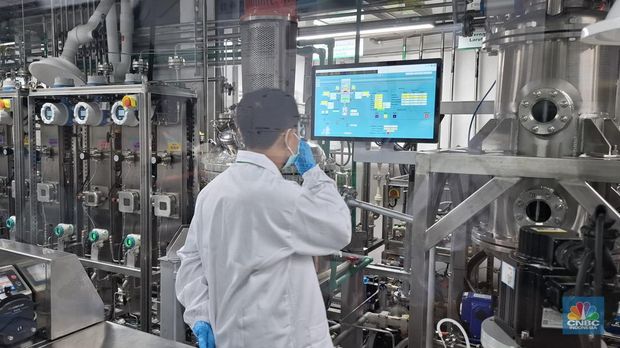
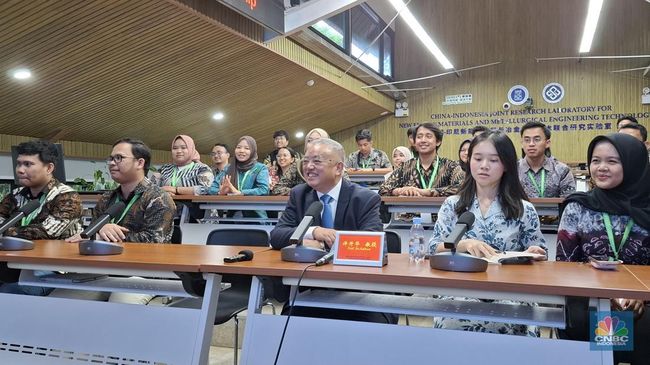
However, the training program through post-graduate and doctoral education at universities in China is not enough to fill the needs of the GEM workforce. Xu then took the initiative to build laboratory facilities at the ITB Campus which reached US $ 270 million (Rp 4.39 trillion) to increase the capacity and speed of local talent training.


This program makes various key positions in the QNB factory more and more filled by Indonesian citizens, even Xu claims in the near future there will be Indonesian citizens who become leaders of the production process in GEM's factory.


GEM-CSU-ITB Laboratory
Photo: Demis/CNBC Indonesia
GEM-CSU-ITB Laboratory


GEM is making the talent development program in RI as one example of an ongoing program initiative in the Belt and Road Initiative scheme also known as the new "Stra Line".


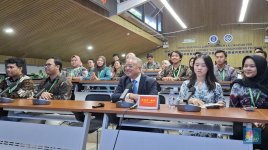
Xu is part of the United Nations Global Compact (UNGC) Steering Commission which held a meeting at the GEM-CSU-ITB Laboratory on the Jatinangor ITB Campus.


In addition to Xu, the commission is also filled by the leaders of other companies from China as well as the leaders of companies from other countries including Indonesia.


Some of the company leaders present include Marjorie Yang from Esquel Group, Kanika Dewan from Ka Design Atelier. Representative from Indonesia is Cheri Nursalim from GITI Group, the parent business of PT Gajah Tunggal Tbk.


Users who are viewing this thread

Latest Posts

Back
Top