Internal Security Review

Mohsin Naqvi discusses counter-terrorism and security cooperation with Chinese envoy in Islamabad

News Desk
March 27, 2026

1774614461806.png

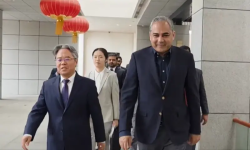
Interior Minister Mohsin Naqvi walks with Chinese Ambassador Jiang Zedong at the Chinese Embassy in Islamabad on March 27. — screengrab via MOIofficialGoP/X

Interior Minister Mohsin Naqvi met with Chinese Ambassador Jiang Zedong at the Chinese Embassy in Islamabad on Friday, where the two discussed matters pertaining to counter-terrorism, security cooperation and the Police Exchange Programme.

The interior ministry posted on social media that Naqvi arrived at the embassy in Islamabad’s Diplomatic Enclave earlier today, where he was welcomed by the ambassador. It also shared a video of him being received by Jiang at the entrance.

“Discussion on the overall situation of the region also took place in the meeting,” the ministry said.

The interior ministry said it was decided to hold a business conference to address security issues faced by Chinese investors in Pakistan, according to the ministry.

It elaborated that in the first phase, meetings will be held with the Chinese business community present in Pakistan; the second phase will involve meetings with those who are interested in investing in Pakistan.

The interior minister also said that a Special Protection Unit is being established for the protection of foreign citizens. The unit will ensure the security of Chinese citizens present in Islamabad, according to Mushtaq Cheema.

The Special Protection Unit officials will also be taught the Chinese language during their training, he added.

On Thursday, Ambassador Jiang had called on Prime Minister Shehbaz Sharif at the PM House for a meeting in which Deputy Prime Minister and Foreign Minister Ishaq Dar, Special Assistant to the Prime Minister Syed Tariq Fatemi, and the foreign secretary were also present.
 
Khyber Pakhtunkhwa

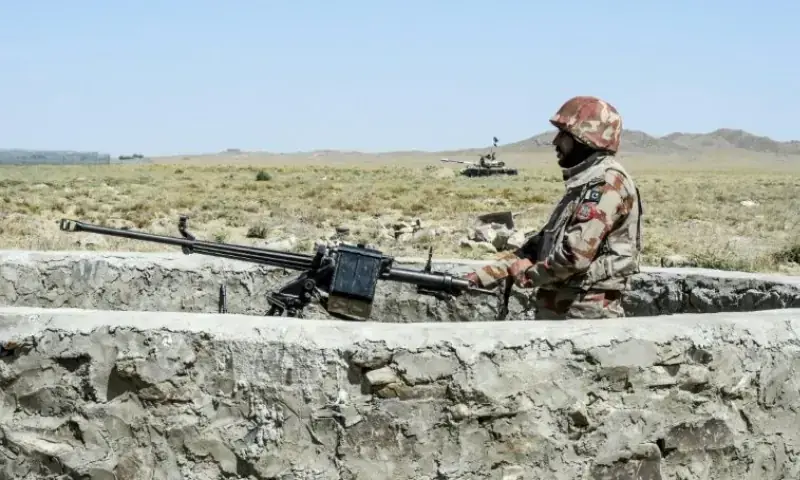
K-P has been battling terrorism since the United States' ouster from Afghanistan, with terrorists often crossing the border to target police convoys and vehicles, resulting in the deaths of several officials and personnel.

Last month, at least seven police personnel, including the station house officer of Shadi Khel Police Station, were martyred in an IED explosion near a police mobile in Lakki Marwat. A week before that, two policemen were killed and 15 people, including five police personnel, were injured in an IED blast in the Rustam Bazaar area of Wana in Lower South Waziristan.

The province has witnessed a surge in terrorist attacks, accounting for the highest number of incidents in the country. Out of a total of 5,397 reported incidents last year, K-P recorded 3,811, followed by Balochistan with 1,557 incidents. Only 29 incidents were reported from the rest of the country. A total of 2,597 terrorists were killed during the year.
 
To view this content we will need your consent to set third party cookies.
For more detailed information, see our cookies page.
 
To view this content we will need your consent to set third party cookies.
For more detailed information, see our cookies page.
 
Despite record militant deaths, Pakistan saw a sharp escalation in militant violence in 2025, with terrorist attacks rising by 34 per cent and terrorism-related fatalities increasing by 21 per cent year on year, according to a report released by the Islamabad-based Pak Institute for Peace Studies.

KP in particular has seen a rise in terrorist attacks in the past year. According to the Annual Security Report 2025 from the Centre for Research and Security Studies (CRSS), the province recorded a significant surge in violence last year as “fatalities rose from 1,620 in 2024 to 2,331 in 2025”.

Due to a resurgence of militancy, especially in KP and Balochistan, where attacks often target security personnel and LEAs, the state has intensified counter-terrorism operations.

Last month, security forces killed 13 terrorists in five separate operations across KP.

These operations came after a lieutenant colonel and a sepoy were martyred in a suicide attack during an IBO in Bannu.

In January, ISPR Director General (DG) Lieutenant General Ahmed Sharif Chaudhry shared that law enforcement agencies of Pakistan — including the army, police, Federal Constabulary, and intelligence agencies — conducted a total of 75,175 IBOs in 2025.
 
On Sunday, a police head constable and his five-year-old daughter were injured when unidentified motorcyclists opened fire near Bannu’s Shahdev area. The same day, the bomb disposal squad defused an improvised explosive device (IED) in the jurisdiction of Kakki police station, averting a major tragedy.

Violence in Bannu has included attacks on police and jirga members, prompting targeted operations by police and security forces in various localities to disrupt militant networks.

On April 19, a terrorist and an alleged suicide bomber were killed by security forces during an intelligence-based operation (IBO) in Bannu. The Inter-Services Public Relations (ISPR) said the terrorist was the “main handler” of a suicide bomber who resulted in the martyrdom of Lt Col Gul Faraz during an IBO in Bannu on February 21.
 
🚨🚨 Unprovoked firing by Afghan Taliban across the border in Bajaur, 9 civilians martyred, 12 injured:

During March and April 2026, six tragic incidents of unprovoked firing and shelling from across the border by Afghan forces occurred in the Mamund and Slarzai areas of Bajaur District.

In these attacks, the civilian population was targeted, resulting in the martyrdom of 9 innocent individuals, including 3 women and 6 children, while 12 others were injured.

Shelling in the Lagri Mamund and Taria Shah Slarzai areas led to the complete destruction of 18 residential houses, causing severe damage to the local population and instilling widespread fear and panic.

The Bajaur District Administration and security forces responded swiftly and effectively to bring the situation under control. Immediate medical aid was provided to the injured, who were later transferred to Peshawar for better treatment.

Immediate relief was provided to the affected families, while efforts are underway for the restoration of destroyed homes and compensation payments to the heirs of the martyrs and the injured.

The District Administration and security forces are continuously monitoring the situation and taking all possible measures to protect the lives and property of the public.
 
During this one year, the Fitna al-Khawarij has targeted security forces, civilian populations, and the public through multiple quadcopter attacks, in which hundreds of ordinary people and security forces personnel have been martyred and injured.

The Fitna al-Khawarij uses quadcopters against the general public to achieve their nefarious objectives and to spread fear and terror among the people, for which several video evidences also exist.

Just recently, on April 27, 2026, in Spain Wam, the Kharijites attacked and targeted the house of Malik Liaquat Ali Khan with a quadcopter, in which three children of the house were injured.

On the same day, April 27, 2026, in Aka Khel Bara, the Kharijites carried out an attack with a quadcopter, in which one girl was martyred and 6 were injured.

In addition, on April 5, 2026, in Milwar Bara, the Kharijites attacked a civilian population with a quadcopter, but fortunately, there was no loss of life in it.

Furthermore, on March 10, 2026, in Lakki Marwat, three minor children were injured in a Kharijite quadcopter attack.

Similarly, on December 11, 2025, in the Sheikh Lindak area of Bannu, the Kharijites carried out a quadcopter attack near a school on a cricket ground, in which three innocent children were martyred.

But why doesn't the provincial government condemn these Kharijites or take action against them regarding these drone and quadcopter attacks by the Kharijites?

Why, despite dozens of quadcopter attacks by the Kharijites over the course of a year, has the government remained a silent spectator?

It should be remembered that the police works as a front-line force against terrorism, but no measures have been taken to enhance their capacity.

The question is: why hasn't the shortage of 15,306 police personnel been fulfilled yet?

Doesn't the provincial government realize that a weak police force cannot effectively defend against terrorism?

What is the reason that, instead of accepting responsibility after every failure, there is a tradition of blaming security institutions?

The people are asking: Does the government have any clear security policy, or is everything limited to mere statements?

Is the protection of citizens' lives and property a priority for the government or not?

The time has come for Chief Minister Suhail Afridi to provide clarification, because now the question is not just about performance, but also about the trust of the people.

To view this content we will need your consent to set third party cookies.
For more detailed information, see our cookies page.
 

Terrorist attacks drop 42% in April​


Casualties decline for second straight month, reveals report

Our Correspondent
May 02, 2026

ISLAMABAD: Pakistan saw a second straight month of improving security indicators in April 2026, with militant attacks and related casualties dropping sharply, according to a new report by the Pakistan Institute for Conflict and Security Studies (PICSS).

The think tank recorded 85 verified militant attacks in April, down from 146 in Marcha 42% decline, while fatalities from such attacks fell from 106 to 60, extending a downward trajectory that began in the previous month.

The report attributes the improvement to Pakistan's cross-border military campaign against militant groups and Taliban positions between February 26 and March 18, which later gave way to a suspension of hostilities and talks in Urumqi, China.

The operation, named Operation Ghazab lil-Haq, was launched following unprovoked firing by the Afghan Taliban from across the border.

Despite the decline in attacks, overall combat-related deaths, including those from militant violence and security operations, stood at 291 in April.

Militants accounted for 224 of these deaths, representing 77% of the total.

The remaining casualties included 28 security personnel, 37 civilians, and two members of pro-government peace committees.

Losses among security forces dropped significantly from 59 in March to 28 in April, a 53% decrease, while civilian fatalities remained relatively stable, falling slightly from 39 to 37.
 
The report also highlighted a notable reduction in injuries. Overall injuries declined from 210 in March to 131 in April, a 38% decrease.

Civilian injuries fell from 98 to 54, while militant injuries dropped from 57 to 31.

Injuries among security personnel decreased marginally from 48 to 46, and no injuries were reported among pro-government peace committee members.

According to PICSS, most of the 85 attacks recorded in April were low-intensity incidents, although a few high-impact events stood out.

These included two suicide attacks in Bannu district of Khyber Pakhtunkhwa and a major assault on a mining facility in Chagai district of Balochistan.

Regionally, Khyber Pakhtunkhwa remained the most affected province, followed by Balochistan. In mainland K-P, attacks declined slightly from 51 in March to 45 in April, while fatalities remained unchanged at 34.

The most significant improvement was recorded in K-P's tribal districts, where attacks dropped by 40% from 35 to 21, and deaths fell sharply by 82% to just six.

At the same time, security forces intensified operations in these areas, killing 120 militants in April -- up from 24 in March -- accounting for more than half of all militant deaths nationwide during the month.
 
Monitoring:

Distraught over the martyrdom of Sheikh al-Hadith Hazrat Maulana Idris Tarangzai, brother Maulana Yusuf Tarangzai brands the Taliban government in Afghanistan a cradle of terrorism ‼️

In Charsadda, following the martyrdom of the renowned religious leader and Sheikh al-Hadith Hazrat Maulana Idris Tarangzai, his brother Maulana Yusuf Tarangzai is overwhelmed with grief. During a conversation with the media, while mentioning his brother's martyrdom, he said that Maulana Idris Tarangzai devoted his entire life to serving the religion of Islam, peace, and unity, yet he was mercilessly martyred.

Maulana Yusuf Tarangzai held the Taliban government in Afghanistan responsible for spreading terrorism in Pakistan, stating that the ongoing bloodshed in Khyber Pakhtunkhwa and the targeted killings of religious figures have become intolerable, and this oppression must be accounted for.

Maulana Yusuf Tarangzai said that his brother, Maulana Idris Tarangzai, always advocated for peace, moderation, and religious harmony.

He accused the Taliban government in Afghanistan of fueling terrorism in Pakistan and demanded strict action.

It may be recalled that Sheikh al-Hadith Hazrat Maulana Idris Tarangzai was targeted on May 5, 2026, near a funeral in the Utmankhel area of Charsadda by terrorists of the Kharijite fitna, as a result of which he was martyred.


To view this content we will need your consent to set third party cookies.
For more detailed information, see our cookies page.
 
To view this content we will need your consent to set third party cookies.
For more detailed information, see our cookies page.
 

Users who are viewing this thread

Pakistan Defence Latest

Country Watch Latest

Back
Top