Internal Security Review

To view this content we will need your consent to set third party cookies.
For more detailed information, see our cookies page.
 
🔺 Four facilitators of the suicide attacker have been arrested.

🔺 The Afghan Daesh master mind behind the suicide attack has also been arrested.

🔺 The planning, training, and indoctrination for the attack were conducted by Daesh in Afghanistan.

🔺 Under the patronage of the Afghan Taliban, Daesh and other Khwarij organizations pose a major threat to regional and global peace.

🔺 Further intelligence based operations against Khwarij are ongoing.
 
To view this content we will need your consent to set third party cookies.
For more detailed information, see our cookies page.
 
Wahid Mehsud, known as Jagri Mehsud, his story is actually a complete picture of the decline, internal destruction, and ruthless nature of TTP.

The man who, in 2008, stood alongside Baitullah Mehsud in the formation of TTP, who played a central role in shaping the organization’s military structure, recruitment, and cross-border operations, was ultimately killed by the very same organization he had empowered with his blood and time.

Jagri Mehsud was no marginal figure. Whether it was attacks against security forces in North Waziristan or operations in Afghanistan, his name was always counted among TTP’s most effective field commanders.

Even after Baitullah Mehsud’s death, during the era of Hakimullah Mehsud, he continued to be regarded as one of the organization’s closest and most influential figures. This was the period when TTP still tried to present itself as an ideological movement, but in reality it had already become a violent group revolving around power, money, and fear.

With the passage of time, differences within TTP came out into the open. The struggle for leadership, control over resources, and personal interests divided the organization into factions.

It was as a result of this internal chaos that people like Jagri Mehsud realized that this group was not fighting for any religious or public cause, but merely wanted survival through the barrel of the gun. His surrender to the state in 2016 was the outcome of this very realization.

The state’s policy has been clear: whoever lays down arms and wishes to return to the fold of the constitution and law should be given a chance.

Under this very policy, after rehabilitation, Jagri Mehsud was made a part of a local peace committee at a limited level.

However, for TTP this was intolerable. Every former member who cooperates with the state is considered a traitor in their eyes.

The suicide attack during a wedding ceremony in Dera Ismail Khan was a continuation of this very mindset.

This attack was not only aimed at Jagri Mehsud, but was a message to all those who wish to abandon extremism and return to a peaceful life.

This incident proves false all of TTP’s claims in which they talk about tribal traditions, religious values, and public support.

Targeting a wedding ceremony in a tribal society is proof that for this organization, neither the sanctity of religion, nor tradition, nor the value of human life holds any importance.

The killing of Jagri Mehsud brings forward a bitter but clear truth: TTP is no longer merely an enemy of the state; it has become a suicidal organization that devours even its own former comrades.

A group that does not spare even its founders cannot represent any ideology, resistance, or struggle.

After today’s incident, there should be no room left for any ambiguity. TTP is a terrorist organization whose sole purpose is to spread fear and create instability.

It is imperative for the state to remain steadfast in its policy against terrorism, to provide protection to those who choose the path of peace, and to uproot this mindset that turns weddings, funerals, and ordinary citizens into battlefields.

The story of Jagri Mehsud is a conclusion, a warning, and a proof — proof that the path of terrorism ultimately leads only to destruction.


To view this content we will need your consent to set third party cookies.
For more detailed information, see our cookies page.
 
To view this content we will need your consent to set third party cookies.
For more detailed information, see our cookies page.
 
The terrorist who carried out the suicide bombing at the Imambargah in Islamabad has been identified as Yasir son of Bahadur Khan.

To view this content we will need your consent to set third party cookies.
For more detailed information, see our cookies page.
 
To view this content we will need your consent to set third party cookies.
For more detailed information, see our cookies page.
 
The Khawarij are using mosques in the name of Islam as centers of terrorism.

Mosques, which are centers of peace, worship, and reform, are being used for terrorism—this is clearly and blatantly against Islam.

To view this content we will need your consent to set third party cookies.
For more detailed information, see our cookies page.
 
To view this content we will need your consent to set third party cookies.
For more detailed information, see our cookies page.
 
To view this content we will need your consent to set third party cookies.
For more detailed information, see our cookies page.
 

Pakistan tops Global Terrorism Index with 6pc increase in terror-related deaths

News Desk
March 22, 2026

1774180518932.png

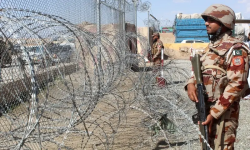
A soldier keeps watch at the Pakistan-Afghanistan border in Chaman, Balochistan on March 19. — AFP
https://whatsapp.com/channel/0029VaMc238IiRov8okfYy3n
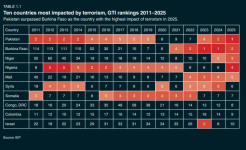
Pakistan has ranked number one on the Global Terrorism Index for the first time, recording a six per cent increase in terrorism-related deaths, 1,139, in 2025, it emerged on Sunday.

The Global Terrorism Index 2026 published by the Institute for Economics and Peace (IEP) provides a comprehensive summary of the key trends and patterns in terrorism over the last two decades.

The report ranks 163 countries (99.7pc of the world’s population) according to the impact of terrorism. The indicators include the number of terrorist incidents, fatalities, injuries and hostages.

1774180571676.png

The Global Terrorism Index. — Screengrab via report

According to the report, Pakistan’s “strained” relationship with neighbouring countries, particularly Afghanistan, and rising violence from the banned Tehreek-i-Taliban Pakistan (TTP) and the banned Balochistan Liberation Army (BLA) have created “significant security” risks for the country.

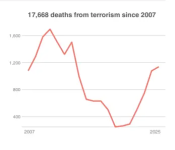
“Deaths from terrorism in Pakistan are now at their highest level since 2013, with the country recording 1,139 terrorism deaths and 1,045 incidents in 2025,” the report said.

The report noted that the TTP had emerged as the “deadliest” terror group in Pakistan and the third deadliest globally.

Infographic
 
1774180652657.png

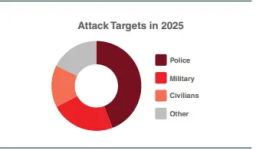
Infographic shows the targets of TTP’s attacks in 2025.— Screengrab via report.
“TTP attacks constitute over 67pc of total attacks in Pakistan since 2009, and it is responsible for five times as many attacks in Pakistan as the second most active group, the BLA,” the report said.

It added that the TTP emerged as the only group out of the four deadliest — Islamic State (IS), Jamaat Nusrat Al-Islam wal Muslimeen (JNIM), TTP, and al-Shabaab — to record an increase in the number of incidents orchestrated by in the last year.

“Incidents increased by 24pc in 2025, with 595 attacks compared to 481 attacks in 2024. All of the group’s attacks occurred in Pakistan, primarily within Khyber Pakhtunkhwa near the border with Afghanistan,” the report said.

1774180710772.png

The total deaths Pakistan has witnessed due to TTP attacks. — Screengrab via report

At least 637 deaths were attributed to the group in 2025 — the highest since 2011 and amounting to 56pc of terrorism-related deaths in the country.

It added that the largest attack carried out by the group in 2025 “was an armed attack targeting military forces, resulting in the death of 21 people”.
 
According to the report, the Afghan Taliban’s rise to power in Afghanistan had “profoundly impacted Pakistan’s security and stability”.

“It provided the TTP with the means and motivation to significantly expand their geographic reach and operational efficiency, resulting in a considerable rise in violent extremism in the region.”

The report noted that this was the “sixth consecutive year” in which Pakistan witnessed a surge in terrorism deaths. It also observed a “slight decline” in the total number of terror attacks in 2025.

However, it noted that the country recorded a spike in hostages taken in Pakistan, from 101 in 2024 to 655 in 2025.

It attributed the rise to the Jaffar Express attack, where 442 people were taken hostage, also contributing to a surge in global numbers for hostage taking.

“If this incident had not occurred, the overall number of hostages would have decreased by 30 per cent from 2024 to 2025,” the report said.

The report noted that KP and Balochistan remained the most affected by terrorism in the country, accounting for “over 74pc of terrorist attacks and 67pc of deaths in Pakistan in 2025”.
 
Globally, the report noted a “substantial fall” in terrorism, with the deaths from terrorism falling by 28pc to 5,582, and the number of attacks decreasing by nearly 22pc.

The IS and its affiliates remained the deadliest terrorist organisation in 2025, followed closely by JNIM, TTP, and Al-Shabaab.

“They were collectively responsible for 3,869 deaths, or 70pc of all terrorism fatalities,” the report said.

It added that under 70pc of the deaths from terrorism occurred in only five countries, Pakistan, Burkina Faso, Nigeria, Niger, and the Democratic Republic of Congo (DRC), adding that Sub-Saharan Africa has now become the “global epicentre of terrorism”.

The report also observed a “significant increase” in terrorism incidents in Western countries, recording an increase of 280pc totalling up to 57 deaths.

“This increase was largely driven by several mass-casualty attacks, including the New Orleans truck attack in the United States in January, and the Bondi Beach shooting in Australia in December,” it said.

The report also observed that there were several “high-profile” attacks in the West, including the “assassination of US conservative political influencer Charlie Kirk and the killing of two Israeli Embassy staff members in Washington, DC”.

Last year, Pakistan ranked second in the Global Terrorism Index 2025, with the number of deaths in terrorist attacks rising by 45pc over the past year to 1,081.
 

Users who are viewing this thread

Latest Posts

Back
Top