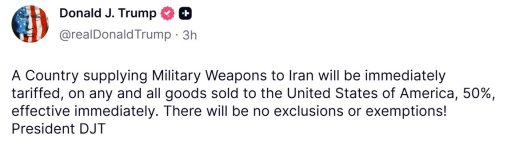
As I said Iran has to understand what he's trying to cover that forces his hand!
Everything is financial. The oil prices will instantly hit $120 and bond yields that have dropped 25-30 basis points will climb instantly.
There is systemic risk to his bluster and he knows it... he made his casino deal knowing he was broke but played the banks and investors into backing his project that still went bankrupt.
He's fishing... reading the room.
Operation Sindoor 2.0 on 'Pause' by
India Phraand Dolun Thrump!
Almost three weeks.. I should say Iran is still standing. The
Millet e Iran that is. Coconuts caved in rather too quickly. As expected.
Curse of Browns = Coconuts.
Who called Uncle first?
Without a doubt the one who was Screaming everyday.. in fever for attention.
India Phraand became
Surrendera Thrump! Birds of a Feather.
There is NO CeaseFire. Smoke Screen. ONly a fool or a coconut will fall for it.
Now that
Inertia is Broken and everything is Open, in a Flex.. so many more
Events are Ready to spring forth...
Things must Fundamentally chance otherwise... Nothing has happened. Won't you say?
In this
Third Actor Dynamics Flux must Give way to Form...
New Form must jell and then become Solid State. Otherwise, all for naught.. selling Iran by the
Bazari is not new. So I fear the obvious.
Can the US bomb Iran to Stone Age without a very, very steep Price? No.
Can the US nuke Iran? Yes. But then even a
Bigger Inertia will be Broken.
Victory?
For the US to have a Sell-able Narrative and keep the GCC under its thumb.
For Iran to be
Free to be a
Sovereign.
Truly Sovereign. Straits Officially under the belt.
This not the place.. but I would say though... it has been a Very Long Time/Path for Iran to seek Sovereignty. Iran has been not be such for at least past 1 and half century.
The War of Iranian Independence is NOT over yet. It might become like our War of Independence... which we lost and became Eternal Coolies.
Anyhow, the name the
Game is Consolidation now
in the Third Actor Dynamics.
Does Iran possess a Foresight and Depth of Understanding to Seize the Moment?
Or will it be happy that its coconuts can get a belly rub and keep fetching the fxxxing ball?
Who knows.. the Iranians start buying downtown properties now ..Openly that is.
Or will Iran remain
Alive to the Momentum of History and finally become the
First Brown Nation to become Truly Sovereign?
The GCC now has to understand that the Third Actor Dynamics are more vitalised than before and a
New Security n Economic Framework needs to be worked out... relying on the Empire is a Mirage.. but then desert does like its mirages.. or is it the Djins?
Pitty for India that it could not join the war with the US and its allies... by attacking Pakistan...
Doing the same false-flag thing might not be that valuable now that the
Inertia is Broken for good.
Oman doesn't want money from the Stratis.. noble of them!
Iran must now Collect all of it.
The One/Ones who can bring fore a Solid Security n Economic Architecture that encompasses all of West Asia and includes Pakistan and Turkiye .. in it as integral parts.. will emerge as a
Pole of Great Significance in the Emerging World Order.
Flux. Flux. Flux.
To the Bold the Fortunes!
Mun Khorsid um.
Mun Jamshid um.
Mun Se Kishwar um.
Mun Noor e Jahan um.