Imagery Update: Construction is Ongoing at the Natanz Tunnel Facility
by David Albright, Sarah Burkhard, Spencer Faragasso, and the Good ISIS Team
March 25, 2024
 Download PDF
ISIS is a non-profit, non-partisan institution providing public knowledge of nuclear proliferation and international security.

isis-online.org
This report is an imagery update from earlier reports on the construction of a new Iranian centrifuge assembly facility, to be buried deep under Kolang Gaz La mountain, located south of the Natanz Fuel Enrichment Plant. Commercial satellite imagery acquired over the last year and a half shows that three years after excavation commenced for the new tunnel facility in the fall of 2020, construction is still ongoing. While the four tunnel entrances were largely complete as of October 2022, the main Western tunnel entrance continued to be strengthened and reinforced, and security structures were added around the site, signs of continuous efforts by Iran to increase the hardness and survivability of the site. The modest, but continuous growth in the large spoil piles located near the Western and Eastern tunnel entrances throughout 2023 indicates that while initial tunneling is complete, construction inside the tunnel complex, likely related to the finishing of the underground rooms, is ongoing. Recent images from September 2023 and January 2024 still show frequent vehicular movement, particularly the movement of dump trucks and other heavy machinery along the Western and Eastern spoil piles. Further, recent imagery still shows no visible external signs of heating, cooling, and ventilation installed at the site that would indicate an advanced stage of construction. The slower-than-expected pace of construction makes it unclear when the facility will actually become operational, but it may not become fully operational in 2024. Given that this facility replaces an above-ground facility at Natanz destroyed in the summer of 2021, Iran’s original goal of quickly replacing this destroyed facility has failed. There is no new information clarifying concerns about whether Iran will also build a gas centrifuge facility under this mountain, in essence deploying many of the assembled advanced centrifuges in an adjacent underground room. Iran’s refusal to fulfill the obligations under modified Code 3.1 of its comprehensive safeguards agreement (CSA) to declare new nuclear facilities such as uranium enrichment plants in the design phase, and continued lack of full cooperation with the International Atomic Energy Agency (IAEA), complicates addressing this concern.
Construction Progress at Mt. Kolang Gaz La Complex
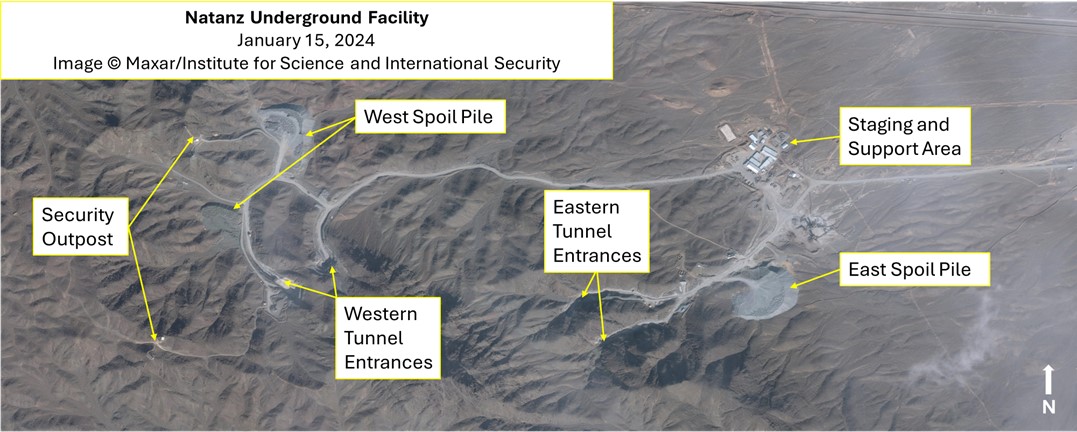
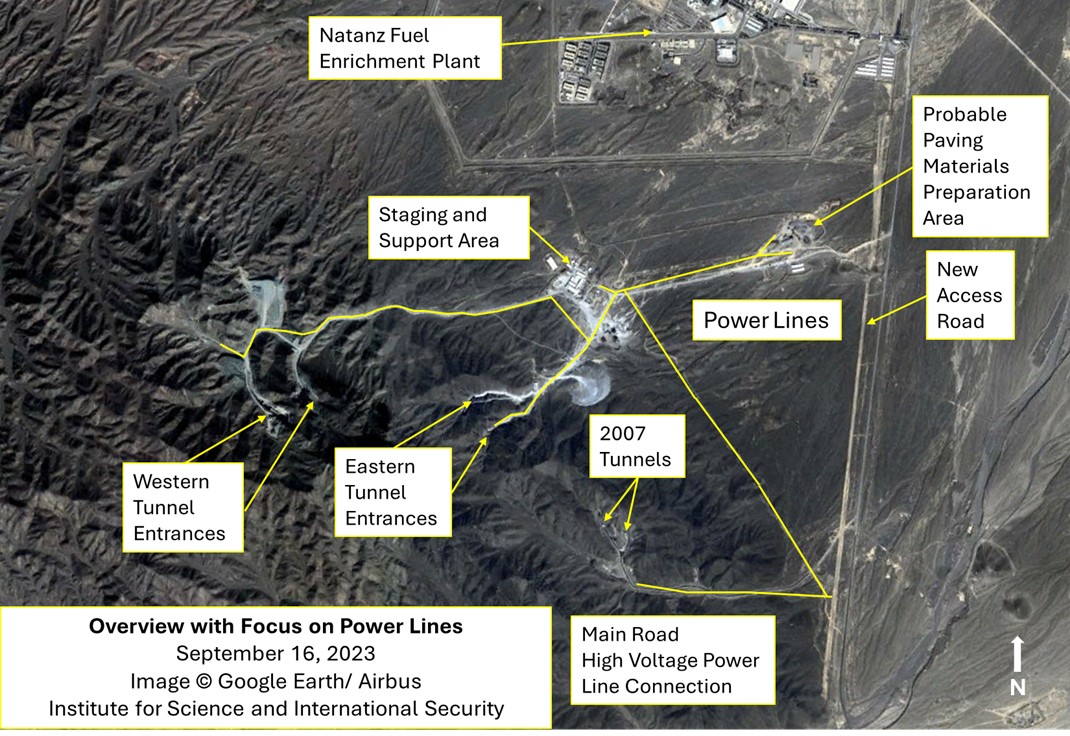
Satellite imagery taken between October 25, 2022 and January 15, 2024, indicates continued construction and excavation activities at the tunnel complex under Mt. Kolang Gaz La, where Kolang translates to “pickaxe”. The site is slated to hold a new, large, advanced centrifuge assembly facility that replaces the Iranian Centrifuge Assembly Center (ICAC) destroyed in an attack in July 2020. Iran is apparently determined to make the new facility harder to destroy. In fact, the tunnel complex is more deeply buried than the Fordow underground enrichment plant, with more entrances and no apparent ventilation shaft, making it harder to destroy than Fordow and certainly harder than a surface facility. Figure 1 provides an overview of the complex.
Figure 1. A January 2024 overview of the tunnel complex under construction just south of the Natanz Fuel Enrichment Plant.
The Institute last assessed in November 2022 that the four tunnel entrances had been completed.
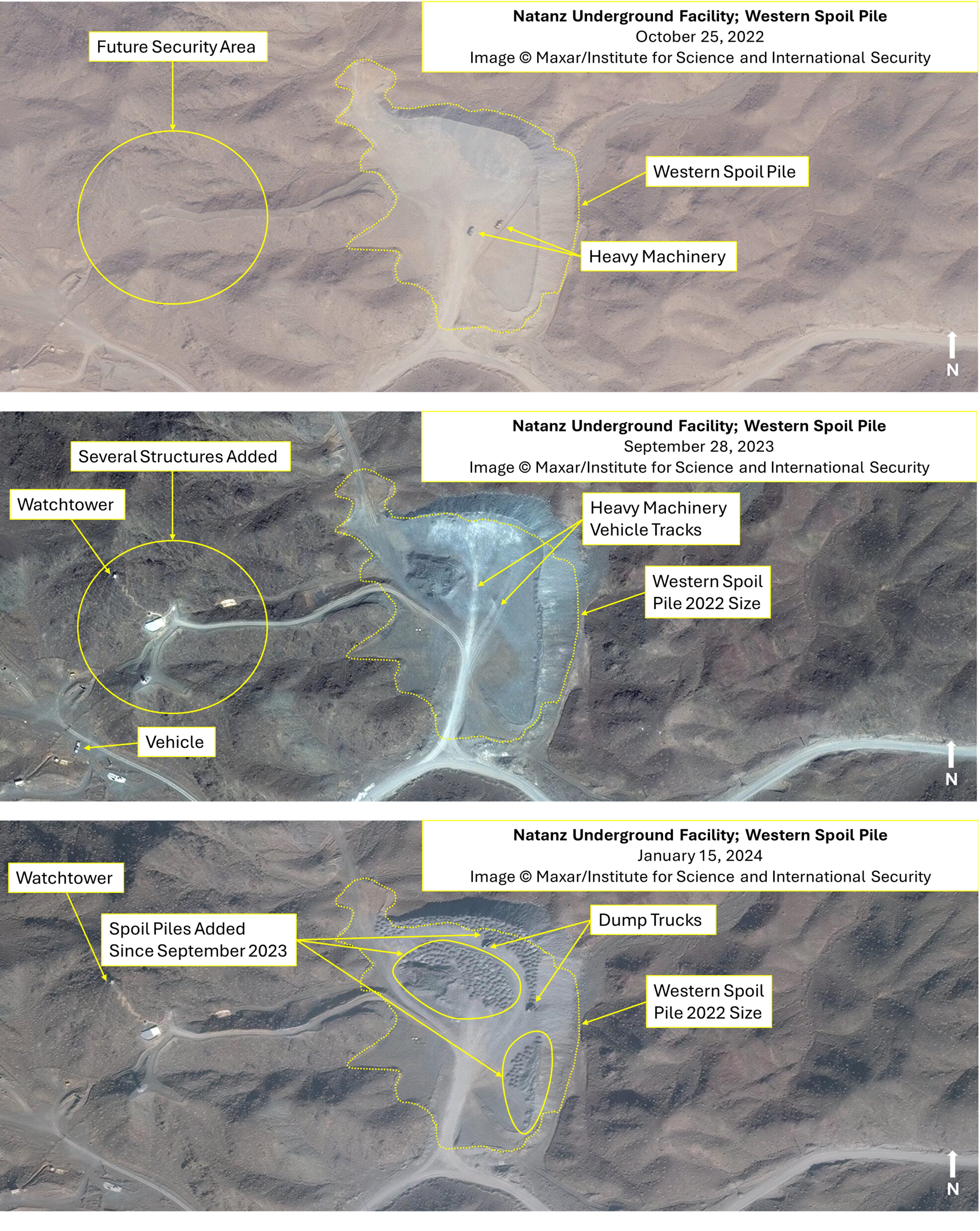
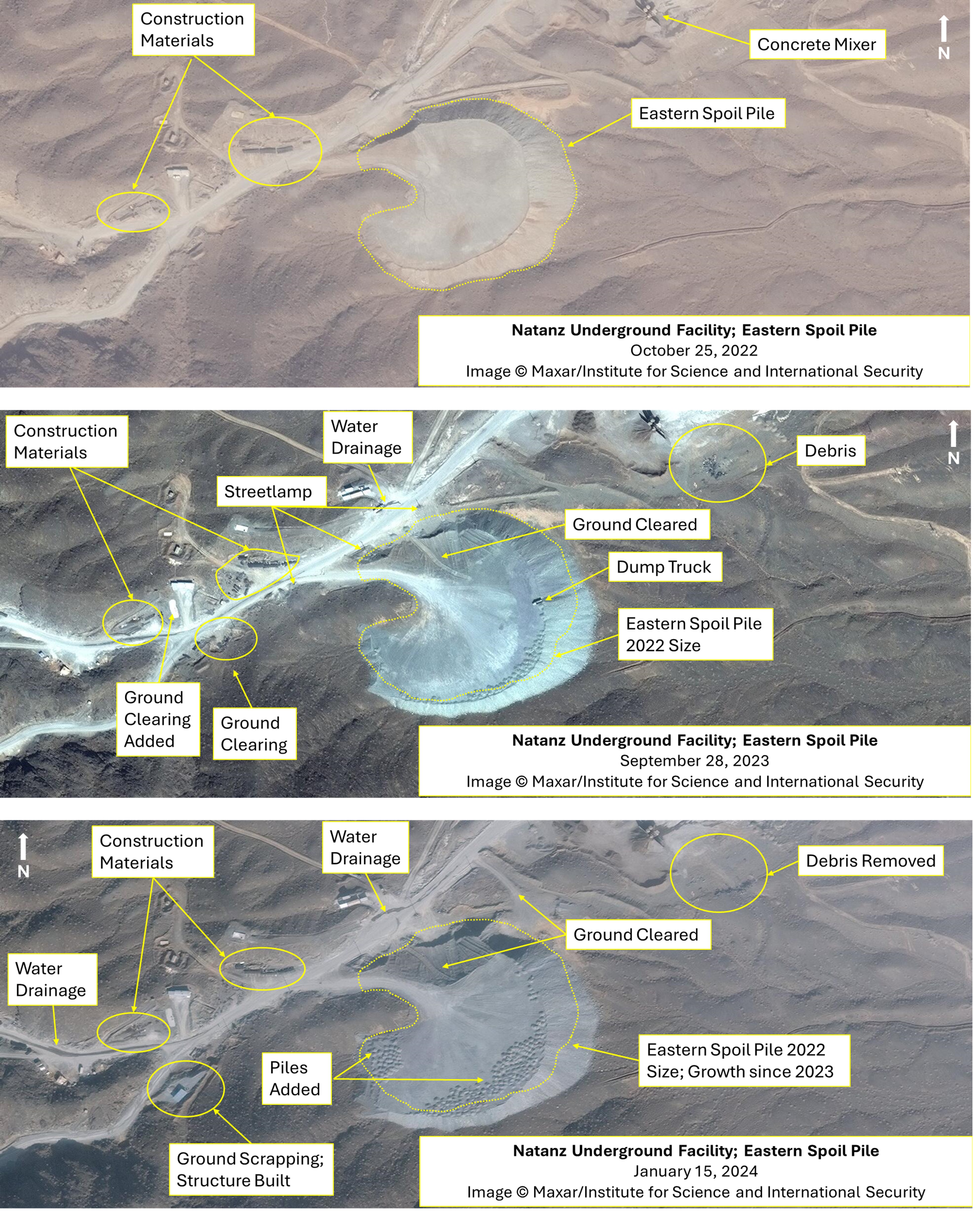
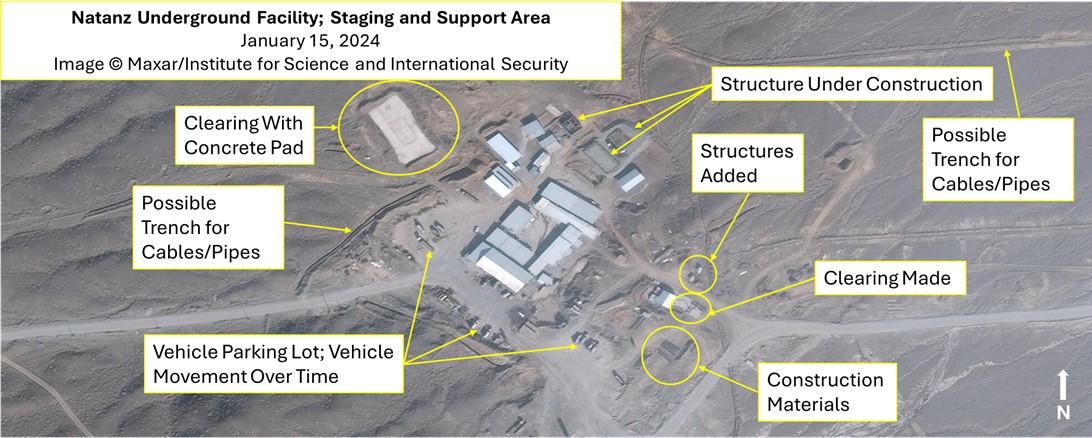
1 The latest imagery from January 2024 shows signs of continued excavation at the site, likely related to the finishing of the underground rooms inside the tunnel complex. Images taken from October 2022, September 2023, and January 2024, show that the large nearby spoil piles near the Western and Eastern tunnel entrances have expanded and there is additional construction activity nearby at the staging and support area (see Figures 2, 3, and 4).
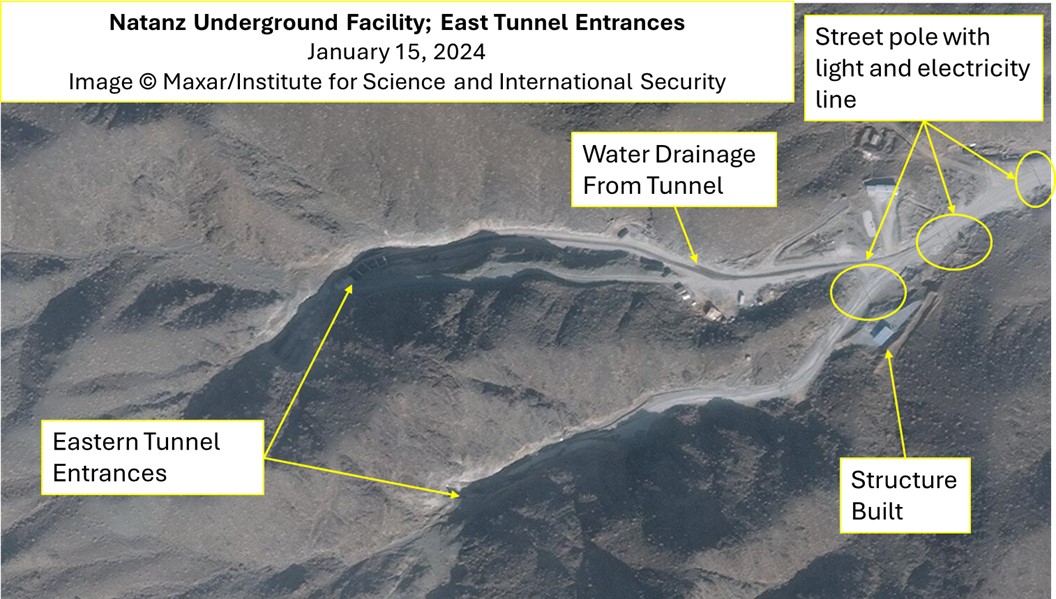
Other signs of continued construction exist. Around both the Western and Eastern tunnel entrances and spoil piles there are visible tire tracks as well as vehicles that can be seen moving periodically. The vehicles appear to be trucks and other heavy machinery, like bulldozers, used to move and haul debris, construction materials, and equipment. The number of vehicles parked at the staging and construction support area between the Eastern and Western tunnel entrances changes frequently. Several new buildings, structures, and clearings have also appeared at the staging and support area (see Figure 4). Images from October 2022 and into January 2024 show construction materials positioned along the road leading to the Eastern tunnel entrances. A January 15, 2024, image shows additional clearings and ground scraping near the Eastern tunnel entrances, where small structures were built (see Figure 5).
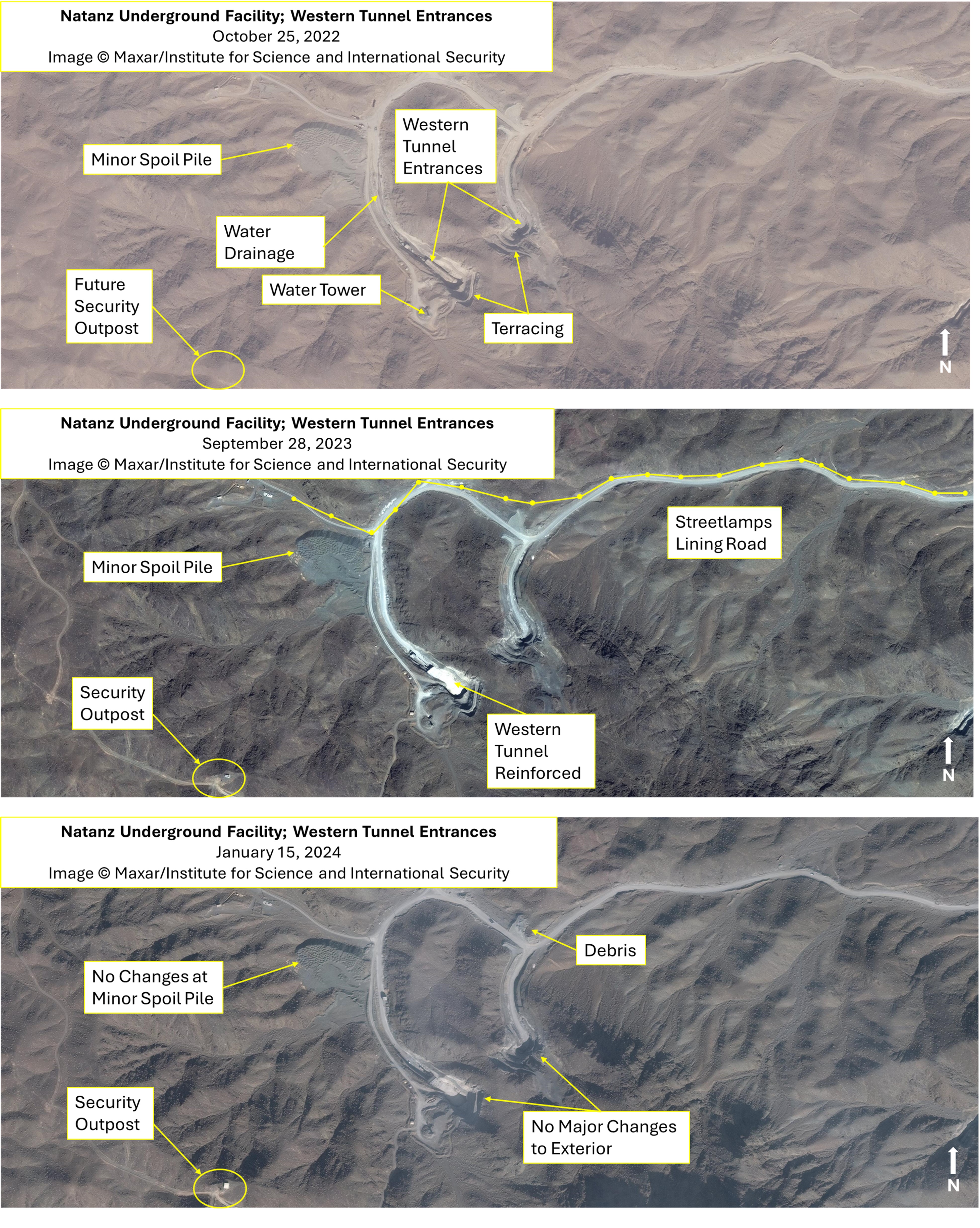
Images taken between October 2022 and January 2024 show water drainage coming from both the Western and Eastern tunnel entrances (see Figure 5 and 6). It is unclear what the source of the water is, perhaps a byproduct of the construction process, but most likely from natural ground water. Earlier in the tunnel excavation process, water outflow was frequently detected from the secondary eastern tunnel; this earlier outflow was assessed to be likely an unexpected and possibly ongoing challenge encountered during excavation.
Visible efforts have been made to reinforce and strengthen the main Western tunnel entrance, otherwise the tunnel entrances themselves are largely unchanged. A large part of the Western tunnel entrance extension has now been covered, possibly with soil or concrete, in order to reinforce it and provide additional protection to enhance the entrance’s survivability (see Figure 6). The same is expected for the main Eastern tunnel entrance extension.
Two security outposts were added near the Western tunnel entrances. A highland security monitoring station and a watch tower were constructed roughly 450 meters southwest from the main Western tunnel entrance (see Figure 6). Construction on the security area began in May 2023 and finished around early August 2023. Another security outpost was constructed northeast of the Western tunnel entrances, near the Western spoil piles.
Poles can be seen dotting the roads leading in the direction of the Eastern and Western tunnel entrances (see Figures 6 and 7). These poles serve a dual purpose as holding streetlamps as well as a transformer and the electrical line. The power line can be traced back to the main road leading to the Natanz enrichment plant, and appears to serve the tunnel complex built in 2007, and a newly built, likely production plant for paving materials (see Figure 7). Further, a wide, newly graded access road running parallel to the main road can be seen, connecting the 2007 tunnel and the Mt. Kolang Gaz La complex, and extending further north towards the Natanz enrichment plant.
The new paving material production plant, built in addition to the existing concrete batch plant near the staging and support area, could be an indication of a transition from tunnel construction to equipment installation. Once the tunneling work is complete, the need for less dusty conditions (with vehicles traveling in and out of the tunnels) will become increasingly important. The equipment needs to be kept clean and the air handling/filtering systems do not work well in dusty conditions either. Thus, asphalt and/or concrete road surfaces will likely be installed throughout the complex.
To date, there is no visible sign of ventilation and external cooling equipment, but it is expected to be installed at some point, where the need for ventilation is especially high for a centrifuge assembly facility, as it would include a clean room. There is no visible sign of a utility services building, similar to what is found just near the tunnels at the Fordow Fuel Enrichment Plant. It is also unclear whether the facility will have a ventilation shaft for vertical ventilation; both Iran’s Fordow and Iran’s Boroujerdi tunnel facility have visible ventilation shafts near their mountain peak, but Iran may have found a different way of ventilating the facility or a way to camouflage the shaft. Further, no visible evidence can be seen for the installation of additional electrical lines or piping leading into the tunnel entrances.
Refusal to Implement Modified Code 3.1
A January 2022 Institute analysis found that the new complex will likely be more deeply buried than the Fordow enrichment plant and have significantly more floor space, raising questions about other sensitive nuclear activities at the site, most worrisome, enrichment activities. In particular, will this site house a gas centrifuge facility?
2 Under the subsidiary arrangements to Iran’s comprehensive safeguards agreement (CSA), modified Code 3.1 requires Iran to provide the IAEA with notification and early design information when it has taken a decision to build a new nuclear facility or authorize its construction. However, in February 2021, Iran notified the IAEA that Iran will no longer abide by the code.
3 The IAEA is increasingly confronting Iran about its non-compliance with modified Code 3.1, as Iran has begun the construction of new nuclear power reactors without providing the IAEA the appropriate notification and design information.
4 Iran’s blatant refusal to comply with this obligation complicates efforts to determine if the Kolang Gaz La site will hold an advanced centrifuge enrichment plant.