Misc. Bookmarked Posts

I think everyone is forgetting just how much assistance India's space program received from the West, especially the USA. The US basically declassified the Atlas program for ISRO - India's space program has always run ahead of its missile program thanks to US assistance - especially in technical training, education exchange, providing equipment, satellite building and commercial contracts for satellite launch...

In the nuclear arena India similarly benefited from what was basically a transfer of Candu reactor technology (with US blessing) to allow an indigenous build program, plus a CIA outfit Vitro International provided India with the technical plans and equipment for a complete reprocessing plant! It's actually astonishing that France provided a copy of its Rapsodie breeder reactor to India way back in 1985. China didn't get that technology from Russia until 2010.

Pakistan's nuclear program is only *just now* entering a mature phase, the Chashma reprocessing plant probably isn't even fully operational. Sure Pakistan has received assistance too. Given that Kanupp was the only reactor that Canadian General Electric ever built, it was probably a CIA outfit too, and France/Belgium gave pakistan limited reprocessing technology.

But Pakistans space program will continue to rely on China, the UAE and Turkey - especially in satellite building. The problem with Suparco right now is that it has nothing to launch.


Probably nothing until 2035. I still think the first PakSLV will be a modified Shaheen-III - like China's Ceres-1B

Ceres-1.jpeg
 

Modified duplicated KANUPP SMR One 100 Mwe or  300 MWth

KANUPP SMR Two 70 Mwe or  200 MWth


I know they were looking in to an indigenous version of Kanupp-1, as an SMR, but this good idea seems to have gone nowhere in favour of Integral PWR designs


Not sure how possible it will be to duplicate CNP-300. You would need heavy forgings to build the RPV, something Pakistan does not have.

The EPR and VVER-TOI seem to be the safest PWR's. India's IPHWR-700 is basically a reliable CANDU. South Korea's APR1400 is safer and has more reduncancy than the AP1000 which is a disaster waiting to happen. Hope Pakistan and Turkey avoid AP1000/CAP1400 like the plague. Pakistan should just stick with Hualong-1 and then transition to breeders (including thorium breeder reactors)
Here found it:


To this end, by March 2022, six power plants (four at Chashma and two at Karachi) have begun contributing around 3500 MW of base load electricity to national grid. To meet future targets, preliminary work planning is under way for C-5 project (1100 MW), Chashma Engineering Complex (Fuel Fabrication Plant) and Indigenous Nuclear Power Plant (340 MW).


PAKISTAN ATOMIC ENERGY COMMISSION

- Pakistan Research Reactor-3 (PARR-3)
(10MWth upgradable to 20 MWth)


S U P A R C O

- Pakistan Multi-Mission
Communication Satellite System
(PakSat-MM1)

- Feasibility and System Definition
Study (FSDS) of Pakistan
Communication Satellite - 2
(PakSat-2)

- Establishment of Pakistan Space
Centre (PSC)

- Pakistan Optical Remote Sensing
Satellite (PRSS-O2)

All old ongoing projects. Spaceport seems to have been dropped for the time being as well.
 
The PAEC is all set to expand the footprint of nuclear energy as it has prepared plans to set up two new power plants — K-4 and K-5 — of 1,400MW each in Karachi, while two nuclear plants — M-1 and M-2 — of 1,400MW each are planned in Muzaffargarh, Punjab.

What model are these future 1400 MW reactors? CAP1400 or Hualong Two? The CAP1400 is based on the CAP1000 which is based on Westinghouse's AP1000 and is inherently unsafe. I hope both China and Pakistan do not employ this reactor without design changes to containment and the steel liner.
 
PAKISTAN ATOMIC ENERGY COMMISSION

Ongoing: Pakistan Research Reactor-3
(10MWth upgradable to 20 MWth)

New: LEU Based Mo-99 Production
Facility (MPF)

S U P A R C O

Ongoing: Establishment of Pakistan Space
Center (PSC)

Ongoing: Feasibility and System Definition
Study (FSDS) of Pakistan Remote
Sensing Synthetic Aperture Radar
Satellite System (PRSS-S1)

Ongoing: Feasibility and System Definition
Study (FSDS) of Pakistan Satellite
Navigation Program (PSNP)

Ongoing: Feasibility and System Definition
Study (FSDS) of Spaceport

Ongoing: Pakistan Optical Remote Sensing
Satellite (PRSS-O2)

New: Feasibility and System Definition
Study (FSDS) of Pakistan
Communication Satellite - 2
(PakSat-2)


Tel Aviv [Israel], September 18 (ANI): All-weather allies Pakistan and China signed a new nuclear agreement that will push the world towards a renewed nuclear race and conflict.

Fabien Baussart, in a blog post in The Times of Israel, said that it is a dangerous new nuclear pact.

The Framework Agreement on Deepening Nuclear Energy Cooperation was signed by Pakistan Atomic Energy Commission (PAEC) and China Zhongyuan Engineering Cooperation on September 8, 2021.


The agreement, finalised at a high-level meeting on August 20, 2021, was signed through virtual mode and would remain valid for ten years, reported The Times of Israel.

The agreement envisages the transfer of nuclear technology, uranium mining and processing, nuclear fuel supply and setting up research reactors, which will help Pakistan increase its nuclear weapons stockpile.

For China, an enhanced Pak nuclear arsenal adds teeth to its grand strategy of countering India's military strength, said Baussart.

Although the 2021 agreement envisages cooperation in construction, maintenance and waste management of nuclear power reactors, the likelihood of diversion of technology and material for reprocessing facilities meant for producing nuclear warhead material remains dangerously high, if past experience of Pakistan's illegal nuclear trade and diversion is to be taken into account, reported The Times of Israel.

These suspicions are strengthened by the agreement's sweeping scope and content.

The main thrust of the agreement is comprehensive cooperation on the construction and maintenance of all future nuclear power projects in Pakistan.

Four new plants are on the anvil-two to be located at Karachi (K-4/K-5) and two at Muzaffargarh (M-1/M-2). These plants will be constructed under the Engineering Procurement and Construction Mode by adopting Chinese Hualong One Pressurize Water Reaction (HPR)-100 technology.

The site for M-1 and M-2 plants has already been finalised on the banks of Taunsa-Panjnad link canal in Tehsil Kot Addu, about 32 km from Muzaffargarh in Punjab, reported The Times of Israel.

As per the agreement, besides the construction of these four plants, China will strengthen its involvement in operating and maintaining all nuclear power plants in Pakistan, including refuelling outages, technical up-gradation and spare parts. Supplementary agreements to augment the main agreement are to be signed in the near future.

Five significant components of the agreement which offers Pakistan unprecedented access to China's nuclear capability in terms of technology, material and training are - a) Exploration and mining of uranium and training of personnel; b) Lifetime nuclear fuel supply and supply of initial refuelling fuel assemblies and associated core components; c) setting up of miniature neutron source reactor ; d) Radioactive management resources and assistance, including decommissioning of nuclear facilities, radioactive waste transport and disposal and radiation protection measures and; e) Nuclear technology application, including nuclear medicine, irradiation processing, radiopharmaceuticals, radioactive sources supply and manpower training, reported The Times of Israel.

The China-Pakistan nuclear cooperation dates back to 1986. China over the years has utilised official agreements to supply Pakistan with technology and material for nuclear warheads.

The September 2021 agreement substantially expands this cooperation with China helping strengthen Pakistan's nuclear industry chain by setting up additional plants, aiding uranium exploration, supply of nuclear fuel, nuclear waste management and nuclear technology applications, said Baussart. (ANI)
 
@RescueRanger to the rescue bro, nice one.
Anytime, i've tried to move the best ones from Pak Army/Airforce and Navy archive too. But there is too much to save. I've moved some of Gary's good posts here too in the Military History thread too.

The rest will be up to members here to InshaALLAH, add new threads with quality information.
 
Anytime, i've tried to move the best ones from Pak Army/Airforce and Navy archive too. But there is too much to save. I've moved some of Gary's good posts here too in the Military History thread too.

The rest will be up to members here to InshaALLAH, add new threads with quality information.

Thank you so much for your efforts brother.
 
PakSAT-MM1R - (replacement for PakSAT-MM1) is due to be launched in 2024

Feasibility studies and funding/contracts for for PRSS-O2 were approved in the last PSDP - I expect it will have to be launched around 2023/2024 as PRSS-1 has a 7 year life. It will probably be launched with PakTES-1B.

No idea about PRSS-S-1. Even Turkey hasn't launched it's SAR satellite Gokturk-3 yet.

PNSS-1 and PSNP always seemed like longer term projects.

iCube-2 is the sort of thing you might launch as a dummy satellite for your first, second or third SLV attempt after mastering stage separation and orbital insertion.
 
  • Like
Reactions: Waz
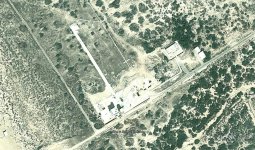
A large launch pad appears to be being constructed at the National Development Complex. You can see it on GoogleEarth.

33°37'56.25"N 72°41'55.62"E

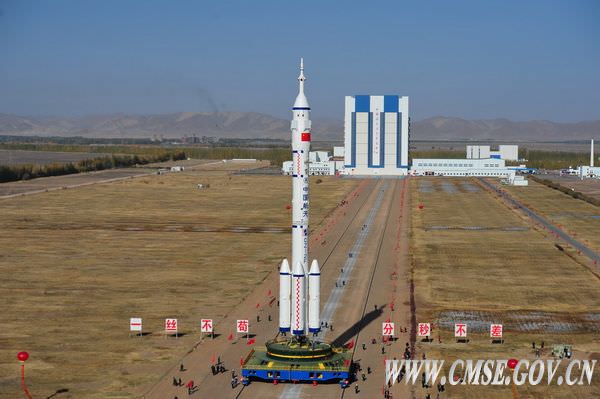
Construction appears after 2005 and is likely too large for the Shaheen II. The rails transport the launch vehicle into position similar to this one in China...

201110271147123011.jpg


Looks like this one might be for testing...it would make more sense to build the launch pad near the coast.
It is not a Launch Pad but rather a rocker sled used for testing missiles etc. Very few countries in the world have this faclity.

Rocket sleds are used to accelerate equipment considered too experimental (hazardous) for testing directly in piloted aircraft. The equipment to be tested under high acceleration or high airspeed conditions is installed along with appropriate instrumentation, data recording and telemetry equipment on the sled. The sled is then accelerated according to the experiment's design requirements for data collection along a length of isolated, precisely level and straight test track.
 
Actually, according to my sources that I cannot reveal, the Shaheen III/SLV is a 3 stage missile with VERY similar dimensions and a range comparable to India's Agni V. A new larger first stage booster has been in development for quite some time.
 
A long range SLV or long range missile launch pad seems to be now externally complete at the Sonmiani Bay Launch facilty. Looks to be for a solid fuel SLV/missile as no flame trenches or fuel tanks are visible. Construction started in 2003.

Google Earth coordinates 25°11'59.03"N 66°44'21.28"E
Agreed, since the facility has been there since the 70s-80s. The alleged launch pad was being constructed in early 2000s, but then construction work stalled, and it seems to be resumed in 2012 (according to historical images).

Irrespective of the topic at hand, it is actually a pretty good source. Here is the snapshot of this place (SUPARCO's Rocket testing range):
1704061287052.jpeg
 

Users who are viewing this thread

Back
Top