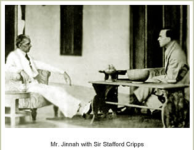
Muhammad Ali Jinnah - The Great Leader

1758655770184.png


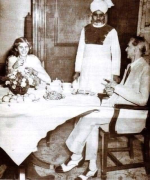
It was during Jinnah's stay in Ziarat that Dr. Colonel Elahi Bakhsh asked Fatima Jinnah: "How can I persuade your brother to eat something? Tell me about a food he particularly likes." Fatima Jinnah said that there used to be a cook in Bombay who used to prepare some such dishes that my brother used to eat with great pleasure, but after the creation of Pakistan, that cook went somewhere.

She remembered that he was a resident of Lyallpur (present Faisalabad) and said that perhaps some information about him could be found there.

Hearing this, the doctor requested the Punjab government to find this cook and send him for a visit immediately. Somehow or the other, the cook was found and he was sent for a visit immediately, but Jinnah was not informed about his arrival.
He expressed surprise on seeing his favorite dishes on the dining table and happily ate a lot of food.

Jinnah inquired who had prepared these dishes today, to which his sister said that the Punjab government had found our Bombay cook and sent him here and he had prepared the food of his choice.

Jinnah asked his sister who had borne the cost of finding this cook and sending him here. He said that the Punjab government had done this feat. Yes, no one else spent it.

Then Jinnah called for the file related to the cook and wrote on it that ‘It is not the job of any government agency to provide the cook and food of the Governor General’s choice. The details of the expenditure should be prepared so that I can pay it from my own pocket’ and then this happened!!”

Excerpt from the special report “The Last 60 Days of the Quaid-e-Azam’s Life”.
BBC Urdu
 
1758741091491.png


11 August – National Minorities Day in Pakistan

Let us reflect through the mirror of the past

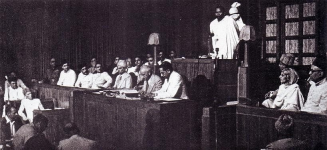
On 11th August 1947, Jogendranath Mandal presided over the first session of Pakistan’s Constituent Assembly in Karachi. A prominent Dalit leader and one of the founding figures of the new nation, he played a crucial role in shaping its early legal and political framework.

When the Muslim League joined the Interim Government of India in October 1946, Muhammad Ali Jinnah nominated Mandal as one of its representatives, assigning him the law portfolio. He later became Pakistan’s first Minister for Law and Labour.

But what went so wrong that he chose to leave Pakistan and return to India in 1950?

In his resignation letter, Mandal described the deteriorating conditions faced by the small Hindu minority left in Karachi—then the capital of Pakistan—as deplorable. He recounted the widespread appropriation of Hindu temples and gurdwaras by Muslims, many of which were converted into cobbler shops, slaughterhouses, and hotels.

Mandal expressed harsh words, holding Liaquat Ali Khan's Government responsible for inaction, failure to uphold secular values, and inability (or unwillingness) to protect minorities.
Courtesy Sohail Ansari
 
1758742135898.png

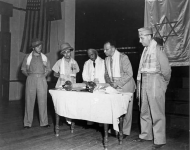
At the Passover (Pesach) in Karachi - 1942.

A Jewish festival commemorating the Israelites' liberation from slavery in ancient Egypt. The holiday lasts seven or eight days and commences with (includes) a special Seder meal.
 
1616605722537.png


Mr Jinnah attend the marriage of Mr N H Faruqi and Maryam Jaffer in New Delhi, 6 April 1947


Standing L to R: 1. Mohammad Ali Maniar, 2. Khwaja Hasan Nizami 3. Saeed Ahmad Siddiqui 4. Haroon E. H. Jaffer 5. Essa E. H. Jaffer 7. Mr. S. Ghani 8. Syed Azizul Hasan 9. Aziz Ahmad Siddiqui 10. Badruddin Hasan Faruqi 11. Mr. Mohammad Mustafa 12. Aziz Ahmad (Khalish) Siddiqui 13. Raza Habib Rizvi 14. Khalil Ahmad Siddiqui 15.Ahmad E. H. Jaffer 16. Rafiq Ahmad 17. Neena Ismail Jaffer 18.Ismail E. H. Jaffer 19.Mushtaq Ahmad 20.Habib Ahmad Rizvi

Sitting L to R: 1. Sardar Abdur Rab Nishtar 2. I. I. Chundrigar 3. Begum Ra'ana Liaquat Ali Khan 4. Quaid-e- Azam Mohammad Ali Jinnah 5. Nooruddin Hasan Faruqi 6. Liaquat Ali Khan 7. Fatima Jinnah 8. Raja Ghazanfar Ali Khan 9. Hussain Imam 10. Wahab A. Jaffer (in Hussain Imam's lap)

Ground L to R: 1. Shafa'at Habib Rizvi 2. Nusrat Rizvi 3. Kader A. Jaffer 4. Javed Siddiqui 5. Razzak Essa Jaffer 6. Saadat Rizvi 7. Rafat Habib 8. Mazhar Rizvi
 
1616711970224.png


An early depiction of the All-India Muslim League members across the Subcontinent.
 
Quaid e Azam arriving for the adoption of Pakistan Resolution March 23, 1940


1618514156361.png


...................
 
Quaid-e-Azam & Fatima Jinnah arrives to a reception at Karachi, Pakistan, with Liaquat Ali Khan,
I.I. Chundrigar, Ghulam Muhammad (later became the Governor General), Agha Shahi, and Jamshed Mehta.

Date: 1st July 1948


1618526042751.png
 
Pakistan's First Cabinet

1620168292874.png


From left: Fazlur Rehman, Ghulam Muhammad, Liaquat Ali Khan, M A Jinnah, I I Chundrigar, Abdul Rab Nishtar and Abdul Sattar Pirzada
 
Quaid E Azam Jinnah Ali Lyallpur (Faisalabad) Dhobi Ghat.


1623001375061.png
 
Quaid-e-Azam with Liaquat Ali Khan, Allama Mashraqi. Barrister Mian Ahmed Shah and Sir Ziauddin Ahmed.


1623002112441.png
 
Quaid-e-Azam M.A. Jinnah with the Ahmedabad Municipal Committee, 1941.

1623003976838.png
 
A view of the funeral procession of the Quaid.
Date 12 Sept. 1948


1623715544442.png
 
Father of the nation and the first governor of Pakistan, General Quaid-e-Azam Muhammad Ali Jinnah.


1631324556921.png
 
Quaid-e-Azam Muhammad Ali Jinnah With Mohammad Abdul Latif, Pir Sahib Zakori Sharif At Dera Ismail khan In April 1948.


1607629934057.png


Pir Abdul Latif Zakori (1914 - 1978)

Pir Sahib Zakori Sharif played a leading role in the 1945 NWFP Assembly elections and was instrumental in securing 17 seats for the Provincial Muslim League; himself returning from Lakki Marwat, Bannu District constituency.

During the crucial phase of Pakistan Movement he faced bravely a lot of hardships and imprisonment on many occasions. During the \'Civil Disobedience Movement\' he hoisted the Pakistan Muslim League flag after removing the Union Jack from the Deputy Commissioner's House in Bannu and was arrested soon after leading a procession against the British Rule. The arrest of Pir Sahib turned into a great public uproar and a large number of his followers turned up for voluntary arrest which almost filled the entire jails of NWFP; resultantly temporary prison houses had to be arranged at Serai Naurang, Bannu, and other places to lodge the protestors.

On his release on June 3,1947 he preceded to New Delhi on the special invitation of Quaid-e-Azam to participate in the All India Muslim League Council meeting at Imperial Hotel. He delivered there an impressive and forceful speech. Quaid-e-Azam had a great faith in Pir Sahibs political acumen and sagacity and reposed a great confidence in him to turn the forthcoming \'Referendum\' in NWFP a success.

Pir Sahib Zakori Sharif did, indeed, come to the high expectations of the Quaid and worked so tirelessly for the NWFP Referendum that the Quaid-e-Azam addressed him as \"Fateh Referendum\".

He was one of those luminaries of the Pakistan Movement who laid the foundation of Muslim League in NWFP and nullified the hold of all India Congress and other Anti-Pakistan forces in the Province. He remained a member of the NWFP Assembly from 1945 to 1950.

He died on February 2,1978 depriving the Country of a great freedom fighter and leaving millions of his followers to mourn his death.

To commemorate the Pioneers of Freedom (Series) Pakistan Postal Services Corporation is issuing a set of three commemorative postage stamps of Re. 1/- denomination on August 14,1993.
 

Users who are viewing this thread

Country Watch Latest

Latest Posts

Back
Top