Pakistan Automobile Industries

Auto industry’s comeback looks different


BR Research
December 16, 2025

There is a recovery underway in Pakistan’s auto market which is fully visible in the five-month sales data for FY26. Such a recovery looks very different from that existed at the industry’s last peak. Total passenger cars, SUVs and LCVs sold in 5MFY26 were close to 75,000 units, up 47 percent from last year, a significant jump for the industry. But these volumes are still at least a third below the market’s historic peak. That peak year was just four years ago in FY22 when the market looked credibly different from what it looks today.
For one, new launches had just come to market. Hyundai was only one year into the launchof its models Elantra, Sonatra, Tucson and Porterin FY22 but already mopping up 4 percent of the market. Changan was launching its first cross over SUV Oshan after Alsvin started selling a year before and Kia had already launched Stonic. Haval was still making just rickshaws (though it was bringing Haval Jolion CBUs as early as 2021).
 
The recovery is across the board, some performing better than others. For instance, passenger car demand has improved (up 43%) but this recovery seems uneven. Volumes are well below peak levels, particularly in the mid and upper sedan segments. While Honda and Toyota have posted strong year on year gains, current volumes don’t match their previous market performance. The question is: are sedans still the backbone of the market that they once were?

In 5MFY26, more than half of the passenger car market (56%) is dominated by Suzuki’s hatchbacks while 26 percent and 15 percent are Toyota’s Corolla+Yaris and Honda’s City+Civic sedans respectively. The rest—2 percent—belong to Hyundai’s Elantra and Sonatra. While the passenger car market did not look too dramatically differentfrom this before, as Suzuki always dominated the market, the difference here is not only that legacy companies have shared some of their demand with new entrants, sedans have shared a fair portion of its demand with SUVs with people modelling up due to greater options.

At the lower end, legacy models like Mehra and Bolan redirected demand to Alto which has absorbed much of the small-car segment, operating close to its historic peak as Every took over the space vacated by Bolan. Affordability constraints and lack of options at this level haveensured Suzuki continues to drive market volumes, if not the bottom-line.

Competition has started spicing up the market, which could forcecompanies to offer financing deals and more attractive bells and whistles, there is still no visible price competition. Both Hyundai and Haval now command a meaningful slice of the industry volumes, largely through SUVs, as Toyota’s share stabilized and Honda’s share remained structurally smaller. The market is more crowded certainly, maybe more competitive and slowly less dependent on the Japanese assemblers as buyers take a chance on Chinese brands. But growth in market size is limited and selective.

Growth in the coming year will be driven by buyers who can afford larger vehicles or are prioritizing practicality over traditional sedan ownerships. Bigger is better in the Pakistani market. With financing costs becoming cheaper, SUVs (including electric options)and cross overs for previous sedan owners may not be a giant leap. For manufacturers, the incentive is clear: high margin models and segments will set the pace. For the industry: the pie may still be smaller, but the slices have changed.
 

Pakistan’s Millat Tractors to export tractors to Africa under own trademark

BR Web Desk


1766421454467.png


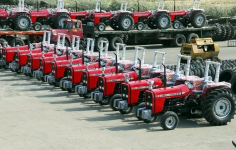
Millat Tractors Limited (MTL), a Pakistani tractor manufacturer, has inked an agreement with Massey Ferguson Corp (MFC) and AGCO Limited, the owner of the Massey Ferguson brand, to export Millat-branded tractors directly to Africa.

The listed company shared the development in a notice to the Pakistan Stock Exchange (PSX) on Monday.

“Millat Tractors Limited (MTL) has entered into an agreement with Massey Ferguson Corp. (MFC) and AGCO Limited, the owner of MF brand and a leading global manufacturer and distributor of agricultural equipment, whereby MTL has been assigned the African Territory for export of Millat Tractors.

“Under this agreement, MTL will export its tractors to Africa directly under its own trade mark, thereby expanding its international footprint and contributing to Pakistan’s export growth.

“This is in addition to MF-branded tractors being exported to Africa and rest of the world through AGCO Corporation, USA.

This collaboration is expected to greatly enhance MTL’s presence in the African region and strengthen its long-term business prospects globally.

Last month, the company’s management in its corporate briefing session shared that with sales to Afghanistan hampered by political instability, MTL was exploring new markets, including Mexico, Africa and Sri Lanka, to sustain and expand its overseas presence.

Millat Tractors Limited is a public limited company incorporated in Pakistan in 1964. MTL is engaged in the manufacturing and sale of internationally acclaimed tractors, diesel generating sets and prime movers, diesel engines and forklift trucks.

MTL is also involved in the sale, implementation and support of Industrial and Financial System (IFS) applications locally and abroad. As of June 30, 2024, the company has an annual capacity of 30,000 tractors per annum on a double-shift basis.
 

Efforts being made to impose taxes on imported electric vehicles, Senate panel told

  • Govt aims to reduce transport sector’s import bill of $9 billion
Rehan Ayub
December 29, 2025

The Senate Standing Committee on Industries and Production was informed on Monday that the government was considering imposing taxes on imported electric vehicles (EVs) to curb the transport sector’s $9-billion import bill.

Chaired by Senator khalida Ateeb, the meeting was attended by Senators Danesh Kumar, Syed Masroor Ahsan, and officials from the Ministry of Industries and Production and the Federal Board of Revenue (FBR).

“Officials informed that the efforts are being made to impose taxes on imported electric vehicles. Taxes on locally manufactured electric vehicles will be minimal or zero.

Additional duties have been imposed on the import of EV parts that are being manufactured locally,” the Senate Secretariat said in a statement.

Meanwhile, Ministry of Industries and Production advised the provincial governments not to charge registration fees on EV vehicles, provide same type of number plates across the country, and charge lesser tool from EV vehicles.
 
The Senate committee was given briefing by officials regarding the current policy for establishing manufacturing units of EVs automobiles indicating motorcycles/bikes in the country.

According to the officials, 17 licenses for three-wheelers and 77 licenses for two-wheelers have so far been issued in the country.

Pakistan government’s target is to shift 30% of vehicles to EVs by 2030.

A total of 2.2 million vehicles would be distributed among the public through government subsidies by 2030, the official told.

“There are 20 million vehicles and more than 20 million motorcycles in the country. This year, 116,000 motorcycles and 3,170 rickshaws will be provided to the public.

Over five years, Rs120 billion will be generated through the carbon levy and this amount will be utilised to provide subsidies on electric vehicles,” the Senate panel was informed.
 

New Energy Vehicles (NEV) Policy 2025-30

The New Energy Vehicles (NEV) Policy 2025-30 aims at reduction of vehicular emissions, improvement of air quality, enhancing the productive use of excess electricity generation capacity in the system, and lowering oil import.

It also seeks to lay the foundations for development of a competitive local NEV industry, transfer of technology and creating green jobs, with intentions to foster synergies among the federal and provincial governments.

The policy envisions converting 30% of new sales of bikes, rikshaws, passenger cars, light commercial vehicles, buses and trucks to new energy vehicles by 2030.

Beyond the policy period, the country has ambitions in reaching NEV sales to 50% by 2040 and aiming for a net-zero transport fleet by 2060.

The policy also highlights that a major barrier to NEV adoption in Pakistan is high upfront cost. This necessitates measures to reduce prices closer to those of internal combustion engine (ICE) vehicles in line with regional and global practices.
 

Why buyers go elsewhere​

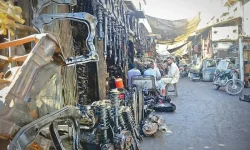
One of the reasons for the low turnout of buyers, traders said, is the availability of axles, suspension parts and shock absorbers in other small and medium-sized markets at lower prices. They say engines remain Shershah’s core line, but for most other components, buyers can now shop elsewhere.

Another problem is the lack of parking on main roads and even inside the market, traders said. Damaged, narrow internal roads, which they say have not been repaired for decades, further restrict access.

Many consumers prefer buying axle- and suspension-related items from other markets, which they feel are hassle-free and appear cheaper than Shershah Market. Some axle and suspension dealers also pay visits to Dubai and Far East countries to directly import parts instead of procuring them from Shershah.

Traders and repairers say the differences become more obvious when comparing rates across markets. Consumers witness price disparity in axle, suspension and shock absorbers in different markets, which, they say, points to the presence of smuggled parts compared to duty-paid parts that cost more. Chinese parts are also present, they added.
 

Pakistan amends used vehicles import policy​

By Aleem Malik
Jan 15, 2026

ISLAMABAD: The federal government has amended the import policy for used vehicles, abolishing the personal baggage scheme amid rising inflows that were putting pressure on local automobile manufacturers.

The government has endorsed amendments approved by the Economic Coordination Committee (ECC) to the Import Policy Order (IPO) 2022. Following the approval, the Ministry of Commerce has issued a Statutory Regulatory Order (SRO) to formally notify the changes.

Under the revised policy, only the Transfer of Residence and Gift schemes will remain applicable for importing used vehicles, while the personal baggage scheme has been discontinued.

According to the new rules, imported vehicles will be non-transferable for one year, meaning they cannot be sold or transferred to another person during this period.

The government has also extended the permissible import period for vehicles from 700 days to 850 days.

The policy maintains that the maximum age of imported vehicles is capped at three years from the date of manufacture. Additionally, minimum safety and environmental standards will now be mandatory for all imported used vehicles.

Under the Transfer of Residence Scheme, vehicles must be imported from the same country where the overseas Pakistani is residing.

Earlier, the federal cabinet allowed overseas Pakistanis to import used cars that are up to three years old under two existing schemes by approving the decision of the ECC meeting held on December 9, 2025.
 

No more imports of ‘personal’ used cars


Aamir Shafaat Khan
January 16, 2026

KARACHI: The Ministry of Commerce has amended the Import Policy Order 2022, imposing a ban on the import of used cars under the “personal baggage scheme.”

The ministry on Wednesday issued an SRO 61(I)/2006, which said that used cars would be imported only under the “transfer of residence and gift schemes.”

Vehicles imported under the gift and transfer of residence schemes shall remain non-transferable for a period of one year from the date of importation, the SRO said.

Vehicles imported under the transfer of residence scheme shall be from the same country in which the overseas Pakistani resides. The time frame for importing the vehicles has also been extended to 850 days from the previous 700 days from the date on which the Goods Declaration for the last import under this order was filed.


Commerce ministry restricts import of second-hand vehicles to ‘gift’ and ‘transfer-of-residence’ schemes

The SRO further stated that minimum safety and environmental standards and regulatory measures, as applicable to the commercial importation of used vehicles, duly notified by the Ministry of Industries and Production or the Engineering Development Board (EDB), shall apply mutatis mutandis to vehicles imported under the gift and transfer of residence schemes.

Earlier in January, the Federal Cabinet ratified the Economic Coordination Committee (ECC) decision of December 9, 2025, allowing overseas Pakistanis to import used vehicles up to three years old under two schemes.

All Pakistan Motor Dealers Association (APMDA) Chairman H.M. Shahzad painted a gloomy picture of the arrival of used cars in 2026, following an influx of 40,000 used cars in FY25 and 18,000 units in 6MFY26 (first six months of FY26).
 
On Dec 9, 2025, the personal baggage scheme, which had long facilitated overseas Pakistanis, had been abolished, while the gift and transfer of residence schemes were further tightened with additional restrictions. The decision has created anxiety among overseas Pakistanis and stakeholders in the motor import business.

The government, he said, would lose millions of dollars in duties and taxes, as the import of 40,000 vehicles had contributed $500 million to the exchequer in FY25. The commercial import of vehicles has also been subjected to highly unreasonable terms, he added.

Mr Shahzad said that out of the total imports of used cars, the share of small cars (660cc) was 90 per cent, while 99pc of small cars were finding their way into Pakistan from Japan.

He said that previously, out of the total imports of used cars, 99 per cent arrived under the “personal baggage scheme.”

Regarding commercial imports of used cars, he said standard operating procedures are being formulated, but the government has already imposed a 40 per cent regulatory duty on used cars (under five years old) until June 30, 2026, on top of existing duties. He said the regulatory duty would be reduced by 10 per cent annually from FY27, reaching zero by FY30.

On Jan 12, Pakistan Association of Automotive Parts and Accessories Manufacturers Chairman Usman Aslam Malik and Senior Vice Chairman Shehyar Qadir said that the government’s decision to regularise used car import schemes is a major step towards restoring their original intent for genuine overseas Pakistanis while safeguarding the country’s local automotive and auto parts industry.
 

Pakistan car sales jump 43% YoY in first seven months of FY26

  • Car sales stand at 111,377 units in 7MFY26, against 77,686 units in 7MFY25

Gohar Ali Khan
February 10, 2026

Car sales in Pakistan increased by 43% year-on-year (YoY) to 111,377 units in the first seven months of the fiscal year 2025-26 (FY26), showed Pakistan Automotive Manufacturers Association (PAMA) on Tuesday.

Car sales (including LCVs, Vans, and Jeeps) stood at 77,686 units in 7MFY25.

In January 2026, car sales in Pakistan clocked in at 23,055 units, marking a 43-month high, reflecting a 36% YoY and 74% MoM increase.

“There are two reasons for the increase in sales of all vehicles; a decrease in interest rate set by the State Bank of Pakistan (SBP) and light-and-small industry improved performance following a boost in auto sales,” auto analyst Mashood Khan said.

“If better financing policy including a further fall in the interest rate was formed, auto sales could skyrocket to 250,000 units in the coming year,” he maintained.

Car sales in Pakistan are likely to touch 170,00o-180,000 units in the current fiscal year.

“Car sale benchmark touched almost 230,000 in 2021-2022, while cars were sold in more than 230,000 units in 2017-2018. The sales still lagged behind those past figures, but this augurs well that the sales are gaining momentum in comparison with the last year,” he said.
 
PAMA data showed massive increases in the sales of overall all two-three-and-four wheelers.

Sales of trucks and buses soared by 91% to 4,633 units. Motorcycles and rickshaws also increased by 32% to 1,103,356 units.

However, sales of farm tractors slid by 23% to 15,434 units.

Car and motorcycle expert Muhammad Sabir Shaikh said there was a five-year gap after the Covid-19 pandemic when people avoided purchasing new vehicles or changing old cars due to poor economic conditions.

“Now, with better economic conditions, people are buying new vehicles and changing old cars. People are turning to new purchases, which are boosting sales for a couple of months in the country.

“Sales of both two, three, and four wheelers are skyrocketing as the PAMA shared data of a few brands which are its members only. Around 30-40% data of vehicles are missing as PAMA can collect the data from other brands in a local market with the help of the Engineering Development Board (EDB),” Shaikh maintained.

“When it comes to the increase of EV (electric vehicles) motorbikes and rickshaws, they could not pick up momentum as per expectation of their surge in 2026 as models of EV bikes are not being finalised or set.

That is why people are not switching over to EV bikes, while EV bike trend are surging in Punjab because of robust support of Punjab government due to rising smog in cities in Punjab.”

Another expert Shafiq Ahmed Shaikh said the automotive sector had entered a major recovery phase in Q3 of FY2026.
 
“January figures demonstrate an aggressive expansion across nearly all segments, driven by a sharp decline in the central bank’s policy rate to 10.5% (down from 22% in 2024).

This is reflected in the near doubling of truck production and sales, indicating a surge in industrial logistics and fixed investment. Heavy vehicle demand is being fueled by fleet renewals as businesses capitalise on cheaper financing.”

Car sales (as reported by PAMA) in Pakistan clocked in at 23,055 units in January 2026, marking a 43-month high, reflecting a 36% YoY and 74% MoM increase.

Shafiq said passenger cars and 2/3 wheelers had also grown, with lower interest rates and interest free instalment schemes, which he believes revitalised auto financing and released significant pent-up demand for both entry-level and premium vehicles.

About the decline in the sale of farm tractors, he said the slump could be attributed to farm economics specifically a drop in certain commodity prices, rising input costs for fertiliser and fuel, and reduced rural disposable income.

“In my view, some incentives should be given to the agricultural sector, otherwise a prolonged tractor slump may eventually impact wider rural development and the economy,” Shafiq said.
 

Users who are viewing this thread

Pakistan Defence Latest

Country Watch Latest

Back
Top