Sindh seals 34 MoUs at Shanghai moot
CM offers 10-year tax holiday to attract Chinese investment in energy, other sectors
Our CorrespondentOctober 16, 20262 min read
facebook twitter whatsup linkded email
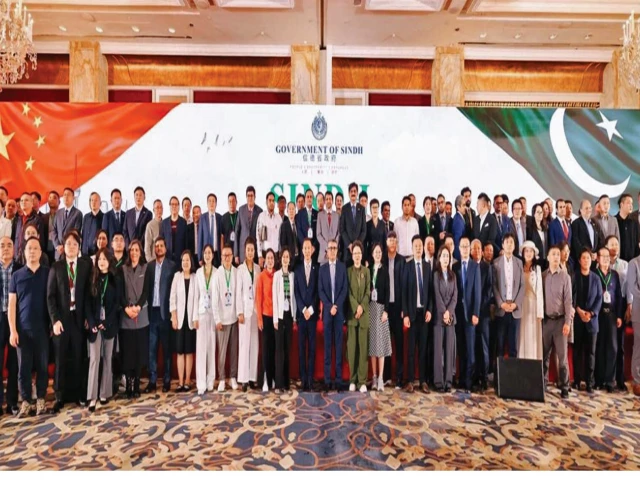
for a group photograph at the conclusion of the Sindh Investment Conference session. PHOTO: EXPRESS
KARACHI:
The Sindh government has secured 34 memorandums of understanding (MoUs) with Chinese and Pakistani businesses and government entities at an investment conference in Shanghai, seeking to attract investment in energy, manufacturing, agriculture and emerging technologies.
Chief Minister Murad Ali Shah, addressing the media after the second Sindh Investment Conference, said the agreements covered government-to-government (G2G) and business-to-business (B2B) cooperation, with the aim of creating jobs, expanding industry and strengthening economic ties.
The day-long conference, held after a gap of 12 years, attracted around 400 delegates, including investors, business leaders, Chinese companies and financial institutions.
Shah described Sindh as a cost-effective destination for manufacturers and exporters, citing its strategic location, skilled workforce, industrial capacity and access to regional markets.
"Shanghai transformed its economy by promoting investment, and Karachi is poised to scale new heights of development through a similar model," he said.
A major focus was the Dhabeji Special Economic Zone (SEZ), a China-Pakistan Economic Corridor (CPEC) priority project spanning approximately 1,530 acres in Thatta district. Proposed industrial clusters include automotive manufacturing, pharmaceuticals, electronics, textiles, steel and warehousing.
Shah said investors in special economic zones could benefit from a 10-year income-tax exemption and duty-free imports of capital goods, subject to applicable laws. The Sindh Investment Department has also established a dedicated China Desk and a Single Window Facility Centre to facilitate investors. Each agreement would be assigned a focal person and reviewed at the highest level of the provincial government, he said. "For us, the signing is the beginning of the work, not the end."
Energy, technology, agriculture
Key areas of cooperation include Thar coal utilisation, coal-to-chemicals, renewable energy, electric vehicle manufacturing, charging infrastructure and mineral processing. Sindh's wind-energy potential is estimated at around 50,000 megawatts.
The province is also seeking investment in artificial intelligence, cloud computing and data centres. Under its People's Information Technology Programme, around 1,500 young people are trained annually to meet digital-sector requirements.
The conference highlighted the 435-acre Education City Special Technology Zone, which aims to attract investment in software, financial technology, biotechnology, clean energy and electronics.
Agriculture and food processing offer further opportunities, including rice processing, mango-pulp production, date processing and red-chilli dehydration, supported by modern technology, cold-chain facilities and export logistics.
Ports and existing investment
Shah said Karachi's commercial importance and Sindh's two major seaports offered investors access to domestic and international markets.
Karachi Port handled approximately 53.95 million tonnes of cargo and 2.651 million twenty-foot equivalent units (TEUs) of containers in 2024-25, while Port Qasim has an annual handling capacity of around 89 million tonnes. The chief minister cited existing Chinese-backed projects, including Shanghai Electric's 1,320-megawatt Thar Block-I power plant, operational since 2023, and the Port Qasim coal-fired power project.
facebook twitter whatsup linkded email